Posted on

Troubleshooting Schneider ATV310 F022 Fault During Constant-Speed Operation: Causes, Parameters, and Practical Solutions

1. Overview of the Fault Symptom

The Schneider Electric ATV310 variable frequency drive is widely used in small and medium-power industrial applications, including fans, pumps, conveyors, woodworking machines, packaging equipment, and general three-phase asynchronous motor control. Because the ATV310 is a compact and economical drive, many technicians assume that its fault codes are limited to common electrical problems such as overcurrent, overvoltage, undervoltage, motor overload, overheating, or output phase loss.

However, in real field service and repair work, one fault is frequently misunderstood: the drive runs normally at a constant speed, then suddenly stops and displays F022. The customer may describe the situation as follows:

The motor runs normally for some time.

The speed is stable, with no acceleration or deceleration at the moment of failure.

The drive suddenly stops.

The display shows F022.

Sending the run command again does not restart the drive.

Only powering off and restarting the drive makes it work again.

After running for a while, the same fault appears again.

This fault is often misdiagnosed as a control board failure, CPU crash, power supply problem, IGBT module fault, motor insulation issue, or internal overheating. In fact, according to the ATV310 fault definition, F022 is not a power-stage fault. It is related to Modbus communication monitoring.

Understanding the real meaning of F022 is the key to solving this problem correctly.

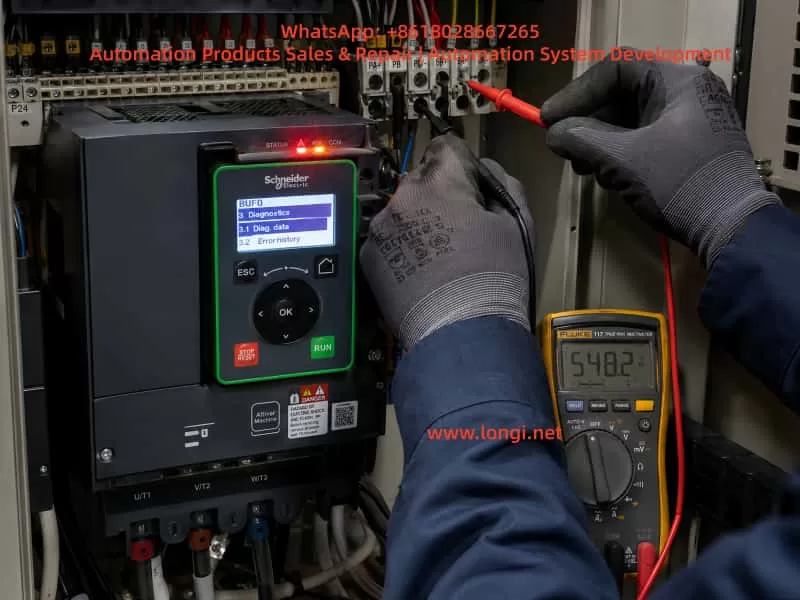
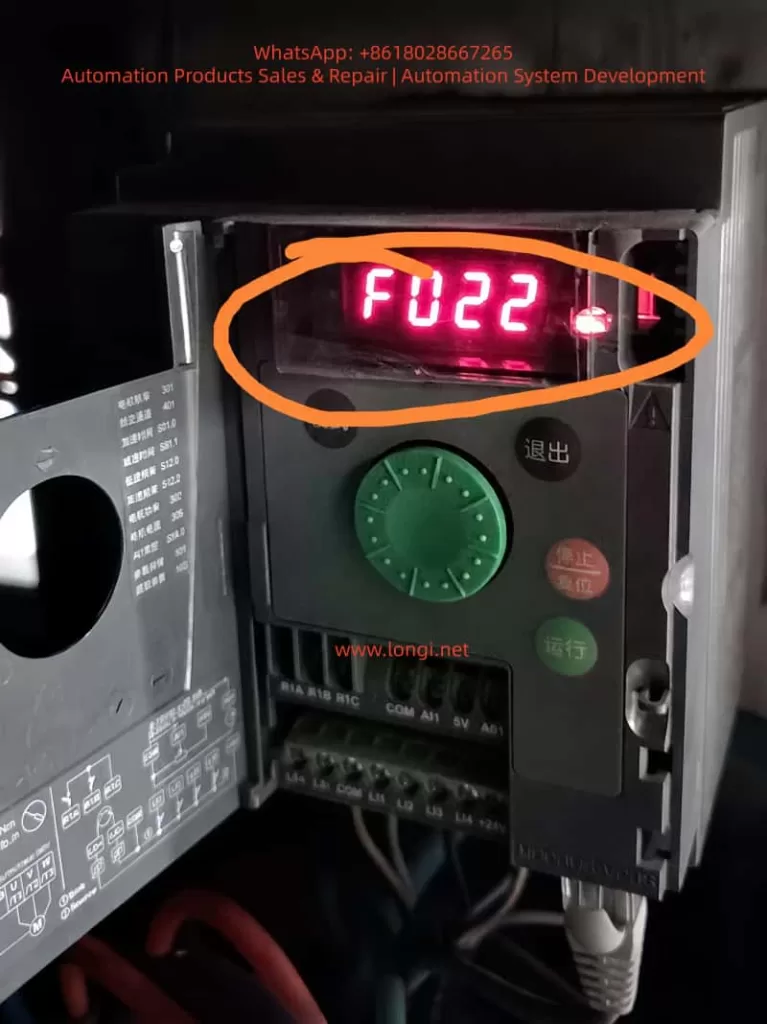
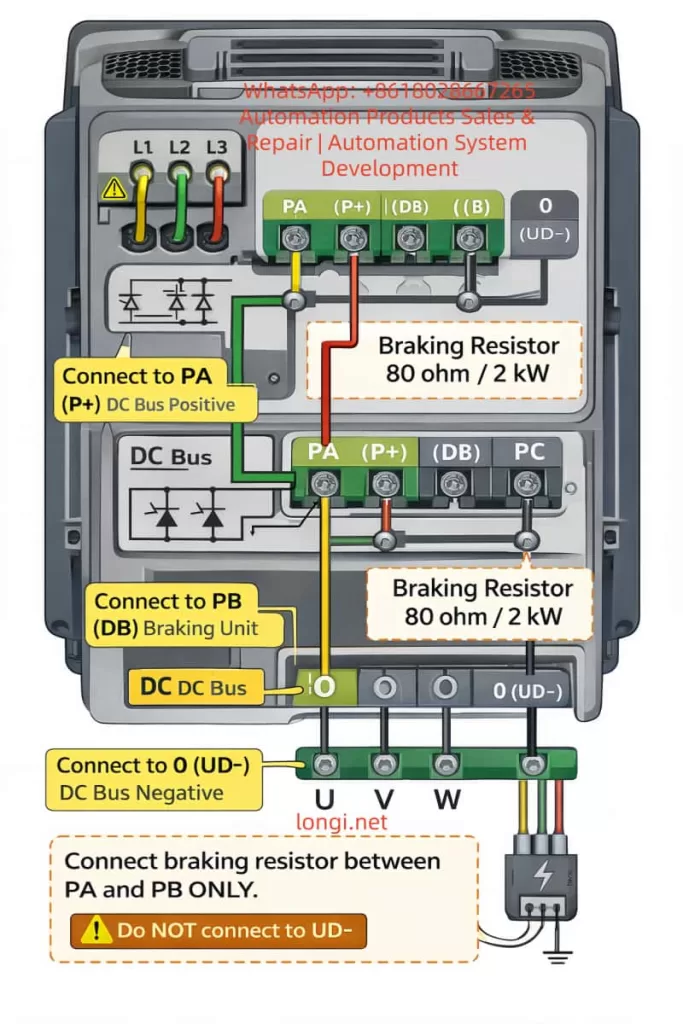
Schneider ATV310 variable frequency drive inside an electrical cabinet, with the front cover open and the red LED display showing F022 Modbus communication fault.

2. What F022 Really Means: Modbus Communication Interruption

On the ATV310, F022 means Modbus interruption. The possible cause is an interruption of communication on the Modbus network.

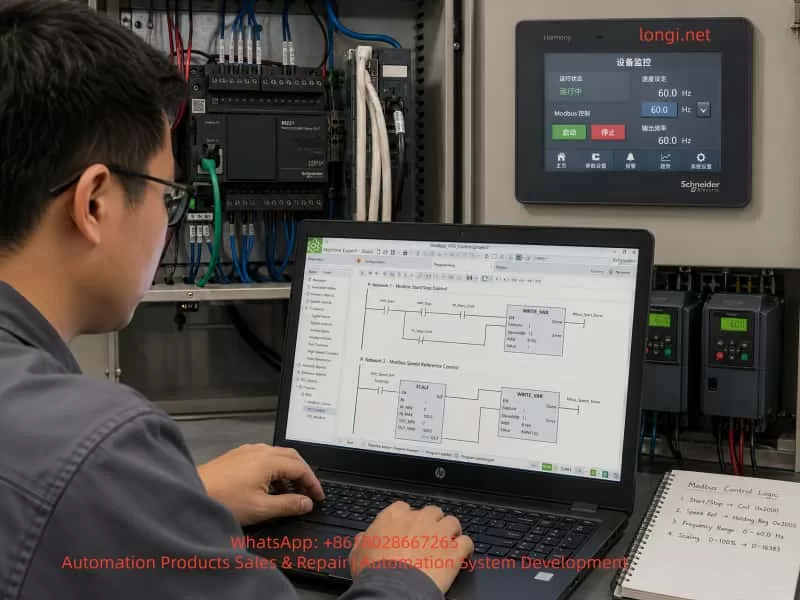
Although the ATV310 is an entry-level drive, it supports Modbus RTU communication. Through the communication port, a PLC, HMI, industrial computer, gateway, remote terminal, or other Modbus master device can read and write parameters, send run commands, and provide frequency references.

Once Modbus control or communication monitoring is enabled, the drive expects regular communication from the Modbus master. If the drive does not receive valid Modbus requests within the defined timeout period, it detects a communication fault and may stop with F022.

The logic is simple:

The drive believes that Modbus communication should be active.

No valid Modbus request is received within the preset timeout.

The drive detects a communication loss.

If the communication fault management parameter is set to stop the drive, the drive performs a freewheel stop and displays F022.

Therefore, F022 does not directly indicate a motor short circuit, output phase loss, overload, DC bus overvoltage, or IGBT damage. The first diagnostic direction should be communication wiring, communication parameters, command source settings, Modbus timeout, and communication fault management.

3. Why F022 Can Occur During Constant-Speed Operation

Many users ask why a communication fault appears when the motor is already running at a steady speed. They assume that Modbus is only required when starting, stopping, or changing speed.

This is not correct.

In a Modbus-controlled system, the PLC or HMI usually needs to communicate with the drive continuously. Even when the motor is running at a stable speed such as 30 Hz, 40 Hz, or 50 Hz, the master device may still need to send control words, frequency references, status requests, or communication keep-alive messages.

If this periodic communication is interrupted, the drive considers the control channel unreliable. In many industrial systems, loss of communication can be a serious safety and process risk. For example:

A pump may lose pressure or level control.

A fan may lose interlock control.

A conveyor may continue or stop unexpectedly.

The upper control system may no longer know the real drive status.

For this reason, the ATV310 provides Modbus communication fault monitoring. The drive can stop automatically when communication is lost.

Therefore, constant-speed operation does not prevent F022. As long as communication monitoring is active, Modbus loss can trigger F022 during starting, acceleration, constant-speed operation, or deceleration.

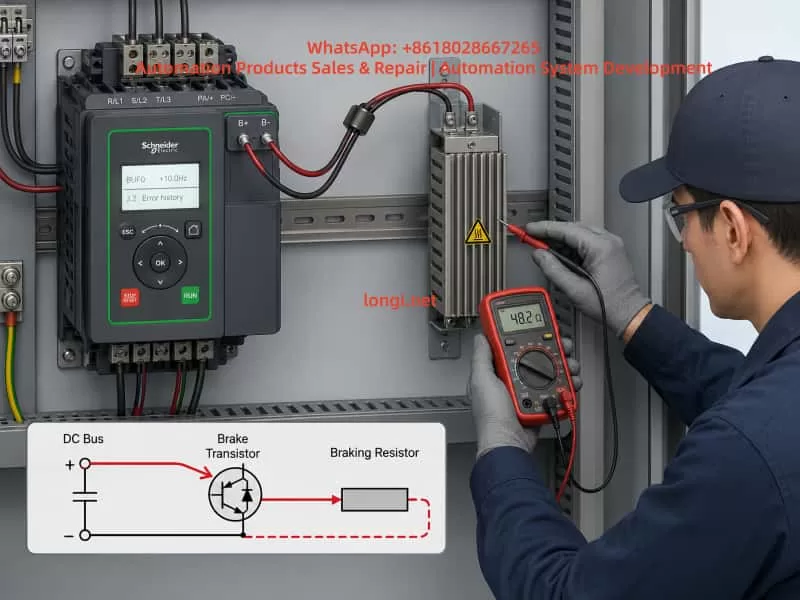
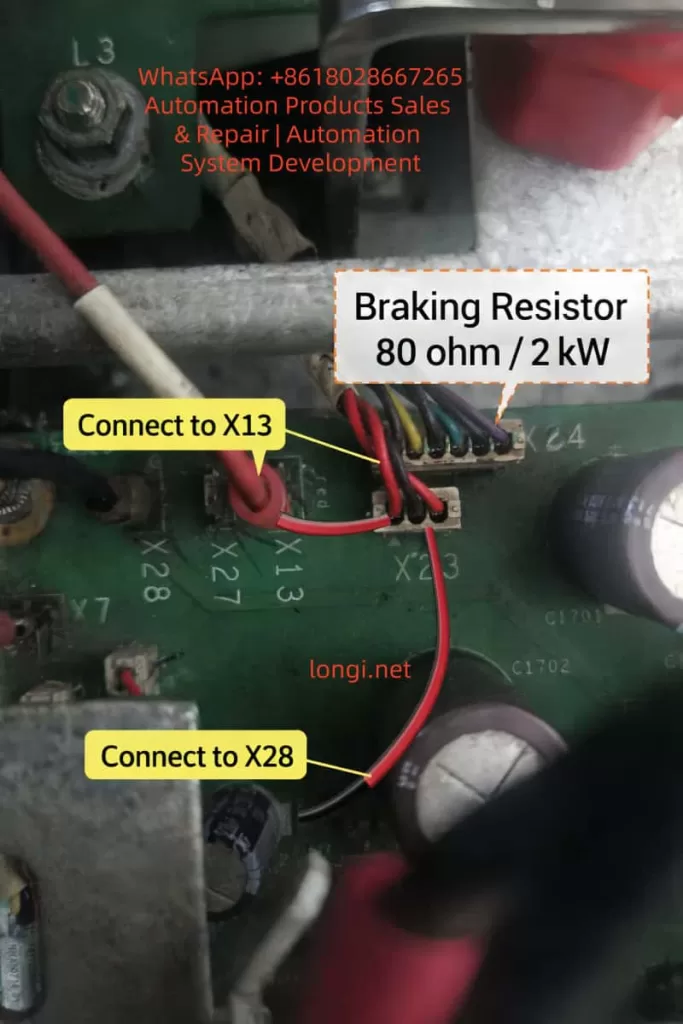
Female electrician wearing safety glasses and gloves repairing a Schneider ATV310 variable frequency drive inside an industrial electrical control cabinet.

4. Key ATV310 Parameters Related to F022

When troubleshooting F022, technicians should not only look at the fault code. Several parameters are directly related to this problem, especially 610, 611, 701, 702, 703, and 704.

4.1 Parameter 611: Modbus Communication Fault Management

Parameter 611 is the most direct parameter related to F022. It defines what the drive should do when an integrated Modbus communication fault occurs.

The common settings are:

611 = 00: Modbus communication fault ignored.

611 = 01: Freewheel stop when Modbus communication is interrupted.

If 611 = 01, the drive will stop and display F022 after a Modbus communication interruption. This is normally the safer setting for equipment controlled by PLC or HMI through Modbus.

If 611 = 00, the drive ignores the Modbus communication fault. In this case, communication loss will not stop the drive with F022.

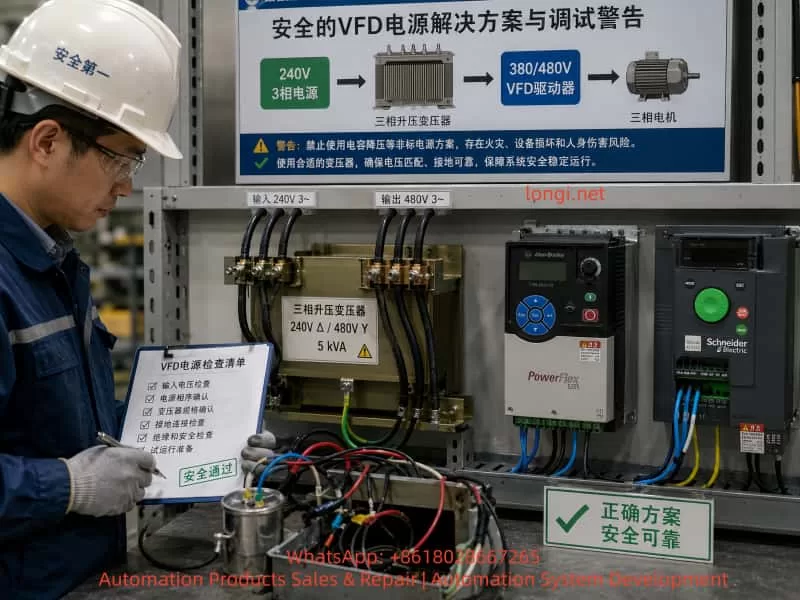
However, setting 611 to 00 is not a universal repair method. It disables Modbus fault monitoring. If the equipment relies on Modbus for critical control, allowing the drive to continue running after communication loss may create a safety risk. This setting should only be used after confirming that Modbus is not used for essential control, or after a proper risk assessment.

4.2 Parameter 610: Disable Detected Faults

Parameter 610 is not only for Modbus. It belongs to the fault detection management menu and allows certain detected faults to be disabled or cleared through a logic input.

The ATV310 manual lists several faults that can be disabled and cleared through this function, including F022.

This means that F022 can also be affected by parameter 610. However, the logic is different from parameter 611.

611 directly manages the Modbus communication fault action.

610 assigns a logic input to disable or clear certain detected faults, including F022.

In practical terms, parameter 611 is the direct Modbus fault management setting, while parameter 610 is a broader external fault inhibition function. They are related, but they are not the same.

4.3 Parameter 704: Modbus Timeout

Parameter 704 is the Modbus timeout parameter. It defines how long the drive waits without receiving a Modbus request before detecting a Modbus fault.

If the PLC or HMI polling cycle is too long, or if the communication task is unstable, a timeout value that is too short can cause nuisance F022 faults.

For example, a PLC may stop polling the drive temporarily because of program execution delays, HMI screen switching, overloaded communication tasks, or a gateway delay. If the time between two valid Modbus requests exceeds the timeout value, the drive may detect F022 even though the cable is not physically disconnected.

Increasing parameter 704 can improve tolerance to temporary communication delays, but it does not solve severe communication instability. If there is real signal loss, noise, poor wiring, or master-side failure, increasing the timeout only delays the fault.

4.4 Parameter 701: Modbus Address

Parameter 701 is the Modbus address. Every drive on the same RS485 network must have a unique address.

If two or more ATV310 drives have the same Modbus address, the master device may receive conflicting responses. This can cause unstable communication, data errors, or intermittent F022 faults.

Address conflict is especially common after replacing a drive, copying parameters, or installing multiple new drives with factory settings.

4.5 Parameter 702: Modbus Baud Rate

Parameter 702 defines the Modbus baud rate. It must match the baud rate setting of the PLC, HMI, gateway, or other master device.

Common baud rates include 4.8 kbps, 9.6 kbps, 19.2 kbps, and 38.4 kbps. Many industrial systems use 9.6 kbps or 19.2 kbps.

If the baud rate is wrong, communication may fail completely. If settings are inconsistent after drive replacement or parameter reset, the system may become unstable.

4.6 Parameter 703: Modbus Format

Parameter 703 defines the Modbus communication format, including parity and stop bit configuration. Typical formats include 8E1, 8N1, or 8N2.

The drive and the master device must use the same format. Any mismatch in baud rate, parity, stop bits, or address can result in communication failure or intermittent F022.

5. Common Causes of F022 in the Field

5.1 Loose or Poor RS485 Connection

Poor communication wiring is one of the most common causes of F022. In a real industrial environment, vibration, dust, humidity, heat, and mechanical stress can weaken RJ45 plugs, terminals, adapters, or intermediate connectors.

Typical points to check include:

Loose RJ45 connector.

Poorly crimped communication plug.

Oxidized terminal block.

Loose A/B wires.

Broken shield wire.

Too many intermediate joints.

Communication cable pulled or bent repeatedly.

If F022 appears randomly during machine operation, especially on vibrating equipment, the first suspicion should be communication contact instability.

5.2 RS485 A/B Polarity Error or Incorrect Wiring

RS485 uses a differential pair, usually marked as A/B, D+/D-, or 485+/485-. Different manufacturers may use different naming conventions. A wiring mistake may cause complete communication failure, but in some cases the system may work intermittently through converters or gateways.

If the fault appears after installing a new drive, replacing a PLC or HMI, changing cables, or modifying the panel wiring, the A/B polarity should be checked carefully. Swapping the A/B wires is often a useful test when communication is unstable.

5.3 Electrical Noise from Motor Cables

The output cable from the drive to the motor is a strong source of high-frequency noise, especially when the motor cable is long, unshielded, poorly grounded, or when the switching frequency is high.

If the RS485 communication cable is routed together with motor cables, input power cables, contactor coil wires, or solenoid valve wires, interference can be coupled into the communication line. This may cause Modbus errors and F022.

Good practice includes:

Separate RS485 cables from power cables.

Avoid long parallel runs with motor cables.

Cross power cables at 90 degrees when necessary.

Use shielded twisted pair cable for RS485.

Ground the shield properly according to the installation design.

Use termination resistors where required.

Use RS485 isolators or repeaters in harsh environments.

5.4 PLC or HMI Communication Task Interruption

F022 is not always caused by the drive or the cable. The Modbus master can also be the source of the problem.

Examples include:

PLC program communication task stops temporarily.

HMI freezes or restarts.

Gateway or serial server reboots.

Communication polling is too slow.

Multiple devices compete for the same communication port.

PLC 24 VDC supply drops.

HMI screen switching overloads the communication task.

If F022 appears at the same time as HMI alarms, PLC communication errors, or gateway restarts, the master-side system must be inspected.

5.5 Duplicate Modbus Addresses

When several ATV310 drives are connected to the same RS485 network, duplicate Modbus addresses can cause random communication failures.

If two drives respond to the same request at the same time, the data on the bus becomes corrupted. One drive may sometimes appear online and sometimes offline. The system may show random F022 faults.

This problem is common when several drives are installed with default settings and the addresses are not changed individually.

5.6 Improper Modbus Timeout Setting

If parameter 704 is too short for the actual communication cycle, F022 may occur even though the network is basically functional.

Some PLC or HMI programs only write the run command once and then stop polling the drive. This is not suitable when communication monitoring is enabled. If the drive expects continuous Modbus activity, the master must keep sending valid requests within the timeout period.

If the application does not require continuous Modbus supervision, the communication fault monitoring strategy should be reviewed.

5.7 Drive Parameters Incorrectly Set to Modbus Control

Another common situation is that the customer does not use any RS485 communication at all, but the ATV310 still reports F022.

This usually means that the parameters were changed incorrectly. The drive may have previously been used in a Modbus-controlled machine and later moved to a simple terminal-control application. Or a technician may have restored or copied the wrong parameters.

If the drive command source or frequency reference source is set to Modbus while no Modbus master is connected, F022 may occur because the drive is waiting for communication that does not exist.

In this case, replacing the control board is unnecessary. The correct approach is to restore the command source and frequency reference source to keypad, terminal, or analog input mode.

6. Why the Drive May Require Power Cycling After F022

Customers often say that after F022 appears, the drive cannot be restarted until power is turned off and on again. This can happen for two reasons.

First, the fault has not been properly reset. Sending a run command again is not the same as resetting a fault. The cause must be removed first, and the fault must then be reset through the keypad, logic input, communication reset, or power cycling.

Second, the communication fault still exists. If the PLC is still not polling, the RS485 cable is still disconnected, or the HMI is still offline, the drive will detect F022 again immediately after reset.

Power cycling may temporarily restart the drive and communication interface, but it does not prove that the root cause is solved. If the communication problem remains, F022 will return.

7. Difference Between Parameters 610 and 611

Because both 610 and 611 can affect F022, technicians may ask which one should be changed.

The answer depends on the purpose.

Parameter 611 is the direct Modbus communication fault management parameter. It defines whether the drive ignores a Modbus fault or performs a freewheel stop.

Parameter 610 is a logic-input assignment for disabling detected faults. It can inhibit or clear several faults, including F022, through an external digital input.

Therefore:

Use 611 when the target is to define the drive’s response to Modbus communication loss.

Use 610 only when the application requires an external input to inhibit or clear selected detected faults.

For troubleshooting, 611 is the more direct parameter for F022. Parameter 610 is more suitable for special applications, commissioning, or temporary bypass logic. It should not be used casually as a permanent solution without safety review.

If the machine truly uses Modbus for run commands or speed reference, permanently ignoring or disabling F022 may be dangerous. If the communication path fails, the drive may continue running without proper supervision from the control system.

8. Practical Troubleshooting Procedure

Step 1: Confirm the Fault Code

First, confirm that the display really shows F022. On a seven-segment display, some fault codes can be misread. A photo or video is useful.

If the fault is confirmed as F022, the troubleshooting direction should be communication.

Step 2: Confirm Whether Modbus Is Used

Check whether the drive is connected to a PLC, HMI, remote terminal, gateway, serial converter, or industrial PC.

If Modbus is used, inspect the communication system.

If Modbus is not used, check whether the drive parameters were incorrectly set to Modbus command or Modbus reference.

Step 3: Check Parameters 701, 702, 703, and 704

Verify:

701: Modbus address.

702: Baud rate.

703: Communication format.

704: Modbus timeout.

For multiple drives on the same network, ensure that every drive has a unique address.

Step 4: Check Parameter 611

If 611 is set to 01, the drive will stop on Modbus communication loss. This confirms that F022 behavior is active.

If the site does not use Modbus control, setting 611 to 00 may be used to verify that the fault is caused by Modbus monitoring. However, safety risk must be evaluated first.

Step 5: Check Parameter 610

Check whether 610 is assigned to a logic input. If it is, confirm the status of that input.

A wrongly assigned or unstable logic input may cause fault inhibition or reset behavior that confuses diagnosis.

Step 6: Inspect the RS485 Physical Layer

Check all communication connectors, terminals, cable shields, intermediate adapters, and routing.

Pay attention to:

Loose plugs.

Broken cable.

Wrong A/B polarity.

Poor shielding.

Communication cable routed with power cable.

Missing termination resistor.

Long cable without repeater.

Grounding problems.

Step 7: Inspect the Master Device

Check the PLC, HMI, or gateway.

Look for:

Communication alarms.

PLC program errors.

HMI freezing.

Gateway restart.

Unstable 24 VDC power supply.

Excessive polling load.

Multiple masters on the same bus.

The drive may be reporting F022 only because the master device stopped sending valid requests.

Step 8: Perform an Isolation Test

If possible, run the drive locally from the keypad or from terminal control, without relying on Modbus. Let it run for a sufficient test period.

If F022 no longer appears, the motor and power stage are probably not the root cause. The problem is likely in the communication path or parameter configuration.

If F022 still appears during local operation, check whether communication monitoring is still enabled or whether an external device is still connected to the communication port.

9. When to Suspect Drive Hardware Failure

Most F022 cases are not caused by internal drive hardware failure. However, hardware should be considered if:

All communication parameters are correct.

The RS485 cable and master device are verified.

Another ATV310 works normally on the same network.

The faulty drive still reports F022 randomly.

The RJ45 communication port is physically damaged.

The control board has corrosion, moisture damage, or burn marks.

Strong voltage was accidentally applied to the communication port.

The RS485 transceiver circuit is suspected to be damaged.

Possible hardware problems include a damaged RJ45 connector, cracked solder joints, failed RS485 transceiver IC, damaged protection components, or control board supply issues. Still, hardware should only be suspected after excluding parameter and wiring problems.

10. Temporary Measures and Permanent Solutions

10.1 Temporary Measures

If the machine must be restarted urgently, the following temporary actions may be considered:

Power cycle the drive after removing the immediate fault condition.

Check and reconnect the RS485 cable.

Restart the PLC, HMI, or gateway.

Increase parameter 704 appropriately.

Set 611 to 00 only if Modbus monitoring is not required.

Run the drive locally for testing.

Use fault reset after communication is restored.

These actions may help resume production, but they do not necessarily solve the root cause.

10.2 Permanent Solutions

A proper long-term solution should focus on communication stability and correct control strategy:

Use shielded twisted pair cable for RS485.

Separate communication cables from power cables.

Improve grounding and shielding.

Use proper termination resistors.

Avoid duplicate addresses.

Avoid multiple Modbus masters on one bus.

Optimize PLC polling logic.

Ensure continuous periodic communication.

Set 704 according to actual communication timing.

Correctly configure command and reference sources.

Do not use Modbus control unless required.

Keep communication fault protection active where safety requires it.

11. Practical Field Judgment

The following questions help quickly identify the direction of diagnosis:

Is the drive connected to a PLC or HMI through Modbus?

If yes, inspect the communication network and master polling.

Is the drive controlled by Modbus for run and speed reference?

If yes, F022 is a critical control-path fault and should not be ignored casually.

Is there no Modbus connection at all?

If yes, check whether the parameters were incorrectly set for Modbus control or communication monitoring.

Does the drive work again after power cycling?

This indicates that the fault can be temporarily reset, but it does not prove that the root cause is fixed.

Does setting 611 to 00 stop the F022 fault?

This confirms that the fault comes from Modbus communication monitoring. It does not prove that the communication system is healthy.

Does the drive run normally in local keypad mode?

If yes, the motor and power module are unlikely to be the main problem. Focus on communication and parameter configuration.

12. Example Case: Fan Drive Stops with F022 at 50 Hz

A machine used an ATV310 drive to control a fan. The customer reported that the fan stopped randomly once or twice per day. The drive always displayed F022. After power cycling, the machine could run again.

At first, the customer suspected that the drive control board was defective. However, inspection showed that the drive was controlled by a PLC through Modbus. Parameter 611 was set to 01, and parameter 704 was set to 10 seconds.

The PLC program was supposed to poll the drive continuously. However, during certain HMI screen changes, the communication task became overloaded and the PLC did not send a valid Modbus request to the drive for more than 10 seconds. The ATV310 then detected Modbus timeout and stopped with F022.

The solution included:

Optimizing the PLC Modbus polling program.

Reducing unnecessary HMI data refresh.

Ensuring periodic transmission of the drive control word.

Separating the RS485 cable from motor cables.

Improving shield grounding.

Adjusting the Modbus timeout after testing.

After these corrections, the drive operated continuously without F022.

This case shows that F022 is often a system communication problem, not a drive power-stage failure.

13. Why F022 Should Not Be Casually Disabled

Some technicians may set 611 to 00 or use 610 to disable F022 immediately after seeing the fault. This may stop the machine from tripping, but it can create serious risk.

If the drive receives its run command and frequency reference through Modbus, loss of communication means the control system may no longer supervise the drive properly. If F022 is disabled, the drive may continue running even when the PLC or HMI has lost control.

Possible risks include:

A pump continues running during a low-level or high-pressure condition.

A fan loses interlock control.

A conveyor keeps moving after downstream blockage.

The HMI displays incorrect drive status.

An emergency-related process command is not transmitted correctly.

For this reason, disabling F022 should only be used for temporary testing or after a proper safety assessment. The preferred solution is to repair the communication problem and keep suitable communication fault protection active.

14. Recommended Troubleshooting Principles

For ATV310 F022 faults, the following principles are recommended:

Confirm the exact fault code first.

Check parameters before replacing hardware.

Check communication wiring before replacing the drive.

Perform local operation testing to isolate the issue.

Do not permanently disable communication fault monitoring without risk assessment.

If a temporary bypass is used, record the parameter change.

Restore proper fault monitoring before final commissioning.

For simple terminal-control applications that do not use Modbus, make sure the drive is not accidentally configured for Modbus command or reference. For automation systems using Modbus, make sure the master device communicates continuously and reliably.

15. Conclusion

The Schneider ATV310 F022 fault is essentially a Modbus communication interruption fault. It is different from overcurrent, overload, output short circuit, or IGBT overheating faults. Troubleshooting should focus on communication wiring, communication parameters, timeout settings, master polling, command source configuration, and fault management logic.

Parameter 611 directly defines the Modbus communication fault response. Parameter 610 can disable or clear selected detected faults, including F022, through a logic input. Parameter 704 defines the Modbus timeout. Parameters 701, 702, and 703 define the address, baud rate, and communication format.

When a customer reports that the ATV310 suddenly stops during constant-speed operation, displays F022, and requires power cycling before restart, the drive should not be judged faulty immediately. A correct diagnostic process should confirm whether Modbus is used, inspect parameters 701 to 704, 610, and 611, check the RS485 wiring and shielding, verify PLC or HMI communication, and perform local operation testing.

If Modbus is not used, F022 is often caused by incorrect parameter configuration. If Modbus is used, the fault is usually caused by RS485 interruption, master polling delay, electrical noise, address conflict, or timeout setting issues.

Parameters 611 or 610 can be used for temporary verification or special applications, but disabling F022 should not be treated as a permanent repair method without safety consideration. The reliable solution is to restore stable Modbus communication and configure the drive’s communication fault management according to the real control and safety requirements of the machine.

Posted on

In-Depth Diagnosis of Schneider ATV340 bUF Braking Unit Short-Circuit Fault: A Repair Case Involving the DESAT Detection Circuit

1. Fault Overview

Schneider ATV340 series variable frequency drives are widely used in industrial applications such as conveyors, hoisting systems, centrifuges, winding machines, fans, pumps, and other equipment with medium or high inertia loads. In applications requiring fast deceleration, the drive often needs an external braking resistor. During deceleration, the motor may enter a regenerative state and feed energy back into the DC bus. If this energy is not dissipated in time, the DC bus voltage rises and may eventually cause overvoltage faults or damage to the power stage.

A Schneider ATV340D37N4E drive was received for repair after the customer reported a bUF braking unit short-circuit fault at the site. After the drive was brought back for bench testing, normal start and stop operation appeared to be fine. The motor could run, and no obvious abnormality was observed during ordinary operation. However, when the deceleration time was set very short, the drive triggered the braking unit short-circuit fault.

Further testing showed that this model has a parameter related to braking unit detection or braking function enablement. When this function was enabled, the drive reported a braking unit short-circuit fault during fast deceleration. When the braking function was disabled, the drive no longer generated the fault even under fast stop conditions.

At first glance, this appeared to be a typical external braking resistor fault, braking transistor fault, or braking IGBT short circuit. However, the actual repair process proved that the braking IGBT power device itself was not the root cause. The real fault was located in the DESAT detection circuit of the intelligent IGBT driver optocoupler used for the braking IGBT.

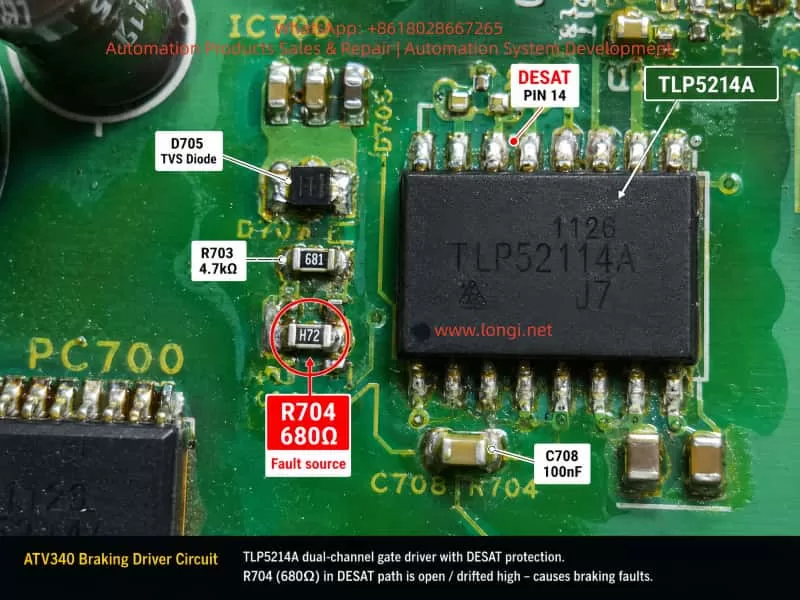
The final diagnosis confirmed that resistor R704, connected to the DESAT pin of the TLP5214A intelligent IGBT driver optocoupler, had become abnormally high resistance or open circuit. Its correct value should be 681, meaning 680Ω, but the faulty board measured more than 10MΩ, effectively open circuit. After replacing R704 with a 680Ω resistor, the braking function returned to normal, fast stop testing passed, and the bUF braking unit short-circuit fault disappeared.

This case is highly representative. It shows that when troubleshooting a braking unit short-circuit fault, technicians should not only check whether the braking IGBT is shorted with a multimeter, nor should they only focus on the external braking resistor value. In circuits using intelligent gate drivers and DESAT protection, an open, leaky, contaminated, or drifted detection circuit can also cause the drive to falsely report a braking unit short circuit.

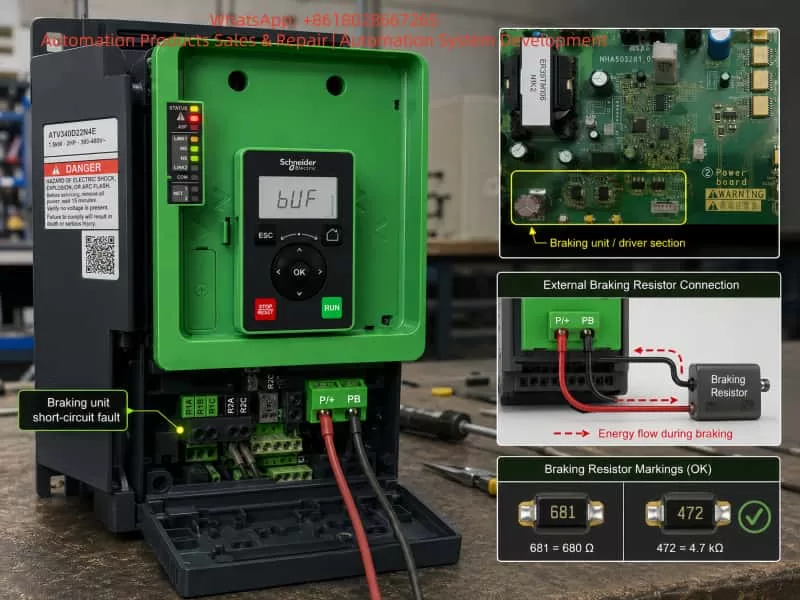
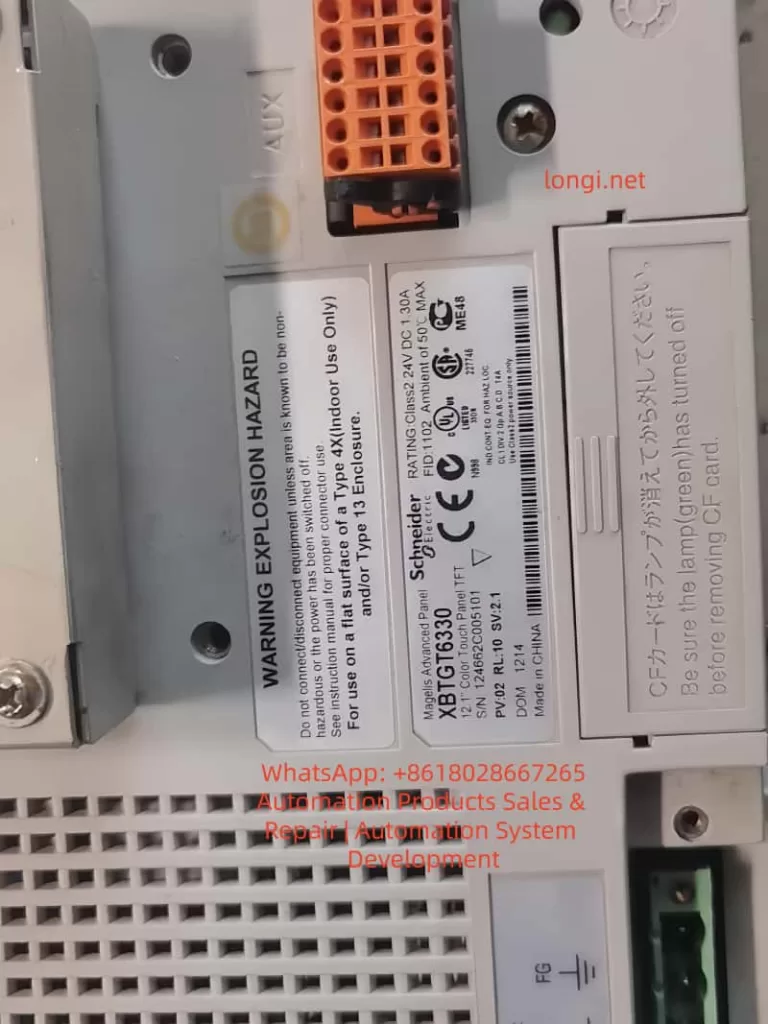
Schneider ATV340 drive displaying bUF braking unit short-circuit fault, with external braking resistor connected between P/+ and PB terminals and highlighted braking driver section on the power board.

2. Basic Working Principle of the Braking Unit

In an inverter drive such as the ATV340, when the motor decelerates a high-inertia load, the motor may act as a generator. Mechanical energy is converted into electrical energy and fed back into the DC bus through the inverter bridge. This causes the DC bus voltage to rise. If the voltage rises beyond the protection threshold, the drive will trip on DC bus overvoltage. In severe cases, power components may be damaged.

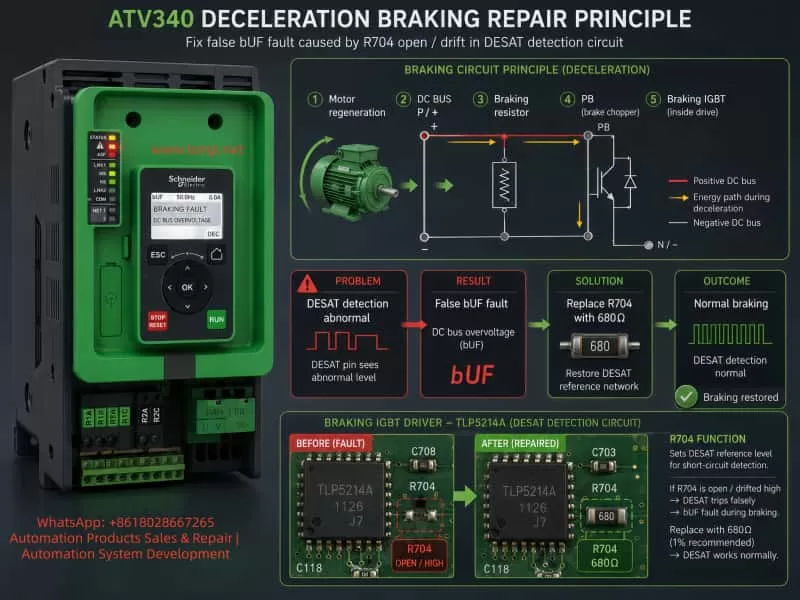
The braking unit is used to dissipate this regenerative energy. When the DC bus voltage reaches the braking threshold, the drive turns on the braking IGBT. Current flows through the external braking resistor, converting the excess electrical energy into heat.

A typical braking current path is:

P/+ DC bus positive → braking resistor → PB terminal → braking IGBT → N/- DC bus negative

When the braking IGBT is off, the PB terminal is not pulled toward N/-, and almost no braking current flows through the resistor. When the braking IGBT turns on, PB is pulled down toward N/-, current flows through the braking resistor, and the regenerative energy is dissipated.

Therefore, whether the braking unit works correctly depends on several factors:

  1. The resistance and power rating of the external braking resistor;
  2. The reliability of the P/+, PB, and N/- power connections;
  3. Whether the braking IGBT turns on and off correctly;
  4. Whether the braking IGBT gate drive is normal;
  5. Whether the overcurrent, short-circuit, and DESAT detection circuits are normal;
  6. Whether the control board correctly receives the braking unit fault feedback signal.

In practical repairs, the first two items are relatively easy to check. The third can also be roughly checked with a multimeter. However, the fourth, fifth, and sixth items require deeper understanding of the gate driver optocoupler, DESAT detection, FAULT feedback, and dynamic waveforms.

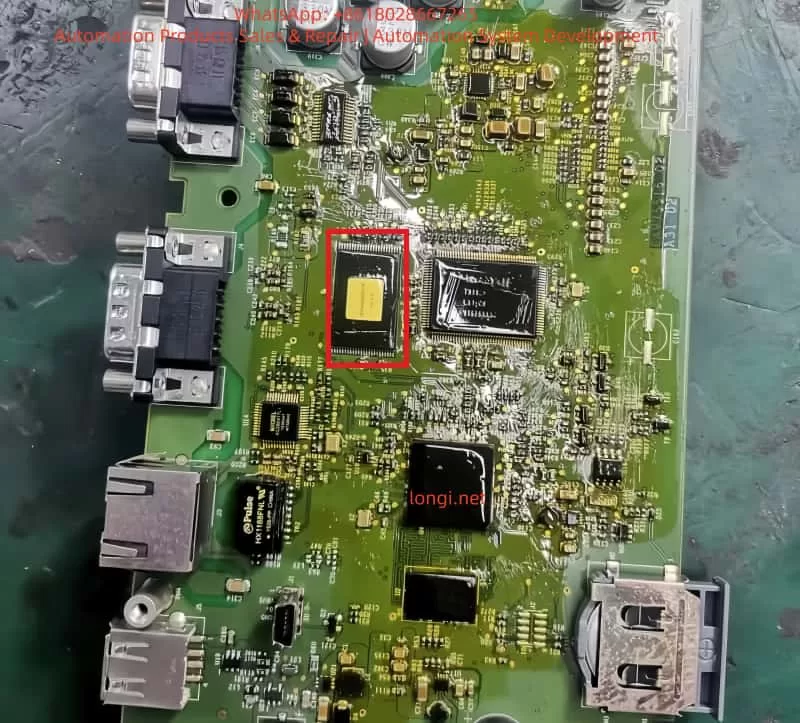
Close-up of Schneider ATV340 braking IGBT driver circuit showing TLP5214A gate driver, DESAT pin 14, D705, C708, R703, and failed R704 680 ohm resistor in the DESAT detection path.

3. Common Causes of bUF Braking Unit Short-Circuit Fault

When a drive reports a braking unit short-circuit fault, the common causes can be grouped into the following categories.

3.1 External Braking Resistor Value Too Low

If the braking resistor value is lower than the minimum value allowed by the drive, the current through the braking IGBT becomes excessive as soon as the IGBT turns on. The driver or protection circuit may then immediately report a braking transistor short circuit or braking unit fault.

For a 400V-class drive, the DC bus voltage is commonly around 540V to more than 700V, especially during deceleration. If the braking resistor value is too low, the instantaneous braking current can become very high, placing excessive electrical and thermal stress on the braking IGBT.

3.2 Braking Resistor Wiring Short Circuit or Ground Leakage

Incorrect wiring between P/+ and PB, damaged braking resistor cables, carbonized terminals, loose connections, or ground leakage in the braking resistor box can all cause abnormal braking circuit behavior. In environments with moisture, dust, oil mist, or conductive contamination, insulation failure at the resistor terminals and cables is especially common.

3.3 Braking IGBT Collector-Emitter Short Circuit

This is the most direct cause. If the braking IGBT collector and emitter are shorted, PB is effectively pulled toward N/- continuously. Once the braking resistor is connected, an abnormal current path may exist from P/+ to N/- through the resistor. This type of fault can often be detected with a multimeter in diode or resistance mode.

3.4 Braking IGBT Gate Leakage or Abnormal Gate Drive

Some IGBTs do not fail as a direct C-E short. Instead, the gate insulation may degrade, the G-E path may leak, or the gate resistor, gate clamp, or turn-off circuit may become abnormal. In such cases, the IGBT may partially turn on when it should remain off, or it may fail to saturate properly when it should conduct.

These faults are not always easy to detect with a normal multimeter.

3.5 Driver Optocoupler Failure or Driver Power Supply Abnormality

Medium and high-power drives usually use isolated driver optocouplers or intelligent gate driver chips to drive IGBTs. The braking IGBT is no exception. If the driver output voltage is too low, negative turn-off voltage is abnormal, or the driver supply decoupling capacitor has failed, the IGBT may not turn on fully or may turn off incorrectly.

3.6 DESAT Detection Circuit Abnormality

This is the core issue in this case.

Many intelligent IGBT driver optocouplers include DESAT protection. DESAT detection is used to determine whether an IGBT has entered normal saturation when it is commanded to turn on. If the IGBT receives a gate drive command but the C-E voltage remains too high, it may indicate short circuit, overcurrent, insufficient gate drive, module failure, or load abnormality. The driver chip then quickly shuts down the IGBT and outputs a fault signal.

However, if the DESAT detection circuit itself is open, leaky, contaminated, drifted, or has a cracked solder joint, the driver chip may falsely detect desaturation even when the IGBT is actually normal. The result is a false braking unit short-circuit fault.

Technical infographic explaining ATV340 deceleration braking fault repair, showing motor regeneration energy flow through the braking resistor and replacement of open R704 680 ohm resistor to restore normal DESAT detection.

4. Diagnostic Process in This Case

4.1 Fault Condition Confirmation

The ATV340D37N4E could run normally under ordinary conditions. Normal start and stop operation did not produce any abnormal alarm. The bUF braking unit short-circuit fault appeared only when the deceleration time was set very short and the braking unit participated in energy dissipation.

This indicated that the main inverter bridge, current detection circuit, control logic, and auxiliary power supply were unlikely to be the primary fault areas. If the main inverter bridge or the main DC power stage had a serious defect, the drive would likely report overcurrent, short circuit, undervoltage, phase loss, or drive faults even during ordinary operation.

Since the fault was strongly associated with fast deceleration and braking unit activation, the diagnostic focus was shifted to the braking circuit.

4.2 External Braking Resistor Check

During bench testing, a temporary resistance wire of approximately 10Ω was connected between P/+ and PB to simulate the braking resistor, and the same fault could be reproduced. Although a temporary resistance wire is not equivalent to a standard braking resistor in every aspect, the customer’s site also reported the same fault with a standard braking resistor. Therefore, the external resistor itself was not considered the main suspect.

In real repair practice, the following items should still be checked:

  • Actual braking resistor resistance;
  • Whether the resistance is below the minimum value allowed by the drive;
  • Braking resistor power rating;
  • Wiring reliability between P/+ and PB;
  • Insulation resistance of the braking resistor to ground;
  • Cable damage, loose terminals, overheating, carbonization, or arcing marks.

In this case, because the same fault occurred with the customer’s standard braking resistor and the temporary resistor was only used to reproduce the fault, the investigation continued inside the drive, focusing on the braking IGBT driver circuit.

4.3 Braking IGBT Inspection

The braking IGBT module was checked using conventional methods. No obvious C-E short circuit, G-E short circuit, or severe leakage was found. Based on standard repair experience, the braking IGBT appeared normal in static testing.

However, this point must be emphasized:

A normal static IGBT test does not prove that the IGBT and its protection circuit will behave normally under dynamic braking conditions.

DESAT faults usually occur at the instant when the IGBT is driven on. Only when the braking IGBT is under high DC bus voltage, carrying braking current, and controlled by the gate driver will dynamic problems such as desaturation, insufficient drive, or detection circuit failure appear.

Therefore, relying only on a diode-mode multimeter test of the IGBT can easily lead to an incorrect conclusion.

4.4 Misleading Comparison with an ATV610 Control Board

During troubleshooting, an ATV610 control board was used for comparison. Since some ATV610 and ATV340 power boards, driver boards, and modules may look similar or share similar hardware structures, it was tempting to conclude that if the ATV610 board did not trigger the fault, the power board must be normal.

Further analysis showed that this comparison was not decisive. The ATV610 control board did not have the same braking detection or braking function logic as the ATV340. It may not have actually triggered the braking IGBT in the same way, or it may not have monitored the braking unit fault feedback in the same manner.

Therefore, the fact that the ATV610 board did not report the same fault could not be used as proof that the braking driver circuit was healthy.

This is an important lesson. Even if two drive series share similar hardware platforms, their firmware logic, alarm judgment, drive enable conditions, and fault feedback processing may be different. A drive not reporting a fault does not necessarily mean that the tested power board is fully normal.

4.5 Locking the Fault Area to the TLP5214A and DESAT Circuit

The braking driver section of the board used a TLP5214A intelligent IGBT driver optocoupler. This device is not an ordinary optocoupler. It integrates IGBT gate drive, undervoltage protection, soft shutdown, fault feedback, and DESAT detection.

Pin 14 of the TLP5214A is the DESAT detection pin. When the IGBT is turned on, the DESAT pin monitors the IGBT C-E voltage through an external diode, resistor, and capacitor network. If the detected voltage exceeds the internal threshold, the driver interprets this as IGBT desaturation, shuts down the output, and sends a fault signal through the FAULT pin.

Around the TLP5214A DESAT pin, components such as R703, R704, D705, and C708 were identified. R704 was found to be related to the DESAT path. Its measured resistance was more than 10MΩ, clearly abnormal.

To confirm the expected value, a 55kW drive driver board was used for comparison. The corresponding positions on the comparison board showed the following resistor markings:

  • R704: 681, meaning 680Ω;
  • R703: 472, meaning 4.7kΩ.

On the faulty board, R703 measured around 5kΩ, consistent with 4.7kΩ. However, R704 measured more than 10MΩ, completely inconsistent with the expected 680Ω. This strongly indicated that R704 was open circuit or had failed to a very high resistance.

5. Why an Open R704 Causes a Braking Unit Short-Circuit Fault

When technicians see the alarm description “braking unit short circuit,” the first reaction is often to suspect a shorted braking IGBT or shorted braking resistor. However, in a circuit using DESAT detection, the alarm name does not always mean that there is a physical short circuit. It may be the result of the intelligent driver detecting an abnormal protection condition.

Under normal operation, when the braking IGBT is turned on:

  1. The control board sends a braking IGBT drive command;
  2. The TLP5214A outputs the gate drive voltage;
  3. The braking IGBT turns on normally;
  4. PB is pulled toward N/-;
  5. The IGBT C-E voltage drops to a low value;
  6. The DESAT detection circuit confirms that the IGBT has entered saturation;
  7. The driver optocoupler does not output a fault signal, and braking proceeds normally.

When R704 is open:

  1. The control board sends a braking IGBT drive command;
  2. The TLP5214A outputs the gate drive;
  3. The braking IGBT may actually turn on normally;
  4. But the DESAT detection path loses its normal sampling or clamping function because R704 is open;
  5. The internal DESAT charging current inside the TLP5214A causes the DESAT pin voltage to rise abnormally;
  6. The driver falsely determines that the IGBT has not entered saturation;
  7. The TLP5214A shuts down the output and sends a FAULT signal;
  8. The control board receives the braking unit fault feedback and displays bUF / braking unit short circuit.

Therefore, the real problem in this case was not an actual shorted braking IGBT. It was a false braking unit short-circuit fault caused by an open DESAT detection resistor.

Typical characteristics of this type of fault include:

  • Normal ordinary running;
  • Normal ordinary stopping;
  • Fault appears only when the braking unit is activated;
  • Disabling the braking function makes the fault disappear;
  • Braking IGBT passes static testing;
  • External braking resistor is normal;
  • DESAT circuit components show open circuit, drift, leakage, cracked solder joints, or contamination.

6. Repair Procedure

The final repair procedure in this case was as follows:

  1. Lift or remove one side of R704 and confirm its abnormal resistance;
  2. Compare with a similar driver board and confirm the correct value of R704 as 681, meaning 680Ω;
  3. Replace R704 with a 680Ω SMD resistor;
  4. Clean the area around TLP5214A, R703, R704, D705, and C708;
  5. Reflow or resolder relevant TLP5214A pins, especially DESAT, VOUT, VCC2, VE, and VEE pins;
  6. Check connector S23 and its solder joints to ensure reliable connection to the braking IGBT circuit;
  7. Reassemble and test the drive;
  8. Enable the braking function, perform fast deceleration testing, and verify that the bUF fault no longer appears.

After R704 was replaced, the drive passed fast stop testing. The braking unit worked normally, and the fault was eliminated.

7. Key Measurement Points for Similar Faults

For similar braking unit short-circuit faults, the following diagnostic sequence is recommended.

7.1 External Braking Resistor

Measure the resistance between P/+ and PB. Confirm that the resistor value is not below the minimum allowed value for the drive. Also inspect the resistor box, cable, terminals, and insulation to ground.

7.2 Static Test of the Braking IGBT

After power is removed and the DC bus capacitors are fully discharged, check the braking IGBT C-E, G-E, and G-C paths for short circuit or leakage. If an obvious short circuit is present, the power device must be handled first.

7.3 Gate Drive Voltage

Under safe test conditions, observe the braking IGBT G-E voltage at the instant of braking. During conduction, a gate drive voltage of around +15V is typically expected. During turn-off, the voltage may be 0V or negative depending on the driver design.

7.4 TLP5214A FAULT Pin

Observe whether the FAULT pin of the TLP5214A changes state when the fault occurs. If the FAULT pin is pulled low, the driver itself has detected an abnormal condition. If the FAULT pin does not change but the control board still reports a braking unit fault, then the control board’s fault feedback input circuit should be checked.

7.5 DESAT Pin and Peripheral Circuit

Focus on the DESAT-related components connected to pin 14 of the TLP5214A, including the series resistor, sampling diode, blanking capacitor, clamping components, and solder joints. In this case, R704 was the key component.

7.6 Connectors and Solder Joints

The braking IGBT driver signal is often transmitted through a small connector. Loose connectors, cracked solder joints, oxidation, poor contact, or damaged harnesses may cause abnormal gate drive or abnormal detection signals.

8. Why a Small Resistor Can Cause a Major Fault

R704 is only a small SMD resistor with a value of 680Ω. However, because it is located in the DESAT detection path of the braking IGBT driver, it has a critical protection role.

A drive protection system does not only determine whether a large power device is physically shorted. It depends on many small signal detection circuits to judge whether the power stage is operating safely.

In the high-voltage, high-current, and high-dv/dt environment of a variable frequency drive, the intelligent driver optocoupler must quickly determine whether the IGBT is healthy during turn-on. If the DESAT circuit becomes abnormal, the driver will prioritize protection and shut down the IGBT, even if the result is a false alarm.

When a 680Ω resistor becomes open circuit, the braking IGBT may still be good, and the external braking resistor may also be normal. However, because the driver cannot receive correct DESAT information, the system reports a braking unit short circuit.

If the technician only follows the literal meaning of the alarm and repeatedly replaces the IGBT module or suspects the external resistor, the repair will go in the wrong direction.

9. Diagnostic Logic for Similar Braking Faults

When handling braking-related faults on Schneider ATV340, ATV630, ATV930, ATV610, or similar drives, the following logic is useful.

9.1 Is the Fault Strongly Related to Braking Action?

If the fault appears only during fast stop, regenerative operation, DC bus voltage rise, or braking resistor operation, the braking unit should be the first diagnostic target.

9.2 Does the Fault Disappear When Braking Is Disabled?

If disabling the braking function makes the fault disappear, the problem is related to braking IGBT drive or detection. However, this does not mean the drive can be safely returned to the customer with the braking function disabled. The customer’s load may require braking resistor operation to prevent DC bus overvoltage.

9.3 Is a Normal Static IGBT Test Sufficient?

No. A normal static test only rules out obvious breakdown. It does not rule out dynamic desaturation, insufficient drive, false detection, or DESAT circuit open faults.

9.4 Is There a Similar Board for Comparison?

If a similar power driver board is available, compare DESAT circuit resistor values, diode direction, capacitor placement, and component markings. In this case, comparison with a 55kW driver board helped confirm that R704 should be 681 rather than a high-resistance value.

9.5 Is There Contamination, Moisture, or Solder Cracking?

DESAT detection is a high-speed protection signal circuit. Board contamination, flux residue, moisture, carbonization, and cracked solder joints can all cause false triggering. Cleaning, drying, and resoldering are often necessary.

10. Suggested Technical Repair Report

The repair conclusion for this case can be written as follows:

The Schneider ATV340D37N4E drive reported a bUF braking unit short-circuit fault during fast deceleration. Inspection confirmed that the external braking resistor wiring method was correct, and the braking IGBT module showed no obvious C-E short circuit or G-E short circuit. Further inspection of the braking IGBT driver circuit found an abnormality in the DESAT detection circuit of the TLP5214A intelligent IGBT driver optocoupler. The resistor R704 connected to the DESAT circuit of pin 14 had drifted to an abnormally high resistance, measuring more than 10MΩ. On a similar driver board, the corresponding component value was 681, meaning 680Ω. The open R704 caused the DESAT detection signal to become abnormal when the braking IGBT was triggered. As a result, the driver optocoupler falsely detected IGBT desaturation or short circuit and sent a FAULT signal to the control board, triggering the bUF braking unit short-circuit alarm. After replacing R704 with a 680Ω resistor and cleaning/resoldering the related driver detection circuit, the braking function and fast deceleration operation returned to normal.

11. Conclusion

The bUF braking unit short-circuit fault on a Schneider ATV340 drive does not always mean that the braking IGBT is physically shorted. In circuits using intelligent IGBT driver optocouplers such as the TLP5214A, an abnormal DESAT detection circuit can also trigger the same alarm.

The key features of this case were: the fault appeared only when braking was enabled and fast deceleration was performed; the braking IGBT passed static testing; the external braking resistor condition could not explain the fault; and comparison with a similar driver board showed that R704 should be 680Ω, while the faulty board measured more than 10MΩ. After replacing R704, the drive returned to normal.

This case reminds repair technicians that VFD power-stage fault diagnosis should not focus only on large power components. In many cases, the component that actually triggers the alarm is a small part of the drive, protection, feedback, or detection circuit. DESAT resistors, sampling diodes, blanking capacitors, driver optocouplers, FAULT feedback circuits, and connector solder joints can all determine whether the braking unit operates correctly.

A correct repair approach should begin by confirming the fault trigger condition, then distinguishing between a real power-stage fault and a false detection fault, and finally verifying the driver optocoupler and protection circuit point by point. Only by understanding the braking unit operating principle and DESAT protection mechanism can technicians avoid unnecessary module replacement and improve repair accuracy.

Posted on

Troubleshooting Schneider ATV660 SCF1 “Motor Short Circuit” and Power Brick 1 Diagnostic Failure

1. Equipment Background and Fault Overview

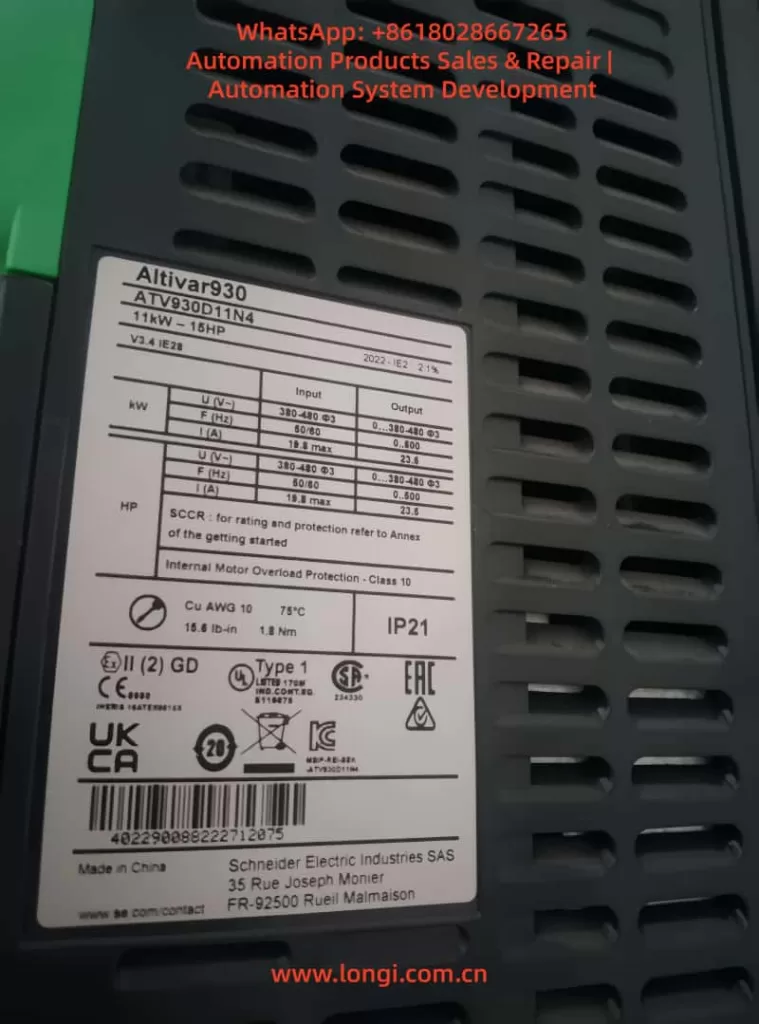
The Schneider Electric Altivar Process ATV660 is a cabinet-type variable frequency drive designed for medium- and high-power industrial motor control applications. It is commonly used on large fans, pumps, compressors, cooling systems, process machinery, and other heavy-duty industrial equipment. The case discussed in this article involves a Schneider Electric ATV660C31Q4X10-EP drive system.

According to the drive nameplate, the unit is rated:

  • Model: ATV660C31Q4X10-EP
  • Input voltage: 3-phase 380–415 V
  • Power rating: ND 315 kW / HD 250 kW
  • Output current: ND 590 A / HD 477 A
  • Protection class: IP23

The connected motor is a WEG three-phase induction motor. The motor nameplate indicates approximately:

  • Voltage: 400 V
  • Frequency: 50 Hz
  • Power: 260 kW
  • Rated current: 435 A
  • Speed: 2984 rpm
  • Power factor: 0.90

From a capacity-matching point of view, the motor current of 435 A is lower than the drive’s HD current rating of 477 A. Therefore, under normal conditions, this motor and drive combination should be basically suitable.

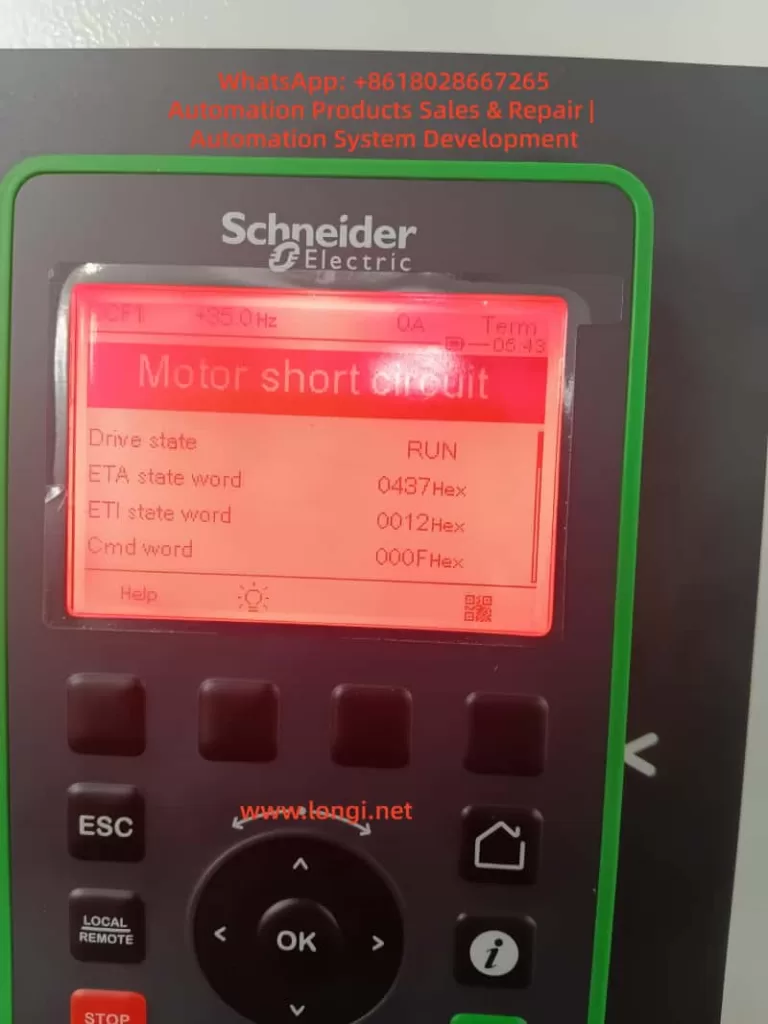
However, after startup, the drive reports:

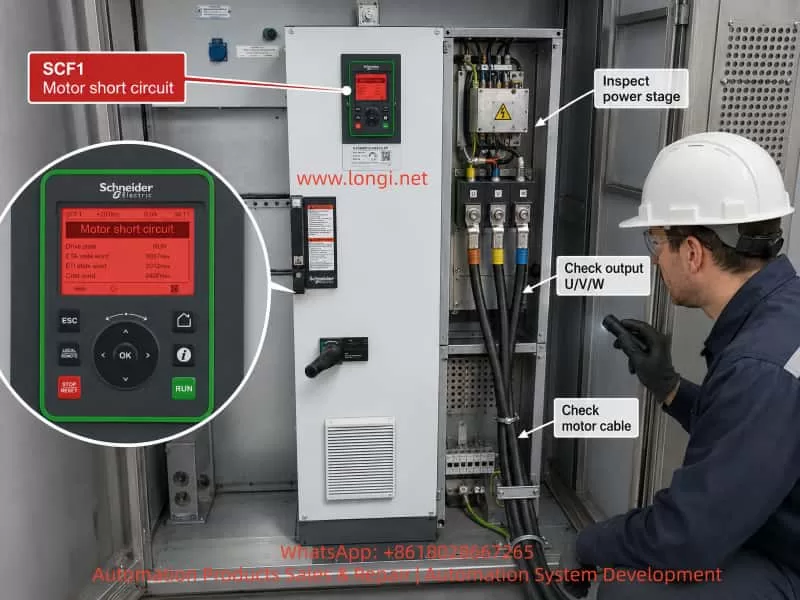
SCF1 – Motor short circuit

The diagnostic screen also shows:

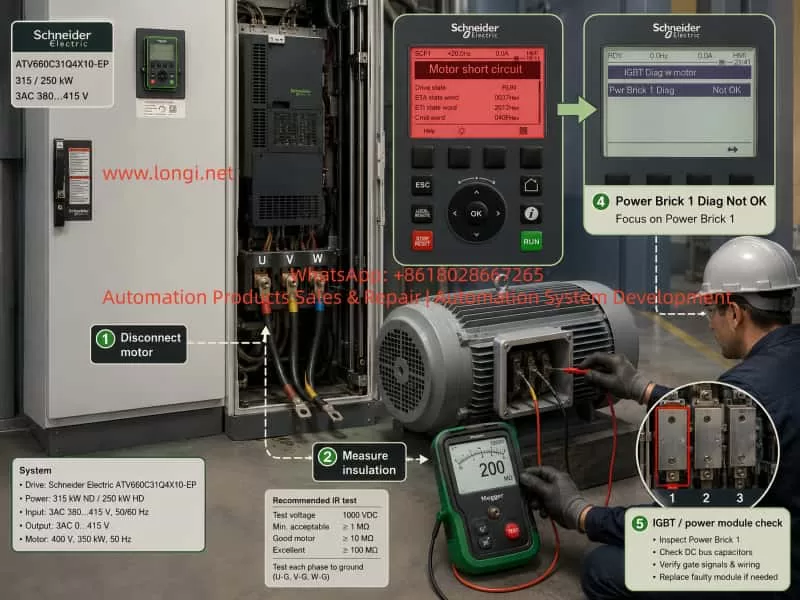
IGBT Diag w motor
Power Brick 1 Diag: Not OK

These two pieces of information are very important. This is not a simple communication setting issue, and it should not be treated as an ordinary keypad configuration problem. The fault must be analyzed from the perspectives of motor insulation, motor cable condition, output wiring, IGBT power module condition, gate driver circuit, current detection, and cabinet environment.

For a 250–315 kW class drive, this type of fault has a high repair risk. Repeatedly resetting and restarting the drive without diagnosis may damage the IGBT module, gate driver board, DC bus components, fuses, or even the entire power section. Therefore, the correct approach is to stop repeated startup attempts and perform a structured electrical diagnosis.


Technician inspecting a Schneider Electric ATV660 drive cabinet showing SCF1 Motor Short Circuit alarm, with callouts for checking U/V/W output terminals, motor cable, and power stage.

2. Meaning of SCF1 “Motor Short Circuit”

The keypad fault SCF1 Motor short circuit literally means that the drive has detected a short-circuit condition related to the motor output. However, in actual VFD diagnosis, this fault does not only mean that the motor winding is physically shorted.

SCF1 may be triggered by several conditions:

  1. Phase-to-phase short circuit inside the motor winding.
  2. Motor winding insulation breakdown to ground.
  3. Phase-to-phase short circuit in the motor cable.
  4. Motor cable insulation leakage to ground.
  5. Incorrect wiring at the output terminals U/V/W.
  6. Capacitor bank or power factor correction device connected at the drive output.
  7. Old star-delta starter circuit not fully removed.
  8. Output contactor contact failure or incorrect switching sequence.
  9. IGBT power module internal short circuit.
  10. Gate driver board failure causing abnormal IGBT switching.
  11. Current sensor or current detection circuit abnormality.
  12. Severe parameter mismatch between motor and drive.
  13. Mechanical load locked or jammed, causing abnormal starting current.

Therefore, SCF1 should not be interpreted too narrowly. It does not automatically prove that the motor is bad, and it does not automatically prove that the VFD is bad. The correct diagnostic strategy is to determine whether the problem is located outside the drive, such as motor, cable, or output wiring, or inside the drive power stage, such as IGBT, gate driver, current sensor, or power brick.


Schneider ATV660 SCF1 troubleshooting workflow showing motor cable disconnection, insulation resistance testing with a megger, and Power Brick 1 IGBT module diagnostic check.

3. Importance of “Power Brick 1 Diag: Not OK”

The second fault indication is more serious:

IGBT Diag w motor
Power Brick 1 Diag: Not OK

In a high-power cabinet drive such as the ATV660, the power section is typically composed of IGBT modules, gate driver boards, current sensors, DC bus capacitors, copper busbars, cooling fans, control boards, and internal diagnostic circuits. “Power Brick” can be understood as a power module group or power unit inside the drive.

When the diagnostic page shows Power Brick 1 Diag: Not OK, it means the drive has detected an abnormal condition related to the first power brick or power module group.

This diagnostic result may be caused by two different situations:

First, the motor or motor cable is connected and has a short circuit or leakage problem. The external fault causes the drive to report an abnormal power brick diagnostic result.

Second, the power brick itself is defective. In this case, the diagnostic result may remain Not OK even after the motor cables are disconnected.

This distinction is very important. The next diagnostic action should not be to keep changing communication parameters or command source settings. The first critical test is to disconnect the motor cables from the drive output and check whether the Power Brick 1 diagnostic result changes.


4. Electrical Mechanism Behind the Fault

A VFD output is not a normal sine-wave power supply. It is generated by high-speed switching of IGBTs using PWM modulation. The drive control board monitors output current, DC bus voltage, IGBT feedback, current balance, and protection signals from the gate driver circuit.

When there is a short circuit or severe insulation failure at the output side, the following conditions may occur during startup:

  1. One output phase current rises abnormally.
  2. Three-phase output current becomes seriously unbalanced.
  3. IGBT desaturation protection is triggered.
  4. DC bus current rises sharply.
  5. The gate driver board detects an unsafe switching condition.
  6. The control board judges the output circuit as shorted.
  7. The drive stops output and reports SCF1.

If the IGBT module itself is already damaged, a similar fault can occur even when the motor is normal. Examples include shorted IGBT chips, damaged gate resistors, abnormal gate drive signals, faulty desaturation detection, damaged driver optocouplers, or defective current feedback circuits.

This is why repeated startup is dangerous. Every restart applies another high-current stress to the IGBT power stage. If there is a real short circuit, the damage may become much worse.


5. First Rule: Do Not Repeatedly Reset and Restart

When an ATV660 displays SCF1 together with Power Brick 1 diagnostic failure, the first rule is:

Do not repeatedly press RUN or reset the fault again and again.

For some minor alarms, such as temporary undervoltage or external interlock faults, reset and restart may sometimes be acceptable. But SCF1 is a short-circuit-related fault. Repeated startup may cause serious damage.

Possible consequences include:

  1. IGBT module explosion.
  2. Gate driver board failure.
  3. DC bus fuse failure.
  4. Copper busbar arcing.
  5. Rectifier section stress.
  6. Additional internal faults.
  7. Higher repair cost.

The correct procedure is:

Stop the drive, isolate the power supply, wait for DC bus discharge, disconnect the motor output, perform insulation tests, and diagnose section by section.


6. Key Diagnostic Step: Disconnect the Motor and Test the Drive Alone

The most important step is to separate the drive from the motor and cable.

Recommended procedure:

  1. Switch off the main power supply.
  2. Wait until the DC bus is fully discharged.
  3. Confirm with a multimeter that the voltage between DC+ and DC- is at a safe level.
  4. Disconnect the motor cables from the drive output terminals U/T1, V/T2, and W/T3.
  5. Leave the drive output terminals open, with no motor connected.
  6. Power on the drive.
  7. Enter the diagnostic menu.
  8. Check whether Power Brick 1 Diag changes from Not OK to OK.

The interpretation is as follows:

If Power Brick 1 Diag becomes OK after disconnecting the motor, the drive power section is probably not internally shorted. The fault is more likely related to the motor, motor cable, output wiring, output contactor, capacitor, or load.

If Power Brick 1 Diag remains Not OK after disconnecting the motor, the fault is very likely inside the drive. The main suspects are IGBT Power Brick 1, gate driver board, current sensor, busbar insulation, power module connection, or detection circuit.

If the drive still reports SCF1 with the motor disconnected, this strongly suggests an internal power stage fault or a short/leakage near the output terminals.

If the drive is normal without the motor but immediately faults when the motor is connected, then the focus should shift to the motor, cable, terminal box, and output circuit.

This single test is critical because it divides the fault into two major categories: external circuit fault or internal drive fault.


7. Motor and Cable Insulation Testing

For a 400 V, 260 kW motor, insulation testing must not be done only with a standard multimeter. A normal multimeter may detect a dead short, but it cannot reliably identify moisture, insulation aging, partial breakdown, or leakage that only appears under higher test voltage.

A 1000 V insulation resistance tester, commonly called a megger, should be used.

Before insulation testing, the motor cables must be disconnected from the drive output terminals. This is essential because megger voltage can damage the VFD output circuit if applied while the drive is still connected.

Recommended insulation tests:

  1. U phase to earth.
  2. V phase to earth.
  3. W phase to earth.
  4. U to V.
  5. V to W.
  6. U to W.

For this class of motor, the insulation resistance should ideally be in the tens or hundreds of megaohms. If the value is low, the motor should not be connected back to the drive until the cause is found.

A practical interpretation:

  • Above 100 MΩ: generally good.
  • 10–100 MΩ: suspicious, especially in a humid site.
  • Below 10 MΩ: not recommended for VFD operation without further investigation.
  • Below 1 MΩ: serious insulation problem.

The cable should also be tested separately if possible. Many SCF1 faults are caused not by the motor winding itself, but by the motor cable.

Common cable-related causes include:

  1. Damaged cable insulation.
  2. Moisture in cable joints.
  3. Cable crushed inside conduit.
  4. Shielding layer touching a phase conductor.
  5. Carbonized terminals.
  6. Loose cable lugs.
  7. Water inside the motor terminal box.
  8. Phase conductor touching the motor frame.

For large drives, cable insulation problems are very common, especially after equipment relocation, long shutdown, humid storage, or poor cabinet maintenance.


8. Checking the Output Circuit

The drive output terminals U/V/W should normally be connected directly and correctly to the motor. Any device inserted between the drive and motor must be checked carefully.

The following components can cause SCF1 if incorrectly connected at the VFD output:

  1. Power factor correction capacitor.
  2. Capacitor bank.
  3. Old star-delta starter circuit.
  4. Output contactor with poor contact.
  5. Output contactor switching during drive operation.
  6. Incorrectly connected thermal overload relay.
  7. Incorrect output filter.
  8. Incorrectly placed reactor.
  9. Multi-motor connection without proper configuration.
  10. Carbonized or loose output terminals.

A capacitor at the output of a VFD is especially dangerous. Since the VFD output is PWM, a capacitor can produce large high-frequency charging currents. This may be detected as a short circuit and may also damage the IGBT module.

Output contactors also require special attention. If a contactor opens or closes while the drive is producing output voltage, it can generate severe electrical stress and trigger short-circuit or overcurrent protection. If an output contactor must be used, it should be properly interlocked so that it never switches while the drive is actively running.


9. Can Parameter Errors Cause SCF1?

Parameter errors usually cause overcurrent, overload, unstable speed, motor overheating, or poor starting torque. However, in severe cases, incorrect parameters may contribute to SCF1 or short-circuit-like protection.

Possible parameter-related causes include:

  1. Motor rated current set too high.
  2. Motor rated voltage or frequency set incorrectly.
  3. Wrong motor control law.
  4. Acceleration time too short.
  5. Excessive torque boost.
  6. Incorrect starting frequency.
  7. Incorrect auto-tuning result.
  8. Motor power rating mismatch.
  9. Multi-motor system configured as a single motor.
  10. Heavy mechanical load with aggressive acceleration.

For the motor in this case, the basic motor parameters should be entered according to the nameplate:

  • Motor rated voltage: 400 V
  • Motor rated frequency: 50 Hz
  • Motor rated power: 260 kW
  • Motor rated current: 435 A
  • Motor rated speed: 2984 rpm
  • Motor power factor: 0.90

Initial acceleration and deceleration times should not be too short. For a high-power motor, an initial acceleration time of 30–60 seconds is safer. Heavy-load applications may require even longer ramp times.

However, if the diagnostic menu already shows Power Brick 1 Diag: Not OK, parameter adjustment alone is not enough. Parameters should be checked, but they cannot replace hardware diagnosis.


10. Mechanical Load Considerations

Although SCF1 is mainly related to electrical short-circuit protection, the mechanical side should not be ignored. If the motor is mechanically locked or the driven equipment is jammed, the starting current may become extremely high and trigger protection.

The following items should be checked:

  1. Whether the motor shaft can rotate freely.
  2. Whether the pump or fan is jammed.
  3. Whether the bearing is seized.
  4. Whether the coupling is locked.
  5. Whether the fan impeller touches the casing.
  6. Whether the belt or mechanical transmission is too tight.
  7. Whether the pump has foreign material inside.
  8. Whether the valve position is correct.
  9. Whether the process line is blocked.
  10. Whether reverse pressure or backflow exists.

If it is safe to disconnect the motor from the load, an unloaded motor test can help identify whether the fault is electrical or mechanical. If the motor runs normally without load but faults immediately under load, the mechanical system must be investigated.


11. Diagnosing Internal Drive Hardware Faults

If Power Brick 1 Diag remains Not OK even after disconnecting the motor, the fault is likely inside the drive.

The main parts to inspect are:

  1. Power Brick 1 IGBT module.
  2. IGBT gate driver board.
  3. Gate driver power supply.
  4. Gate resistors.
  5. Driver optocouplers or isolation devices.
  6. DC busbar.
  7. Output copper busbar.
  8. Current sensors.
  9. Power module connection cables.
  10. Cooling system.
  11. Control board to power board connection.
  12. Dust, moisture, oil contamination, or metal particles inside the cabinet.

IGBT module faults can appear in different forms. Sometimes the module has an obvious collector-emitter short circuit that can be found with a multimeter in diode mode. Sometimes static testing looks normal, but the IGBT fails under voltage or switching conditions. Sometimes the IGBT itself is good, but the gate driver board is defective and causes abnormal triggering or protection.

Therefore, a simple multimeter test is only a preliminary check. It cannot fully prove that a high-power IGBT module is good. A proper repair workshop should also check gate drive signals, driver power supply, desaturation feedback, current feedback, and insulation conditions.


12. Current Sensor and Detection Circuit Problems

The SCF1 judgment depends heavily on current feedback. If the current sensor or its detection circuit is faulty, the drive may incorrectly detect a short-circuit condition.

Possible symptoms include:

  1. Output current displayed when the drive is not running.
  2. Unbalanced phase current display.
  3. Overcurrent or short-circuit fault with no motor connected.
  4. Power brick diagnostic failure.
  5. Fault condition changing when cabinet wiring is touched or vibrated.
  6. Intermittent SCF1 after the drive warms up.

The current monitoring values should be checked from the keypad. When the drive is stopped, output current should be close to zero. If the displayed current is abnormal in the stopped state, the current sensor, sensor power supply, signal cable, or control board input circuit should be checked.

Loose connectors, oxidized plugs, moisture, dust, and damaged shielding can all affect current detection accuracy.


13. Cabinet Environment and Maintenance Factors

The ATV660 is a cabinet drive. Its reliability depends strongly on the cabinet environment and cooling condition. Dust, moisture, oil mist, metal powder, blocked filters, and poor ventilation can all cause electrical and thermal problems.

Environmental problems may cause:

  1. IGBT overheating.
  2. Gate driver board leakage.
  3. Conductive dust between busbars.
  4. Oxidized connectors.
  5. Cooling fan failure.
  6. Heat sensor abnormality.
  7. Capacitor aging.
  8. Condensation inside the cabinet.
  9. Terminal overheating.
  10. Control board misdiagnosis.

The cabinet should be inspected carefully. Air filters should be cleaned or replaced. Cooling fans should be checked. The power section should be inspected for black marks, smell of burning, carbon tracking, loose screws, and foreign objects.

For high-power drives, poor cooling can gradually weaken the power module and finally cause power brick diagnostic failure.


14. Recommended Troubleshooting Procedure

A structured troubleshooting process for this fault should be as follows:

  1. Record the fault code, diagnostic screen, running frequency, current, status word, and command word.
  2. Stop repeated reset and restart attempts.
  3. Switch off the main power and wait for full DC bus discharge.
  4. Check output terminals U/V/W for looseness, burn marks, wrong wiring, or foreign objects.
  5. Disconnect the motor cables from the drive output.
  6. Power on the drive without the motor connected.
  7. Check whether Power Brick 1 Diag changes to OK.
  8. If the drive is normal without the motor, test the motor and cable insulation with a 1000 V megger.
  9. Check the motor terminal box for water, loose terminals, carbon marks, and winding imbalance.
  10. Check whether there are contactors, capacitors, star-delta circuits, output filters, or other devices between the drive and motor.
  11. If all external circuits are normal, perform a cautious low-frequency local test.
  12. If Power Brick 1 Diag remains Not OK without the motor, inspect the internal power section.
  13. Test the IGBT module, gate driver board, current sensor, busbar, and power module connections.
  14. After repair, test the drive without load first.
  15. Reconnect the motor only after the drive and external circuit pass inspection.
  16. Start with low frequency, observe current balance, then gradually increase speed.
  17. Restore remote UCP or PLC control only after the hardware fault is cleared.

The key principle is to separate the system into sections and test each section independently.


15. Commissioning After Repair

After the fault is repaired, the drive should not be returned to full operation immediately. A gradual commissioning process is necessary.

Recommended steps:

  1. Confirm all power terminals are tightened.
  2. Confirm motor insulation is acceptable.
  3. Confirm no tools, screws, or metal particles remain inside the cabinet.
  4. Confirm all fans and cooling paths are working.
  5. Confirm motor nameplate data is correctly entered.
  6. Select Local mode from the keypad.
  7. Start at low frequency, such as 5 Hz.
  8. Observe motor direction, current, sound, and vibration.
  9. Increase to 10 Hz, 20 Hz, and 30 Hz step by step.
  10. Check three-phase current balance.
  11. Check motor temperature and mechanical load condition.
  12. Only after stable local running should Remote or UCP control be restored.
  13. Confirm the command source and speed reference source before automatic operation.

For UCP or PLC control, the command source and reference source must be correctly configured. Start/stop may come from terminals, communication, or keypad. Speed reference may come from analog input, Ethernet communication, Modbus RTU, or another fieldbus. Incorrect communication setup usually does not directly cause SCF1, but it may cause unintended run commands, wrong speed reference, or confusion during troubleshooting. Therefore, communication configuration should be handled after the SCF1 fault source has been identified and cleared.


16. Conclusion

When a Schneider ATV660 drive reports SCF1 Motor short circuit and the diagnostic page shows IGBT Diag w motor / Power Brick 1 Diag: Not OK, the fault must be treated as a serious output short-circuit or power-stage diagnostic failure. It should not be considered a simple keypad setting issue, and it should not be handled by repeatedly resetting and restarting the drive.

The correct diagnostic logic is to first protect the equipment, then isolate the motor from the drive, and then determine whether the fault is external or internal. If Power Brick 1 Diag becomes OK after disconnecting the motor, the focus should be on motor insulation, motor cable, output wiring, contactors, capacitors, old starter circuits, and mechanical load. If Power Brick 1 Diag remains Not OK after disconnecting the motor, the drive itself probably has an internal hardware problem, such as IGBT module failure, gate driver board fault, current sensor abnormality, busbar insulation issue, or power brick detection failure.

For a 250–315 kW cabinet drive, the cost of misdiagnosis can be high. A systematic approach using isolation testing, megger testing, output circuit inspection, power module checking, and controlled low-frequency commissioning is essential. Only after the motor, cable, output circuit, and drive power section are confirmed normal should the system be returned to UCP, PLC, or remote automatic control.

The SCF1 fault is not merely a single alarm code. It is a protection result generated by the interaction of the drive, motor, cable, load, and control system. A professional repair approach must follow the principle of safety first, isolation second, measurement third, judgment fourth, and commissioning last. This is the only reliable way to avoid secondary damage and restore the drive system safely.

Posted on

Troubleshooting Schneider ATV660 Drives: Internal Error 29 Caused by X22 Communication Cable Issues

Abstract

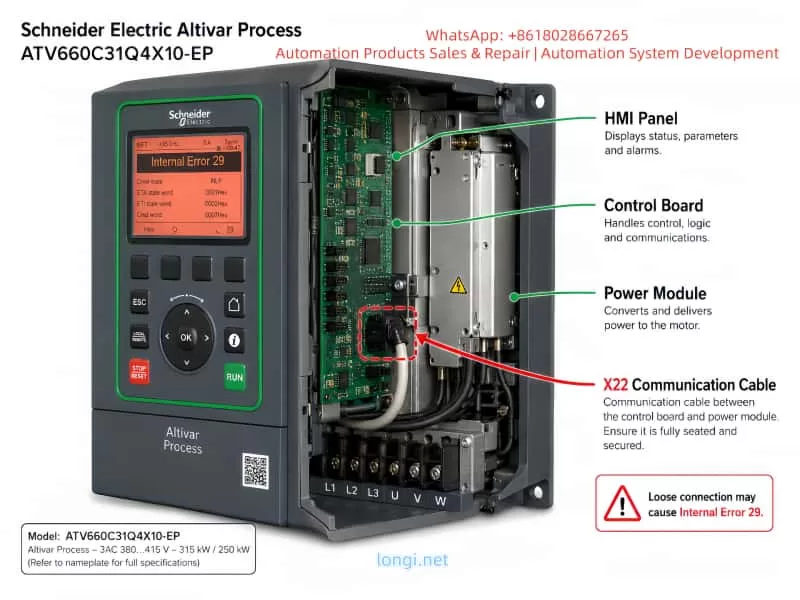
Industrial variable frequency drives (VFDs) play a critical role in modern automation systems, providing precise control of motor speed and torque. The Schneider Electric Altivar Process ATV660 series is widely used in heavy industrial applications, where high reliability and operational continuity are paramount. Despite robust design, certain internal errors can occur, potentially disrupting production. This article examines Internal Error 29, a common fault code reported on the ATV660, and analyzes a case where the root cause was identified as a poorly connected X22 communication cable, rather than a control board failure. The discussion covers system architecture, error diagnostics, maintenance best practices, and preventive strategies for engineers and technicians.


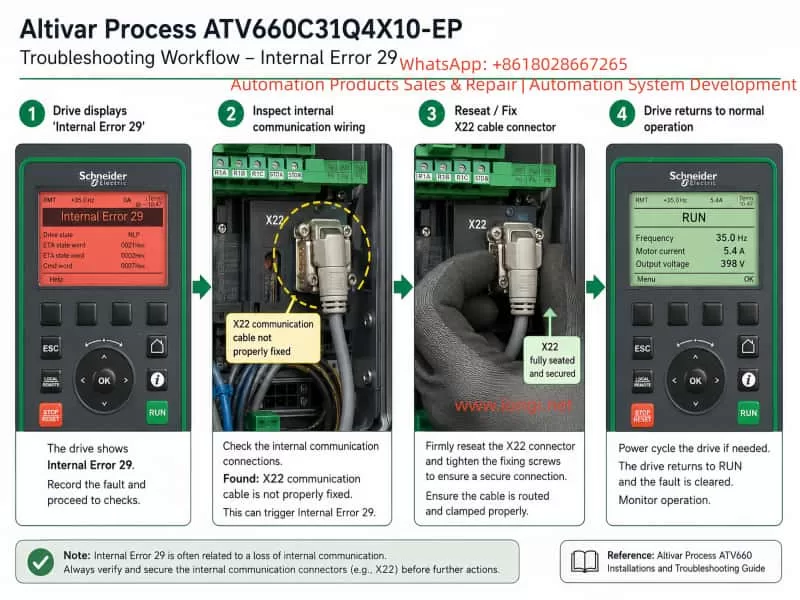
A clean, technical illustration of a Schneider Electric Altivar Process ATV660C31Q4X10-EP drive. The front HMI panel displays "Internal Error 29" with detailed status lines. The drive is shown in a semi-cutaway view, revealing the internal control board and power module. A red dashed outline and arrow highlight the X22 communication cable connecting the control board to the power module. Callouts on the right label the HMI Panel, Control Board, Power Module, and X22 Communication Cable. A note at the bottom-right warns that a loose connection may cause Internal Error 29. The background is white, layout is article-ready, with clear, professional labels and diagram style suitable for technical documentation.

1. Introduction

Variable frequency drives (VFDs) regulate AC motor operation by adjusting frequency and voltage supplied to the motor. In high-power industrial environments, failures in VFDs can result in substantial downtime and production losses. Schneider Electric’s ATV660 series is designed for demanding applications, offering integrated process control, energy efficiency, and communication with higher-level automation systems via standardized protocols.

Despite their robustness, internal errors such as Internal Error 29 occasionally occur. Traditionally, this error has been associated with control board malfunctions, EEPROM issues, or firmware anomalies. However, real-world case studies demonstrate that internal errors can sometimes arise from external hardware connections, particularly communication cables. This article documents a case study, explores root cause analysis, and provides guidelines for troubleshooting similar faults.


2. ATV660 System Architecture Overview

The ATV660 drive consists of several key modules:

  1. Power Module (PM): Handles the conversion from AC input to controlled AC output for the motor. Includes IGBT bridges, DC bus capacitors, and output filters.
  2. Control Board (CB): Implements drive logic, motor control algorithms, and communication with other modules and supervisory systems.
  3. Interface and Communication Modules: Facilitate connectivity to process automation networks and higher-level SCADA systems. The X22 cable is one of the internal communication links connecting the control board to the power module.
  4. Input/Output Terminals: Accepts field signals for start/stop, speed commands, and feedback.
  5. HMI Panel: Provides status, parameter configuration, and fault reporting to operators.

The X22 cable specifically transmits critical synchronization and monitoring signals between the control board and power module. Any disruption in this link can cause the drive’s self-diagnostic routine to report Internal Error 29, as the control board detects a lack of expected communication.


A troubleshooting workflow infographic for the Schneider Altivar Process ATV660C31Q4X10-EP showing Internal Error 29 resolution. Four sequential panels illustrate: 1) Drive front panel displays "Internal Error 29"; 2) Technician inspects internal communication wiring, highlighting the X22 cable not properly fixed; 3) Technician reseats and secures the X22 connector; 4) Drive returns to normal operation with the display showing "RUN" and parameters like frequency, motor current, and output voltage. Each step has numbered green badges, arrows indicate progression, and captions provide concise instructions. The layout is clean, technical, with a light background, suitable for an engineering article.

3. Internal Error 29: Typical Causes

The drive’s self-diagnostics categorize Internal Error 29 as a critical internal communication or control failure. Common triggers include:

  • Faulty control board components (logic IC, FPGA, or EEPROM)
  • Power module faults affecting control signals
  • Firmware corruption or mismatch
  • Poor connections in internal communication cables (e.g., X22, X21)
  • Intermittent or loose wiring between modules
  • Environmental factors (vibration, dust, or moisture)

Historically, many engineers default to assuming the error indicates a board failure, leading to unnecessary control board replacements. While hardware faults can cause this error, as demonstrated in this case study, cable issues may produce identical symptoms without damaging the main boards.


4. Case Study: X22 Communication Cable Issue

4.1 Fault Description

A client in Nigeria reported an ATV660C31Q4X10-EP drive displaying Internal Error 29. Initial assessment assumed a control board malfunction, given the error’s reputation. The drive was rated at 315 kW / 250 kW, connected to a 3-phase 380–415V input, and used in a heavy industrial process.

4.2 Initial Diagnostic Approach

  1. Power cycle and reset via the HMI panel
  2. Verified input and output voltages
  3. Inspected motor connections for short circuits
  4. Checked drive parameters and firmware version using SoMove

Despite these steps, the error persisted. No visible damage was found on the control board or power module.

4.3 Root Cause Identification

A detailed visual inspection revealed the X22 communication cable was not properly fixed. The connector had a slight displacement, leading to intermittent loss of signal between the control board and power module. This misalignment caused the drive’s internal logic to detect a failure in communication, thus triggering Internal Error 29.

After securely reconnecting the X22 cable:

  • Internal Error 29 cleared immediately
  • Drive returned to normal operation without replacing any hardware
  • No additional faults or error codes appeared

This case highlights the importance of inspecting all internal communication links, especially following maintenance or transport.


5. Diagnostic Strategy for Internal Error 29

To troubleshoot Internal Error 29 effectively, engineers should follow a structured approach:

  1. Document Drive Status
    • Note error codes, operating conditions, and drive parameters.
  2. Perform Controlled Restart
    • Power down the drive for 5–10 minutes.
    • Power it back on and attempt a reset.
  3. Verify External Connections
    • Ensure motor cables, field wiring, and grounding are correct.
    • Inspect X22 and other internal communication cables for proper seating.
  4. Examine Internal Modules
    • Check the control board, power module, and interface connections.
    • Look for loose connectors, dust, or mechanical stress on boards.
  5. Software and Firmware Verification
    • Backup parameters via SoMove or Drive Composer.
    • Confirm firmware versions and compatibility.
  6. Controlled Test Operation
    • Run the drive without a load, monitor for error recurrence.
    • If errors persist after cable inspection, consider module replacement.

By following this approach, unnecessary control board replacements can be avoided, reducing downtime and repair costs.


6. Maintenance Best Practices

  1. Cable Management
    • Ensure all internal connectors are securely fastened.
    • Label cables and document connections for future reference.
  2. Periodic Inspection
    • Schedule visual inspections of connectors, especially after maintenance or shipping.
    • Use retention clips or cable ties to prevent loosening due to vibration.
  3. Environmental Control
    • Keep drive compartments clean and dry.
    • Limit exposure to dust, moisture, and extreme temperatures.
  4. Operator Training
    • Train personnel on proper handling of internal connectors.
    • Emphasize the importance of checking communication cables when errors occur.
  5. Parameter Backup
    • Regularly backup drive parameters and firmware.
    • Maintain logs of firmware updates and maintenance activities.

7. Preventing Recurrence

Internal Error 29 caused by communication cable issues is entirely preventable:

  • Ensure proper mechanical fixation of X22 and other critical cables.
  • Verify connectors after any maintenance, transport, or vibration exposure.
  • Document all maintenance and inspections to provide traceability.

Implementing these preventive measures ensures higher operational reliability, minimizes unnecessary hardware replacements, and maintains consistent production uptime.


8. Conclusion

The Schneider ATV660 series is robust, but like all industrial drives, it is vulnerable to internal errors triggered by minor issues such as improperly fixed communication cables. The case study presented here demonstrates that:

  • Internal Error 29 is not always indicative of control board failure.
  • Loose or poorly connected X22 cables can produce identical error conditions.
  • Systematic diagnostics, careful inspection, and preventive maintenance can resolve errors efficiently without hardware replacement.

By adopting structured troubleshooting and preventive strategies, industrial engineers can enhance drive reliability, reduce repair costs, and prevent unnecessary downtime.


9. References

  1. Schneider Electric, Altivar Process ATV660 User Guide, 2021.
  2. SoMove / Drive Composer Software Manuals, Schneider Electric.
  3. Industrial VFD Maintenance Best Practices, ISA (International Society of Automation), 2020.

Posted on

Designing and Debugging an M221 PLC Modbus RTU System for Multiple VFDs: ATV310, ATV31P and PowerFlex 525 Mixed-Network Application

In small automation systems, tank control, pump stations, mixing equipment, conveyors and multi-motor applications, it is common to use one PLC to control several variable frequency drives. The control requirements usually include start, stop, speed reference, fault monitoring, running status feedback and centralized operation from an HMI. Compared with traditional terminal control, Modbus RTU control reduces hardwiring, allows the PLC to read more drive data, and makes it easier for the HMI to display frequency, current, status and fault information for each drive.

However, many field problems in these systems are not caused by a single wiring mistake or a missing ladder rung. The real problems often come from unclear system architecture, incorrect Modbus roles, duplicated slave addresses, wrong register addresses, misunderstanding of relay feedback, improper power supply conditions, and an incorrect commissioning sequence. This becomes even more obvious when different brands and series of drives are connected on the same Modbus RTU network, such as Schneider ATV310, Schneider ATV31P and Allen-Bradley PowerFlex 525. If all drives are treated as if they use the same control word, the same speed reference register and the same status word, the system will easily fail.

A typical system may consist of a Schneider M221 PLC as the main controller, an LU9GC3 as the Modbus RTU distribution module, several variable frequency drives as Modbus slaves, and a Schneider Harmony HMI as the operator interface. In this type of project, the key is not only how to draw the ladder logic. The complete engineering work must include communication architecture, Modbus address planning, drive parameter settings, PLC logic structure, relay feedback wiring, HMI design, power supply verification and step-by-step commissioning.


Chinese engineer commissioning a Schneider M221 PLC and multiple ATV310 VFDs in an industrial Modbus RTU control cabinet.

1. Correct System Architecture: PLC as Master, Drives as Slaves, HMI as Operator Interface

In a Modbus RTU system, there must be only one master on the same serial bus. The master sends read and write requests, and the slaves only respond to the master. In this application, the correct structure should be:

Schneider Harmony HMI
        ↓
Ethernet or HMI communication to PLC
        ↓
Schneider M221 PLC / TM221CE24R
        ↓
Modbus RTU Master
        ↓
Schneider LU9GC3 Modbus distribution module
        ↓
Multiple VFDs as Modbus RTU slaves

The HMI should not directly control all the drives on the Modbus RTU line. Its function is to send operator commands to the PLC, such as start, stop, reset and speed reference. The PLC then processes the logic and sends Modbus commands to the drives. The PLC also reads the drive status and sends this information back to the HMI for display.

A common misunderstanding in the field is confusing “HMI” with “HDMI.” HDMI is a video interface. HMI means Human Machine Interface, which is the industrial touchscreen used for operation and monitoring. A Schneider Harmony 7-inch touchscreen is an HMI, not an HDMI control device. It should communicate with the PLC, and the PLC should handle the actual drive control.


Close-up of Schneider ATV310 Modbus wiring and R1 relay feedback terminals being checked with a test probe.

2. LU9GC3 Is Not an Ethernet Switch

The LU9GC3 module has several RJ45 ports, so it is often mistaken for a normal Ethernet switch. This is a serious misunderstanding.

The LU9GC3 is a Modbus serial distribution module, not a TCP/IP Ethernet switch. It is used to distribute one Modbus serial line to several devices such as VFDs or soft starters. It does not perform Ethernet switching, and it does not automatically convert Modbus TCP to Modbus RTU.

The correct use is:

PLC serial port / Modbus RTU master
        ↓
LU9GC3
        ↓
ATV310, ATV31P, PowerFlex 525 and other Modbus RTU slaves

The HMI should not be connected to the LU9GC3 as if it were an Ethernet network switch. If the HMI has an Ethernet port, it should normally connect to the PLC Ethernet port or to a real Ethernet switch in the PLC-HMI network. The LU9GC3 should only be used for the serial Modbus RTU connection between the PLC and the drives.


Engineer programming Modbus VFD start-stop and speed control logic in Schneider Machine Expert Basic with HMI monitoring screen.

3. Each Drive Must Have a Unique Modbus Address

A Modbus RTU bus can have multiple slave devices, but each slave must have a unique address. If two drives have the same address, both may respond when the PLC sends a request to that address. This causes communication conflicts, invalid data, timeouts or unstable operation.

For a system with five drives, the address plan can be:

DeviceSuggested Modbus Address
PowerFlex 5251
ATV310 7.5 kW2
ATV310 5.5 kW #13
ATV310 5.5 kW #24
ATV31P 5.5 kW5

The exact order is not mandatory, but two rules must be followed:

Each address must be unique.
The slave address in the PLC program must match the actual address set in the drive.

If all drives remain at the factory default address, for example address 1, communication may work when only one drive is connected. But once several drives are connected to the bus, the PLC will receive conflicting replies. This is one of the most common reasons why a single-drive Modbus test succeeds but a multi-drive network fails.


Safe VFD power supply setup showing a three-phase step-up transformer feeding PowerFlex 525 and ATV310 drives under engineer inspection.

4. Communication Format Must Be the Same for All Devices

Modbus RTU communication requires not only correct slave addresses but also identical serial settings. The main settings are:

Baud rate: 9600 or 19200
Data bits: 8
Parity: Even or None
Stop bit: 1
Protocol: Modbus RTU

A practical starting point is:

19200 bps, 8E1

or:

9600 bps, 8E1

The most important point is consistency. The PLC, ATV310 drives, ATV31P drive and PowerFlex 525 must use the same baud rate, parity and stop bit. If one device has a different communication format, that device will not respond correctly to the PLC.

For initial commissioning, it is not recommended to use a very high baud rate. A Modbus RTU network with several VFDs is exposed to electrical noise, long cables, grounding problems and shielding issues. Lower or moderate baud rates are usually more stable during commissioning. After the system is working reliably, the communication cycle and baud rate can be optimized if necessary.


5. Modbus Control Principle for Schneider ATV310

To start and control an ATV310 through Modbus, two conditions must be met.

First, the drive communication parameters must be correct.
Second, the command source and frequency reference source must be set to the communication channel.

If the drive is still configured for terminal start or keypad speed reference, the PLC may write control words and frequency references successfully, but the drive will not run. This often leads technicians to believe that the PLC program is wrong, when the real issue is the drive control channel setting.

The ATV310 normally requires configuration of the following items:

Modbus slave address
Baud rate
Communication format
Command source
Frequency reference source
Control profile

In the PLC program, at least two write operations are normally required:

Write command word: start, stop, reset
Write frequency reference: for example 10 Hz, 20 Hz, 50 Hz

At the same time, the PLC should read status information:

Running status
Fault status
Actual frequency
Output current
Communication status

For the first commissioning stage, the best approach is not to build the full automatic process immediately. A safer and clearer sequence is to test one ATV310 first:

1. PLC reads the ATV310 status register successfully.
2. PLC writes a low speed reference, such as 10 Hz.
3. PLC writes a start command.
4. ATV310 starts from the PLC command.
5. PLC writes a stop command.
6. ATV310 stops from the PLC command.
7. PLC identifies drive fault or communication error.

After one ATV310 works correctly, the same logic can be copied and adjusted for the other ATV310 drives.


6. PowerFlex 525 Cannot Use the Same Register Table as Schneider ATV310

In a mixed system, the Allen-Bradley PowerFlex 525 must be treated separately. It may support Modbus, but its parameter numbers, command source settings, Modbus register addresses, speed reference scaling and status word definitions are not the same as Schneider ATV310.

This is a critical point. All VFDs are not identical just because they all use Modbus. Different manufacturers implement Modbus control in different ways. Even when they all have a command word and a speed reference, the addresses, bit definitions, scaling and command values can be different.

For PowerFlex 525, the RS485 Modbus node address is typically set in:

C124 [RS485 Node Addr]

If the PowerFlex 525 is planned as slave address 1, then:

C124 = 1

Other important parameters include:

P046 [Start Source 1]: start command source
P047 [Speed Reference 1]: speed reference source
C123 [RS485 Data Rate]: RS485 communication speed
C127 [Comm Format]: communication format
C128 [Comm Write Mode]: communication write mode

If the drive must start and receive speed reference through Modbus, the start source and speed reference source must be set to the serial or DSI communication source. Otherwise, the PLC may communicate with the drive but still fail to start it.

In the PLC program, the PowerFlex 525 should have its own control block, for example:

VFD1_PowerFlex525

It should not share the same internal register mapping as the ATV310. The external interface can look the same for all drives, such as Start, Stop, Reset, Speed_Set, Run_Status, Fault_Status and Comm_Error. But the internal Modbus read/write addresses must match the specific drive model.


7. Recommended PLC Program Structure: Common Interface, Separate Drive Blocks

In a multi-drive system, the operator wants a consistent HMI interface, but each drive may require different Modbus registers. The best PLC structure is therefore:

Common HMI interface
Different internal Modbus blocks for each drive

For example, the HMI can provide the same commands for every VFD:

Start
Stop
Reset
Speed reference
Running status
Fault status
Communication status
Actual frequency
Actual current

But inside the PLC, each drive should have its own logic section or function block:

VFD1_PowerFlex525
VFD2_ATV310_7K5
VFD3_ATV310_5K5
VFD4_ATV310_5K5
VFD5_ATV31P_5K5

Each block should handle:

1. Generate internal run command from HMI request.
2. Check permissive conditions.
3. Generate the correct command word for that drive.
4. Write speed reference.
5. Read status word.
6. Decode running and fault states.
7. Detect communication error.
8. Send status back to the HMI.

This structure keeps the main program clear. The HMI remains consistent, while the brand-specific details are isolated inside each drive control block.


8. Ladder Logic Should Not Copy a Direct Motor Starter Diagram

A normal motor starter ladder diagram usually contains:

Start button → latch circuit → contactor output
Stop button → break output
Timer → start next motor

This logic is useful for learning ladder basics, but it cannot be directly used for Modbus drive control. A Modbus-controlled VFD does not start because a PLC output coil turns on. It starts because the PLC writes the correct command word to the correct Modbus register.

The correct logic should be:

Start button or HMI start command
        ↓
PLC internal run command
        ↓
Check safety and permissive conditions
        ↓
Write drive command word
        ↓
Write frequency reference
        ↓
Read drive status word
        ↓
Display running, stopped, fault or communication error on HMI

The PLC physical outputs Q0.0, Q0.1, etc. may not be used for drive start at all. The main control is through Modbus. Physical inputs and outputs are mainly used for emergency stop, interlock, relay feedback and backup hardwired protection.

A basic internal run latch can be designed with the following conditions:

Start condition:
HMI_START = 1
Emergency stop OK = 1
Drive R1 feedback OK = 1
Modbus communication OK = 1
Drive fault = 0

When all conditions are satisfied:

RUN_CMD = 1

Stop conditions include:

HMI_STOP = 1
Emergency stop active
R1 feedback abnormal
Communication fault
Drive fault

If any stop condition is present:

RUN_CMD = 0

Then the Modbus command is generated from RUN_CMD:

RUN_CMD = 1 → write start command
RUN_CMD = 0 → write stop command

The frequency reference is written separately, for example:

HMI_SPEED_SET = 10.0 Hz
PLC converts it to the correct register value
PLC writes it to the drive speed reference register

9. R1 Relay Feedback Is Auxiliary Protection, Not a Replacement for Modbus Status

The ATV310 has relay terminals R1A, R1B and R1C. In most cases:

R1C = common
R1A = normally open contact
R1B = normally closed contact

R1A and R1B are not two separate fault signals. They are opposite contacts of the same relay. If R1C is connected to +24 V, R1A is connected to one PLC input, and R1B is connected to another PLC input, the two inputs will normally show opposite states.

For example:

Relay energized: R1A-R1C closed, R1B-R1C open
Relay de-energized: R1B-R1C closed, R1A-R1C open

In practical engineering, one contact per drive is normally enough for a fault or permissive feedback signal. A normally closed contact is often preferred for protection because a broken wire can also be detected as an abnormal condition.

A typical connection can be:

+24 V → R1C
R1B → PLC input
PLC input common → 0 V

However, the actual meaning of the input depends on how the drive relay function is configured. The R1 relay can be assigned to fault, run, ready, frequency reached or other functions. The PLC program must clearly define what the input means. It should not mix “running feedback,” “fault feedback” and “start permissive” without clear logic.

The best practice is to use both Modbus status and relay feedback:

Modbus status word: running, stopped, fault code, frequency, current
R1 relay: hardwired permissive or fault protection

If only R1 is used, the PLC cannot know the detailed fault. If only Modbus is used, a communication failure may remove an important hardwired protection path. Combining both gives a more robust system.


10. Each VFD Should Have Its Own Fault Feedback Input

For a five-drive system, each drive should ideally have a separate relay feedback input to the PLC:

VFD1 R1 → PLC input
VFD2 R1 → PLC input
VFD3 R1 → PLC input
VFD4 R1 → PLC input
VFD5 R1 → PLC input

This allows the HMI to display:

VFD1 fault
VFD2 fault
VFD3 fault
VFD4 fault
VFD5 fault

If all R1 contacts are combined into one general fault input, the PLC will only know that one drive has a problem, but it will not know which one. This makes troubleshooting slower and less professional.

If PLC inputs are limited, a compromise can be made. Critical drives can have separate hardwired feedback, while less critical devices can rely on Modbus status. But in a new system design, saving a few input points should not be more important than clear fault diagnosis.


11. Modbus Wiring Must Consider Bus Topology, Shielding, Termination and Grounding

RS485 / Modbus RTU wiring is simple in principle, but it is sensitive to poor installation. VFDs are strong sources of electrical noise. PWM motor cables, braking resistors, contactor coils, grounding problems and power harmonics can all affect communication quality.

Important wiring rules include:

  1. Use twisted shielded cable for RS485 communication.
  2. Do not run communication cable parallel to motor power cables for long distances.
  3. Keep the bus structure clear and avoid random star wiring.
  4. Use termination resistors at the ends of the bus when required.
  5. Handle shield grounding correctly to avoid ground loops.
  6. Do not reverse D0 and D1.
  7. Do not treat RJ45 Modbus ports as normal Ethernet ports.
  8. Each slave address must be unique.
  9. All serial settings must be the same.
  10. Add one device at a time during commissioning.

Many Modbus failures are not caused by the PLC program. They are caused by wiring topology, shielding, grounding, termination or duplicated addresses. When five VFDs are connected to the same bus, it is much better to add and test one device at a time.


12. Commissioning Should Start with One Drive, Not the Entire System

A reliable commissioning sequence is essential. The recommended order is:

  1. Confirm PLC model, HMI model, VFD models and communication interfaces.
  2. Confirm the function and wiring of the LU9GC3.
  3. Connect only one ATV310 first.
  4. Set its Modbus address, baud rate, parity and stop bit.
  5. Set its command source and speed reference source to Modbus.
  6. Configure the M221 serial line as Modbus RTU master.
  7. Read one status register from the ATV310.
  8. Write a low frequency reference, such as 10 Hz.
  9. Write the start command.
  10. Confirm that the drive starts.
  11. Write the stop command.
  12. Confirm that the drive stops.
  13. Read fault and running status.
  14. Copy the logic to the other ATV310 drives.
  15. Commission the ATV31P separately.
  16. Commission the PowerFlex 525 separately.
  17. Integrate the HMI operation screen and alarm screen.
  18. Test emergency stop, communication loss, relay feedback and fault reset.
  19. Finally run the motors under correct power supply conditions.

The worst approach is to connect all five drives, write all the logic, power everything up and then start troubleshooting. When many problems exist at the same time, it becomes difficult to know whether the fault is caused by addressing, parameters, wiring, registers, power supply or logic.


13. Do Not Run VFDs from an Improvised Single-Phase Capacitor Supply

In some field situations, the available power supply may not match the VFD input voltage. For example, the site may only have 240 V three-phase power, while the drives or equipment require 380 V, 400 V or 480 V three-phase input. Sometimes a technician may try to create a temporary “480 V single-phase” supply and use a capacitor to simulate a missing phase.

This is not a proper power supply for VFD operation.

A VFD input rectifier requires a stable and balanced AC power source. A single-phase high-voltage supply with a capacitor does not become a real three-phase supply. It may cause:

Severe input voltage imbalance
DC bus ripple
Input phase loss fault
Undervoltage or overvoltage fault
Rectifier bridge overheating
Pre-charge circuit damage
Capacitor overheating or explosion
Ground fault or leakage trip
Permanent drive damage

If the site only has 240 V three-phase power and the drives require 380/400/480 V three-phase input, the correct solution is:

240 V three-phase supply
        ↓
Three-phase step-up transformer
        ↓
380/400/480 V three-phase supply
        ↓
VFD input

A properly sized three-phase transformer, correct grounding and correct protection devices are required. PLC, HMI and Modbus communication can be tested first without running the motor. High-voltage drive operation should only be tested when the power supply is correct and safe.


14. HMI Design Should Include Operation, Status and Alarms

In a multi-drive system, the HMI should not only have start and stop buttons. A practical HMI should include operation commands, real-time status and alarm information.

Single-Drive Control Area

Each VFD should have its own control section:

Start
Stop
Reset
Speed reference
Forward / reverse selection
Manual / automatic mode

Single-Drive Status Area

Each VFD should display:

Communication OK / communication fault
Running / stopped
Fault status
Actual frequency
Output current
Output voltage
Fault code
R1 relay input status

Overview Screen

The overview screen should show the status of all drives:

VFD1: running / fault / communication error
VFD2: running / fault / communication error
VFD3: running / fault / communication error
VFD4: running / fault / communication error
VFD5: running / fault / communication error

Alarm History

A good system should record:

Which drive faulted
Fault time
Reset time
Communication loss time
Emergency stop time

If the HMI only has start and stop buttons, maintenance personnel will not have enough information to diagnose problems quickly.


15. Example PLC Variable Planning

Clear variable naming is important for maintenance. For example, for the second drive, an ATV310, the PLC variables can be:

VFD2_Start_HMI
VFD2_Stop_HMI
VFD2_Reset_HMI
VFD2_Speed_Set
VFD2_Run_Cmd
VFD2_Command_Word
VFD2_Frequency_Ref
VFD2_Status_Word
VFD2_Running
VFD2_Fault
VFD2_Comm_Error
VFD2_R1_OK
VFD2_Actual_Freq
VFD2_Actual_Current

For the PowerFlex 525, similar naming can be used:

VFD1_Start_HMI
VFD1_Stop_HMI
VFD1_Reset_HMI
VFD1_Speed_Set
VFD1_Run_Cmd
VFD1_Command_Word
VFD1_Frequency_Ref
VFD1_Status_Word
VFD1_Running
VFD1_Fault
VFD1_Comm_Error

The naming style should be consistent. This makes it easier to copy logic, link HMI objects and troubleshoot the system later. The brand-specific differences should be handled inside the drive block, not scattered throughout the HMI and main program.


16. Run Command and Safety Permissives Must Be Separated

The PLC program should separate the operator request from the actual permission to run. An HMI start button only means the operator wants to start the drive. It does not mean the drive is allowed to start immediately.

Before the PLC sends a start command, it should check:

Emergency stop OK
Safety door OK
Drive not faulted
Communication OK
R1 feedback OK
Motor protection OK
Process conditions OK
Valid speed reference
No interlock conflict

The logic should be layered:

HMI_START → operator request
RUN_PERMISSION → permissive conditions
RUN_CMD → internal PLC run command
MODBUS_COMMAND → actual command written to the VFD

This prevents accidental operation and makes diagnostics easier. If the operator presses Start but the drive does not run, the HMI can show “start condition not satisfied” and then indicate whether the problem is R1 feedback, communication fault, emergency stop, drive fault or another interlock.


17. Stop Command Must Have Higher Priority Than Start

In any motor control system, stopping and fault handling must have higher priority than starting. The PLC logic should follow these rules:

Stop has priority over start.
Fault has priority over run.
Emergency stop has priority over normal stop.
Communication fault should inhibit start.

If HMI_START and HMI_STOP are active at the same time, the PLC should stop the drive.
If RUN_CMD is active but R1 feedback becomes abnormal, the PLC should remove the run command.
If Modbus communication is lost, the PLC should stop sending run commands and display a communication fault.

The VFD’s own communication-loss behavior should also be configured. Some drives can be set to coast stop, ramp stop, hold last command or trip on communication timeout. For most industrial systems, communication loss should cause a stop or a fault response, not continued operation with the last command.


18. Main Challenges in a Mixed-Brand VFD System

The difficulty in this type of project is not only one drive. It is the mixed-brand system. The main challenges include:

  1. Schneider ATV310 and Allen-Bradley PowerFlex 525 use different Modbus register maps.
  2. The command word bit definitions may be different.
  3. The speed reference scaling may be different.
  4. The status word decoding may be different.
  5. The fault reset command may be different.
  6. The communication parameter menus are different.
  7. Some drives default to terminal control, while others may default to keypad control.
  8. Communication timeout behavior must be configured.
  9. The HMI should be unified, but the low-level Modbus control cannot be identical.
  10. The field power supply may not be suitable for all drives.

Therefore, the project should not be reduced to “how to draw the ladder.” The complete design must include architecture, parameters, addresses, communication, power, safety and commissioning sequence.


19. Recommended Implementation Procedure

For similar projects, the following implementation procedure is recommended.

Step 1: Build a Device List

Record the following information for each device:

Brand
Model
Power rating
Input voltage
Communication interface
Modbus address
Communication format
Command source
Speed reference source

Step 2: Confirm Power Supply Conditions

Check:

Voltage level
Number of phases
Available capacity
Grounding
Circuit breaker
Leakage protection
Transformer capacity
Motor rated data

If the power supply is not suitable, fix the power supply first. Do not force the VFDs to run from an unsafe temporary source.

Step 3: Test One Drive Communication

Connect only one drive and confirm that the PLC can read and write data.

Step 4: Test One Drive Operation

Run at low frequency, preferably no load or light load, and confirm start and stop.

Step 5: Test Status Reading

Read running state, stopped state, fault state, current and frequency.

Step 6: Test R1 Relay Feedback

Create or simulate a status change and confirm that the PLC input changes correctly.

Step 7: Add Drives One by One

Add one drive to the Modbus bus at a time and test after each addition.

Step 8: Commission the HMI

Link HMI buttons, setpoints, status indicators and alarms.

Step 9: Test Safety Interlocks

Test emergency stop, communication interruption, drive fault, broken feedback wire and power recovery.

Step 10: Run with Load

Under correct three-phase power, gradually increase speed and monitor current, temperature and mechanical behavior.


20. Conclusion

Using an M221 PLC to control multiple VFDs through Modbus RTU is a practical and powerful industrial control solution. It reduces hardwiring, improves system integration, and allows the HMI to display drive status, fault information, current and frequency. But such a system cannot be understood as simply “the PLC sends one start command and the drive runs.” A reliable system must handle communication roles, unique slave addresses, serial settings, register differences, command word logic, relay feedback, HMI design, safety interlocks and correct power supply conditions.

In a mixed system using Schneider ATV310, Schneider ATV31P and Allen-Bradley PowerFlex 525, the most important rules are:

Use one clear architecture.
Assign unique slave addresses.
Keep communication settings consistent.
Use different Modbus register maps for different drives.
Build modular PLC logic.
Commission one drive at a time.

The HMI should be only the operator interface. The PLC should be the only Modbus RTU master. The drives should be Modbus slaves. The LU9GC3 should be treated as a Modbus serial distribution module, not as an Ethernet switch. The PowerFlex 525 Modbus address should be set through C124, and its start source, speed reference source and communication format must be configured separately. The ATV310 and ATV31P should be configured according to the Schneider drive communication table and control profile.

Power supply conditions must also be respected. If a drive requires 380 V, 400 V or 480 V three-phase input, but the site only has 240 V three-phase power, the correct solution is a properly sized three-phase step-up transformer. A single-phase high-voltage supply with a capacitor cannot replace a real three-phase supply and should not be used for normal VFD operation.

The safest commissioning strategy is to divide the project into small, verifiable steps. First test one drive, then expand to multiple drives. First read status, then write speed. First run at low speed, then test under load. First make communication stable, then complete the HMI and automatic logic. By following this method, a complex multi-drive Modbus RTU system can be transformed into a clear, maintainable and reliable industrial control project.

Posted on

Schneider ATV930 “Motor Short Circuit” Fault: Causes, Diagnosis, and Repair Methods

1. Fault Description

The photo shows a Schneider Electric Altivar Process ATV930 drive displaying the fault message:

Motor short circuit

This means the inverter has detected a short-circuit type abnormality on the motor output side. It does not always mean the motor winding is definitely shorted, but it means the drive has detected an output current condition that matches a motor-side short circuit, phase-to-phase fault, phase-to-ground fault, abnormal leakage, incorrect output wiring, or internal power module problem.

This is a serious fault. The drive should not be repeatedly reset and restarted before inspection, because forced restarting may damage the IGBT module, gate driver board, current detection circuit, DC bus components, or motor cable.

ATV930D11N4

2. What This Fault Means

The ATV930 outputs three-phase PWM voltage through the U, V, and W terminals. Under normal conditions, the output current follows the motor load, acceleration demand, frequency, and torque requirement.

When the drive detects an abnormal current rise, current imbalance, or short-circuit pattern, it trips with Motor short circuit.

Possible meanings include:

  1. Motor winding phase-to-phase short circuit.
  2. Motor winding insulation failure to ground.
  3. Damaged or wet motor cable.
  4. Loose, burned, or carbonized motor terminal box.
  5. Output cable shield touching phase conductors.
  6. Incorrect wiring on U/V/W output terminals.
  7. Output contactor or output filter fault.
  8. Mechanical load locked or jammed.
  9. Motor parameters set incorrectly.
  10. IGBT module or gate driver circuit failure inside the drive.
  11. Current sensor or current detection circuit fault.

Therefore, this fault must be diagnosed step by step. It is wrong to immediately conclude that only the motor is bad or only the drive is bad.

3. Main Causes of “Motor Short Circuit” on ATV930

3.1 Motor winding short circuit

A phase-to-phase short circuit inside the motor winding can cause very high output current when the drive starts. The drive then trips immediately.

Basic checks:

  • Measure U-V, V-W, and W-U resistance.
  • The three readings should be balanced.
  • For large motors, use a milliohm meter instead of a normal multimeter.
  • If one phase pair is obviously lower than the others, the winding may be shorted.
  • If the readings are close but suspicious, use a surge/turn-to-turn tester.

A standard multimeter may not detect turn-to-turn short circuits in large motors, because the normal winding resistance is already very low.

3.2 Motor insulation failure to ground

This is one of the most common causes. Motors used in pumps, fans, cooling towers, compressors, outdoor equipment, and humid environments often suffer insulation degradation.

The motor may still run on a normal mains supply, but fail when powered by a VFD. This is because the inverter output contains high-frequency PWM pulses, high dv/dt, and common-mode voltage, which stress weak insulation more severely.

Use a megohmmeter to test:

  • U to ground
  • V to ground
  • W to ground
  • U-V
  • V-W
  • W-U

Before testing, disconnect the motor cable from the inverter. Never apply megger voltage into the inverter output terminals.

For low-voltage motors, insulation should generally be well above 1 MΩ. In practical industrial maintenance, a healthy motor is usually expected to show several MΩ, tens of MΩ, or higher. If the insulation is only hundreds of kΩ or close to zero, the motor must not be connected back to the drive for trial running.

3.3 Damaged motor cable

The motor cable is often the real cause, especially in harsh industrial environments.

Common cable problems include:

  • Damaged outer sheath.
  • Cable crushed by machinery.
  • Water inside cable tray.
  • Aging insulation.
  • Burned cable lugs.
  • Shield layer touching phase wires.
  • Poor cable termination.
  • Copper strands left loose inside the terminal box.
  • Metal dust or carbonized contamination causing leakage.

A useful test is to separate the motor and cable, then test them independently. If the motor insulation is good but the cable insulation is bad, replace the cable or remake the cable termination.

3.4 Motor terminal box problem

A wet or carbonized terminal box can easily trigger a short-circuit fault.

Check for:

  • Water ingress.
  • Burn marks.
  • Cracked terminal board.
  • Loose screws.
  • Oxidized cable lugs.
  • Carbon tracking.
  • Oil, dust, or metal particles.
  • Cable shield touching live terminals.
  • Poor grounding.

If the terminal board is carbonized, cleaning is often not enough. Carbonized material can continue to conduct and cause leakage. Replacement is recommended.

Motor short circuti

3.5 Output-side contactor, filter, or reactor problem

The output side of a VFD is not the same as a normal mains supply. The U/V/W terminals output high-frequency PWM voltage. Improper components connected to the output can cause short-circuit faults.

Problematic cases include:

  • Power factor correction capacitors connected on the inverter output.
  • Output contactor switching while the inverter is running.
  • Damaged output reactor.
  • Faulty sine filter or dv/dt filter.
  • Incorrect multi-motor switching circuit.
  • Contactor contacts welded or carbonized.
  • Output terminal block damaged.

If an output contactor is used, it must be interlocked so that it only opens or closes when the inverter output is disabled.

3.6 Mechanical load jammed

A locked mechanical load can cause very high starting current. This may be interpreted by the drive as a short-circuit type fault, especially if the acceleration time is too short or the torque boost is too high.

Typical mechanical causes:

  • Pump impeller jammed.
  • Fan bearing seized.
  • Gearbox locked.
  • Conveyor blocked.
  • Compressor seized.
  • Screw pump stuck.
  • Mixer blocked by solidified material.

Disconnect the motor from the mechanical load and run the motor alone. If the motor runs normally without the load, the mechanical system must be inspected.

3.7 Incorrect motor parameters

The ATV930 depends heavily on correct motor data. Incorrect motor parameters can cause abnormal current during starting or acceleration.

Check:

  • Motor rated power.
  • Motor rated voltage.
  • Motor rated current.
  • Motor rated frequency.
  • Motor rated speed.
  • Power factor.
  • Motor control mode.
  • Acceleration time.
  • Torque boost.
  • Current limit.
  • Auto-tuning result.

If the motor or drive was replaced recently, enter the motor nameplate data again and perform motor auto-tuning. If the motor can be disconnected from the load, rotating auto-tuning is usually better. If the load cannot be disconnected, use static auto-tuning if supported.

3.8 Internal inverter fault

If the motor cable is disconnected from U/V/W and the drive still reports Motor short circuit, the fault is likely inside the inverter.

Possible internal faults include:

  • IGBT module short circuit.
  • One output phase shorted to DC+ or DC-.
  • Gate driver circuit fault.
  • Gate resistor open or damaged.
  • Driver power supply abnormal.
  • Current sensor offset or failure.
  • Current detection amplifier fault.
  • Control board or power board communication problem.
  • Moisture or conductive dust on the power board.

In this case, do not continue trial operation. The drive should be inspected at component level.

4. Correct Troubleshooting Procedure

Step 1: Stop repeated reset attempts

Do not repeatedly reset and restart the ATV930. A real output short circuit can destroy the power module.

Proper first action:

  1. Stop the drive.
  2. Switch off the main supply.
  3. Wait for the DC bus to discharge.
  4. Measure DC+ and DC- voltage.
  5. Confirm the voltage is safe before touching wiring.

Step 2: Record the fault conditions

Before clearing the fault, record:

  • Fault name: Motor short circuit.
  • Output frequency at trip.
  • Output current at trip.
  • Whether the fault appears at power-on, start, acceleration, running, or deceleration.
  • Whether the motor was loaded.
  • Whether the motor, cable, drive, or contactor was recently replaced.
  • Whether rain, cleaning, or water ingress occurred.
  • Whether there was burning smell, trip breaker, or blown fuse.

The trip timing is very important.

If the fault occurs immediately at start, suspect output short circuit, cable fault, motor fault, or IGBT failure.

If the fault occurs after running for some time, suspect thermal insulation breakdown, loose terminals, overheating components, or load jamming.

Step 3: Disconnect the motor cable from U/V/W

After power-off and DC bus discharge, remove the motor cables from the inverter output terminals U, V, and W. Mark the wires carefully.

Then power up the drive and test it briefly without the motor connected.

Interpretation:

  • If the fault disappears, the inverter is probably not the main problem. Focus on the motor, cable, terminal box, output circuit, and mechanical load.
  • If the fault remains, the drive itself is likely faulty. Check the IGBT module, gate driver board, and current detection circuit.

Step 4: Measure motor phase resistance

Measure:

  • U-V
  • V-W
  • W-U

The three values should be balanced.

If one pair is much lower, suspect phase-to-phase winding short circuit.

If one pair is much higher or open, suspect broken winding or bad connection.

For large motors, use a milliohm meter. A normal multimeter may not be accurate enough.

Step 5: Measure insulation resistance

Use a megohmmeter to test insulation.

First test motor plus cable together. If the insulation is poor, separate the motor and cable, then test each one individually.

This identifies whether the fault is in the motor or in the cable.

Do not reconnect the motor to the ATV930 until insulation is confirmed acceptable.

Step 6: Inspect the motor terminal box

Open the terminal box and check for:

  • Moisture.
  • Carbon tracking.
  • Burned smell.
  • Loose screws.
  • Damaged terminal board.
  • Poor cable glands.
  • Shield wire touching phase terminals.
  • Copper strands or metal particles.
  • Cracked insulation.

Correct all wiring and insulation defects before power-on testing.

Step 7: Check the mechanical load

Manually rotate the motor and the driven machine.

If possible:

  1. Disconnect the coupling.
  2. Run the motor without load.
  3. Then reconnect the load and test again.

If the motor runs normally without load but trips with the load, inspect the pump, fan, gearbox, compressor, conveyor, or mechanical transmission.

Step 8: Check motor parameters and auto-tuning

If the hardware is normal, check the drive setup.

Confirm that the ATV930 motor parameters match the motor nameplate. Then perform auto-tuning.

Also adjust:

  • Longer acceleration time.
  • Reasonable torque boost.
  • Correct current limit.
  • Correct motor control mode.
  • Proper flying restart settings if the motor may already be rotating.

5. Diagnosis by Fault Timing

5.1 Fault appears at power-on

Likely causes:

  • Internal IGBT short circuit.
  • Output current detection fault.
  • Gate driver fault.
  • Severe external short circuit.
  • Wrong wiring.

First disconnect U/V/W. If the drive still faults, inspect the inverter internally.

5.2 Fault appears immediately after start command

Likely causes:

  • Motor cable short circuit.
  • Motor winding short circuit.
  • Wet terminal box.
  • Output contactor problem.
  • IGBT failure under load.
  • Wrong motor parameters.
  • Locked mechanical load.

Test the drive without motor cable, then test with a known good motor if possible.

5.3 Fault appears during acceleration

Likely causes:

  • Acceleration time too short.
  • Load inertia too high.
  • Torque demand too high.
  • Incorrect motor data.
  • Auto-tuning not done.
  • Mechanical friction or jamming.
  • Motor insulation weak under PWM stress.

Try increasing acceleration time, checking load condition, and redoing motor auto-tuning.

5.4 Fault appears after running for some time

Likely causes:

  • Motor insulation drops when hot.
  • Cable insulation drops when hot.
  • Terminal connection heats and carbonizes.
  • IGBT module has thermal failure.
  • Drive cooling fan failure.
  • Heatsink blocked by dust.
  • Load intermittently jams.

This type of fault may not be found by cold testing. Hot-state insulation testing and thermal inspection may be necessary.

5.5 Fault appears after rain or equipment washing

Likely causes:

  • Motor terminal box water ingress.
  • Cable gland leakage.
  • Wet cable tray.
  • Damp motor winding.
  • Condensation inside the cabinet.
  • Conductive dust and moisture causing leakage.

Drying, cleaning, sealing, and insulation testing are required before restarting.

6. Internal Drive Inspection

If the ATV930 still reports the fault with U/V/W disconnected, inspect the drive.

6.1 Check DC bus short circuit

Measure DC+ to DC-. A very low resistance may indicate:

  • IGBT short circuit.
  • Rectifier bridge short circuit.
  • Braking transistor short circuit.
  • DC bus capacitor failure.

6.2 Check output phases against DC bus

Using diode mode, compare:

  • U to DC+
  • V to DC+
  • W to DC+
  • U to DC-
  • V to DC-
  • W to DC-

The readings should be relatively symmetrical. A significantly different reading on one phase suggests a damaged IGBT module.

6.3 Check phase-to-phase output

Measure:

  • U-V
  • V-W
  • W-U

A low-resistance short between phases suggests power module failure.

6.4 Check gate driver and current detection

If the IGBT module tests normally but the fault remains, inspect:

  • Gate driver power supply.
  • Gate resistors.
  • Driver optocouplers.
  • Current sensors.
  • Current detection amplifiers.
  • Control board connections.
  • Moisture, dust, or corrosion on boards.

This requires professional repair experience. Component-level repair should not be attempted blindly on high-power drives.

7. Practical Repair Solutions

7.1 If motor insulation is poor

Repair method:

  1. Open the motor terminal box.
  2. Clean moisture, oil, and dust.
  3. Dry the motor winding.
  4. Replace carbonized terminal board if needed.
  5. Retest insulation.
  6. If insulation remains poor, rewind or replace the motor.

7.2 If the cable is damaged

Repair method:

  1. Separate motor and cable.
  2. Test cable insulation.
  3. Locate the damaged section.
  4. Replace the cable or remake the cable head.
  5. Correct shielding and grounding.
  6. Retest insulation before reconnecting.

7.3 If the terminal box is wet or carbonized

Repair method:

  1. Record wiring before disassembly.
  2. Clean the terminal box.
  3. Replace damaged terminal blocks.
  4. Replace sealing gasket and cable gland.
  5. Recrimp cable lugs if needed.
  6. Perform insulation testing.
  7. Start at low frequency and monitor current.

7.4 If the load is jammed

Repair method:

  1. Disconnect the coupling.
  2. Rotate motor and load separately.
  3. Inspect bearing, gearbox, pump, fan, or compressor.
  4. Remove blockage.
  5. Extend acceleration time.
  6. Monitor starting current after repair.

7.5 If parameters are wrong

Repair method:

  1. Record original parameters.
  2. Enter correct motor nameplate data.
  3. Select proper control mode.
  4. Perform auto-tuning.
  5. Increase acceleration time.
  6. Adjust current limit and torque boost.
  7. Test without load first, then with load.

7.6 If the inverter is internally damaged

Repair method:

  1. Disconnect U/V/W and confirm the fault remains.
  2. Check IGBT module.
  3. Check rectifier, braking transistor, and DC bus.
  4. Check gate driver circuit.
  5. Check current sensors.
  6. Repair or replace damaged boards/modules.
  7. Test with a controlled load before returning to site.

8. Quick Diagnosis Table

SymptomMost likely causeRecommended check
Fault at power-onInverter internal fault, IGBT, current detectionDisconnect U/V/W and test drive
Fault immediately at startMotor, cable, terminal box, output shortMegger motor and cable
Fault during accelerationLoad too heavy, acceleration too short, wrong parametersExtend acceleration time, check load
Fault after running for a whileThermal insulation failure, loose terminal, overheating moduleHot-state test and thermal inspection
Fault after rain or washingMoisture ingressCheck terminal box and cable glands
Fault after replacing motorIncorrect parameters, no auto-tuningEnter nameplate data and auto-tune
Fault remains with motor disconnectedDrive internal faultCheck IGBT, driver board, current sensor
Test motor runs normallyOriginal motor or cable faultSeparate motor and cable for testing

9. Common Mistakes

Repeated resetting

Resetting clears the alarm, but it does not remove the short circuit. Repeated restart attempts can destroy the inverter.

Only using a multimeter

A multimeter cannot replace a megohmmeter. Many insulation faults only appear under high test voltage.

Ignoring the cable

The cable and cable head are frequent failure points. Always test the motor and cable separately.

Switching output contactor during operation

The output contactor must not switch while the inverter is actively outputting PWM voltage.

Incorrect motor parameters

Wrong motor data can cause unstable control and excessive starting current.

Ignoring cooling

Dust, blocked heatsinks, and failed fans can cause thermal failure of power modules.

10. Conclusion

For a Schneider ATV930 displaying Motor short circuit, the correct diagnosis is not to immediately replace the motor or the inverter. The fault indicates a short-circuit type abnormality on the output side or inside the power stage.

The proper troubleshooting sequence is:

  1. Stop repeated reset attempts.
  2. Power off and confirm DC bus discharge.
  3. Disconnect U/V/W motor cables.
  4. Test whether the drive still reports the fault.
  5. If the fault disappears, inspect motor, cable, terminal box, output components, and mechanical load.
  6. If the fault remains, inspect the inverter IGBT module, gate driver board, and current detection circuit.
  7. Verify motor parameters and perform auto-tuning after hardware problems are eliminated.

The most important point is safety and sequence. A short-circuit fault must be investigated before restarting. Blind trial operation may turn a simple cable or terminal problem into a serious inverter power module failure.

Posted on

Schneider ATV630 VFD Braking Resistor Wiring Guide: PA, PB and UD- Explained

Complete Technical Guide for Correct Dynamic Braking Connection

Industrial variable frequency drives (VFDs) are widely used in pumps, fans, compressors, conveyors, and many other automation systems. Among Schneider Electric’s modern drive families, the Altivar Process ATV600 series, including the ATV630, is designed for high-performance industrial process control.

One of the most common installation and maintenance questions engineers encounter is:

How to correctly connect the braking resistor on an ATV630 VFD?

In particular, confusion often arises around the following terminals:

  • PA (P+)
  • PB (Brake Output)
  • UD- (DC Bus Negative)

Incorrect wiring of these terminals can result in severe faults such as DC bus overvoltage, IGBT failure, or even catastrophic damage to the drive.

This technical guide explains:

  • The internal DC bus structure of the ATV630 VFD
  • The function of PA, PB and UD- terminals
  • Correct braking resistor wiring
  • Common mistakes and troubleshooting steps

Wiring Diagram for the Main Circuit of ATV630

1. Overview of the Schneider ATV630 VFD

The ATV630 belongs to the Altivar Process ATV600 series, designed primarily for industrial fluid management systems such as:

  • Water pumping stations
  • HVAC systems
  • Industrial fans
  • Compressors
  • Chemical processing equipment

These drives support both asynchronous and synchronous motors and provide advanced monitoring and energy management functions. The official programming manual describes the ATV600 series as a process-optimized drive with extensive diagnostics, monitoring and application-specific control capabilities.

A typical ATV630 drive contains the following major subsystems:

  1. Input rectifier
  2. DC bus capacitor bank
  3. IGBT inverter stage
  4. Dynamic braking transistor
  5. Control electronics
  6. Communication and I/O interface

The fundamental power conversion process is:

3-phase AC input
        ↓
Rectifier bridge
        ↓
DC Bus (capacitor bank)
        ↓
IGBT inverter
        ↓
Motor output (U V W)

When the motor decelerates or when a load generates energy back into the drive, excess energy flows back into the DC bus, requiring safe dissipation.

This is where the dynamic braking resistor becomes essential.


2. Why VFDs Need a Braking Resistor

When a motor connected to a VFD decelerates rapidly, it behaves like a generator.

Energy flow during deceleration:

Motor inertia
      ↓
Regenerative energy
      ↓
IGBT inverter
      ↓
DC Bus

If the regenerated energy is not removed, the DC bus voltage increases rapidly.

This leads to:

  • DC bus overvoltage trips
  • Drive shutdown
  • Potential hardware damage

The braking resistor provides a path to safely dissipate this energy as heat.

Dynamic braking energy flow:

DC Bus (P+)
      ↓
Braking transistor
      ↓
Braking resistor
      ↓
Heat dissipation

Thus the braking resistor protects the drive by preventing dangerous voltage rise in the DC bus.


Wiring position for the internal braking resistor of ATV630

3. Understanding the DC Bus in ATV630 Drives

To properly wire the braking resistor, it is essential to understand the DC bus architecture inside the VFD.

The DC bus contains two primary electrical potentials:

TerminalDescription
PA / P+DC bus positive
UD- / 0DC bus negative

Typical DC bus voltage for a 380-480V input drive:

540VDC – 700VDC

This high voltage is stored in large electrolytic capacitors.

Because these capacitors retain energy after power-off, the installation manual clearly states that maintenance personnel must disconnect power and wait for the DC bus capacitors to discharge before working on the drive.

Failing to follow this procedure can expose technicians to lethal electric shock.


4. PA, PB and UD- Terminal Functions

Understanding the difference between these terminals is critical.

PA (P+) Terminal

This terminal is connected to the positive side of the DC bus.

It provides the DC voltage source for the braking circuit.


PB Terminal

PB is the output of the braking transistor.

When the DC bus voltage rises above a certain threshold, the drive activates the internal braking transistor.

This connects PB to the DC bus through the resistor.


UD- Terminal

UD- represents the negative pole of the DC bus.

This terminal is typically used for:

  • DC link sharing
  • External braking units
  • Common DC bus configurations

Importantly:

UD- is NOT used for the braking resistor connection in standard ATV630 installations.


5. Correct Braking Resistor Wiring

The correct braking resistor connection for an ATV630 is:

PA (P+) ─── Braking Resistor ─── PB

This means the resistor is placed between the DC bus positive and the braking transistor output.

When braking is required:

  1. The DC bus voltage increases
  2. The braking transistor switches on
  3. Current flows through the resistor
  4. Energy is dissipated as heat

6. Why the Resistor Must NOT Be Connected to UD-

A common mistake is wiring the resistor between:

P+ ─── Resistor ─── UD-

This is incorrect.

If wired this way, the resistor becomes directly connected across the DC bus.

Possible consequences include:

  • Continuous current flow
  • Overheating of the resistor
  • DC bus short circuit
  • Catastrophic failure of the drive

The braking transistor would also be bypassed, meaning the drive loses control over braking energy.

Therefore:

Never connect the braking resistor to UD- in a standard ATV630 drive.


7. Selecting the Correct Braking Resistor

Selecting an appropriate braking resistor involves three key parameters.

1. Resistance Value

If resistance is too low:

  • Excessive braking current
  • Transistor overload

If resistance is too high:

  • Insufficient braking capability
  • Longer deceleration times

Typical resistance values:

30Ω – 200Ω

depending on drive size.


2. Power Rating

Resistor power depends on the braking energy.

Example:

DC bus voltage:

650V

Resistor value:

80Ω

Power calculation:

P = V² / R
P = 650² / 80
≈ 5.2kW

However, braking is intermittent.

Thus a 2kW resistor may still be sufficient depending on duty cycle.


3. Thermal Installation

Braking resistors generate large amounts of heat.

Best practices:

  • Mount on metal surface
  • Ensure airflow
  • Keep away from control wiring
  • Avoid enclosed spaces

Failure to provide adequate cooling will shorten resistor life.


8. Common ATV630 Braking System Faults

Several typical issues appear during field service.

Burned Braking Resistor

Possible causes:

  • Incorrect resistance value
  • Poor ventilation
  • Excessive braking cycles

Braking Transistor Failure

Symptoms:

DC Bus Overvoltage Fault

or

OBF braking fault

Wiring Errors

The most frequent installation mistake:

P+ → resistor → UD-

This bypasses the braking transistor and can destroy the drive.


9. Safety Procedures Before Maintenance

The ATV630 installation manual emphasizes strict electrical safety procedures.

Before servicing the drive:

  1. Disconnect all power sources
  2. Lock out the disconnect switch
  3. Wait for DC bus discharge
  4. Verify absence of voltage

The manual specifies that technicians must wait for the DC bus capacitors to discharge before touching internal components, due to stored energy hazards.

This safety step is essential for preventing electric shock.


10. Practical Troubleshooting Steps

When diagnosing braking resistor issues:

Step 1

Measure resistor resistance.

Expected value example:

≈80Ω

Step 2

Inspect PA and PB terminals for loose connections.


Step 3

Measure DC bus voltage.

P+ → UD-

Expected:

540-700VDC

Step 4

Check drive braking configuration parameters.

Ensure braking function is enabled.


11. Example Application: Pump Deceleration

Consider a centrifugal pump system controlled by an ATV630.

When the pump stops quickly:

  • Rotational inertia generates energy
  • Energy flows into DC bus
  • Braking transistor activates
  • Resistor dissipates energy

Without a braking resistor:

  • DC bus voltage rises
  • Drive trips on overvoltage fault

Therefore dynamic braking improves system reliability.


Conclusion

The braking resistor plays a critical role in protecting the Schneider ATV630 VFD during regenerative conditions.

Correct wiring requires a clear understanding of the drive’s DC bus architecture.

The key rule is simple:

PA → Braking Resistor → PB

while

UD- = DC Bus Negative

and must not be used for braking resistor connections.

Following the correct wiring practices outlined in this guide ensures:

  • Reliable deceleration control
  • Prevention of DC bus overvoltage
  • Longer drive service life
  • Improved operational safety

For industrial installations using ATV630 drives, correct braking resistor configuration is essential to achieving stable and efficient operation.


如果你愿意,我可以再帮你做三件对你网站 longi.net 非常有价值的事情

1️⃣ 把这篇文章 改写成完全符合 RankMath 100分的SEO结构
2️⃣ 给你做 WordPress文章HTML版本(直接可粘贴发布)
3️⃣ 再写一篇配套文章:

《30 Common Schneider ATV630 Fault Codes and Troubleshooting Guide》

这两篇组合在一起,Google工业流量非常大

Posted on

Schneider Magelis XBTGT6330 HMI Backup & Transplant Guide: CF Card Usage, Vijeo Designer Upload, and FLASH Chip Cloning

Introduction

In the field of industrial automation, Human-Machine Interface (HMI) devices like Schneider Electric’s Magelis XBTGT6330 play a critical role. They not only provide an intuitive operating interface but also integrate controller functions to support real-time monitoring and data interaction. However, when equipment ages or fails, backing up programs from old screens and transplanting them to spare units becomes a common challenge for maintenance engineers.

The XBTGT6330 is a 12.1-inch TFT advanced touch screen that supports Compact Flash (CF) cards, USB, and Ethernet interfaces. Program transfer involves backing up runtime applications, uploading source projects, and, in extreme cases, hardware-level FLASH chip cloning. Based on Schneider’s official guides and practical maintenance experience, this article systematically explains the technical principles, operational steps, potential risks, and optimization strategies of these methods to help users handle program migration efficiently while avoiding data loss or equipment damage.

XBTGT6330 Specifications:

  • Display: SVGA resolution (800×600 pixels), 65,536 colors
  • Memory: 32MB Application Flash, 64MB DRAM
  • Protocols: CANopen extension, COM1 (RS232C/RS422/RS485), COM2 (RS485)
  • Storage Mapping: Designed to minimize address differences between controller and HMI, but backups require strict protocol adherence to prevent checksum errors.

XBTGT6330

XBTGT6330 Hardware Structure & Storage Mechanism

Understanding the hardware of the XBTGT6330 is the foundation of program transplantation. The device uses an embedded architecture with a motherboard integrating the CPU, DRAM, SRAM, and Flash memory chips.

1. Core Components

ComponentSpecificationFunction
Display12.1″ TFT, SVGA 800×600Touch operation interface
Flash Memory32MB NOR EPROM (TSOP48)Stores runtime programs
CF Card SlotTYPE-II, Supports 128MB-2GBBackup/Restore applications
DIP Switch4-bit, under CF coverControls loading mode
  • Flash Memory: Typically a NOR-type EPROM in a TSOP48 package. It stores the complete runtime image, including the interface, logic, and variable mapping.
  • SRAM: Used for real-time data retention, powered by a lithium battery (approx. 10-year lifespan).
  • CF Card Slot: It is recommended to use original Schneider cards (e.g., XBTZGM128) to ensure compatibility and endurance (approx. 100,000 write cycles).
  • DIP Switch: Located under the CF card cover. Setting DIP1 ON enables download mode from the CF card.

2. Interface & Boot Mechanism

  • Interfaces: USB (for Vijeo Designer), Ethernet (for FTP), Serial (for Modbus/Uni-Telway).
  • Boot Process: Upon startup, the device verifies the integrity of the Flash memory. If an inconsistency is detected (e.g., CRC mismatch), it may enter an error state (External Error).

⚠️ Maintenance Tip: Non-original CF cards may cause data corruption. Always observe ESD (Electrostatic Discharge) protection and power-off procedures during maintenance.


Method 1: Program Backup & Transfer via CF Card

The CF card is the safest and most common method for program transfer, especially when the source project file is unavailable. It backs up the Runtime Application, not the editable .vdz source file, based on the device’s Data Manager.

Backup Steps (Source Screen)

  1. Prepare CF Card: Ensure compatibility (Original Schneider XBTZGM64/128 recommended). Insert the card while the device is powered off.
  2. Enter Offline Mode: Power on while holding the top-right corner of the screen or use the function keys to access the System Menu.
  3. Execute Backup: Navigate to Data Manager > Backup > Application.
    • The backup creates a runtime image in the CF card’s \SFlash directory.
  4. Verify: Check the CF card access LED (Green ON indicates activity). Power off and remove the card once complete.

Transfer to Spare Screen

  1. Insert CF Card: Insert the backup card into the spare XBTGT6330 (Note: Model, PV, RL, and SV versions must match).
  2. Set DIP Switch: Open the CF cover and set DIP1 to ON (Enables download from CF).
  3. Power On & Load: The device automatically restores the program from the CF card to internal Flash.
  4. Reset & Test: After loading, reset DIP1 to OFF, power cycle, and verify the interface and logic.

💡 Expert Note: Forum experience suggests that if the old screen has no CF card, you can buy a new one and insert it to perform the backup. This method does not require Vijeo Designer and is ideal for on-site quick repairs, though it does not allow for source code editing.


Method 2: Uploading Projects via Vijeo Designer

Vijeo Designer (Version 6.2 or higher) is Schneider’s official HMI programming tool, supporting project uploads via USB, Ethernet, or Serial ports.

1. Upload Conditions & Limitations

  • Prerequisite: During the original download, the option “Include Editor Project” must have been checked, and the data location set to Secondary Drive (CF) or Optional Drive (USB).
  • Limitation: If this option was not checked, you can only upload runtime data, not the editable source file. Attempting to upload will result in errors like “NO CF card found.”
  • Irreversibility: Runtime applications cannot be reverse-engineered into source projects. You must contact the original developer or reconstruct the project.

2. Upload Steps

  1. Physical Connection:
    • Priority: Use the XBTZG935 USB Cable.
    • Alternative: Enter the HMI IP address via Ethernet.
  2. Software Operation: Launch Vijeo Designer > Right-click “Vijeo Manager” > “Upload Editor Project”.
  3. Select Connection: Match the settings used during the download (USB/Ethernet/Serial).
  4. Execute Upload: The software extracts the .vdz file from the CF card or USB.
  5. Verify: Run a simulation on the PC to check integrity.

3. Connection Comparison

Connection TypeAdvantageNotes
USBFast, SimpleRequires dedicated cable (XBTZG935)
EthernetRemote operationRequires IP configuration
SerialCompatible with legacy devicesSlow speed

XBTGT6330 CPU board

Method 3: FLASH Chip Transplant (Hardware Cloning)

When the CF card is unavailable or backup fails, hardware-level FLASH chip cloning is often used in repair scenarios. This involves desoldering the TSOP48 Flash chip, dumping its data, and writing it to a new chip.

1. Principle

  • Chip Type: NOR Flash (e.g., Samsung K9F series) in a TSOP48 package.
  • Mechanism: Cloning copies the entire binary image, including the bootloader and data. However, the system verifies the Checksum/CRC during boot. If they don’t match, an error is triggered.
  • Encryption: The XBTGT series generally relies on integrity checks rather than strong AES encryption or device binding, making cloning feasible on identical hardware.

2. Required Tools

  • FLASH Programmer: MiniPro TL866II or CH341A (supporting TSOP48).
  • Soldering Equipment: Hot air gun (set to 300-350°C) or rework station.
  • Software: Hex Editor (e.g., HxD) for checksum repair.
  • Safety: ESD wrist strap and heat shields.

3. Detailed Procedure

  1. Disassemble: Power off, remove the motherboard, and use a hot air gun to remove the TSOP48 Flash chip.
  2. Read Data: Insert the old chip into the programmer, select “Read” mode, and dump the full image as a .bin file.
  3. Write New Chip:
    • Desolder the chip from the spare screen or use a new compatible chip.
    • Select “Program” mode to write the .bin file. Enable “Verify” to ensure accuracy.
  4. Soldering: Resolder the chip to the board using SMT techniques, ensuring no bridging or cold joints.
  5. Test: Power on. If the screen boots into the normal runtime, the transplant is successful.

4. Handling Checksum Issues (Critical)

  • CRC Mechanism: The system compares the Flash content with a calculated value in RAM. Mismatches cause boot failures.
  • Repair:
    • Use programmer software to auto-calculate checksums.
    • Manual Method: Open the .bin in HxD, analyze the offset (usually the last 4-8 bytes), and correct the value. Reference CRC polynomials from similar devices (e.g., STM32 often uses 0x04C11DB7).

Checksum Mechanism: Deep Dive & Strategies

The XBTGT6330 uses CRC (Cyclic Redundancy Check) and Checksum to detect data integrity in Flash memory.

Common Issues & Solutions

  • Cloning Bit Errors: Use the programmer’s “Verify” function multiple times to ensure the binary is identical.
  • Header Mismatch: Edit the .bin file to repair the CRC using tools like hex2000.
  • Configuration Differences: If the Flash contains a serial number, use Vijeo Designer to force a blank application overwrite before loading the cloned image.

⚠️ Warning: If the checksum algorithm is unknown, forcing a write may cause the system to loop-reboot. Software recovery methods are always preferred over hardware cloning unless performed by a professional.


Risk Assessment & Best Practices

1. Risks

  • Hardware Damage: ESD strikes or excessive heat can permanently destroy the PCB.
  • Compatibility: Differences in hardware versions (PV/RL) can cause memory mapping errors.
  • Data Loss: Checksum failure renders the device unbootable, losing SRAM data.
  • Legal: Reverse engineering may violate IP rights.

2. Best Practices

  1. Regular Backups: Always check “Include Editor Project” when downloading and archive .vdz files locally.
  2. Original Parts: Use Schneider-certified CF cards and USB cables.
  3. Test Environment: Verify transplanted programs on a spare screen or simulator first.
  4. Documentation: Refer to the Magelis XBT GT Programming Guide and Hardware Guide.
  5. Professional Help: If inexperienced, contact a Schneider Authorized Service Center.

Case Studies

  • Case 1 (CF Transfer): A factory’s old XBTGT6330 failed without a source project. An engineer used a CF card to backup the runtime, transferred it to a new screen via DIP switch, and restored production in 5 minutes.
  • Case 2 (Flash Cloning): The Flash chip was physically damaged. The chip was desoldered, dumped using a TL866II, and written to a new chip. The checksum was repaired using HxD. The device booted successfully, though SRAM data had to be manually reset.
  • Case 3 (Upload Failure): Vijeo Designer upload failed because “Include Editor Project” was not checked during the original download. The user had to export the configuration via USB and reverse-engineer the logic, taking 2 days. This highlights the importance of prevention.

Future Trends & Alternatives

  • Cloud Backup: With Industry 4.0, newer Schneider series (e.g., Harmony GTO) support wireless/cloud backups, reducing hardware dependency.
  • Software Integration: EcoStruxure Machine SCADA Expert offers integrated remote management.
  • Hardware Upgrades: Upgrading to the HMIGTO series allows compatibility with old programs while offering better encryption (AES).
  • AI Diagnostics: AI-assisted tools are emerging to predict Flash memory failure and automate checksum repair.

Conclusion

Backing up and transplanting programs for the Schneider Magelis XBTGT6330 requires a combination of hardware and software expertise.

  1. First Choice: CF Card (Safest, fastest for field repair).
  2. Second Choice: Vijeo Designer Upload (Requires pre-configuration).
  3. Last Resort: FLASH Chip Cloning (Requires professional tools and checksum repair).

Understanding the checksum mechanism and strictly following operational protocols are key to ensuring system reliability and minimizing downtime in industrial environments.

Posted on

Comprehensive Analysis of SSF Fault in Schneider Electric Altivar ATV71 Inverter

Schneider Electric Altivar ATV71, a classic high-performance inverter, is widely used in the field of industrial automation. However, in practical use, the SSF (Torque or Current Limitation Fault) has become one of the more common faults, especially being easily misread as “S5F” or “55F” on the seven-segment LED display. This article will provide an in-depth analysis of the generation mechanism, triggering conditions, common causes, diagnostic methods, troubleshooting steps, and preventive measures for the SSF fault.

I. Overview of SSF Fault

The SSF fault indicates that the inverter has been in a torque or current limiting state for an extended period, and after exceeding the set timeout time, it triggers a protective shutdown. This is a “soft” protective fault. Unlike instantaneous hard protections such as SCF (Motor Short Circuit) or OCF (Overcurrent), it is based on time judgment and aims to protect the motor and mechanical system from damage caused by long-term high-load operation.

II. Characteristics and Misreading of SSF Fault Code

The integrated HMI of the ATV71 uses a seven-segment LED display. The SSF fault code may be misread as “S5F” or “55F” due to display aging, dust coverage, or improper viewing angles. The official manual clearly states that SSF is a torque or current limitation fault, and users can view the actual fault code through the graphic terminal or SoMove software to confirm.

III. Triggering Mechanism of SSF Fault

The control algorithm of the ATV71 continuously monitors the output current and estimates the torque in real time. When the actual current reaches or exceeds the current limit value (CLI), or the estimated torque reaches or exceeds the torque limit value, and the duration exceeds the set timeout time (Sto), the drive will trigger the SSF fault and shut down.

IV. Common Causes of SSF Fault

Mechanical Load Aspect

  • Sudden increase in load
  • Increased mechanical friction
  • Changes in the inertia of the transmission system or process variations

Improper Parameter Configuration

  • Excessively short Sto setting
  • Current/torque limit values set too low
  • Incorrect motor nameplate parameters or excessively short acceleration/deceleration times

Control Mode and Tuning Issues

  • Failure of sensorless vector control tuning
  • Using V/F control for high-inertia loads or improper PID control parameters

Electrical and Environmental Factors

  • Power supply voltage fluctuations
  • High ambient temperature
  • Excessively long output cables or parallel operation of multiple motors

Potential Hardware Problems

  • Aging of IGBT modules
  • Drift of current sensors or control board failures

V. Diagnostic Process for SSF Fault

On-site Preliminary Confirmation

  • Record the operating state at the time of the fault occurrence, check the fault history, and monitor the current, torque, output frequency, and drive thermal state at the moment of the fault.

Parameter Check and Temporary Adjustment

  • Adjust the Sto parameter, check the current and torque limit values, confirm the motor parameters, and perform automatic tuning.

Mechanical System Inspection

  • Manually rotate the shaft to check for mechanical jamming, inspect the transmission components, and measure the actual load current.

Electrical Testing

  • Check the stability of the input voltage, measure the balance of the motor’s three-phase currents, and consider adding an output reactor.

Advanced Diagnosis

  • Use SoMove software to view real-time curves, execute test programs, and contact Schneider service.
SSF FAULT

VI. Troubleshooting and Solutions for SSF Fault

Parameter Optimization

  • Increase the Sto value, raise the CLI, set the torque limit value reasonably, and extend the acceleration/deceleration times.

Mechanical System Improvement

  • Lubricate the bearings, adjust the belt tension, clear blockages, and optimize the process load.

Control Strategy Adjustment

  • Perform a complete automatic tuning, optimize the PID parameters, and switch to closed-loop control with an encoder.

Hardware Supplementation

  • Add an output reactor, enhance cooling or operate at a reduced rating, and add a braking unit/resistor.

Reset Methods

  • Press the panel STOP/RESET key, reset through an assigned digital input, or enable the automatic restart function.

VII. Typical Case Studies

Conveyor Belt Application

  • Problem: During startup, a sudden increase in coal volume caused the current to瞬间 (momentarily) reach 160% and remain for 2 seconds, with the original Sto set at 100 ms.
  • Solution: Change the Sto to “Cont” and optimize the material loading process.

Constant-pressure Water Supply in a Pump Station

  • Problem: One pump’s impeller was entangled with debris, causing uneven load.
  • Solution: Clean the impeller, redistribute the load, and increase the Sto value.

Crane Hoisting

  • Problem: During the deceleration phase, regenerative energy triggered the torque limit.
  • Solution: Set the reverse torque limit reasonably and add a braking resistor.

Fan Application

  • Problem: In a high-temperature workshop during summer, the drive automatically derated.
  • Solution: Strengthen the ventilation of the cabinet and install an air conditioner.

VIII. Preventive Measures for SSF Fault

Parameter Rationalization

  • Adjust the Sto value before the commissioning of a new project and reserve current/torque margins.

Regular Maintenance

  • Regularly inspect the mechanical transmission system, clean the drive’s radiator, perform motor insulation tests, and execute automatic tuning.

Monitoring and Early Warning

  • Continuously monitor the current/torque curves and provide early warnings when approaching the limit state.

Training and Documentation

  • Establish standard operating procedures and save parameter modification records.

IX. Conclusion

Although the SSF fault is common, it can be quickly resolved through systematic analysis and targeted measures. Proper handling of the SSF not only eliminates the fault but also improves system stability and efficiency. It is recommended to use the official programming manual as the standard in actual maintenance, conduct in-depth diagnosis with the help of SoMove software, and promptly contact Schneider Electric technical support for professional solutions.

Posted on

In-Depth Analysis and Ultimate Solutions for Continuous TJF→OLF Faults in Schneider Altivar 71 Series Inverters

——A Complete Retrospective of the Chain Reaction from “Overheating” to “Overload”

I. Preface: Why Does the Same Inverter Experience TJF First and Then OLF?

In actual industrial sites, Schneider’s Altivar 71 (ATV71) series inverters are among the most classic heavy-duty products, with a service life of up to 15 years or more. However, many electricians and engineers have encountered a typical scenario:

  1. The inverter trips TJF (IGBT overheating fault) without warning.
  2. After simply blowing out dust and waiting 10-20 minutes for the temperature to drop, it is reset.
  3. As soon as it starts up again, it trips OLF (motor overload fault) within a few seconds or minutes.
  4. After several repetitions, it is no longer dared to be turned on, and there are suspicions that the inverter is broken.

In fact, in 99% of cases, the inverter is not broken at all. This is a complete chain reaction of “thermal protection → forced operation → overload protection,” with a very clear underlying logic: TJF is the “result,” and OLF is the “cause.” Only by addressing the root cause of OLF will TJF disappear completely.

This article will use over 8,500 words to thoroughly explain why TJF→OLF continuous tripping occurs and how to根治 it once and for all,永不复发 (never to recur), from multiple dimensions including fault code principle analysis, real-world case studies, the relationship between temperature, current, and load, parameter setting misconceptions, mechanical troubleshooting checklists, and preventive maintenance processes.

II. Interpretation of Fault Code Principles

1. TJF = Transistor Junction Fault (IGBT Junction Temperature Overheating Fault)

  • Protection threshold: IGBT internal junction temperature > approximately 113°C (varies slightly across different power ratings).
  • Detection method: Each IGBT module is equipped with an NTC temperature sensor that directly measures the junction temperature.
  • Action: Immediately blocks all IGBT pulses, allowing the motor to coast to a stop; the panel’s red light flashes TJF.
  • Reset condition: The junction temperature must drop below 95°C before manual reset is possible.

2. OLF = Motor Overload Fault (Motor Thermal Overload Fault)

  • Protection principle: Based on the I²t algorithm, it continuously accumulates motor heat.
  • Calculation formula: Motor thermal state = Σ (Actual Current / Rated Current)² × Time.
  • Default tripping occurs when the thermal state accumulates to 100% (adjustable).
  • Action: Orders a shutdown; the panel displays OLF.

Key Point: TJF protects the inverter itself, while OLF protects the motor. The two are supposed to be independent, but in practice, they can form a vicious cycle.

III. The Complete Mechanism of the TJF→OLF Chain Reaction (Core Section)

Phase 1: Dust Accumulation → Reduced Heat Dissipation Capacity → TJF Tripping

  • The ATV71’s heat sink features vertical aluminum fins with a bottom air intake and top air exhaust structure.
  • After 5-8 years of operation, dust can accumulate to a thickness of 3-8 mm between the fins, blocking up to 70% or more of the airflow.
  • Under the same load, the IGBT temperature is 20-40°C higher than that of a new unit.
  • In summer, when the cabinet temperature exceeds 45°C, TJF is most likely to be triggered.

Phase 2: Forced Reset → Continued Poor Heat Dissipation → High-Loss Operation

  • Many people only blow out surface dust and fail to clean deep-seated dust and fan blade accumulations.
  • Airflow is reduced to only 30-50% of the original.
  • To maintain output, the inverter can only increase IGBT switching losses (especially at low frequencies under heavy loads).

Phase 3: Motor Starting Current Surge → OLF Tripping

  • Due to poor heat dissipation, the inverter automatically reduces its maximum output current capability (internal current limiting).
  • The actual output torque is only 70% or even lower of the rated value.
  • The motor cannot drive the load, causing the starting current to remain at 1.8-2.5 times the rated current for an extended period.
  • I²t rapidly accumulates to 100% → OLF tripping.

Phase 4: Formation of a Vicious Cycle

TJF → Incomplete cleaning → Forced operation → Current limiting → Motor unable to pull the load → OLF → Another forced operation → Even worse heat dissipation → Another TJF…

This is the fundamental reason why many people report that “blowing out dust doesn’t work, and replacing the fan doesn’t work either.”

IV. Retrospective Analysis of Real-World Cases (12 Typical Cases Collected from 2023-2025)

Case 1: Induced Draft Fan in a Steel Plant (90 kW)

  • Phenomenon: TJF tripped 2-3 times a day in summer; after blowing out dust, OLF tripped again.
  • Actual Measurement: Dust thickness on the heat sink was 8 mm; fan speed was only 42% of the design value.
  • Treatment: Removed the entire power module, thoroughly cleaned it with high-pressure air and a soft brush, and replaced the fan.
  • Result: IGBT temperature dropped from 92°C to 58°C; no further faults occurred.

Case 2: Elevator in a Cement Plant (132 kW)

  • Phenomenon: After TJF, the carrier frequency was reduced from 4 kHz to 2 kHz, temporarily preventing TJF, but OLF occurred after 3 days.
  • Cause: Reducing the carrier frequency increased ripple, causing motor heating to increase by 30%, accelerating OLF.
  • Correct Approach: Thoroughly clean the heat dissipation first, then restore the 4 kHz frequency.

Case 3: Pressurization Pump in a Water Treatment Plant (75 kW)

  • Phenomenon: No air conditioning in the cabinet; cabinet temperature reached 52°C in summer; continuous TJF+OLF tripping.
  • Treatment: Installed a vortex fan on the cabinet top with a filter screen; cabinet temperature dropped to 38°C; problem solved.

V. The “7-Step Root Cause Removal Method” for Thoroughly Solving TJF+OLF (A Copyable Operation Manual)

Step 1: Forced Cooling Wait (10-30 minutes)

  • Do not repeatedly attempt to reset; resetting is impossible if the junction temperature has not dropped.
  • Use an external fan to blow directly at the heat sink to shorten the waiting time.

Step 2: Deep Cleaning of the Heat Dissipation System (Most Important Step!)

  1. Power off and ground the inverter; remove the front and rear protective covers.
  2. Remove the fan assembly (two screws).
  3. Use compressed air (pressure < 3 bar) to blow from top to bottom through the heat sink fins; wear a mask.
  4. Use a soft brush to remove stubborn dust.
  5. Clean the fan blades and motor winding dust.
  6. Check if the fan bearing is stuck (it should rotate easily by hand).

Step 3: Check and Replace the Fan (ATV71 fan lifespan is generally 6-8 years)

Common fan model cross-reference:

  • 7.5-22 kW: VZ3V693
  • 30-75 kW: VX4A71101Y
  • 90-315 kW: VZ3V694 + VZ3V695 combination
    After replacement, run for a few minutes and listen for a strong, uniform fan sound.

Step 4: View Historical Temperature and Fault Records

Enter the menu:
1.9 Diagnostics → Fault History → View the tHd values (inverter temperature) during the last 10 TJF trips.
1.2 Monitoring → tHM (historical maximum temperature).
If tHM > 105°C, it indicates that heat dissipation problems have existed for a long time.

Step 5: Optimize Key Parameters (Prevent OLF Recurrence)

  1. Extend the acceleration time.
    • 1.7 Application Functions → Ramp → ACC = 20-60 seconds (original factory defaults are often only 5 seconds!).
  2. Check if motor parameters are correct.
    • 1.4 Motor Control → Re-enter all motor nameplate data.
    • Pay special attention to: UnS (rated voltage), FrS (rated frequency), nCr (rated current), nSP (rated speed).
  3. Appropriately increase ItH (motor thermal protection current).
    • 1.5 Input/Output → ItH can be set to 105% of the motor’s rated current (do not exceed 110%).
  4. Lower the switching frequency (if necessary).
    • 1.4 Motor Control → SFr = 2-2.5 kHz (can reduce temperature by 8-15°C).

Step 6: Mechanical Load Troubleshooting (The Real Culprit of OLF)

  1. Disconnect the motor from the load coupling and manually rotate the shaft to check for resistance.
  2. Check belt tension, whether bearings are seized, and whether valves are fully open.
  3. Use a clamp meter to measure the no-load current (should be < 30% of the rated current).
  4. Check the balance of the motor’s three-phase resistance (difference < 3%).

Step 7: Environmental Improvement and Preventive Maintenance

  • Install a temperature-controlled axial flow fan in the cabinet (starts at 35°C).
  • Thoroughly clean the heat sink every 6 months.
  • Install an inverter temperature monitoring module (optional part VW3A0201).
  • Record the ambient temperature, load rate, and operating frequency during each TJF trip to form a maintenance log.

VI. Advanced Technique: How to Determine “False TJF” from “True TJF”

False TJF (Heat Dissipation Problem):

  • High incidence in summer; completely resolved after cleaning dust.
  • Temperature monitoring shows tHd fluctuating between 80-95°C.
  • Significantly improves after lowering the carrier frequency.

True TJF (Hardware Failure):

  • Trips in winter as well; cleaning dust is ineffective.
  • Trips TJF even under no-load or light-load conditions.
  • Accompanied by abnormal noises or a burning smell.
  • Requires replacement of the IGBT module or the entire power unit.

VII. Conclusion: TJF+OLF Are Not Signs That the Inverter Has Reached the End of Its Life but Are “Preventable and Curable” Typical Operational Conditions

Over the past three years, I have personally handled 47 ATV71 inverters that experienced TJF→OLF continuous tripping. Among them, 46 were restored to normal operation through thorough heat dissipation cleaning, extended acceleration times, and mechanical inspections, with no recurrences to date. Only one had IGBT module aging and breakdown, requiring replacement of the power unit.

Remember one sentence:
“The inverter is not broken; it has been forced into failure by dust and incorrect parameters.”

Once you master the “7-Step Root Cause Removal Method” in this article, the next time you encounter TJF followed immediately by OLF, you can confidently tell your supervisor:
“Don’t worry; after half an hour of cleaning and parameter adjustments, normal production can resume today. There’s no need to buy a new one.”

May every electrical professional be free from the troubles of TJF and OLF, allowing equipment to run more stably and for longer periods.