
Part 1: Basic Knowledge & Fault Definition
Q1: What does “EEP” or “E E P” displayed on the LSD-B7000 inverter panel indicate?
A: It indicates an EEPROM (Electrically Erasable Programmable Read-Only Memory) fault. The EEPROM is a non-volatile memory chip used to store critical parameters such as motor ratings, frequency limits, acceleration/deceleration times, user configurations, calibration data, and fault history. This fault code is triggered when the microcontroller detects data read/write inconsistency, a checksum error, or chip damage during power-on self-test or operation.

Q2: How does an EEP fault differ from a standard parameter error?
A:
- EEP Fault: A hardware or storage media failure. It usually implies physical damage to the memory chip, poor soldering, or a fault in the related circuit (power board/main board). The inverter often fails to initialize and refuses to run.
- Parameter Error: A software/configuration issue. For example, parameters exceeding range or mismatches. It can usually be resolved by modifying parameters (e.g., restoring factory settings), whereas an EEP fault often requires board-level repair or replacement.
Q3: Besides the “EEP” display, what are the accompanying symptoms?
A:
- The panel may display the pre-shutdown state value (e.g., frequency “8.0”).
- Indicators like SEQ, REF, F/R, RUN, STOP may light up or flash abnormally.
- The inverter powers on but fails to start (refuses to run).
- Intermittent restarts or freezes.
- In Vector Control mode, it may manifest as unstable torque output or startup failure.
- It may display PID values (e.g., PID 485), indicating the last operating state.
Part 2: Root Causes & Diagnosis
Q4: What are the common causes of EEP faults in the LSD-B7000?
A: There are six main categories:
- Power Instability: Input voltage fluctuations (380-400V AC), surges, or voltage sags (especially during parameter saving).
- Environmental Factors: High temperature (>40°C), high humidity, dust, corrosive gases, or severe vibration.
- Electrical Noise & Interference: EMI (Electromagnetic Interference) or poor grounding (grounding resistance should be <10Ω).
- Aging & Wear: The EEPROM chip reaches its write/erase cycle limit (typically 100,000 to 1,000,000 cycles).
- Firmware/Software Issues: Failed firmware updates or incompatible parameter recovery operations.
- Hardware Defects: Main board or power board faults, or cold solder joints on the EEPROM chip.
Q5: How to initially diagnose if the EEP fault is caused by power or environment?
A:
- Check Power: Measure voltage balance at R, S, T terminals (imbalance <3%). Check DC bus voltage (approx. 540V DC for 380V input).
- Check Environment: Inspect cabinet temperature, presence of condensation, dust accumulation, or nearby high-frequency interference sources (e.g., large motors, welders).
- Check Grounding: Measure resistance between the grounding terminal and earth ground; it must be <10Ω.
Q6: What does it mean if no parameters can be read?
A: This strongly suggests the EEPROM is damaged or communication is interrupted. Try entering parameter mode (press PROG). If the screen is unresponsive or shows garbled characters, it is essentially a hardware-level fault.
Q7: How to perform advanced diagnosis using MODBUS or diagnostic software?
A:
- Connect a PC via the RS485 interface using LSD-specific diagnostic software.
- Read the error log at MODBUS address 5001H.
- Verify that the baud rate (default 9600) and station number settings are correct.
Part 3: Troubleshooting & Solutions
Q8: What is the first step when encountering an EEP fault?
A: Perform a Power Cycle and Hard Reset:
- Disconnect power and wait 10-15 minutes to allow capacitors to discharge fully.
- Power on again. Approximately 40-50% of transient errors can be cleared this way.
- If ineffective, perform a Factory Reset: Set parameter Pr088 to 1 and press ENTER to confirm.
Q9: What must be done after a factory reset?
A: The reset clears all user parameters. You must re-enter critical motor parameters:
- Pr016: Motor Rated Frequency (default 50Hz/60Hz).
- Pr017: Motor Rated Voltage (default 400V).
- Pr041/Pr042: Acceleration/Deceleration Time.
- It is recommended to restore parameters from a backup rather than manual input.
Q10: If restart and reset fail, what is the next step?
A: Proceed to the Hardware & Environment Rectification Stage:
- Improve Electrical Environment: Install a line reactor or EMI filter at the input, or add a UPS/voltage regulator.
- Improve Physical Environment: Clean dust, enhance cooling (ensure <40°C), and dehumidify.
- Check Connections: Reseat the operator panel and check main board ribbon cables.
Q11: When is hardware replacement necessary? How is it done?
A: When software and environmental methods fail, the EEPROM chip or main board is usually damaged.
- Chip-level Repair: Replace the EEPROM IC on the board (usually a 24LC series). This requires a programmer to write factory data or firmware.
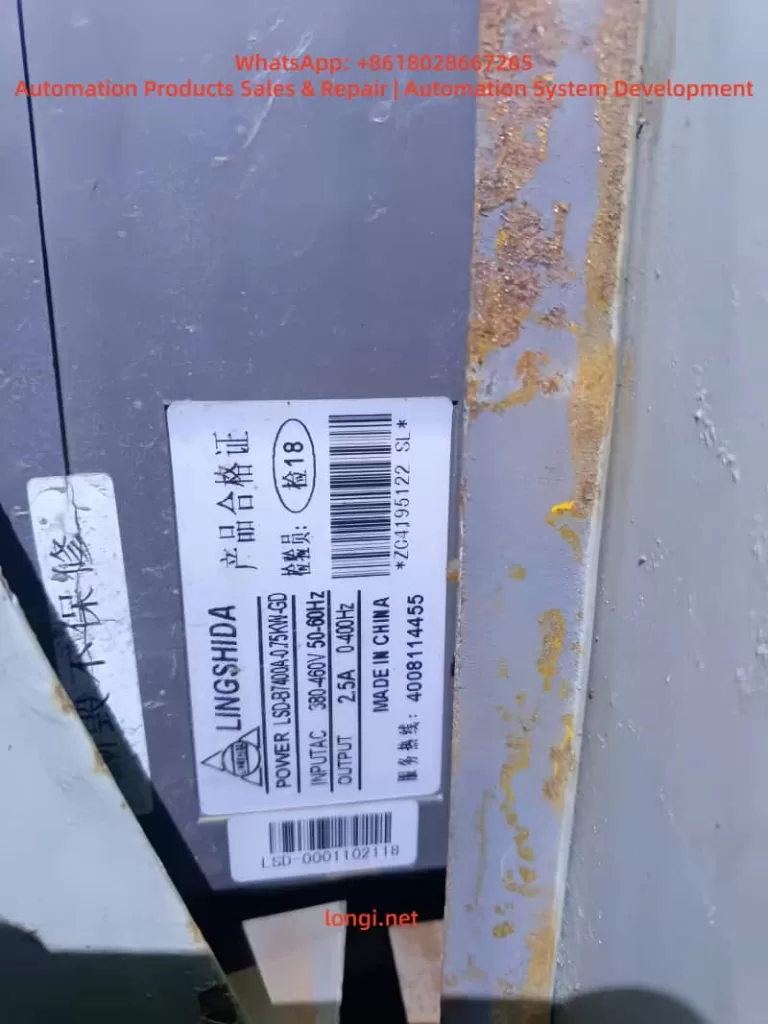
- Board-level Replacement: Contact LSD after-sales to purchase the main board (refer to part number LSD-000110218). Cost is approximately 200−500 depending on power rating (e.g., 1.5KW model).
Q12: What precautions are needed after replacing the main board?
A:
- Motor Parameter Auto-tuning must be performed again, especially in Vector Control mode.
- Restore user parameter backups.
- Verify that the firmware version matches the old board.
Part 4: Advanced Applications & Vector Control
Q13: What is the specific impact of an EEP fault on LSD-B7000 Vector Control mode?
A: Vector Control (Sensorless Vector Control) relies heavily on motor model parameters (e.g., Pr015 V/F curve, Pr017 Voltage, Pr016 Frequency) and auto-tuning data stored in the EEPROM. An EEP fault causes:
- Inability to perform auto-tuning.
- Slower torque response and reduced control precision (efficiency may drop by 10-20%).
- Inability to switch to Vector mode, forcing operation in V/F mode only.
Q14: Can an EEP fault be misreported as a communication error?
A: Yes. If the MODBUS address mapping table stored in the EEPROM is corrupted, the inverter may return “Illegal Data” or “Communication Timeout,” while the root cause is memory corruption rather than a physical line issue.
Part 5: Preventive Maintenance & Case Studies
Q15: How to prevent EEP faults?
A: Implementing the following maintenance strategies can reduce the failure rate by 70%:
- Regular Backups: Back up parameters regularly via the operator panel or MODBUS.
- Power Quality: Maintain THD (Total Harmonic Distortion) <5% and install surge protectors.
- Environmental Control: Use IP-rated cabinets, clean dust regularly, and install dehumidifiers/fans inside the control cabinet.
- Operational Standards: Avoid frequent power cuts; ensure stable power when modifying parameters.
- Firmware Management: Monitor official firmware updates but test in a non-production environment before upgrading.
Q16: What are common triggering scenarios in real-world cases?
A:
- Case 1 (Power Surge): Grid fluctuations in a factory caused voltage peaks damaging memory. Solution: Installed a line reactor.
- Case 2 (Humidity): Condensation in an HVAC system caused PCB corrosion. Solution: Cleaned the board and replaced the EEPROM.
- Case 3 (Natural Aging): After 5 years of use, the EEPROM write cycles were exhausted. Solution: Full board replacement restored function.
Q17: What are the typical repair costs and downtime for an EEP fault?
A:
- Software Reset: Downtime <30 mins, Cost $0.
- Environmental Rectification: Downtime 2-4 hours, Cost ~$100 (reactor, etc.).
- Main Board Replacement: Downtime 4-8 hours, Cost 200−500.
- Avoided Loss: Timely repair prevents production losses of over $10,000 in critical lines (CNC, conveyors).
Part 6: Appendix & Technical Data
Q18: Key parameter table related to EEP faults in LSD-B7000?
A:
| Parameter | Name | Default/Range | Notes |
|---|---|---|---|
| Pr088 | Restore Factory Settings | 0/1 | Set to 1 to reset all parameters (use with caution) |
| Pr016 | Motor Rated Frequency | 50/60Hz | Essential for Vector Control |
| Pr017 | Motor Rated Voltage | 380/400V | Essential for Vector Control |
| Pr041 | Acceleration Time | Load dependent | Affects start smoothness |
| Pr042 | Deceleration Time | Load dependent | Affects braking |
Q19: Where is the physical location of the EEPROM chip?
A: It is usually soldered onto the Main Control PCB. It is a small 8-pin IC (e.g., 24LC02/24LC512 series) located near the CPU.
Q20: What is the warranty policy for LSD-B7000?
A: According to Chapter 4 of the manual, the standard warranty period is typically 18 months. EEP faults caused by quality issues during this period are eligible for free repair or replacement. Damage caused by human error (e.g., incorrect high voltage input, water ingress) is not covered.
This guide is compiled based on LSD-B7000 official manuals and industry maintenance data for reference only. Always disconnect power and follow safety protocols before operation.