
Introduction to Variable Frequency Drives and the Err08 Fault
Variable frequency drives (VFDs), also known as inverters or adjustable speed drives, are essential components in modern industrial automation systems. They control the speed and torque of AC motors by varying the frequency and voltage of the power supplied to the motor. This technology enables energy savings, precise process control, and extended equipment life in applications ranging from conveyor systems to HVAC units. Delixi, a prominent Chinese manufacturer under the Delixi Group, has established itself as a reliable provider of electrical equipment, including the CDI-EM60 series VFDs. These drives are designed for general-purpose applications, offering robust performance in environments requiring vector control, V/F control, and high overload capacity.
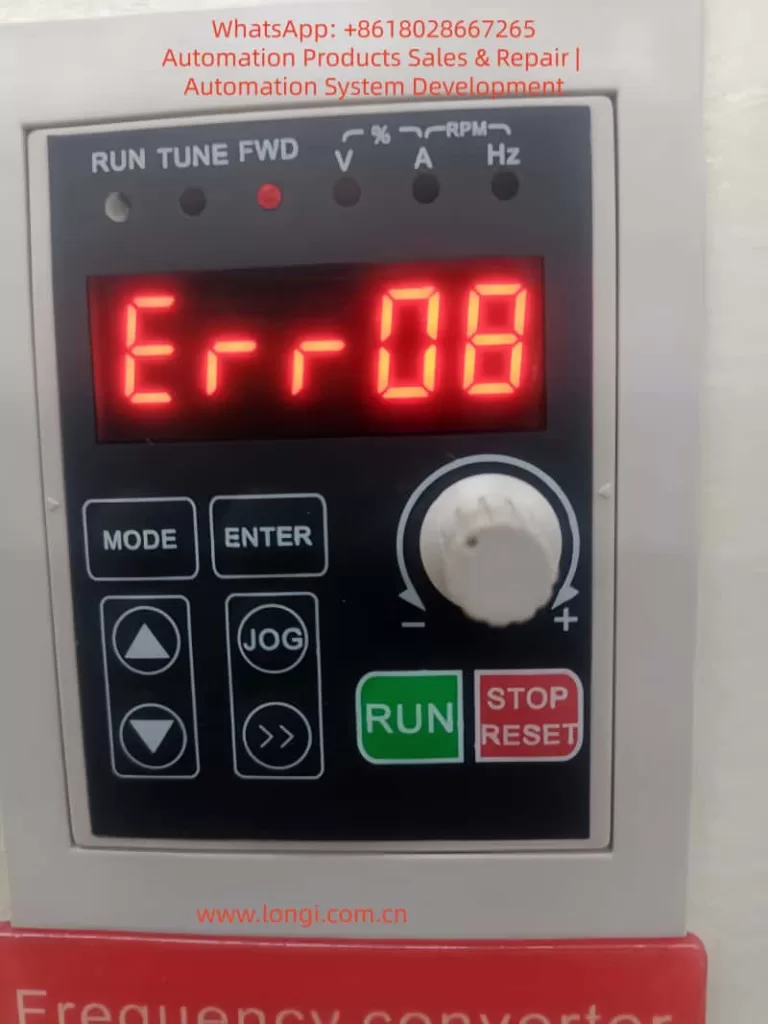
The CDI-EM60 series is particularly popular due to its compact design, user-friendly interface, and cost-effectiveness. However, like any electronic device, VFDs can encounter faults that disrupt operations. Fault codes are diagnostic tools displayed on the VFD’s panel to indicate specific issues, allowing technicians to quickly identify and resolve problems. Among these, the Err08 fault code is a common occurrence in the CDI-EM60 series, signaling an undervoltage condition in the DC bus during operation. This error can lead to unexpected shutdowns, reduced system efficiency, and potential damage if not addressed promptly.
Understanding Err08 is crucial for maintenance personnel, engineers, and system integrators working with Delixi inverters. This fault typically arises from power supply inconsistencies or internal circuit issues, and resolving it requires a systematic approach. In this comprehensive technical article, we delve into the meaning of Err08, its underlying causes, detailed troubleshooting steps, preventive strategies, and related advanced topics. Drawing from the official Delixi CDI-EM60 operation manual and industry best practices, this guide aims to equip readers with the knowledge to handle this fault effectively. Whether you’re dealing with a Delixi CDI-EM60G0R4S2 model or similar variants, this resource provides actionable insights to minimize downtime and optimize performance.
Undervoltage faults like Err08 are not unique to Delixi but are prevalent across VFD brands due to the sensitivity of power electronics to voltage fluctuations. In industrial settings, where power quality can vary due to grid instability or load demands, such errors account for a significant portion of VFD failures. According to industry reports, electrical supply issues contribute to over 30% of VFD downtime, making proactive fault management essential. This article emphasizes a logical, step-by-step methodology to diagnose and fix Err08, ensuring compliance with safety standards and enhancing system reliability. By the end, you’ll have a thorough understanding of how to tackle this issue, potentially saving thousands in repair costs and lost productivity.
Overview of the Delixi CDI-EM60 Series Variable Frequency Drives
The Delixi CDI-EM60 series represents a line of compact, high-performance VFDs tailored for single-phase and three-phase AC motor control. These drives support input voltages from 220V to 380V, with power ratings ranging from 0.4kW to 7.5kW, making them suitable for small to medium-sized applications. Key features include open-loop vector control (SVC) for precise torque management, V/F control for simple speed regulation, and a built-in PID controller for process automation. The series boasts a 150% overload capacity for 60 seconds and 180% for 3 seconds, allowing it to handle demanding loads like pumps, fans, and compressors.
Structurally, the CDI-EM60 incorporates a modular design with an integrated keypad for parameter setting and monitoring. The display panel shows real-time data such as output frequency, current, voltage, and fault codes in a clear LED format. Input terminals support analog signals (0-10V or 4-20mA), digital inputs for multi-speed control, and relay outputs for alarms. Communication options include RS485 Modbus protocol, enabling integration with PLCs and SCADA systems. The drive’s efficiency exceeds 95%, and it features built-in protections against overcurrent, overvoltage, overload, and short circuits.
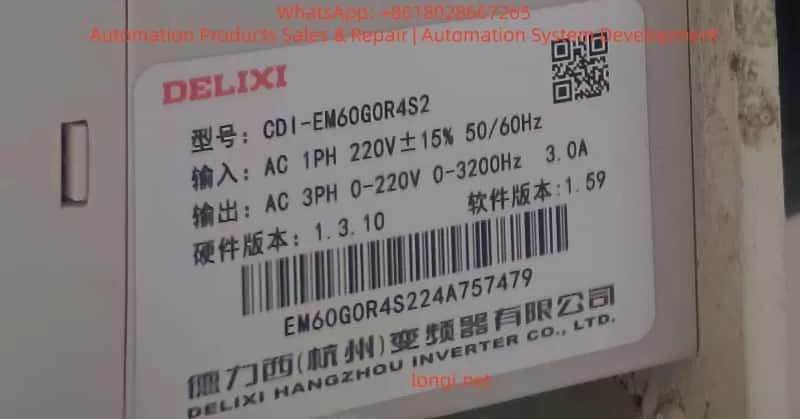
In terms of specifications, the CDI-EM60 operates in ambient temperatures from -10°C to 40°C, with IP20 protection against dust and moisture. Models are classified by voltage grades: S1 for single-phase 220V, S2/T2 for three-phase 220V/380V, and T4 for higher voltage applications. For instance, the CDI-EM60G0R4S2 model, as shown in user-provided images, is a 0.4kW single-phase 220V drive with a frequency range of 0-3200Hz and 3.0A output current. This model is commonly used in light industrial machinery, such as woodworking tools or small conveyor belts.
Applications of the CDI-EM60 span various sectors. In manufacturing, it regulates motor speeds for assembly lines, reducing energy consumption by matching output to demand. In water treatment, it controls pump speeds for efficient flow management. HVAC systems benefit from its soft-start capability, preventing mechanical stress on fans and blowers. The series’ reliability is enhanced by features like auto-tuning for motor parameters, which optimizes performance without manual calibration.
However, the CDI-EM60’s advanced electronics make it susceptible to environmental and electrical disturbances. Fault codes, including Err08, serve as the first line of defense, alerting users to anomalies. Proper installation, such as ensuring adequate ventilation and grounding, is vital to maximize the drive’s lifespan, typically rated at over 10 years with regular maintenance. By understanding the series’ capabilities, users can better contextualize faults like Err08 and implement targeted solutions.
Understanding Fault Codes in Delixi VFDs
Fault codes in Delixi VFDs are alphanumeric indicators that appear on the keypad display when the drive detects an abnormality. These codes are part of a self-diagnostic system that monitors parameters like current, voltage, temperature, and communication status. In the CDI-EM60 series, faults are prefixed with “Err” followed by a two-digit number, such as Err08. The display alternates between the code and related data, with LED indicators for run status, forward/reverse, and units (Hz, A, V).
The fault system categorizes errors into recoverable and non-recoverable types. Recoverable faults, like minor overloads, can be reset via the “STOP/RESET” button or external signals. Non-recoverable ones, such as hardware failures, require power cycling or professional intervention. The manual lists over 40 fault codes, from Err00 (no fault) to Err40 (buffer resistance fault), each with specific triggers and remedies.
When a fault occurs, the VFD halts output to protect the motor and itself, activating relay outputs for external alarms. Users can access fault history through parameters in group P6.0 (e.g., P6.0.00 for the most recent fault), which records the code, frequency, current, bus voltage, and timestamp. This data is invaluable for root-cause analysis.
General troubleshooting for any fault begins with safety: disconnect power, wait for capacitor discharge (typically 5-10 minutes), and use insulated tools. Consult the manual for code-specific advice, and avoid repeated resets without addressing the cause, as this can exacerbate damage. For Err08, the focus is on voltage-related parameters, but understanding the broader system helps differentiate it from similar codes like Err04 (overvoltage at constant speed).
Detailed Explanation of the Err08 Fault Code
The Err08 fault code in the Delixi CDI-EM60 series indicates an undervoltage condition in the main DC bus circuit during operation. This means the DC voltage, which is rectified from the AC input and used to generate the output waveform, has dropped below a predefined threshold. The VFD continuously monitors the bus voltage via internal sensors, and if it falls too low, the drive triggers Err08 to prevent unstable operation or component failure.
Detection thresholds vary by model grade:
- S1 series (single-phase 220V): 100V DC
- S2/T2 series (three-phase 220V/380V): 200V DC
- T4 series (higher voltage): 350V DC
For example, in the CDI-EM60G0R4S2 (S2 grade), Err08 activates if the bus voltage dips below 200V. This threshold accounts for normal fluctuations but flags significant drops that could impair inverter performance.
Undervoltage differs from overvoltage faults (Err04-Err06) in that it stems from insufficient power supply rather than excess. It typically occurs during running states, not startup, distinguishing it from power-on issues. If ignored, Err08 can lead to motor stalling, increased current draw, or harmonic distortions, potentially triggering secondary faults like Err01 (overcurrent).
Technically, the DC bus voltage is derived from the rectifier bridge, which converts AC to DC, smoothed by capacitors. Nominal bus voltage for a 220V input is around 310V DC (√2 * 220V), and for 380V, it’s about 537V DC. A drop below threshold might result from input voltage sags, where the peak AC doesn’t suffice to maintain the DC level. The VFD’s control algorithm relies on stable DC for PWM (pulse-width modulation) output, so undervoltage disrupts this, causing the fault.
In the context of the CDI-EM60, Err08 is logged in P6.0 parameters, allowing review of conditions at fault time. This code is recoverable after correction, but frequent occurrences signal systemic issues.
Common Causes of Err08 Undervoltage Fault
Err08 in Delixi CDI-EM60 VFDs arises from multiple factors affecting the power supply chain. Understanding these causes requires knowledge of electrical principles, as undervoltage impacts the rectifier and DC link.
- Poor Power Supply Connections: Loose or corroded terminals at the input (R, S, T) can increase resistance, causing voltage drops. For instance, a 0.1Ω resistance at 10A current drops 1V, but cumulative effects can push below threshold. Oxidation from humidity or vibration loosens screws, common in industrial environments.
- Input Voltage Outside Specified Range: The CDI-EM60 requires stable AC input (e.g., 220V ±15% for S2 models). Grid fluctuations, brownouts, or long cable runs (voltage drop = I²R) can reduce effective voltage. In rural or overloaded grids, peaks might not reach required levels, especially under heavy load.
- Momentary Power Interruptions: Brief outages (milliseconds to seconds) discharge DC capacitors without recharge, dropping bus voltage. This is prevalent in areas with unstable utilities or during switching of backup generators. The VFD’s ride-through capability is limited; if interruption exceeds hold-up time (typically 10-20ms), Err08 triggers.
- Abnormal Bus Voltage Display or Sensor Issues: Faulty internal voltage sensors or display circuits can misreport values, falsely triggering Err08. Though rare, EMI (electromagnetic interference) from nearby equipment can corrupt readings.
- Faulty Charging Resistor or Bridge Rectifier: The pre-charge circuit uses a resistor to limit inrush current to capacitors. If damaged (e.g., open circuit from overheating), it prevents proper charging. The rectifier bridge, converting AC to DC, might have diode failures due to surges, leading to incomplete rectification and low DC output.
- Capacitor Degradation: Electrolytic capacitors in the DC link age over time, losing capacitance and increasing ripple. This amplifies voltage dips under load. High temperatures accelerate degradation; for every 10°C rise above 40°C, lifespan halves.
- External Factors like Contactor Issues: If an input contactor chatters or fails to close fully, it interrupts power flow. In systems with multiple VFDs, shared bus issues or regenerative loads can indirectly cause undervoltage.
- Overloaded or Mismatched Power Supply: If the upstream transformer or generator is undersized, starting large loads draws excessive current, sagging voltage.
These causes interplay; for example, poor wiring exacerbates grid fluctuations. Diagnostic tools like oscilloscopes reveal waveforms, showing if it’s AC side (sinusoidal distortion) or DC side (excessive ripple).
Step-by-Step Troubleshooting Procedure for Err08
Troubleshooting Err08 requires a methodical, safety-first approach. Always follow lockout-tagout procedures, wear PPE, and use calibrated tools like digital multimeters (DMMs) and clamp meters.
Step 1: Initial Assessment and Fault Reset
- Note the display: Confirm Err08 and record parameters (P6.0.00-P6.0.02) for frequency, current, bus voltage at fault.
- Press STOP/RESET to attempt reset. If it clears but recurs, proceed; if not, power cycle after 5 minutes.
- Check environmental conditions: Ensure ambient temperature <40°C, no dust buildup on vents.
Step 2: Verify Input Power Supply
- Measure AC input voltage at terminals R, S, T with DMM (AC mode). For 220V models, it should be 187-253V; for 380V, 323-437V.
- Check phase balance: Voltage between phases <3% difference. Use a power quality analyzer for harmonics (THD <5%).
- Inspect upstream: Test at the source (panel or transformer) to identify drops from cabling (calculate expected drop using wire gauge and length).
Step 3: Inspect Wiring and Connections
- Visually check terminals for looseness, corrosion, or burn marks. Torque screws to manual specs (e.g., 1.2Nm for M4 terminals).
- Use continuity test on DMM to ensure no breaks in cables. Measure resistance (<0.1Ω per phase).
- Ground check: Verify PE terminal continuity to earth (<10Ω).
Step 4: Monitor DC Bus Voltage
- With power off, discharge capacitors (use resistor across + and -). Power on in no-load mode.
- Access bus voltage via parameter (e.g., d0.03 in monitoring group) or measure directly at P+ and P- (DC mode on DMM). Nominal: ~1.414 * AC RMS. If < threshold (e.g., 200V for S2), fault confirmed.
- Run at low frequency (10Hz) and observe for dips under load.
Step 5: Test Internal Components
- Check rectifier: With power off, test diodes in bridge (forward bias ~0.3-0.7V, reverse infinite). Replace if faulty.
- Inspect charging resistor: Measure resistance (typically 50-100Ω); if open or shorted, replace.
- Capacitor test: Use capacitance meter; values should match rating (e.g., 470µF). Look for bulging or leakage.
Step 6: Advanced Diagnostics
- Simulate conditions: Use a variac to vary input voltage and observe threshold.
- Check for interruptions: Install a voltage logger to capture transients.
- Parameter review: Ensure P0.0.03 (input voltage grade) matches hardware; adjust undervoltage protection if customizable (though fixed in CDI-EM60).
Step 7: Re-test and Verify
- After fixes, run in jog mode (low speed), then full operation. Monitor for 30 minutes.
- If persistent, consult Delixi support with fault logs.
This procedure typically resolves 80% of cases; complex issues may require oscilloscope analysis for ripple or EMI.
Preventive Maintenance to Avoid Err08 and Similar Faults
Prevention is key to avoiding Err08 in Delixi CDI-EM60 VFDs. Implement a quarterly maintenance schedule:
- Power Quality Management: Install surge protectors and voltage stabilizers. Use UPS for critical applications to handle interruptions.
- Wiring Best Practices: Use shielded cables, proper gauges (e.g., 2.5mm² for 0.4kW), and regular inspections.
- Environmental Controls: Ensure ventilation (min. 100mm clearance), clean filters, and control humidity (<90% RH).
- Component Monitoring: Track capacitor health via ESR meters; replace every 5-7 years.
- Parameter Optimization: Set auto-restart after faults (P6.1.03) but limit attempts to avoid cycling.
- Training and Documentation: Train staff on manual procedures; keep logs of voltage trends.
These measures reduce fault incidence by up to 50%.
Advanced Topics: Parameter Settings and System Integration
In advanced setups, Err08 relates to group P6 parameters. P6.1.00 enables phase loss protection, which can indirectly prevent voltage issues. For PLC integration, use Modbus to read fault registers (address 0x8000 for current fault). Adjust ride-through via P3.1.00 (timing functions) to extend tolerance. In vector mode, tune P1.0.00 (motor parameters) to minimize load-induced dips.
Case Studies and Real-World Examples
Case 1: In a textile factory, a CDI-EM60 drove a spindle motor. Err08 occurred intermittently due to grid sags. Solution: Installed a voltage regulator, resolving issues.
Case 2: A pump station saw Err08 from loose terminals after vibration. Tightening and adding lock washers fixed it.
Case 3: Degraded capacitors in an old unit caused chronic Err08; replacement restored operation.
Conclusion
Err08 in the Delixi CDI-EM60 series signals undervoltage, a preventable fault with proper diagnostics. By following this guide, users can resolve issues efficiently, ensuring reliable VFD performance. Always prioritize safety and consult experts for complex repairs. With proactive maintenance, these drives deliver long-term value in industrial applications.