
In modern industrial automation systems, the Variable Frequency Drive (VFD) is one of the core components of motor control systems. With the increasing requirements for energy efficiency, precise control, and automation levels in industrial equipment, VFDs have been widely used in fans, pumps, conveying equipment, compressors, and various production lines.
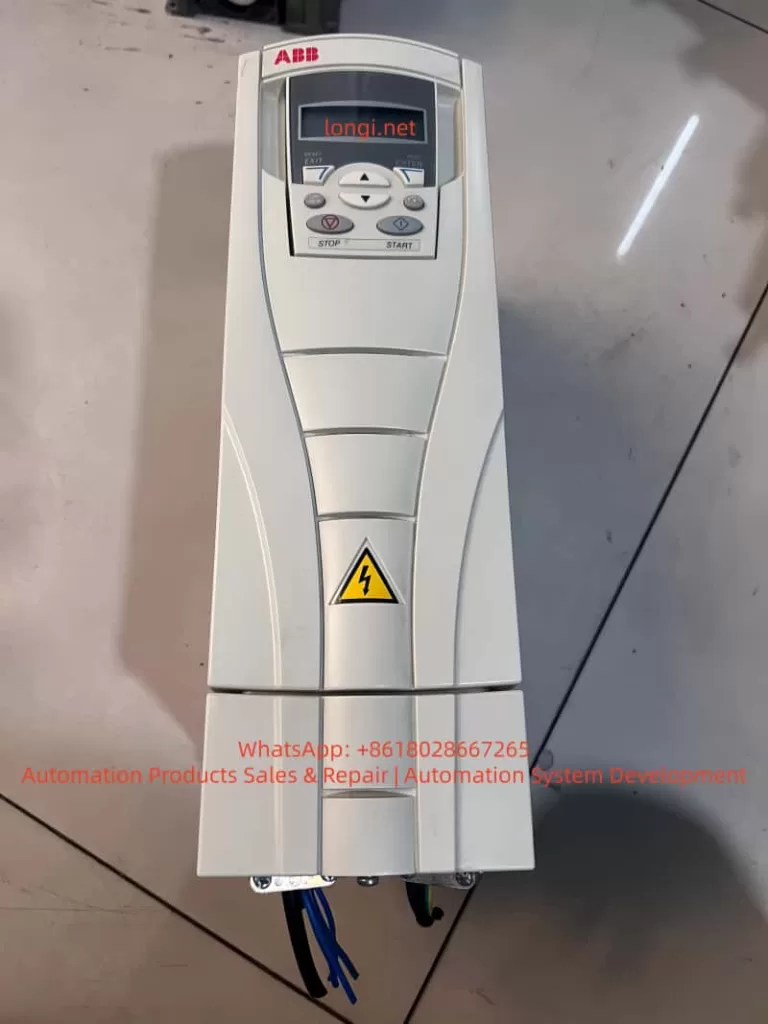
As a new-generation high-performance drive product from ABB, the ABB ACS880 inverter holds a very high market share in the global industrial sector. This series of drives is widely applied in industries such as steel, mining, chemicals, textiles, papermaking, food processing, and new energy due to its high reliability, modular design, and powerful control functions.
However, during long-term operation, any industrial equipment may experience alarms or faults. For maintenance engineers, quickly identifying the alarm codes of the inverter and determining the fault causes are crucial for restoring production.
This article systematically organizes 30 common alarm codes of the ACS880 inverter and provides detailed explanations of their meanings, common causes, and troubleshooting methods, serving as a practical technical reference guide for field engineers.

I. Classification of ABB ACS880 Alarm Codes
The alarm system of the ACS880 is mainly divided into two categories:
1. Warning
A warning indicates that the system operating conditions are not met, but the equipment itself is not damaged.
Characteristics:
- The equipment can continue to operate or remain in standby mode.
- Control conditions need to be checked.
Examples:
- Run Enable Missing
- Emergency Stop
2. Fault
A fault indicates that the system has detected an abnormal state, and the drive must stop operating.
Characteristics:
- The motor stops.
- Resetting is required before operation can resume.
Examples:
- Overcurrent
- Overvoltage
- Motor overload
II. List of Common ACS880 Alarm Codes
Below is a list of the 30 most common ACS880 alarm codes.
| Code | Alarm Name |
|---|---|
| AE50 | Emergency Stop |
| AE5B | Run Enable Missing |
| F0001 | Overcurrent |
| F0002 | DC Bus Overvoltage |
| F0003 | DC Bus Undervoltage |
| F0004 | Drive Overtemperature |
| F0005 | Motor Overtemperature |
| F0006 | Motor Stall |
| F0007 | Earth Fault |
| F0008 | Short Circuit |
| F0009 | Communication Fault |
| F0010 | Encoder Fault |
| F0011 | Parameter Error |
| F0012 | Brake Resistor Overload |
| F0013 | Motor Phase Loss |
| F0014 | Supply Phase Loss |
| F0015 | Speed Feedback Loss |
| F0016 | STO Active |
| F0017 | Current Measurement Fault |
| F0018 | Memory Fault |
| F0019 | Control Board Fault |
| F0020 | Cooling Fan Fault |
| F0021 | Fieldbus Communication Loss |
| F0022 | Torque Limit |
| F0023 | Speed Limit |
| F0024 | Internal Hardware Fault |
| F0025 | DC Bus Ripple |
| F0026 | Parameter Memory Error |
| F0027 | AI Signal Loss |
| F0028 | DI Configuration Error |
The following provides a technical analysis of each of these alarms.
III. Detailed Explanations of Common ACS880 Alarm Codes
1. AE50 – Emergency Stop
Meaning:
The drive has received an emergency stop signal.
Common Causes:
- The emergency stop button is pressed.
- The safety relay is disconnected.
- The PLC safety output is triggered.
Solutions:
- Check the emergency stop circuit.
- Check the safety relay.
- Check the STO signal.
2. AE5B – Run Enable Missing
Meaning:
No run enable signal is received.
Common Causes:
- DI1 is not connected to 24V.
- The PLC has not sent a Run Enable signal.
- The safety circuit is disconnected.
Solutions:
Check the digital input terminals.
3. F0001 – Overcurrent
Meaning:
The motor current exceeds the allowable range.
Common Causes:
- Motor stall.
- Mechanical jamming.
- Too short acceleration time.
Solutions:
Check the load and parameter settings.
4. F0002 – DC Bus Overvoltage
Meaning:
The DC bus voltage is too high.
Common Causes:
- Too fast deceleration.
- Excessive regenerative energy.
Solutions:
- Increase the deceleration time.
- Install a brake resistor.
5. F0003 – DC Bus Undervoltage
Meaning:
The bus voltage is too low.
Common Causes:
- Low grid voltage.
- Poor power supply contact.
Solutions:
Check the input power supply.
6. F0004 – Drive Overtemperature
Meaning:
The internal temperature of the drive is too high.
Causes:
- Poor heat dissipation.
- Fan damage.
- High ambient temperature.
7. F0005 – Motor Overtemperature
Meaning:
The motor temperature exceeds the allowable range.
Causes:
- Overload.
- Poor cooling.
8. F0006 – Motor Stall
Meaning:
The motor is stalled.
Causes:
- Excessive load.
- Mechanical jamming.
9. F0007 – Earth Fault
Meaning:
The motor or cable has a ground leakage.
Causes:
- Motor insulation damage.
- Cable damage.
10. F0008 – Short Circuit
Meaning:
Output short circuit.
Causes:
- Motor winding short circuit.
- Cable short circuit.
IV. Communication and Encoder Faults
11. F0009 – Communication Fault
Meaning:
Control system communication failure.
Causes:
- PLC communication disconnection.
- Modbus failure.
12. F0010 – Encoder Fault
Meaning:
Encoder signal abnormality.
Causes:
- Encoder damage.
- Wiring error.
13. F0011 – Parameter Error
Meaning:
Parameter configuration error.
Causes:
- Parameter out of range.
- Parameter conflict.
V. Hardware and System Faults
14. F0012 – Brake Resistor Overload
Brake resistor overload.
15. F0013 – Motor Phase Loss
Motor phase loss.
16. F0014 – Supply Phase Loss
Input power phase loss.
17. F0015 – Speed Feedback Loss
Speed feedback signal loss.
18. F0016 – STO Active
Safe torque-off activated.
19. F0017 – Current Measurement Fault
Current measurement abnormality.
20. F0018 – Memory Fault
Internal memory error.
VI. Control Board and Hardware Issues
21. F0019 – Control Board Fault
Control board failure.
22. F0020 – Cooling Fan Fault
Fan damage.
23. F0021 – Fieldbus Communication Loss
Fieldbus communication interruption.
24. F0022 – Torque Limit
Torque limit reached.
25. F0023 – Speed Limit
Speed limit reached.
VII. System Parameter and Signal Faults
26. F0024 – Internal Hardware Fault
Internal hardware abnormality.
27. F0025 – DC Bus Ripple
Excessive DC bus ripple.
28. F0026 – Parameter Memory Error
Parameter storage error.
29. F0027 – AI Signal Loss
Analog input signal loss.
30. F0028 – DI Configuration Error
Digital input configuration error.
VIII. General Steps for ACS880 Fault Troubleshooting
When performing on-site maintenance, the following steps can be followed for inspection:
Step 1
Check the alarm code.
Step 2
Check the control circuit.
Step 3
Check the motor and load.
Step 4
Check the input power supply.
Step 5
Check the drive hardware.
IX. Maintenance Recommendations for Inverters
To reduce the occurrence of faults, the following maintenance measures can be taken:
- Regularly clean the heat sink.
- Check cable connections.
- Back up parameters.
- Regularly test motor insulation.
Conclusion
The ABB ACS880 inverter, as a core component in industrial automation systems, provides important safety protection for equipment operation through its alarm system. Correctly understanding the meanings of alarm codes and mastering systematic troubleshooting methods can significantly improve equipment maintenance efficiency and reduce production downtime.
For maintenance engineers, being familiar with these common alarm codes not only enables quick problem localization but also allows for the proactive prevention of potential faults during equipment maintenance and system design.
By establishing standardized maintenance procedures and a technical data library, industrial equipment can operate stably for a long time, thereby improving production efficiency and reducing maintenance costs.