
I. Introduction
In the field of plastic injection molding equipment, the application of servo oil pump technology has become a core indicator for measuring the energy efficiency rating and dynamic response performance of injection molding machines. Donghua Machinery Co., Ltd., as a key enterprise in the domestic injection molding machine industry, utilizes the CM-SVC series servo drives as a dedicated product developed specifically for servo oil pump driving. Based on the technical content of the “CM-SVC Servo Drive Operation Guide Manual” and combined with the operational characteristics of Donghua Machinery injection molding machines in actual production, this user guide is compiled to assist field engineers, equipment maintenance personnel, and process debugging personnel in better mastering the entire process of installation, debugging, parameter optimization, and troubleshooting of this servo system.
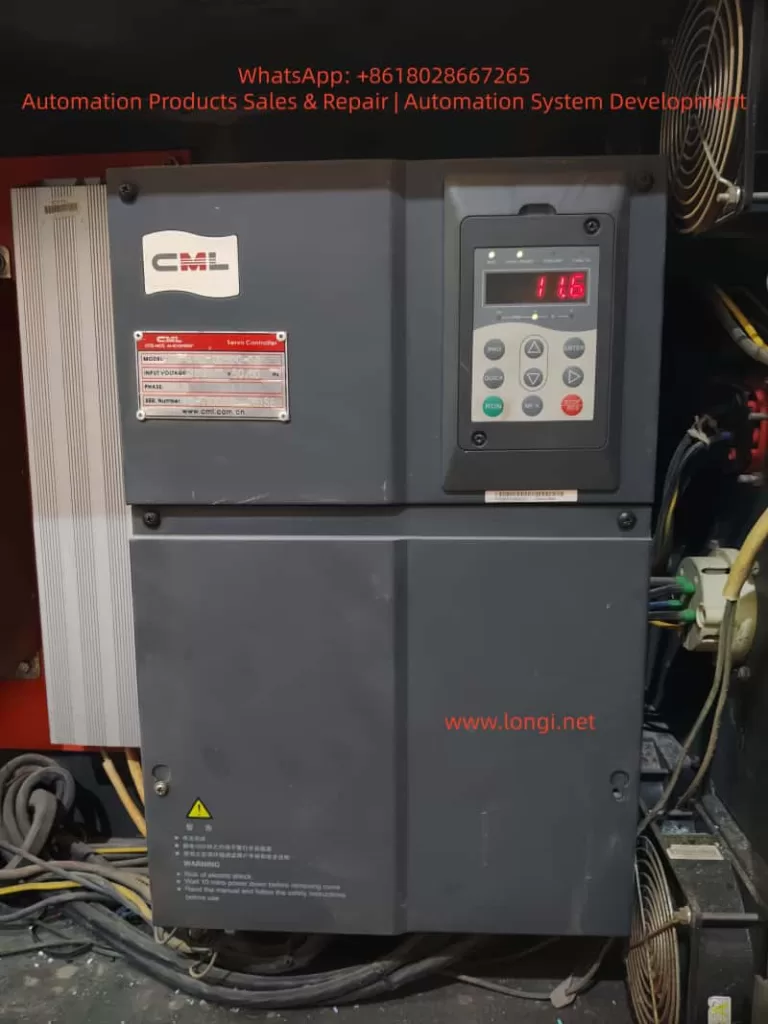
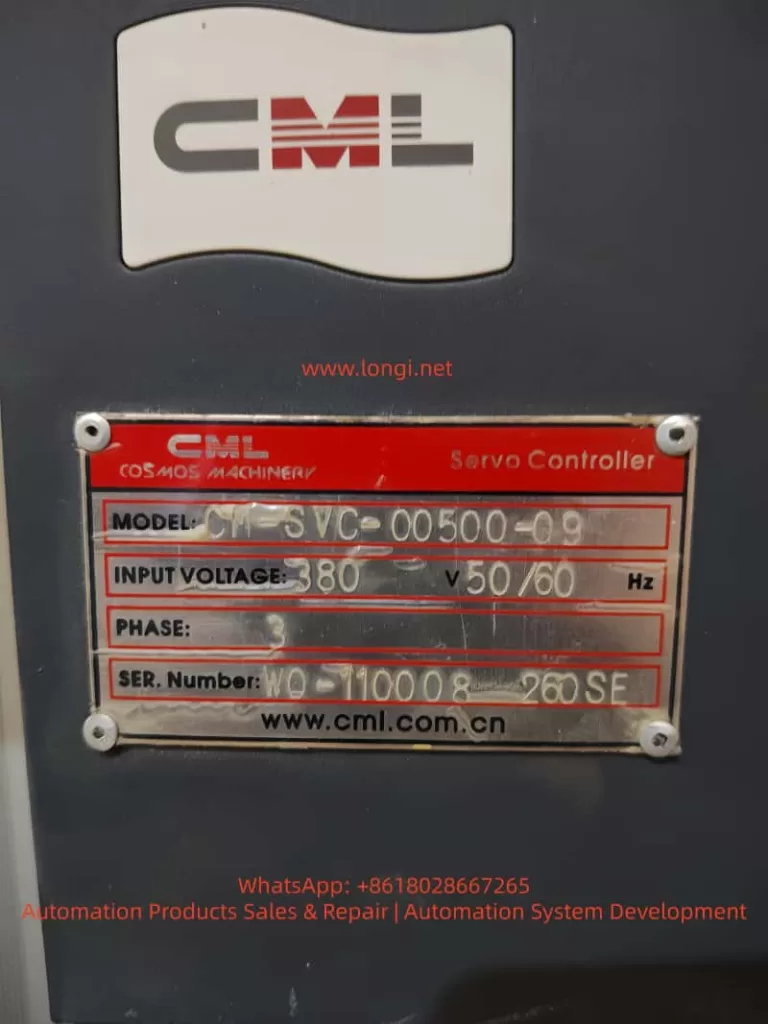
II. Technical Positioning of CM-SVC Servo Drive and Its Adaptability to Donghua Machinery
The CM-SVC series servo drives have a rated current coverage ranging from 15A to 300A and are compatible with three-phase 380V power supplies, capable of stable operation within a voltage fluctuation range of -15% to +20%. This series of drives is specifically designed for servo oil pump control scenarios and incorporates a built-in oil pressure closed-loop control algorithm, CAN communication interface, dual analog input channels, and multi-group PID parameter switching functionality, making it highly compatible with Donghua Machinery’s commonly used hydraulic system architecture of quantitative pump + servo motor + pressure sensor.
Donghua Machinery’s injection molding machine product line covers a clamping force range from 80 tons to over 3000 tons, with its hydraulic systems generally adopting a “flow-pressure dual closed-loop” control strategy. Under this system, the CM-SVC drive can operate in two typical oil pressure control modes:
- Mode 2 (A3-00=2): Analog input method. The AI1 channel receives the oil pressure command (0~10V) from the controller (computer), the AI2 channel receives the flow command (0~10V), and the AI3 channel receives the actual feedback signal from the pressure sensor. This method is suitable for most standard models, offering fast signal response and strong anti-interference capability.
- Mode 1 (A3-00=1): CAN communication input method. Oil pressure and flow commands are transmitted through the CAN bus, with AI3 still serving as the pressure feedback channel. This method is more suitable for large or high-speed models, reducing attenuation and interference of analog signals during long-distance transmission.
Understanding the differences between these two operating modes is fundamental to correctly using this manual. The following sections will provide detailed explanations centered around actual installation, debugging, and operational maintenance.
III. Key Points for Mechanical Installation and Suggestions for Donghua Electrical Cabinet Layout
3.1 Installation Environment Requirements
According to the content in Chapter 1 and Chapter 3 of the manual, the CM-SVC servo drive must be installed under the following environmental conditions:
- Ambient temperature: -10°C to +40°C. If the temperature exceeds 40°C but does not exceed 50°C, derating must be applied.
- Altitude: Below 1000m. Derating is also required if this altitude is exceeded.
- Relative humidity: Less than 95%, non-condensing.
- Absence of corrosive gases, flammable gases, oil mist, and conductive dust.
In Donghua Machinery’s actual production workshops, injection molding machines are usually arranged in a centralized manner, and the ambient temperature in summer may approach the upper limit of 40°C. Therefore, the following points should be noted during electrical cabinet design:
- Heat Dissipation Space: For drives with power ratings of CM-SVC-00400 and above, when installed vertically, the clear distance A between two sets of drives above and below should be greater than 50mm, and heat-insulating deflectors should be added. For models CM-SVC-00700 and above, A should be greater than 300mm.
- Metal Dust Protection: During plastic processing, fine dust may be generated, especially from materials with fillers (such as glass fiber, calcium carbonate). The manual specifically points out that for applications involving metal dust, it is recommended to adopt an external installation method for the radiator. This means extending the heat dissipation part of the drive outside the electrical cabinet while keeping the cabinet sealed.
- Vibration Isolation: The manual requires that vibration should not exceed 0.6G and specifically reminds to keep away from punching machines and other equipment. For large injection molding machines, although the impact from the injection unit and clamping unit is not significant, the drive should not be directly installed on the oil tank cover or frame but should be fixed on an independent electrical cabinet backplate welded with reinforcing ribs.
3.2 Lower Cover Removal and Wiring Space
Figure 3-2 in the manual illustrates the removal method of the metal shell lower cover. During actual wiring, it is recommended to first remove the lower cover, complete the main circuit and control circuit wiring, and then reinstall the cover. For models CM-SVC-01400 and above, the main circuit copper bar terminals are relatively large, and sufficient wrench space (recommended not less than 150mm) should be reserved.
IV. Engineering Guidance for Electrical Wiring
4.1 Key Points for Main Circuit Wiring
Section 3.2.4 of the manual details the terminal definitions of the main circuit and wiring precautions. Combined with Donghua Machinery’s typical configuration, the following key points are emphasized:
- Input Power R, S, T: There is no phase sequence requirement, but it must be connected through a circuit breaker and contactor. Table 3-1 in the manual provides recommended values for circuit breakers, contactors, and wire cross-sections for each model. For example, for CM-SVC-00500, a 125A circuit breaker, 100A contactor, 16mm² input wire, and 10mm² output wire are recommended. On-site wiring must not be lower than this standard.
- External DC Reactor: For models CM-SVC-01400 and above, an external DC reactor is标配(中文应为“标配”意思是 standard configuration,这里按原文保留英文不译更好,即标配用英文“standard”表达更准确,以下按此处理) standard. During installation, the short-circuit copper bar between P and (+) terminals must be removed, and the reactor must be connected in series between P and (+). This is a common error-prone point. If the copper bar is not removed, the reactor is bypassed, leading to increased input harmonics, reduced power factor, and potentially damaging the rectifier module in severe cases.
- Brake Resistor Wiring: For models CM-SVC-00500 and below with built-in brake units, the brake resistor is connected between (+) and PB. The resistance value must not be less than the recommended value in Table 2-6 of the manual; otherwise, the brake unit may be burned. For example, for CM-SVC-00300, the recommended resistance value is ≥32Ω, with a power of ≥1000W. The wiring distance should be less than 5m, and twisted-pair wires should be used.
- Output Side U, V, W: It is strictly prohibited to connect capacitors or surge absorbers. When the motor cable length exceeds 100m, an AC output reactor must be added. Donghua Machinery’s large models (such as those above 1300 tons) sometimes place the electrical control cabinet and oil pump motor separately, with distances possibly exceeding 50m. Although not reaching 100m, it is still recommended to evaluate whether to add a reactor based on the actual site conditions to reduce leakage current and motor insulation stress.
4.2 Key Points for Control Circuit Wiring
The control terminals serve as the bridge between the servo drive and the injection molding machine controller (computer). Table 3-3 in the manual provides a detailed description of terminal functions. The following lists the most commonly used wiring schemes:
- +10V-GND: Provides 10V power externally, with a maximum of 10mA, for connecting external potentiometers (1kΩ~5kΩ). In analog input mode, potentiometers are generally not used; instead, a 0~10V signal is directly output by the controller.
- AI1-GND: Default pressure setting. In Mode 2, it receives the oil pressure command signal output by the controller.
- AI2-GND: Default flow setting. In Mode 2, it receives the flow command signal output by the controller.
- AI3-GND: Pressure sensor feedback signal. Shielded twisted-pair wires must be used, with the shield grounded at the drive side. The sensor is usually of a four-wire system (power +, power -, signal +, signal -), with signal + connected to AI3 and signal – connected to GND.
- +24V-COM: Provides 24V power externally, with a maximum of 200mA. It is used for dry contact input of DI terminals.
- DI1-COM: Digital input 1, with the factory default function being forward rotation (FWD), i.e., the oil pump enable signal. Donghua Machinery’s controller usually outputs a passive contact signal connected between DI1 and COM.
- DI4-COM: Default function is fault reset (RESET), connected to the reset output of the controller.
- T/A1-T/C1: Relay output, with the default function being fault output. When the drive experiences a fault, this relay operates, providing a switch signal to the controller for shutdown protection.
Section 3.2.5 of the manual also provides solutions when the analog input terminals are interfered with: use shielded cables, keep the wiring distance within 20m, and add filter capacitors and ferrite cores if necessary. At the injection molding machine site, there are many electromagnetic interference sources such as frequency converters, contactors, and relays, making these measures very necessary.
V. Detailed Explanation of Parameter Setting and Debugging Process
5.1 Motor Parameter Tuning (Motor Identification)
This is a prerequisite for the normal operation of the servo system. Chapter 7 of the manual provides detailed tuning steps. At Donghua Machinery’s site, the following sequence should be followed:
- Correctly input the motor nameplate parameters: F1-00 (motor type, select 2 for permanent magnet synchronous), F1-01 (rated power), F1-02 (rated voltage), F1-03 (rated current), F1-04 (rated frequency), F1-05 (rated speed).
- Set A1-04 (resolver pole pairs), usually 1 pair or 2 pairs, as provided by the motor manufacturer.
- Set A3-00=0 (non-oil pressure control mode), F0-02=0 (operation panel control).
- If the back EMF (F1-15) is known, perform static tuning (F1-16=1). The motor can be loaded (not disconnected from the oil pump), but it is recommended to open the relief valve to allow the motor to operate under no-load or light-load conditions.
- If the back EMF is unknown, dynamic tuning (F1-16=2) must be performed. At this time, the motor must be disconnected from the load (i.e., the motor shaft disconnected from the oil pump); otherwise, the tuning results will be inaccurate, affecting subsequent speed control and pressure stability.
During tuning, if ERR43 (encoder fault) occurs, check the encoder wiring and A1-04 pole pair setting. After successful tuning, parameters such as F1-10 to F1-15 and A1-02 will be automatically filled in.
5.2 Oil Pressure Control Mode Switching and Automatic Parameter Setting
When switching from non-oil pressure mode (A3-00=0) to oil pressure mode (A3-00=1 or 2), the parameters listed in Table 7-4 of the manual will be automatically set. This means that users do not need to manually modify parameters such as F0-01 (control mode), F0-02 (command source), F4-00~F4-04 (terminal functions), as the system will automatically configure them to recommended values.
However, it should be noted: after automatic setting, if the user manually modifies these parameters again and wishes to retain them, their rationality must be confirmed. For example, F0-17 (acceleration time 1) and F0-18 (deceleration time 1) will be set to 0.0s. This is because in oil pressure control mode, acceleration and deceleration are actually determined by the oil pressure PID and flow command, rather than traditional acceleration and deceleration times. If users do not understand this, they may mistakenly believe that the parameters are lost.
5.3 Core Process Parameter Setting
The following parameters directly affect the action quality of the injection molding machine and need to be adjusted based on the actual mold and process:
- A3-01 (maximum speed): Corresponds to the motor speed when the flow command is 100%. It is recommended to be set within 140% of the motor’s rated speed. For example, if the rated speed is 1500rpm, the maximum speed can be set to 2100rpm. After exceeding 150% of the rated speed, the motor torque decreases sharply, which is unfavorable for pressure holding.
- A3-02 (system oil pressure): The highest working pressure set for the injection molding machine, in kgf/cm². For example, 175kgf/cm² (approximately 17.2MPa).
- A3-03 (maximum oil pressure): The range of the pressure sensor, which should be consistent with the sensor’s nominal value. For example, if the sensor range is 250kgf/cm² (corresponding to 0~10V output), then A3-03=250.0.
- A3-04 (oil pressure command rise time): Filters the oil pressure command signal, in ms. A smaller value results in faster response, but too small a value may cause pressure overshoot. It is generally set to 20~50ms.
- A3-05~A3-07 (first group of PID): Proportional gain Kp, integral time Ti, and derivative time Td. This is the most commonly used set of PID parameters. Increasing Kp or decreasing Ti can improve response speed, but excessive values may cause oscillation. Donghua Machinery’s typical value range: Kp=150~300, Ti=0.05~0.20s, Td is generally set to 0 or a very small value.
- A3-08 (maximum reverse speed): The maximum reverse speed during pressure relief, in percentage of the maximum speed. For example, if set to 50%, the reverse speed does not exceed half of the maximum speed. Reverse rotation is used for rapid pressure relief, but excessive values may cause oil pump reverse rotation noise and even damage the oil pump.
- A3-09 (bottom flow): Minimum flow setting, as a percentage of the maximum speed. It is used to overcome internal leakage of the oil pump and prevent air from entering the oil circuit. It is generally set to 0.5%~3%.
- A3-10 (bottom pressure): Minimum pressure setting, in kgf/cm². It is also used to maintain positive pressure in the oil circuit and is generally set to 0.5~2.0kgf/cm².
5.4 Multi-group PID Switching Logic
The manual provides four groups of oil pressure PID parameters, which can be switched through the digital state combination of DI2 and DI3. Table 7-2 shows the combination relationship. During the actual injection molding process, different DI combinations can be output by the controller to switch PID groups based on different requirements for pressure response in different actions (such as rapid injection, pressure holding, plasticizing, and cooling). For example:
- Rapid injection stage: Fast response is required, so the first group with larger Kp and smaller Ti can be selected.
- Pressure holding stage: Good stability and no overshoot are required, so the second or third group with moderate Kp and larger Ti can be selected.
This function requires the controller to support multiple DO outputs and to perform segmented PID scheduling in the program.
5.5 AI Zero-drift Automatic Calibration
Zero-drift inevitably exists in pressure sensor and controller-output analog signals. The manual provides a very practical function: set A3-20 to 1, and the drive will automatically detect the zero-drift values of AI1, AI2, and AI3 and write them to F4-18, F4-23, and F4-28 (minimum input values). When performing this function, ensure that all analog input signals are 0 (i.e., no pressure command, no flow command, and the pressure sensor is at zero pressure). After calibration, A3-20 automatically reverts to 0.
VI. Fault Diagnosis and Rapid Handling
Chapter 9 of the manual lists 23 fault codes and corresponding handling countermeasures. The following are the most common types of faults and handling experiences at Donghua Machinery’s site:
- ERR02~ERR04 (overcurrent): Common during acceleration, deceleration, or constant speed processes. First, check whether the motor parameters are accurate, especially F1-03 rated current and F1-15 back EMF. Second, check whether the acceleration and deceleration times are too short. For oil pressure control mode, check whether the A3-05~A3-07 PID parameters are too large, causing oscillation.
- ERR05~ERR07 (overvoltage): Common during deceleration or pressure relief processes. The reason is that the motor’s regenerative energy cannot be consumed by the brake resistor. Check whether the resistance value and power of the brake resistor comply with Table 2-6, and whether the brake unit is working properly. For large inertia systems (such as large injection molding machines), it may be necessary to increase the brake resistor power or use multiple brake units in parallel.
- ERR12 (input phase loss): Only models CM-SVC-00350 and above have this protection. Check whether the input power R, S, T is phase-missing and whether the circuit breaker and contactor contacts are in good condition.
- ERR13 (output phase loss): Check whether the connection from the drive output U, V, W to the motor is disconnected or has poor contact.
- ERR14 (module overheating): Check whether the fan is running, whether the air duct is blocked, whether the carrier frequency F0-15 is set too high (recommended 4~8kHz), and whether the ambient temperature is too high.
- ERR42 (CAN communication fault): Occurs under Mode 1 or Mode 3. Check the CAN bus wiring (CANH, CANL) for open circuit or short circuit, whether the terminal resistance matches (120Ω), and whether the communication address A2-01 and baud rate A2-00 are consistent with the controller.
- ERR43 (encoder fault): Occurs during tuning or operation. Check the encoder (resolver) wiring, confirm the A1-04 pole pairs, and check whether the PG card is properly inserted.
- ERR44 (excessive speed deviation): The deviation between the actual motor speed and the command speed exceeds the F9-14 set value and lasts longer than F9-15. Common causes include motor blockage, encoder fault, inaccurate motor parameters, and too low torque upper limit F2-10 setting.
VII. Daily Maintenance and Replacement of Vulnerable Parts
Section 2.7 of the manual provides detailed requirements for maintenance and upkeep. For Donghua Machinery users, the following regular maintenance plan is recommended:
- Daily inspection: Check whether the motor operation sound is abnormal, whether the vibration increases, whether the cooling fan runs normally, and whether the current and voltage displayed on the drive panel are within the normal range.
- Quarterly cleaning: Use a vacuum cleaner or compressed air (dry, low pressure) to clean the dust accumulated on the drive air inlet, heat sink, and fan. For workshops with high dust levels, this should be shortened to once a month.
- Fan replacement every two years: The manual indicates that the fan life is 2~3 years. When the fan makes abnormal noise or the speed decreases, it should be replaced immediately.
- Electrolytic capacitor inspection every four years: The life is 4~5 years. Check for electrolyte leakage and whether the safety valve is raised. If necessary, measure the electrostatic capacitance and insulation resistance.
- Long-term storage: If the drive is stored for more than 2 years, it must be powered on once. The power-on time should be at least 5 hours, and the voltage should be slowly increased to the rated value using a voltage regulator to restore the performance of the electrolytic capacitors.
VIII. Summary
The CM-SVC servo drive is a powerful drive product dedicated to servo oil pump control for injection molding machines. This article provides an engineering interpretation of the key content in the manual, combining the actual application scenarios of Donghua Machinery injection molding machines, from mechanical installation, electrical wiring, parameter debugging, fault handling, to daily maintenance.
The key to mastering this user guide lies in understanding three aspects: first, motor parameter tuning is the foundation and must be accurately performed; second, oil pressure PID adjustment is the soul and needs to be optimized in segments based on the process actions; third, fault codes are clues and should be judged in combination with the manual flowchart and actual measurement data on site.
It is hoped that this article can help field engineers reduce debugging time, lower fault rates, extend equipment life, and enable the CM-SVC servo drive to deliver optimal performance on Donghua Machinery’s injection molding machines.