
I. Introduction
In the field of industrial automation, the Schneider Electric ATV71 series inverters are widely used in motor drive applications such as fans, pumps, conveyor lines, and machine tools due to their high reliability, rich vector control functions, and flexible communication expandability. However, during long-term operation, the SCF3 (ground short circuit) fault is one of the most common causes of inverter shutdowns in ATV71. According to a 2023 fault statistics report from an inverter manufacturer, SCF3 accounts for 28% of all ATV71 faults, primarily occurring in outdoor equipment, humid environments, and multi-motor parallel systems.
The essence of the SCF3 fault is that the ground leakage current on the inverter’s output side exceeds the threshold. If not promptly addressed, it can lead to motor winding burnout, cable fires, and even electric shock accidents. This article will systematically analyze the handling logic of the SCF3 fault from the perspectives of fault principles, cause analysis, troubleshooting steps, solutions, and preventive maintenance, providing electrical maintenance personnel with a practical technical guide.
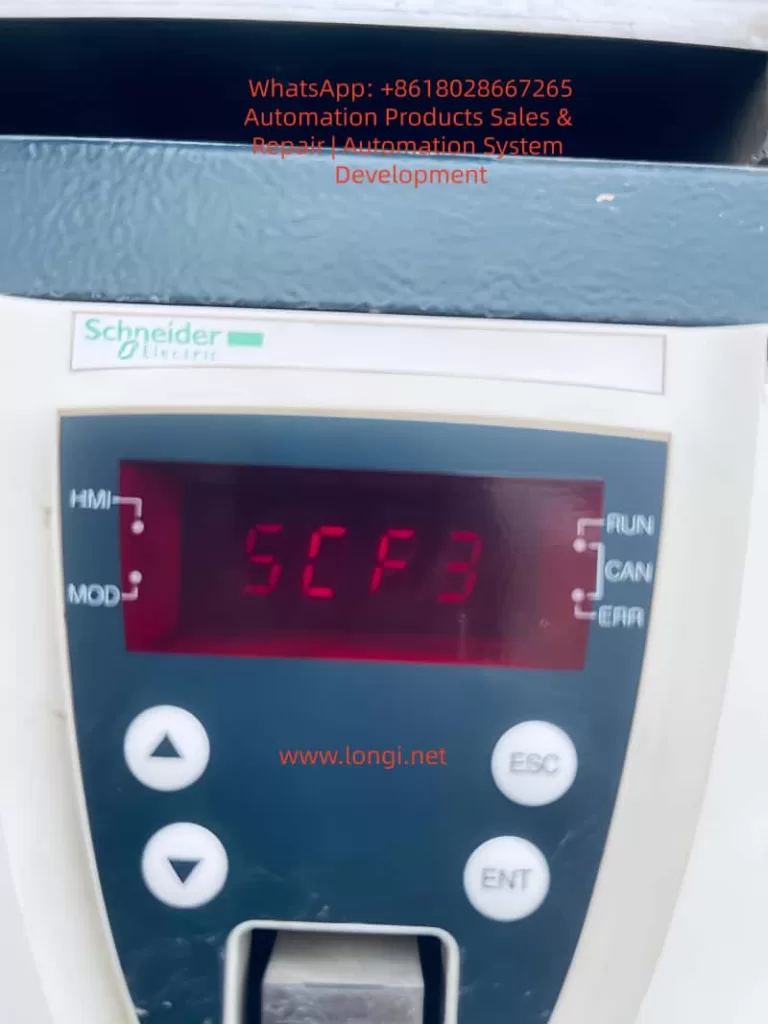
II. Definition and Detection Principle of SCF3 Fault
1. Fault Code Meaning
According to the ATV71 inverter’s “Fault Code Table,” SCF3 corresponds to “Ground Short Circuit.” The trigger condition is that the zero-sequence current (ground leakage current) on the output side exceeds 5%-10% of the inverter’s rated current (the specific threshold varies depending on the power rating. For example, the threshold for ATV71H075N4 (0.75 kW) is 0.05 A, and for ATV71H75N4 (7.5 kW), it is 0.3 A).
2. Core Principle: Zero-Sequence Current Detection
The ATV71 monitors the vector sum of the three-phase output currents (i.e., the zero-sequence current) in real-time through built-in zero-sequence current sensors. In an ideal three-phase balanced system, the vector sum of the three-phase currents is zero. If there is a ground fault in the motor or cable, the zero-sequence current will be equal to the ground leakage current (forming a loop: motor winding → insulation layer → ground → inverter ground terminal). When the zero-sequence current exceeds the set threshold, the inverter immediately triggers the SCF3 fault and blocks the output to prevent the fault from escalating.
3. Key Concept: Ground Leakage Current
Ground leakage current refers to the tiny current between the motor winding, cable insulation layer, and the ground. Its magnitude depends on the insulation resistance (R) and the system voltage (U), as given by the formula:
I=RU
Under normal conditions, with an insulation resistance of ≥1 MΩ (for a 380 V system), the leakage current is ≤0.38 mA. When the insulation resistance drops to 0.5 MΩ, the leakage current increases to 0.76 mA. If the insulation resistance is ≤0.1 MΩ, the leakage current is ≥3.8 mA, which may trigger the SCF3 fault (since the inverter’s threshold is usually 10-50 mA).
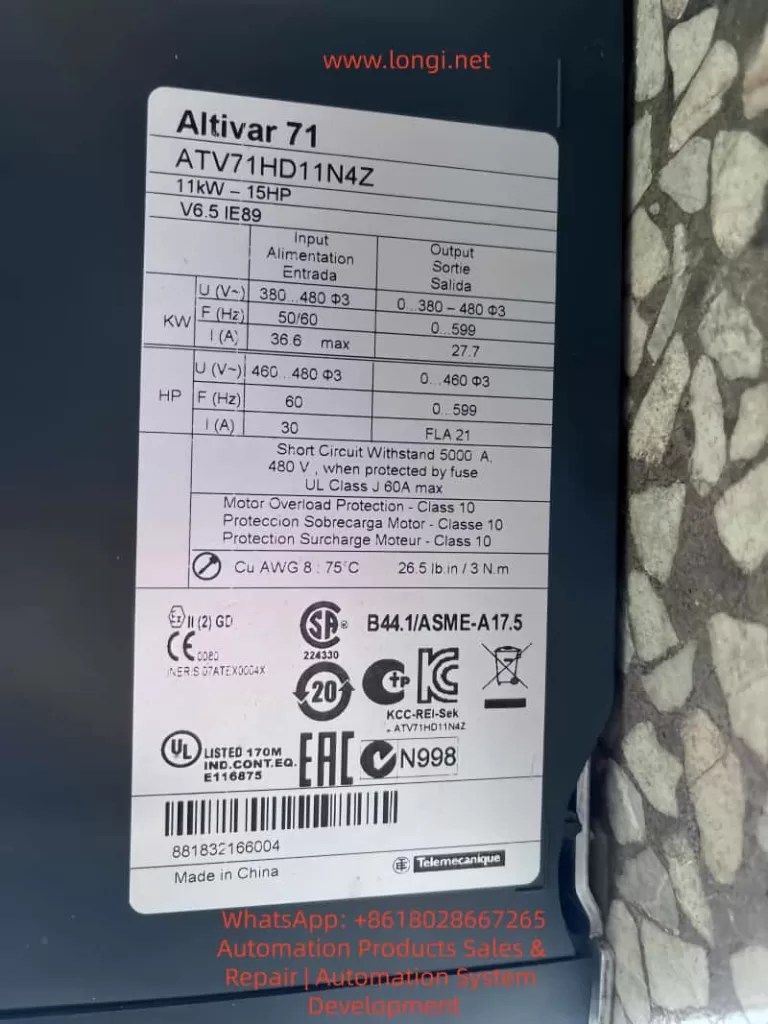
III. Core Causes of SCF3 Fault
The causes of the SCF3 fault can be divided into external factors (motor, cable, grounding system) and internal factors (the inverter itself), with external factors accounting for more than 85% of the cases.
1. External Factors: The Most Common Sources of Faults
(1) Motor Insulation Failure (Accounting for 40%)
The motor is the primary cause of the SCF3 fault, with common reasons including:
- Moisture Absorption: In outdoor equipment or humid environments (e.g., sewage treatment plants), the motor winding absorbs moisture, reducing the insulation resistance from 10 MΩ to below 0.1 MΩ.
- Aging: After more than 10 years of operation, the motor’s insulation varnish cracks and peels off, causing the winding to come into contact with the housing.
- Mechanical Damage: Bearing wear causes the rotor to sweep the stator, or foreign objects enter the motor and scratch the winding insulation layer.
Case: An ATV71H55N4 (5.5 kW) inverter-controlled motor in a textile mill triggered the SCF3 fault after 30 minutes of operation due to a workshop humidity of 85%, which reduced the winding insulation resistance to 0.2 MΩ. After drying the motor (120°C for 6 hours), the insulation resistance recovered to 8 MΩ, and the fault disappeared.
(2) Cable Faults (Accounting for 30%)
Cables are the “weak link” connecting the inverter and the motor, with common problems including:
- Insulation Damage: Cables in drag chains are repeatedly bent (with a bending radius <10 times the diameter) or scratched by metal filings, causing the core wire to come into contact with the shielding layer/ground.
- Loose Connectors: The connectors between the cable and the motor/inverter are not tightened properly, leading to oxidation and increased contact resistance, which generates high temperatures and damages the insulation.
- Shielding Layer Failure: The shielding layer of the shielded cable breaks, preventing it from conducting away the leakage current and causing current accumulation.
Data: A statistical analysis by an automobile factory shows that cable damage in drag chains is the main cause of SCF3 faults (accounting for 60% of cable faults).
(3) Multi-Motor Parallel Connection (Accounting for 15%)
When n motors are connected in parallel, the total leakage current = single-motor leakage current × n. Even if the leakage current of a single motor is 0.02 A (with an insulation resistance of 19 MΩ), the total leakage current of 3 parallel motors reaches 0.06 A. If the inverter’s threshold is 0.05 A, the SCF3 fault will be triggered.
Case: An ATV71H75N4 (7.5 kW) inverter controlling 2 parallel 3 kW motors in a water pump station frequently reported the SCF3 fault due to a total leakage current of 0.08 A (0.04 A per motor), exceeding the threshold of 0.06 A. After installing an output reactor (inductance of 2 mH), the total leakage current dropped to 0.04 A, and the fault was resolved.
(4) Poor Grounding System (Accounting for 10%)
The grounding system is the “discharge path” for leakage current. If the grounding is poor, the leakage current cannot be effectively conducted away and accumulates, triggering the fault:
- Excessive Grounding Resistance: The grounding electrode is corroded by the soil (e.g., in sandy soil), or the grounding wire is too thin (<10 mm²), resulting in a grounding resistance >4 Ω (the specification requires ≤4 Ω).
- Grounding Loop Current: When multiple devices share a grounding system, the grounding wires form a loop current, preventing the leakage current from being properly discharged.
- Loose Grounding Terminals: The grounding terminals of the inverter/motor are not tightened properly, or the grounding wire is broken.
2. Internal Factors: Inverter Faults (Accounting for 5%)
If external factors are ruled out, internal problems with the inverter should be considered:
- Current Sensor Fault: Zero-point drift of the zero-sequence current sensor (e.g., an output voltage offset of 0.1 V) causes the detected leakage current to be too large.
- Protection Circuit Malfunction: Aging of resistors/capacitors in the protection circuit leads to a reduced threshold (e.g., from 10% to 5%).
- Output Component Damage: IGBT or rectifier bridge breakdown causes a short circuit on the output side (usually accompanied by the SCF1 fault).
IV. Systematic Troubleshooting Steps for SCF3 Fault
The troubleshooting of the SCF3 fault should follow the principle of “from simple to complex, from outside to inside” to avoid blind disassembly of equipment. The following is the standard procedure:
Step 1: Confirm the Fault Phenomenon and Record
- Check the Display: Confirm whether “SCF3” is displayed and whether there are accompanying faults (e.g., SCF1, overcurrent).
- Read Fault Records: Check the zero-sequence current value, operating frequency, and output current at the time of the fault through menu 1.10 Diagnostics (e.g., a zero-sequence current of 0.1 A and an operating frequency of 30 Hz indicate that the leakage current increases with frequency).
- Review Historical Faults: If the fault occurs frequently, analyze the pattern (e.g., triggered under specific loads or environments).
Step 2: Check Motor Insulation (The Most Critical Step)
- Tools: 500 V megohmmeter (for 380 V motors), discharge wire.
- Operation:
- Power off and disconnect the motor from the inverter.
- Short-circuit the motor winding and housing with a discharge wire to release residual charges.
- Connect the “L” terminal of the megohmmeter to the winding (U/V/W phases are measured separately) and the “E” terminal to the housing.
- Shake the megohmmeter (120 r/min) and read the insulation resistance value.
- Judgment Criteria:
- ≥1 MΩ: Normal.
- 0.5-1 MΩ: Drying required.
- <0.5 MΩ: Insulation failure, repair required.
Step 3: Check Motor Cable
- Visual Inspection: Check for cable damage, excessive bending (especially in drag chains), and loose connectors.
- Insulation Measurement: Disconnect both ends of the cable and measure the insulation resistance of the core wire to ground with a megohmmeter (≥1 MΩ is normal).
- Shielding Layer Inspection: The shielding layer of the shielded cable must be grounded at both ends (inverter side and motor side). If the shielding layer is broken, repair it with shielding tape.
Step 4: Check Multi-Motor Parallel Connection
- Calculate Total Leakage Current: If n motors are connected in parallel, the total leakage current Itotal=n×Iper_motor (Iper_motor is the leakage current of a single motor, which can be measured with a megohmmeter: Iper_motor=RinsulationU, where U=380V and Rinsulation is the insulation resistance of a single motor).
- Compare with Threshold: Refer to the ATV71 manual to find the ground leakage current threshold for the corresponding power rating (e.g., 0.1 A for ATV71H15N4 (1.5 kW)).
- Solutions: If Itotal > threshold, reduce the number of parallel motors or install an output reactor (refer to the recommended inductance value in the manual, e.g., 1-2 mH for a 1.5 kW inverter).
Step 5: Check Grounding System
- Measure Grounding Resistance: Use a grounding resistance tester (e.g., Fluke 1625) to measure the grounding resistance of the inverter’s grounding terminal (≤4 Ω is normal).
- Check Grounding Connections: Confirm that the grounding terminals of the inverter, motor, and cable shielding layer are tightened and that the grounding wire is not broken/corroded.
- Improve Grounding: If the grounding resistance is too high:
- Add grounding electrodes (drive 2 m deep galvanized angle steel into the ground, with a spacing of ≥5 m).
- Use grounding resistance reducers (fill around the grounding electrodes to reduce soil resistivity).
- Replace with a thicker grounding wire (e.g., from 10 mm² to 16 mm² copper core wire).
Step 6: Check Inverter Itself
If all the above steps are normal, contact Schneider’s after-sales service or a professional maintenance technician:
- Detect Current Sensor: Measure the output voltage of the sensor with a multimeter (normal is 0 V ± 0.05 V). If the offset is too large, calibrate or replace the sensor.
- Test Protection Circuit: Use a signal generator to simulate leakage current and verify whether the protection circuit operates normally.
- Replace Faulty Components: If the sensor or protection circuit is damaged, replace it with a component of the same model (requires manufacturer authorization).
V. Solutions and Cases for SCF3 Fault
1. Solutions for Motor Insulation Problems
- Moisture Absorption: Place the motor in a drying oven (temperature 100-150°C, adjusted according to the insulation class, with an F-class insulation ≤155°C) for 4-8 hours until the insulation resistance is ≥1 MΩ.
- Aging/Damage: If the winding damage area is small, repair it with epoxy resin insulation varnish. If the damage is severe, rewind the winding or replace the motor (the cost is approximately 50%-70% of the motor’s price).
2. Solutions for Cable Problems
- Damaged Cable: Replace it with a shielded cable of the same model (e.g., YJVP-0.6/1 kV), ensuring a bending radius of ≥10 times the diameter.
- Loose Connectors: Retighten the connectors and apply conductive paste (e.g., petroleum jelly) to prevent oxidation.
- Shielding Layer Failure: Repair the broken shielding layer with shielding tape (e.g., 3M 1205) and ensure both ends are grounded.
3. Solutions for Multi-Motor Parallel Connection
- Reduce Parallel Number: For example, change from 3 parallel motors to 2, reducing the total leakage current by 33%.
- Install Output Reactor: Select an reactor with an appropriate inductance (refer to Schneider’s “ATV71 Selection Manual”) and connect it in series on the inverter’s output side to limit the leakage current. For example, for an ATV71H30N4 (3 kW) inverter, the recommended reactor inductance is 1.5-2.5 mH.
4. Solutions for Grounding System
- Re-grounding: Install grounding electrodes (galvanized angle steel 50×50×5 mm, length 2.5 m) according to GB 50169-2016 specifications and drive them into the ground. Use a 16 mm² copper core wire for the grounding wire.
- Use Grounding Resistance Reducers: Fill around the grounding electrodes with grounding resistance reducers (e.g., bentonite-based reducers) to reduce the grounding resistance from 10 Ω to below 2 Ω.
5. Solutions for Inverter Faults
- Current Sensor Fault: Replace it with a sensor of the same model (e.g., LEM LA-55P) and calibrate the zero point (measure the output voltage with a multimeter and adjust it to 0 V).
- Protection Circuit Malfunction: Replace aged resistors (e.g., 10 kΩ/1 W) or capacitors (e.g., 10 μF/25 V), or contact the manufacturer to adjust the protection threshold (requires authorization).
Actual Case Summaries
- Case 1: Motor Winding Damage
An ATV71H30N4 (3 kW) inverter-controlled motor in a mechanical processing plant reported the SCF3 fault during operation. The insulation resistance of the U phase was measured at 0.2 MΩ. After disassembling the motor, it was found that the insulation layer of the U-phase wire was scratched by bearing fragments. After replacing the wire and performing insulation treatment, the insulation resistance recovered to 10 MΩ, and the motor operated normally. - Case 2: Cable Shielding Layer Breakage
An ATV71H75N4 (7.5 kW) inverter controlling 2 parallel motors in a packaging machine frequently reported the SCF3 fault. The cable of one of the motors was found to have a broken shielding layer, with a shielding layer-to-ground insulation resistance of 0.5 MΩ. After replacing the shielded cable and grounding both ends, the fault disappeared. - Case 3: Inverter Sensor Fault
An ATV71H11N4 (11 kW) inverter in a printing press occasionally reported the SCF3 fault while the motor and cable were normal. It was detected that the output voltage of the zero-sequence current sensor was offset by 0.2 V (normal is 0 V ± 0.05 V). After replacing the sensor, the fault did not recur.
VI. Preventive Maintenance and Suggestions for SCF3 Fault
1. Regular Maintenance Plan (Key!)
Develop monthly, quarterly, and annual maintenance plans to identify potential problems in advance:
- Monthly: Check the inverter’s display for fault codes, listen for abnormal vibrations/noise from the motor, and inspect the cable for damage.
- Quarterly: Measure the insulation resistance of the motor/cable with a megohmmeter, check for loose grounding terminals, and clean the inverter’s cooling fan (use compressed air with a pressure of ≤0.2 MPa for blowing).
- Annual: Detect the aging of the inverter’s internal components (capacitors, resistors), calibrate the current sensor, and test the functionality of the grounding protection circuit.
- Every Two Years: Replace the inverter’s cooling fan (a vulnerable part with a lifespan of about 2 years) and check the lubrication of the motor bearings (add lithium-based grease).
2. Environmental Control
- Humidity: Maintain a relative humidity of ≤60% in the environment and install a dehumidifier (e.g., Gree DH40EF).
- Temperature: Keep the inverter’s operating environment temperature between 0-40°C and avoid direct sunlight (install a protective shed).
- Dust: Regularly clean the dust inside the inverter (once every quarter) and install a protective cover (IP54 level).
- Vibration: Avoid installing the inverter near equipment with high vibrations (e.g., punch presses). If unavoidable, install vibration damping pads (e.g., rubber pads with a thickness of ≥10 mm).
3. Correct Installation and Parameter Settings
- Cable Selection: Use shielded cables (model YJVP), and ensure that the shielding layer is reliably grounded at both ends (connected to the PE terminal on the inverter side and the motor housing on the motor side).
- Grounding Installation: The grounding terminals of the inverter, motor, and cable shielding layer must be connected to the same grounding system (with a grounding resistance of ≤4 Ω).
- Parameter Settings: Correctly input the motor’s rated parameters (menu 1.1 Motor Type, 1.2 Rated Voltage, 1.3 Rated Current, 1.4 Rated Frequency) to ensure that the inverter accurately calculates the leakage current. Do not randomly adjust the grounding protection threshold (the fault record in menu 1.10 Diagnostics can be used to view the threshold).
4. Personnel Training
- Operators: Train them in fault identification (e.g., stop the machine immediately when “SCF3” is displayed on the display) to avoid misoperations.
- Maintenance Personnel: Train them in the use of megohmmeters and grounding resistance testers and familiarize them with ATV71 menu operations (e.g., viewing fault records in 1.10 Diagnostics).
VII. Common Misconceptions and Precautions
1. Misconception 1: SCF3 is Only a Motor Problem
Correction: Cable damage, poor grounding, and inverter sensor faults can also cause SCF3. A comprehensive investigation is required.
2. Misconception 2: Using a Multimeter is Sufficient for Insulation Measurement
Correction: A multimeter has a low test voltage (1.5-9 V) and cannot detect minor insulation damage. A megohmmeter (500 V or 1000 V) must be used.
3. Misconception 3: Multi-Motor Parallel Connection is Not a Concern
Correction: The total leakage current is additive. Even if the leakage current of a single motor is small, the total leakage current of multiple parallel motors may exceed the threshold. The total leakage current must be calculated.
4. Misconception 4: Connecting the Grounding Terminal is Enough
Correction: Excessive grounding resistance (>4 Ω) can prevent the leakage current from being discharged. The grounding resistance must be measured and ensured to comply with the specifications.
5. Misconception 5: The Fault Can Be Reset and the Machine Can Continue to Operate
Correction: SCF3 is a serious fault that can lead to motor burnout or inverter damage. The root cause must be thoroughly investigated and resolved before resetting and restarting the machine.
VIII. Conclusion
The SCF3 fault is the most common ground short circuit fault in ATV71 inverters, with its core cause being that the ground leakage current on the output side exceeds the threshold. During troubleshooting, a logical approach of “from outside to inside” should be followed, with a focus on checking motor insulation, cables, grounding systems, and multi-motor parallel connections. The solutions should be tailored to the specific causes, such as drying the motor, replacing cables, installing reactors, and improving grounding.
The key to preventing SCF3 faults is regular maintenance and environmental control. By identifying potential problems such as insulation degradation and cable damage in advance, the downtime caused by faults can be reduced by more than 70%. For electrical maintenance personnel, mastering the troubleshooting and solutions for SCF3 can not only quickly restore production but also extend the service life of equipment (the motor’s service life can be extended by 30%, and the inverter’s service life by 20%).
It is hoped that this article will provide valuable reference for technical personnel and contribute to the stable operation of industrial automation equipment. For further technical support, contact Schneider Electric’s local service center or refer to the “ATV71 Series Inverter Maintenance Manual.”