
1. Introduction
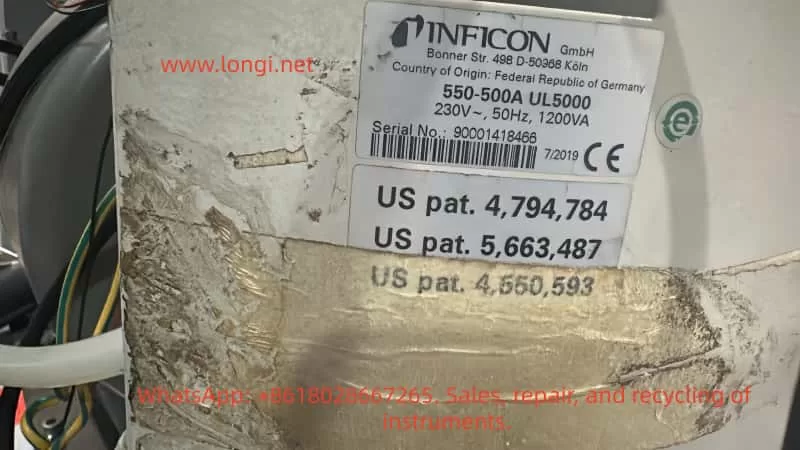
In helium mass spectrometer leak detection systems, operational stability depends heavily on the coordination of the vacuum system. The INFICON UL5000, widely used in industrial and laboratory environments, is a high-precision leak detector whose performance is closely tied to the functionality of its turbomolecular pump (TMP) and backing vacuum system.
A commonly encountered alarm in field applications is:
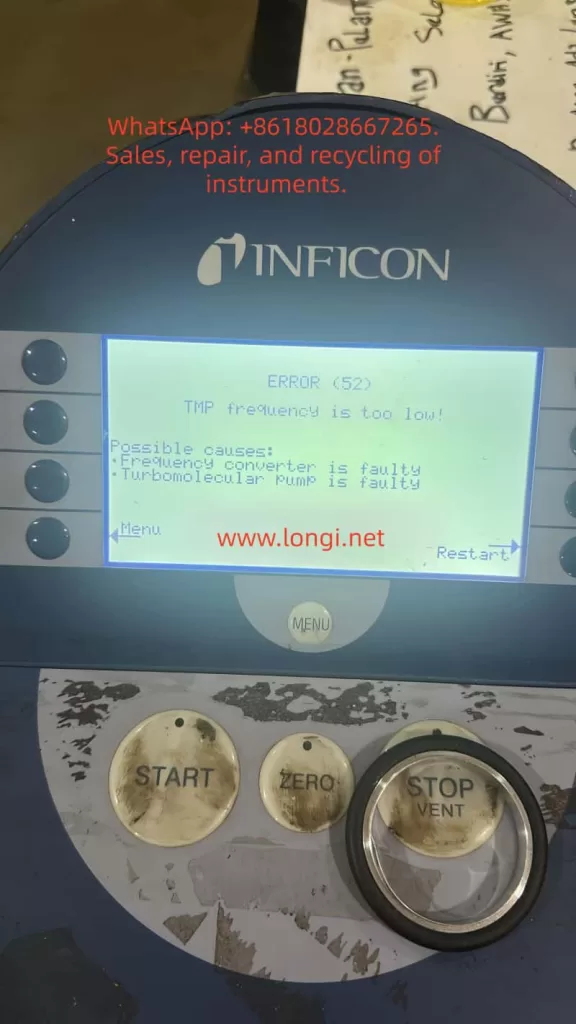
ERROR (52): TMP frequency is too low
This fault prevents the system from entering detection mode and can disrupt production or testing processes. This article provides a structured technical analysis of this error, including system principles, root causes, and practical troubleshooting methods.
2. System Architecture and Working Principle
Understanding Error 52 requires a clear understanding of the UL5000 system architecture.
The UL5000 consists of the following key subsystems:
- Vacuum System
This includes the backing pump (such as a rotary vane or dry pump) and the turbomolecular pump. The backing pump creates the initial vacuum, while the TMP generates high vacuum conditions. - Detection System
This includes the mass spectrometer, ion source, and detector, responsible for helium detection at high sensitivity. - Control System
Comprising the frequency converter, control board, and user interface, this system manages the operation of all components. - Pressure Monitoring System
Multiple pressure sensors monitor system pressure in real time to ensure safe and stable operation.
3. Critical Startup Logic of the TMP
A key misconception is that the turbomolecular pump can start under any condition. In reality, its operation depends on the pre-vacuum level.
The startup sequence of the UL5000 is as follows:
First, the backing pump starts and reduces system pressure to a rough vacuum range.
Second, once the pressure reaches a defined threshold, the control system enables the TMP.
Third, the TMP accelerates to its nominal operating speed.
Finally, the system enters stable detection mode.
If the required vacuum level is not achieved, the TMP cannot accelerate properly.
4. Technical Meaning of Error 52
Error 52 indicates that the turbomolecular pump frequency is below the required operating level.
This implies:
The TMP has not reached its nominal rotational speed.
The control system has detected an abnormal operating condition and triggered protection.
It is important to note that this error does not necessarily mean that the pump itself is damaged. It is often a system-level issue.
5. Root Cause Analysis
Based on field experience, the causes of Error 52 can be categorized into three main groups.
5.1 Insufficient Vacuum Conditions
This is the most common cause.
If the system pressure is too high, the gas load on the TMP increases significantly, preventing it from reaching full speed.
Typical reasons include:
Degraded or malfunctioning backing pump
Vacuum leaks in the system
Loose or improperly sealed connections
Aging or damaged sealing components
Typical symptoms include slow TMP acceleration and delayed fault occurrence.
5.2 Mechanical Issues in the Turbomolecular Pump
The TMP operates at extremely high rotational speeds and requires precise mechanical balance.
Possible issues include:
Bearing seizure or increased friction
Contamination from oil vapor or moisture
Rotor imbalance or deformation
These issues are often accompanied by abnormal noise or unstable operation.
5.3 Drive System Failure
The TMP is driven by a dedicated frequency converter.
Possible faults include:
Failure of the drive module
Unstable or insufficient power supply
Control signal issues
In such cases, the TMP may not start at all, and the error may appear immediately after power-up.
6. Systematic Troubleshooting Procedure
A structured troubleshooting approach should follow a sequence from simple to complex checks.
Step 1: Check the backing pump
Ensure the pump is operating normally and achieving sufficient vacuum.
Step 2: Inspect system sealing
Verify that all connections, flanges, and seals are intact and leak-free.
Step 3: Observe TMP behavior
Determine whether the pump starts, and check for abnormal noise or vibration.
Step 4: Verify electrical connections
Inspect power supply cables and control wiring for stability and proper connection.
Step 5: Perform system reset
Power off the system, wait for a short period, and restart.
7. Typical Fault Distribution
Based on field repair data, the causes of Error 52 are typically distributed as follows:
Most cases are related to insufficient vacuum conditions
Vacuum leakage is the second most common cause
Mechanical TMP failures are less frequent
Drive system failures are relatively rare
This distribution highlights the importance of focusing on the vacuum system before replacing major components.
8. Common Misdiagnosis and Risks
Incorrect diagnosis can lead to unnecessary costs and delays.
Common mistakes include:
Assuming the TMP is faulty without verification
Replacing expensive components without checking the vacuum system
Ignoring environmental factors
A structured diagnostic approach can significantly reduce repair costs and downtime.
9. Environmental Factors
Operating conditions play a significant role in system performance.
High humidity can introduce moisture into the system, affecting TMP operation.
High temperature accelerates component aging.
Long idle periods can lead to bearing degradation or seal failure.
These factors should be considered during troubleshooting and maintenance.
10. Preventive Maintenance Recommendations
To reduce the likelihood of Error 52, regular maintenance is essential.
Recommended practices include:
Periodic inspection of the backing pump
Replacement or maintenance of seals
Keeping the system clean and dry
Avoiding TMP startup under high-pressure conditions
Running the system periodically if it is not in regular use
11. Conclusion
Error 52 on the INFICON UL5000 is a system-level issue rather than a simple component failure. It indicates that the turbomolecular pump cannot reach its required operating speed under current conditions.
In most cases, the root cause lies in insufficient vacuum or system leakage, rather than a failure of the TMP itself.
A systematic troubleshooting approach focusing on the vacuum system should always be the first step, followed by inspection of the TMP and drive system if necessary.