Posted on

Parameter Setup and Troubleshooting for Driving a 400 Hz High-Speed Spindle Motor with a KC500 Inverter

High-speed spindle motors are widely used in CNC routers, woodworking machines, engraving machines, small machining centers, grinding machines, and other high-speed cutting equipment. These motors are very different from ordinary 50 Hz industrial motors. A typical high-speed spindle motor may have nameplate data such as 380 V three-phase input, 400 Hz rated frequency, 24,000 rpm rated speed, and a power rating from 1.5 kW to 5.5 kW or higher.

Because the rated frequency is much higher than the normal mains frequency, this type of spindle motor must be driven by a variable frequency drive. It cannot be connected directly to a 380 V three-phase power supply. When a general-purpose inverter such as the KC500 series is used to drive a 400 Hz spindle motor, correct parameter setting is essential. Incorrect parameters may cause the spindle to stop at 50 Hz, fail to accelerate above 100 Hz, only shake without rotating, or trigger overload faults such as Err10.

This article analyzes a typical case: a KC500 inverter was used to drive a 3.3 kW, 380 V, 7 A, 400 Hz, 24,000 rpm high-speed spindle motor. The customer reported that the device was limited to 50 Hz, then limited to 100 Hz, and the spindle only tried to turn but could not start properly. Later, the inverter displayed an Err10 fault. This is a typical example of incorrect inverter selection, incorrect parameter group understanding, insufficient current margin, and unsuitable commissioning procedure.
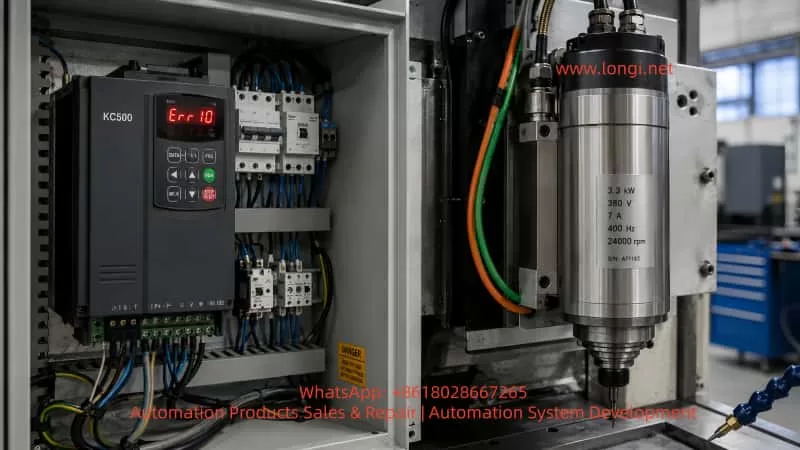
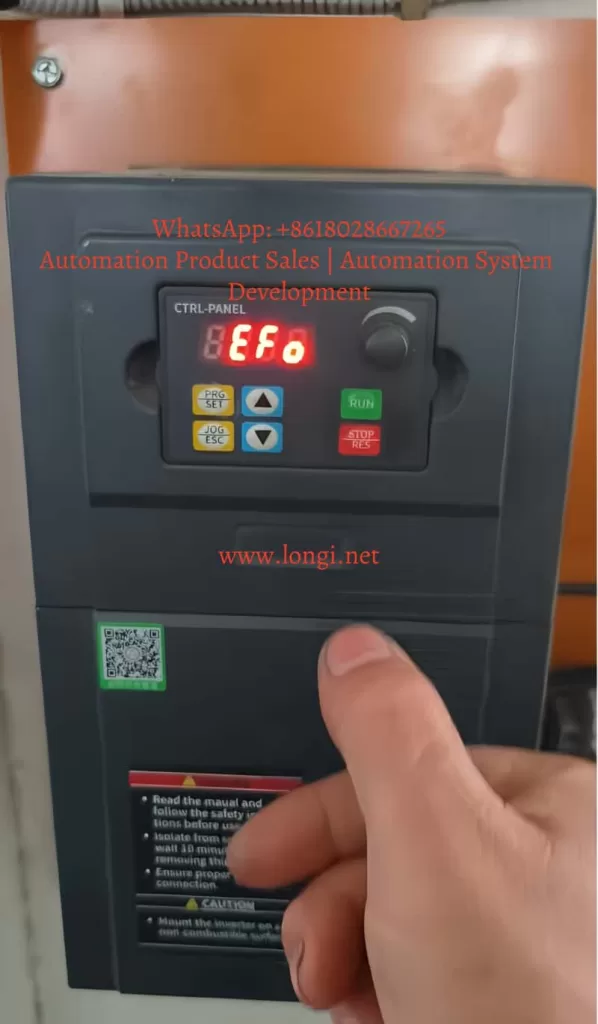
KC500 inverter displaying Err10 fault connected to a 400 Hz high-speed spindle motor in an industrial CNC control cabinet.

1. Difference Between a 400 Hz Spindle Motor and a Standard 50 Hz Motor

A standard three-phase induction motor usually has a rated frequency of 50 Hz or 60 Hz. Its rated speed is normally around 1450 rpm, 2900 rpm, or similar values depending on pole number. A high-speed spindle motor is designed differently. It often uses a much higher rated frequency, such as 300 Hz, 400 Hz, 600 Hz, or even higher.

For a 400 Hz, 24,000 rpm spindle motor, the rated operating point is 400 Hz, not 50 Hz. This means the motor reaches its rated speed and rated output power only when the inverter output frequency is close to 400 Hz. If the inverter is only set to 50 Hz, the spindle runs at only about one-eighth of its rated speed. The output torque and power at that point are limited, and the motor may not be able to start under load.

This is a key point. Many technicians are used to ordinary industrial motors and assume that 50 Hz is the normal operating frequency. For a high-speed spindle motor, this assumption is wrong. If the maximum frequency, upper frequency limit, or frequency source is not set correctly, the inverter may remain limited at 50 Hz. The spindle may then only vibrate, hum, or attempt to rotate without actually accelerating.

A 400 Hz spindle motor also has weaker low-frequency performance than many standard motors. It is normally intended to run at medium to high frequencies. At very low frequency, especially under load, the available starting torque may be insufficient. Therefore, during commissioning, it is often better to test carefully at around 100 Hz with a long acceleration time, rather than forcing the motor to run at 50 Hz under load.
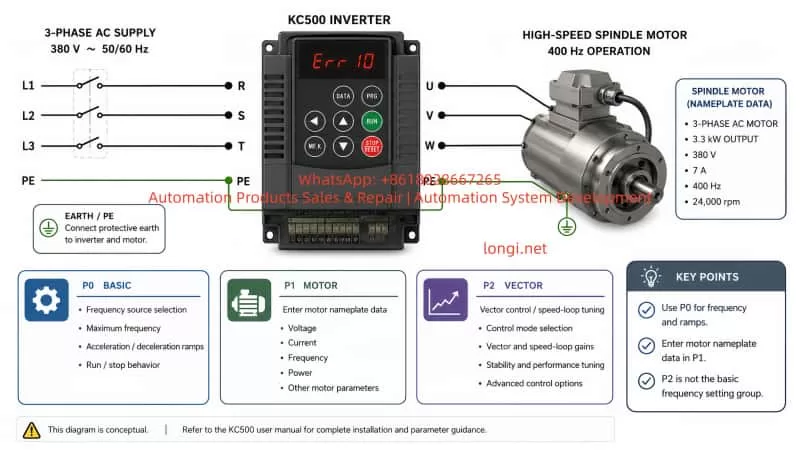
Wiring and parameter setup diagram for a KC500 inverter driving a 380V 400Hz high-speed spindle motor with P0, P1, and P2 parameter guidance.

2. Inverter Selection: Do Not Only Look at the Light-Duty kW Rating

In this case, the inverter used by the customer was marked as KC500-4T-0022G/0040P. This model indicates approximately 2.2 kW heavy-duty rating and 4.0 kW light-duty rating. The output current was marked as 6 A / 10 A.

At first glance, some users may think that because the inverter has a 4.0 kW light-duty rating, it should be able to drive a 3.3 kW spindle motor. This is a common mistake.

For a spindle motor, it is not enough to select the inverter only by the light-duty kW rating. The key is output current and overload capacity under actual load. A high-speed spindle may require strong current during starting, acceleration, cutting, grinding, or when bearing friction is high. For this type of load, the heavy-duty rating is more relevant than the light-duty rating.

The motor in this case is rated at 3.3 kW and 7 A. The inverter heavy-duty output current is only about 6 A. This is already lower than the motor rated current. If the acceleration time is short, the mechanical load is high, the spindle bearing is tight, or the parameters are not correct, the inverter can easily enter overload protection and display Err10.

For a 3.3 kW, 7 A, 400 Hz spindle motor, a more suitable inverter would be KC500-4T3.7G/5.5P or a larger model. A larger inverter provides more current margin, better acceleration capability, and a lower probability of overload faults.

3. Meaning of Err10 on the KC500 Inverter

Err10 generally indicates inverter overload. It is not simply a wiring alarm. It means the inverter is being required to deliver more load current or load capacity than it can safely provide for a certain period.

Common causes include:

The mechanical load is too heavy. The spindle bearing may be damaged, the shaft may be stuck, the belt may be too tight, the coupling may be misaligned, or a cutting tool/load may still be attached during testing.

The motor parameters are incorrect. If rated power, voltage, current, frequency, and speed are not entered correctly, the inverter’s motor model and protection logic will not match the real motor.

The inverter is undersized. In this case, the spindle motor rated current is 7 A, while the inverter heavy-duty current is only around 6 A.

The acceleration time is too short. Accelerating a high-speed spindle from zero to several hundred hertz requires time. If the acceleration ramp is too aggressive, the inverter current rises quickly and may trigger overload or overcurrent.

The control mode or related parameters are unsuitable. For first commissioning, V/F control is usually safer and easier than changing vector speed loop parameters. Incorrectly changing P2 group parameters may cause poor startup behavior or unstable motor control.
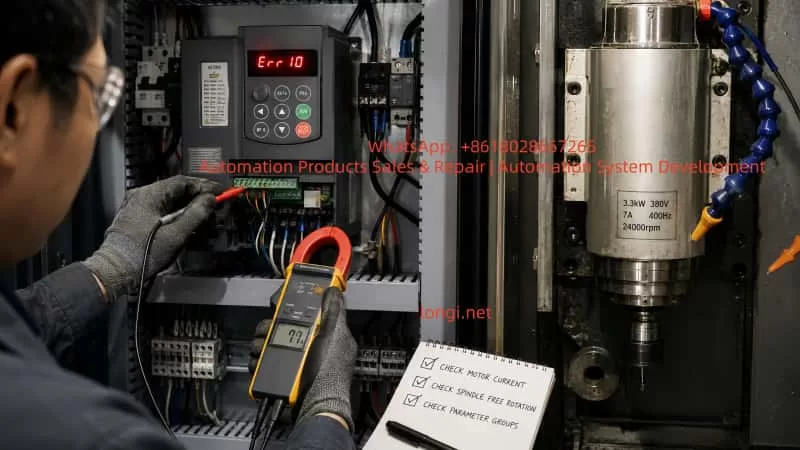
Technician troubleshooting a KC500 inverter Err10 overload fault while measuring current on a 3.3 kW 400 Hz spindle motor system.

4. Do Not Confuse P0, P1, P2, and P3 Parameter Groups

One important issue in this case was that the customer wrote down parameters such as P2-00 = 400 Hz, P2-01 = 20 s, and P2-02 = 20 s. This is incorrect. P2 group is not the correct place to set maximum frequency, acceleration time, or deceleration time.

On many KC500 applications, the parameter groups have different functions:

P0 group is the basic function group. It includes control mode, run command source, frequency source, keypad frequency setting, maximum frequency, upper frequency limit, lower frequency limit, acceleration time, deceleration time, and other basic operating parameters. If the spindle cannot exceed 50 Hz, the first group to check is usually P0.

P1 group is the motor parameter group. It should contain motor nameplate data such as rated power, rated voltage, rated current, rated frequency, and rated speed. These values must be set according to the motor nameplate.

P2 group is normally related to vector control and speed loop parameters. It is not the correct group for basic spindle frequency setting. During basic V/F commissioning, users should not randomly modify P2 parameters. If P2 parameters have already been changed incorrectly, they should be restored to default values before further testing.

P3 group is usually related to V/F control characteristics, including V/F curve and torque boost. For high-speed spindle applications, a linear V/F curve is usually used first. Low-frequency torque boost can be applied carefully, but excessive boost may cause high current and overheating.

Confusing these parameter groups is one of the most common reasons why the spindle cannot start correctly.

5. Why the Inverter May Be Limited to 50 Hz

If a 400 Hz spindle motor is limited to 50 Hz, the problem is usually not the motor itself. It is normally caused by inverter parameter limits or frequency source configuration.

Common causes include:

The maximum frequency is still set to 50 Hz.

The upper frequency limit is still set to 50 Hz.

The keypad frequency setting is only 50 Hz.

The frequency source is not the keypad but an external analog signal, terminal input, or communication command.

The analog input scaling is set so that maximum input only corresponds to 50 Hz.

The run command source and frequency source are bound to another channel.

For a 400 Hz spindle motor, both the maximum frequency and the upper frequency limit must allow 400 Hz operation. It is not enough to change only one parameter. If maximum frequency is set to 400 Hz but the upper limit remains at 50 Hz, the actual output will still be limited. If the frequency source is not the keypad, the keypad setting may also be ignored.

During first commissioning, the simplest method is to use keypad start/stop and keypad digital frequency setting. This removes confusion from external terminals, potentiometers, PLC communication, or analog input scaling.

6. Recommended Basic Parameter Logic for a 400 Hz Spindle

For a 3.3 kW, 380 V, 7 A, 400 Hz, 24,000 rpm spindle motor, the basic setup logic should be as follows.

Use V/F control for first testing. Use keypad command for run/stop. Use keypad digital setting as the frequency source. Set maximum frequency to 400 Hz. Set the upper frequency limit to 400 Hz. Set the lower frequency limit to 0 Hz or a suitable safe value. Set acceleration and deceleration times to a relatively long value at first, such as 20 to 30 seconds.

Motor nameplate data must be entered correctly:

Rated power: 3.3 kW
Rated voltage: 380 V
Rated current: 7 A
Rated frequency: 400 Hz
Rated speed: 24,000 rpm

For the V/F curve, use a linear V/F curve first. A small amount of torque boost may be used to improve low-frequency starting, for example 3% to 5%. However, torque boost should not be increased blindly. Too much boost can cause excessive low-frequency current and overheating.

The most important warning is this: do not set P2-00 as 400 Hz, and do not set P2-01 or P2-02 as acceleration/deceleration time unless the exact function of those parameters is confirmed. For this basic spindle setup, P2 should generally be left at default values.

7. Why the Spindle Only Tries to Turn but Cannot Start

When the spindle only shakes or attempts to turn but cannot accelerate, several causes are possible.

First, the spindle may have mechanical resistance. Before electrical testing, the spindle should be rotated by hand with power off. It should rotate smoothly. If it feels tight, stuck, noisy, or rough, the mechanical problem must be solved first.

Second, the motor winding may have a problem. The resistance between U-V, V-W, and W-U should be balanced. Insulation from winding to ground should be good. A winding fault can cause abnormal current, vibration, or inverter trip.

Third, the inverter may be too small. In this case, the inverter heavy-duty rating is lower than the motor rated current. Even if the motor can rotate without load, it may fail under real conditions.

Fourth, the frequency and V/F settings may be wrong. If the inverter is trying to start a 400 Hz spindle at an unsuitable low frequency with insufficient voltage compensation, the motor may not develop enough torque.

Fifth, acceleration may be too aggressive. A high-speed spindle should not be forced to accelerate too quickly during the first test.

8. Correct Commissioning Procedure

A high-speed spindle motor should not be tested by immediately running to 400 Hz. The commissioning process should be gradual and controlled.

First, check the wiring. Three-phase input power should be connected to R/S/T. The spindle motor should be connected to U/V/W. The motor ground wire must be connected to PE/earth. No capacitor, contactor, power factor correction capacitor, or surge absorber should be installed between the inverter output and the motor.

Second, check the mechanical condition. The spindle should rotate freely by hand when power is off. If possible, remove the tool and test without load first.

Third, simplify the control system. Use keypad operation first. Do not use external terminals, analog input, or communication control until the motor runs correctly.

Fourth, set the correct basic parameters. Set P0 and P1 correctly. Do not randomly change P2. Use V/F control and a long acceleration time.

Fifth, test step by step. Start with around 100 Hz, not heavy load at 50 Hz. If the spindle rotates correctly, increase gradually: 100 Hz, 150 Hz, 200 Hz, 300 Hz, and finally 400 Hz.

Sixth, check rotation direction. If the direction is wrong, stop the inverter completely and swap any two motor output wires U/V/W. Never change output wiring while the inverter is running.

Seventh, monitor output current. If current quickly approaches or exceeds the motor rated current, stop and investigate. If Err10 appears repeatedly, the inverter may be undersized or the mechanical load may be too heavy.

9. Risks of Using an Undersized Inverter

Using an undersized inverter may appear to work during a short no-load test, but it is not reliable. Long-term operation with insufficient inverter capacity can cause frequent overload trips, high internal temperature, reduced capacitor life, stress on the IGBT module, and eventually inverter failure.

A spindle motor should be matched with sufficient current margin. This is especially important when the working environment is hot, the motor cable is long, the spindle bearing condition is unknown, or the load changes quickly during machining.

For a 3.3 kW, 7 A spindle motor, a 2.2 kW heavy-duty inverter is not an ideal choice. A 3.7 kW heavy-duty inverter or larger is more appropriate.

Acceleration and deceleration time also matter. A very short ramp can cause high current during acceleration and overvoltage during deceleration. For first commissioning, 20 to 30 seconds is a safer starting point. After successful testing, the ramp time can be optimized according to the machine requirements.

10. How to Determine Whether the Problem Is Parameter, Motor, Mechanical, or Inverter Related

When a spindle fails to start, the problem should be diagnosed step by step rather than guessing.

If the inverter can run up to 400 Hz without the motor connected, the inverter’s frequency command and output logic are probably functional. If it trips only when the motor is connected, focus on motor parameters, motor condition, mechanical load, and inverter capacity.

If the inverter cannot exceed 50 Hz even without load, check maximum frequency, upper frequency limit, frequency source, keypad setting, and external command configuration.

If the motor winding resistance is unbalanced or insulation to ground is poor, the motor must be repaired before further testing.

If the spindle is mechanically tight or noisy, the mechanical fault must be corrected first. A VFD cannot solve a seized bearing.

If parameters are correct, the spindle is mechanically free, and the motor still cannot start while current rises quickly, the inverter is probably too small or the motor has an electrical fault.

11. Practical Field Recommendations

For technicians commissioning a high-speed spindle with a KC500 inverter, the following recommendations are important.

Always read the motor nameplate first. The key data are voltage, current, frequency, speed, and power.

Do not treat a 400 Hz spindle motor like a 50 Hz industrial motor.

Open both maximum frequency and upper frequency limit to 400 Hz when the motor is rated for 400 Hz.

Use keypad control for the first test. Do not introduce PLC, external potentiometer, or analog signals before the motor runs correctly.

Set the motor nameplate parameters accurately in the motor parameter group.

Do not randomly modify vector control speed loop parameters.

Use V/F control first unless encoder feedback and vector tuning are properly configured.

Use long acceleration and deceleration times during the first test.

Test without load first.

Observe output current during each test.

Select the inverter according to output current and load type, not only according to the light-duty kW rating.

12. Conclusion

A KC500 inverter can be used to drive a 400 Hz high-speed spindle motor, but correct inverter selection and parameter setup are essential. In the analyzed case, the spindle motor was rated at 3.3 kW, 380 V, 7 A, 400 Hz, and 24,000 rpm, while the inverter was a KC500-4T-0022G/0040P. Its heavy-duty rating was smaller than the spindle requirement, so Err10 overload and startup failure were predictable under real conditions.

When a 400 Hz spindle is limited to 50 Hz, cannot start at 100 Hz, only shakes, or triggers Err10, the technician should check the maximum frequency, upper frequency limit, frequency source, run command source, motor nameplate parameters, V/F curve, acceleration time, mechanical load, motor winding condition, and inverter capacity.

The most common mistakes are setting the spindle like a normal 50 Hz motor, using an undersized inverter, and entering frequency or ramp values into the wrong parameter group. In particular, P2 group should not be mistaken for basic frequency and acceleration settings during simple V/F commissioning.

The correct approach is to set the motor parameters according to the nameplate, allow 400 Hz operation in the inverter, use V/F control for the first test, apply a reasonable acceleration ramp, test the spindle without load step by step, and ensure the inverter has enough output current margin. For a 3.3 kW / 7 A spindle motor, a KC500-4T3.7G/5.5P or larger inverter is a more suitable choice than a 2.2 kW heavy-duty model.

Following this method can prevent unnecessary fault misjudgment, reduce inverter overload trips, protect the spindle motor, and ensure stable operation of high-speed machining equipment.
Posted on

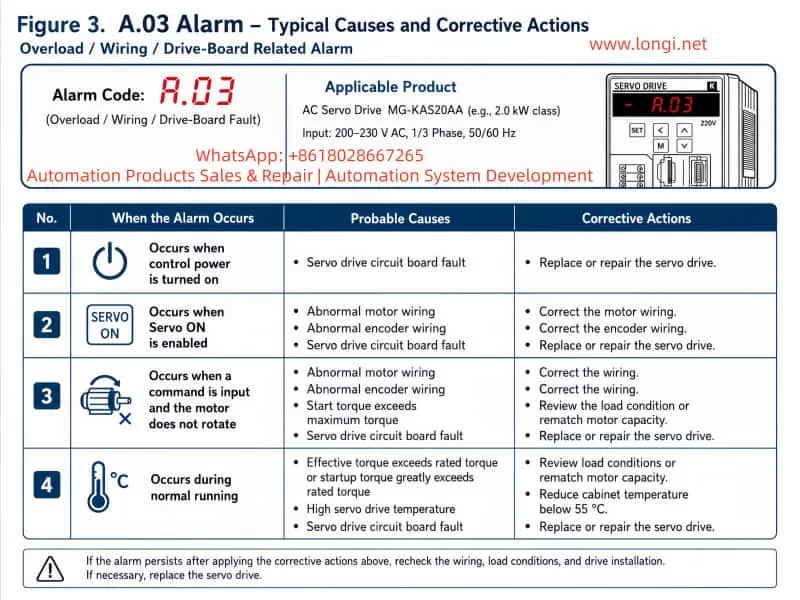
AC Servo Drive MG-KAS20AA “A.03” Alarm Fault Analysis and Handling Guide

1. Overview of the Fault

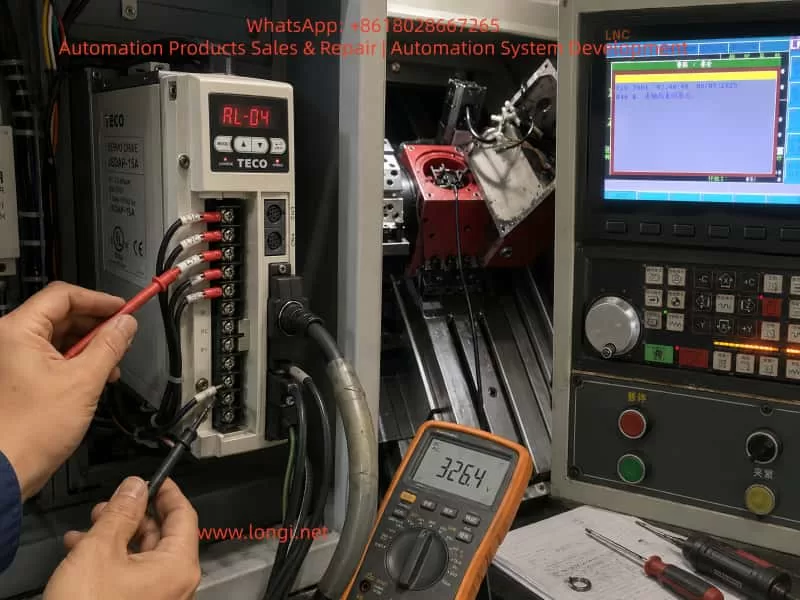
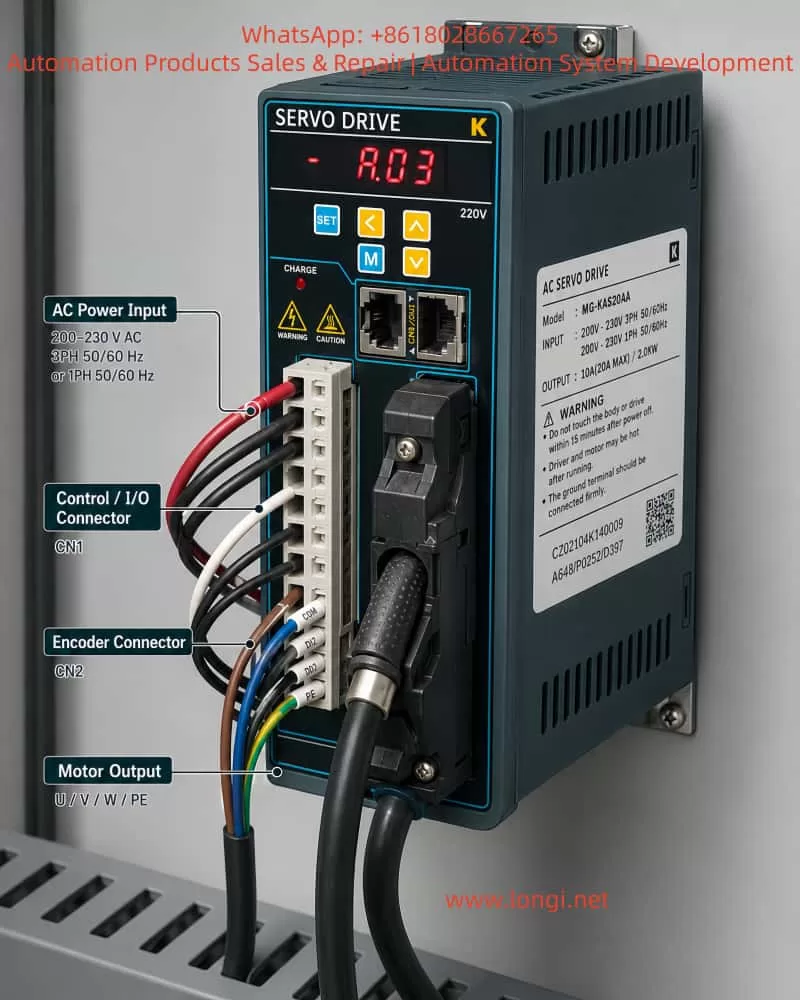
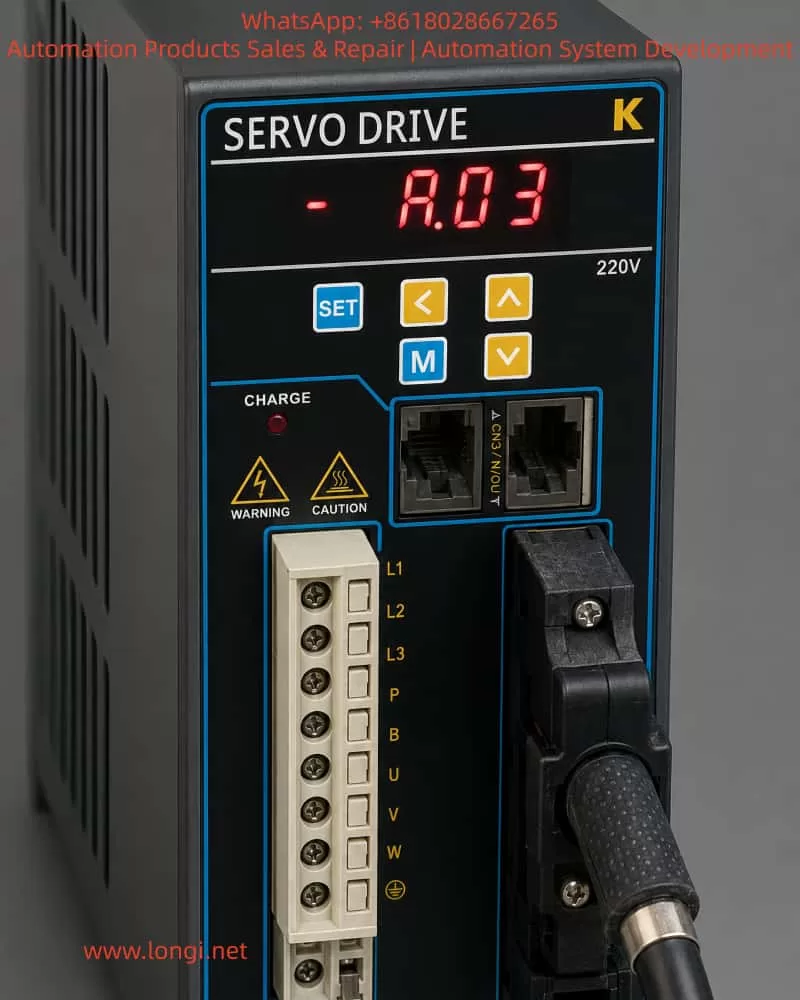
In industrial automation, servo drives are essential for precise control of position, speed, and torque. Based on user reports and inspection images (Attachments 1 and 2), the MG-KAS20AA K-series AC servo drive exhibits the “A.03” alarm code. This code appears on the front panel digital display (Image 2), and the drive fails to rotate, halting the connected mechanical load.

According to the K Series AC Servo Drive User Manual (2017 Engineer Edition V3.0), Chapter 7 and Appendix C, the A.03 alarm falls under overload/torque anomaly faults, primarily associated with:

  1. Servo drive circuit board faults
  2. Motor wiring issues
  3. Encoder signal errors
  4. Load torque exceeding the drive’s limits

Images show U/V/W motor terminals correctly connected, CN1/CN2 encoder interfaces installed, and PE properly grounded, yet the A.03 alarm persists. This indicates the fault is likely related to the drive board or signal compatibility rather than simple wiring issues.


MG-KAS20AA front panel and wiring terminals.

2. Fault Trigger Conditions

Based on the manual, A.03 may be triggered in the following scenarios:

ScenarioTrigger ConditionPossible CauseRecommended Action
Servo ONMotor does not rotateMotor wiring abnormality, encoder wiring issueInspect and correct motor and encoder wiring
Command inputServo motor unresponsiveStart-up torque exceeds maximumAdjust load conditions or re-evaluate motor capacity
Normal operationDrive reports A.03High internal temperature of servo driveReduce drive temperature below 55℃, verify cooling system
Any operationDrive board faultDrive power module or control board malfunctionReplace servo drive or repair circuit board

Given the images, the drive reports A.03 under normal power and command input. Hence, drive board or power module failure is the primary suspected cause.


Front panel display showing A.03 alarm.

3. Detailed Fault Diagnosis Steps

3.1 Visual Inspection and Wiring Verification

  1. Power Check
    • Verify L1/L2/L3 terminals receive 220V three-phase within ±15%.
    • Confirm L1C/L2C control voltage is stable.
  2. Motor Wiring
    • U/V/W terminals correspond to the drive terminals.
    • Measure resistance across phases; check for open or short circuits.
  3. Grounding and Shielding
    • PE terminals connected to drive, motor, and cabinet.
    • Encoder shield connected to the chassis.

3.2 Encoder Signal Check

Per Manual Section 3.4:

  • CN1: Axis A encoder
  • CN2: Axis B encoder

Procedure:

  1. Measure A/B phase signals with an oscilloscope.
  2. Verify PG pulse output matches user parameter settings.
  3. Ensure IN1~IN8 input allocation (P□509~P□512) is correct.
  4. Confirm wiring length and shield integrity (max 3m for command input, max 20m for feedback).

Faulty encoder signals may mislead the drive’s load detection and trigger A.03.


3.3 Drive Board and Power Module Inspection

Manual 7.2.3 highlights common failure points:

  1. Power Modules (IGBTs/MOSFETs)
    • Shorted or open MOSFETs can trigger overcurrent protection (A.03).
    • Measure U/V/W terminal resistances offline; check MOSFETs.
  2. Drive Temperature
    • Overheating or sensor failure can cause A.03.
    • Use infrared thermometer to monitor PCB temperature (<55℃).
  3. Control Board
    • MCU or logic faults may prevent overload signal processing.
    • Check for burnt components or swollen capacitors; replace control board if needed.

3.4 Load Evaluation

A.03 may also result from excessive load torque:

  • Load inertia exceeding 5× motor inertia.
  • Mechanical resistance or over-torque beyond rated motor torque.
  • Aggressive start/stop conditions causing current peaks.

Mitigation:

  1. Inspect load bearings and couplings for jamming.
  2. Measure mechanical torque against motor rating.
  3. Adjust dynamic braking or P-OT / N-OT limit parameters.

3.5 Software and Parameter Verification

  • Check user parameters P□□□: torque limit, load inertia, and travel limits.
  • Confirm control mode (position/speed/torque) matches mechanical load.
  • For absolute encoders, ensure F□009/F□010 settings are correct.

Appendix C fault table excerpt (overload/circuit board/wiring fault).

4. Fault Handling and Recovery

  1. Immediate Measures
    • Power down for at least 15 minutes to discharge capacitors.
    • Inspect cooling and airflow.
  2. Wiring and Encoder Verification
    • Cross-check terminals per manual 3.1–3.4.
    • Confirm encoder signals via oscilloscope.
  3. Circuit Board or Module Maintenance
    • If wiring and encoder are correct, replace power modules or control board.
    • Alternatively, send to manufacturer for repair.
  4. Parameter and Load Adjustment
    • Ensure user parameters are within safe limits.
    • Adjust load or enable torque compensation to reduce peak currents.
  5. Long-term Protection
    • Maintain drive environment below 45℃.
    • Avoid high humidity, dust, or corrosive gases.
    • Ensure proper PE grounding.
    • Inspect encoder and motor connections periodically.

5. Conclusion

The A.03 alarm on K-series AC servo drives indicates overload/torque anomaly, caused by:

  1. Drive board or power module failure
  2. Motor wiring or encoder signal issues
  3. Load exceeding motor capacity
  4. Overheating or insufficient cooling

Resolution Principle:

  • Inspect wiring and connections first.
  • Verify encoder signals and input/output parameter allocation.
  • Evaluate load and mechanical conditions.
  • Replace drive board or power module if necessary.

Following this systematic approach ensures reliable operation of MG-KAS20AA drives, minimizing downtime and safeguarding industrial automation processes.

Posted on

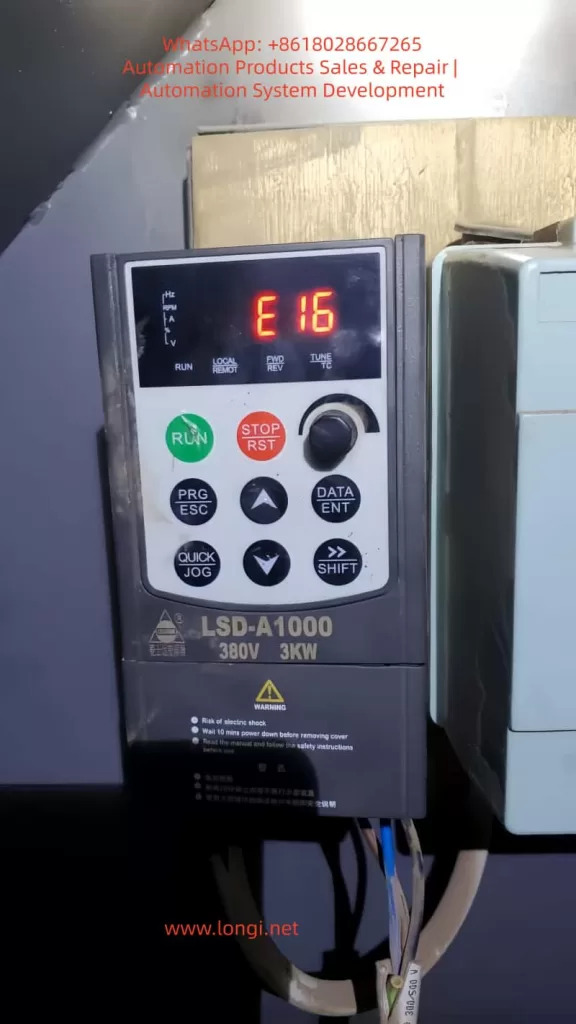
Analysis and Solution Strategy for E16 Communication Abnormality Fault of Lingshida LSD-A1000 Inverter

1. Introduction

In industrial automation production, inverters serve as the core equipment for motor drive, and the stability of their communication function directly impacts the continuity of production processes and the accuracy of data transmission. The Lingshida LSD-A1000 series inverter, known for its high cost-effectiveness and stable performance, is widely used in industries such as textiles, packaging, and machine tools. However, the E16 communication abnormality fault is one of the most common issues with this series, accounting for approximately 15% to 20% of total faults. This fault causes interruptions in data transmission between the inverter and the host computer (e.g., PLC, industrial PC), leading to motor shutdowns, inability to adjust production parameters, and other problems that severely affect production efficiency. This article systematically analyzes the root causes of the E16 fault, provides step-by-step troubleshooting procedures, verifies solutions through case studies, and proposes preventive measures to guide on-site maintenance personnel.

E16 Fault of the LDS-A1000

2. Overview of E16 Fault

2.1 Fault Definition and Symptoms

According to the Lingshida LSD-A1000 inverter manual, the E16 fault code is defined as “Communication Error”. Typical symptoms include:

  • The inverter’s operation panel displays “E16” and cannot start the motor via the RUN key;
  • The host computer (e.g., PLC) fails to read the inverter’s operating parameters (e.g., frequency, current, voltage);
  • The host computer cannot send control commands (e.g., start, stop, frequency adjustment) to the inverter;
  • The communication indicator lights (e.g., RX/TX) between the inverter and the host computer do not flash or flash abnormally.

2.2 Impact of the Fault

The E16 fault disrupts production workflows. If not resolved promptly, it may trigger secondary issues such as:

  • Motor shutdowns, leading to production downtime and increased operational costs;
  • Inability to monitor motor operating status in real time, potentially causing overloads, overheating, or other faults;
  • Interruption of data transmission, affecting the statistics and analysis of production data (e.g., energy consumption, output).

3. Root Cause Analysis of E16 Fault

Based on the fault manual and on-site maintenance experience, the core causes of the E16 fault can be categorized into three major groups: abnormal host computer operationcommunication cable faults, and incorrect communication parameter settings. A detailed analysis of each category is provided below.

3.1 Abnormal Host Computer Operation

The host computer (e.g., PLC, industrial PC) acts as the “initiator” of communication with the inverter. Its operating status directly affects communication stability. Common host computer abnormalities include:

3.1.1 Power Supply Issues

  • Unstable power voltage: The host computer’s power voltage must remain stable within the rated range (e.g., AC 220V ± 10%). Excessive voltage fluctuations (e.g., beyond ± 15%) can cause the host computer’s communication interface (e.g., RS485 interface) to malfunction, preventing signal transmission or reception;
  • Incorrect power wiring: Reversing or failing to ground the host computer’s live (L), neutral (N), and earth (PE) wires can damage the interface circuit, leading to communication interruptions.

3.1.2 Software Faults

  • Communication software not running: If the host computer’s communication software (e.g., SCADA, PLC programming software) is not launched or crashes, a connection with the inverter cannot be established;
  • Incorrect software parameter configuration: Mismatched communication parameters (e.g., baud rate, data bits, stop bits) between the host computer software and the inverter result in incompatible data formats, making signal parsing impossible;
  • Software conflicts: Running multiple communication software programs (e.g., Modbus and Profibus protocols) simultaneously on the host computer occupies interface resources, causing communication errors.

3.1.3 Interface Damage

  • Physical interface damage: Bent, oxidized, or burnt pins on the host computer’s RS485 interface interrupt signal transmission;
  • Interface driver circuit damage: Overvoltage or overcurrent can damage the host computer’s RS485 driver chip (e.g., MAX485), preventing the conversion of TTL signals to RS485 differential signals.
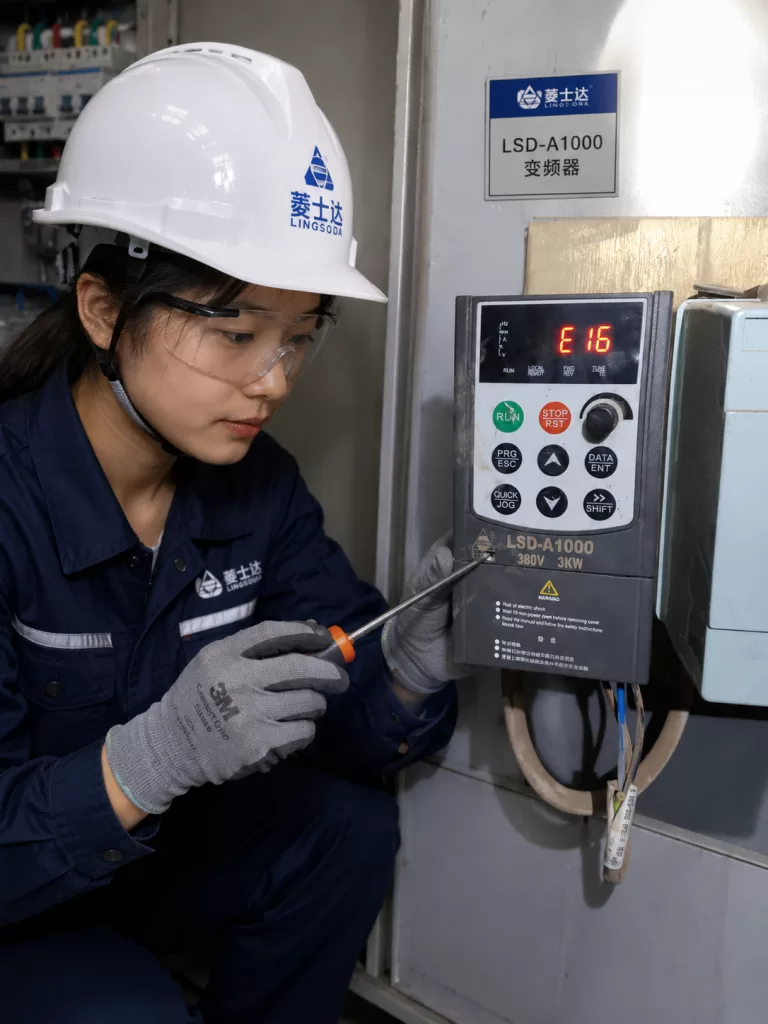
Engineer on-site repairs LSD-A1000 frequency converter

3.2 Communication Cable Faults

Communication cables serve as the “signal channel” between the inverter and the host computer. Their connection status directly impacts communication quality. Common cable faults include:

3.2.1 Incorrect Wiring

  • Reversed A/B wires: RS485 communication uses differential signal transmission. The A wire (positive signal) and B wire (negative signal) must be connected correspondingly (inverter’s A to host computer’s A, inverter’s B to host computer’s B). Reversing them causes signal polarity mismatches, making it impossible for the inverter to recognize host computer commands;
  • Unshielded cables: The shielding layer of RS485 communication cables must be grounded at one end (usually the inverter’s PE terminal). Failing to ground the shielding layer allows external electromagnetic interference (e.g., high-frequency noise from motor startup) to enter the cable, causing signal errors;
  • Loose connections: Loose wiring terminals (e.g., inverter’s TXD/RXD terminals, host computer’s RS485 terminals) result in poor contact and signal interruptions.

3.2.2 Cable Damage

  • Broken wires: Pulling, squeezing, or rodent damage can break the internal conductors of the communication cable, interrupting signal transmission;
  • Short circuits: Shorting the A/B wires of the communication cable to power lines (e.g., AC 220V) or earth wires shorts the signal, preventing it from reaching the inverter;
  • Insulation aging: The insulation layer of the communication cable ages and cracks after long-term use (e.g., over 5 years), causing signal leakage and degraded communication quality.

3.3 Incorrect Communication Parameter Settings

Communication parameters are the “language rules” between the inverter and the host computer. Mismatched parameters prevent the two devices from “communicating.” The Lingshida LSD-A1000 inverter’s communication parameters are primarily stored in the P0 group (parameter numbers P0.00 to P0.15). Common parameter errors include:

3.3.1 Incorrect Communication Address

  • Mismatched inverter and host computer addresses: The inverter’s communication address (P0.01) must match the slave address set in the host computer software (e.g., if the inverter is set to 1, the host computer must also be set to 1). A mismatch prevents the host computer from identifying the inverter, causing communication interruptions;
  • Address conflicts: When multiple inverters are connected to the same host computer, duplicate addresses (e.g., two inverters both set to 1) cause communication conflicts, triggering the E16 fault.

3.3.2 Baud Rate Errors

  • Mismatched baud rates: The baud rate (P0.02) is the data transmission rate of the communication parties (e.g., 9600, 19200, 115200 bps) and must be identical. If the inverter is set to 9600 and the host computer to 19200, data bit synchronization fails, making signal parsing impossible;
  • Baud rate out of range: The Lingshida LSD-A1000 inverter supports a baud rate range of 1200 to 115200 bps. Setting a baud rate beyond this range (e.g., 230400 bps) renders the communication module inoperable.

3.3.3 Errors in Data Bits, Stop Bits, and Parity Bits

  • Mismatched data bits: The number of binary bits per character (data bits, P0.03) must match between the inverter and the host computer (e.g., 7 bits or 8 bits). A mismatch (e.g., inverter set to 7 bits, host computer to 8 bits) causes character parsing errors;
  • Mismatched stop bits: The number of idle bits after character transmission (stop bits, P0.04) must be consistent (e.g., 1 bit or 2 bits). A mismatch (e.g., inverter set to 1 bit, host computer to 2 bits) causes character boundary recognition errors;
  • Incorrect parity bits: Parity bits (P0.05) are used to detect data transmission errors (e.g., no parity, odd parity, even parity). A mismatch (e.g., inverter set to even parity, host computer to odd parity) causes parity check failures, leading to communication interruptions.

4. Troubleshooting Steps and Case Verification for E16 Fault

4.1 Troubleshooting Steps

Troubleshooting the E16 fault should follow the principle of “from simple to complex, from external to internal,” checking the host computer, communication cables, and parameter settings in sequence. Specific steps are as follows:

Step 1: Check Host Computer Operation Status

Objective: Confirm whether the host computer can normally send/receive communication signals.
Procedure:

  1. Check power supply: Use a multimeter to measure the host computer’s power voltage (AC 220V) and ensure it is stable within the rated range (± 10%); check if the power wiring (L, N, PE) is correct and the earth wire is grounded (grounding resistance ≤ 4Ω).
  2. Check software: Confirm that the host computer’s communication software (e.g., KingView, STEP 7) is running and that the software’s communication parameters (baud rate, data bits, stop bits, parity) match the inverter; close unnecessary software (e.g., antivirus, office software) to avoid resource occupation.
  3. Check interface: Observe the host computer’s RS485 interface indicator lights (e.g., RXD, TXD). If the lights do not turn on, use a multimeter to measure the interface’s power voltage (e.g., DC 5V) to confirm if the interface circuit is normal; replace the RS485 interface module if the interface is damaged.

Step 2: Check Communication Cable Connection Status

Objective: Confirm whether the communication cable can normally transmit signals.
Procedure:

  1. Power off inspection: Turn off the power to the inverter and host computer to avoid electric shock;
  2. Check wiring: Refer to the inverter’s wiring diagram (e.g., Figure 1) to confirm correct connection of the communication cable’s A/B wires (inverter’s TXD to host computer’s RXD, inverter’s RXD to host computer’s TXD); check if the shielding layer is grounded at one end (connected to the inverter’s PE terminal); tighten the wiring terminals to avoid looseness.
  3. Test cable continuity: Use a multimeter’s continuity mode to measure the A/B wires of the communication cable (inverter side and host computer side) and confirm there are no broken wires; use a megohmmeter to measure the insulation resistance between the A/B wires and power/earth wires (≥ 1MΩ) to confirm no short circuits.
  4. Replace communication cable: If the cable is damaged (e.g., broken wires, aged insulation), replace it with a new RS485 shielded cable of the same specification (e.g., 2×1.5mm² shielded wire).

Step 3: Check and Correct Communication Parameter Settings

Objective: Ensure the inverter’s communication parameters match the host computer.
Procedure:

  1. Read inverter parameters: Read the P0 group parameters (e.g., Table 1) via the inverter’s operation panel or use the inverter’s dedicated software (e.g., LSD-Config) to connect to the inverter and read parameters;
  2. Compare host computer parameters: Contrast the inverter’s parameters with those set in the host computer software to identify inconsistencies;
  3. Modify parameters: Adjust the inverter’s parameters via the operation panel (steps below) or use dedicated software to modify and download parameters to the inverter:
    • Press the “PRG” key to enter parameter setting mode;
    • Use the “↑/↓” keys to select P0 group parameters (e.g., P0.01);
    • Press the “DATA/ENT” key to enter the parameter modification interface;
    • Use the “↑/↓” keys to adjust the parameter value and the “SHIFT” key to switch parameter bits;
    • Press the “DATA/ENT” key to save the parameter and the “ESC” key to exit.

4.2 Case Verification

Case Background: An LSD-A1000-3KW inverter (controlling a textile machine motor) in a textile factory experienced an E16 fault, causing the textile machine to shut down and affecting production.
Troubleshooting Process:

  1. Check host computer: The host computer (industrial PC) had a stable power voltage (AC 220V), the communication software (KingView) was running, and the software parameters (baud rate 9600, data bits 8, stop bits 1, even parity) matched the inverter manual; the interface indicator lights (RXD, TXD) flashed normally, so the host computer was initially deemed normal.
  2. Check communication cable: After powering off, the wiring was inspected, and it was found that the inverter’s TXD (A wire) was connected to the host computer’s RXD (B wire), and the inverter’s RXD (B wire) was connected to the host computer’s TXD (A wire)—A/B wires were reversed. After re-wiring, the E16 fault persisted when power was restored.
  3. Check parameter settings: The inverter’s P0 group parameters were read via the operation panel, and it was found that P0.02 (baud rate) was set to 9600, while the host computer software’s baud rate was set to 19200—baud rate mismatch. After changing the inverter’s P0.02 to 19200 and saving the parameters, the E16 fault was resolved, and communication between the inverter and the host computer returned to normal.

5. Preventive Measures and Maintenance Suggestions for E16 Fault

To prevent the occurrence of the E16 fault, regular maintenance of the inverter’s communication system is essential. Specific measures are as follows:

5.1 Regular Inspection of Communication Cable Connections

  • Monthly inspection: Check the connection status of the communication cable once a month to ensure correct A/B wire connection, proper grounding of the shielding layer, and no loose wiring terminals;
  • Quarterly testing: Use a multimeter to measure the continuity and insulation resistance of the communication cable every quarter to ensure no damage;
  • Annual replacement: If the communication cable has been in use for more than 3 years, replace it with a new RS485 shielded cable to avoid insulation aging-related faults.

5.2 Regular Verification of Communication Parameters

  • Parameter backup: Back up the P0 group communication parameters (e.g., export via dedicated software) during initial inverter debugging to avoid parameter loss;
  • Semi-annual核对: Check the communication parameters (baud rate, data bits, stop bits, parity, address) between the inverter and the host computer every six months to ensure consistency;
  • Modification records: Record the time, operator, and content of any parameter modifications to avoid accidental misoperations.

5.3 Maintain Stable Host Computer Operation

  • Weekly reboots: Reboot the host computer weekly to clear software cache and avoid software conflicts;
  • Software updates: Promptly update the host computer’s communication software (e.g., KingView patches) to fix software vulnerabilities;
  • Avoid overloading: Install the host computer in a well-ventilated environment to prevent hardware damage due to high temperatures; do not run unrelated software (e.g., games, videos) on the host computer to avoid CPU overloading.

5.4 Establish a Fault Log

  • Record faults: Document the occurrence time, symptoms, troubleshooting process, and solution for E16 faults to establish a fault log;
  • Trend analysis: Regularly analyze the fault log to identify high-frequency causes (e.g., reversed A/B wires, incorrect baud rate settings) and develop targeted preventive measures;
  • Employee training: Train operators on the common causes and simple troubleshooting methods of the E16 fault (e.g., checking wiring, restarting the inverter) to reduce downtime.

6. Conclusion

The E16 communication abnormality fault of the Lingshida LSD-A1000 inverter is essentially an interruption in signal transmission between the inverter and the host computer. Its core causes include abnormal host computer operation, communication cable faults, and incorrect communication parameter settings. The key to resolving this fault lies in comprehensive troubleshooting, narrowing down the fault range step by step from the host computer to the communication cable and then to parameter settings. Through the case verification and step-by-step guidance in this article, on-site maintenance personnel can quickly locate the root cause of the E16 fault and take effective solutions.

Furthermore, preventing the occurrence of the E16 fault is even more critical. By regularly inspecting communication cable connections, verifying parameters, maintaining stable host computer operation, and establishing a fault log, the incidence of the E16 fault can be effectively reduced, improving production efficiency. In industrial automation production, the communication stability of inverters directly affects the continuity of production processes. Therefore, it is essential to attach importance to the maintenance and management of the communication system to ensure unimpeded “dialogue” between the inverter and the host computer.

Appendix: P0 Group Communication Parameter Table for Lingshida LSD-A1000 Inverter

Parameter No.Parameter NameValue RangeDefault ValueDescription
P0.01Communication Address1~2471Slave address of the inverter
P0.02Baud Rate1200~115200 bps9600Data transmission rate
P0.03Data Bits7~88Binary bits per character
P0.04Stop Bits1~21Idle bits after character transmission
P0.05Parity Bit0~200=No parity, 1=Odd parity, 2=Even parity
P0.06Communication Mode0~300=Modbus RTU, 1=Profibus DP
P0.07Timeout Time0~65535 ms100Communication timeout (ms)
Posted on

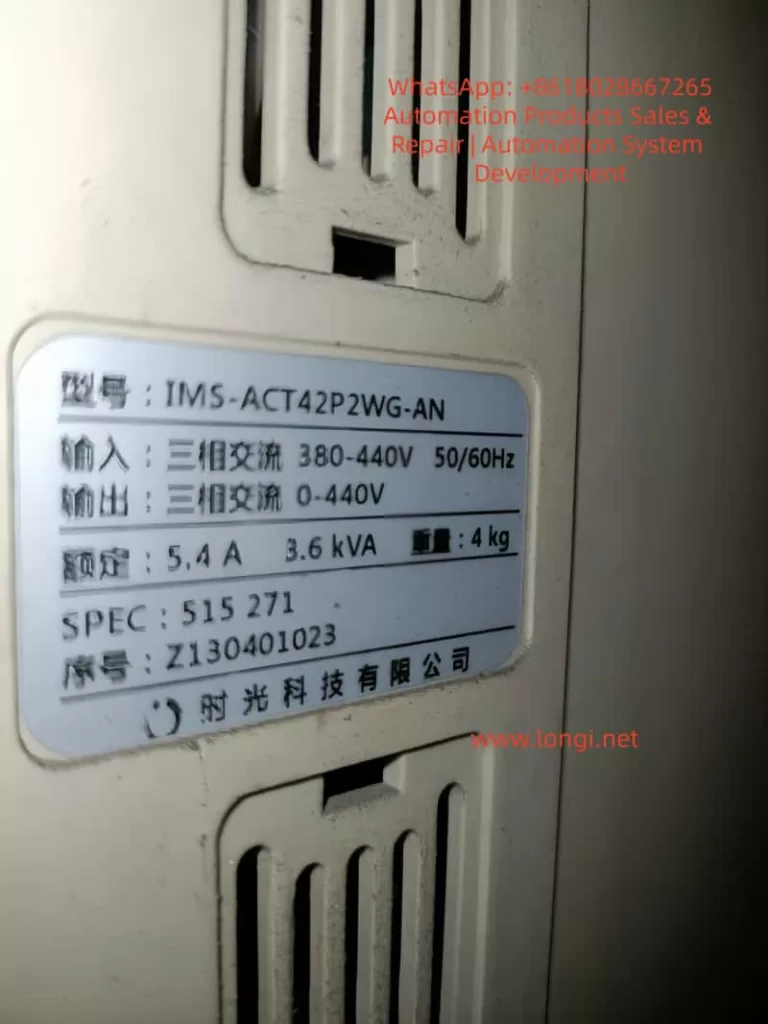
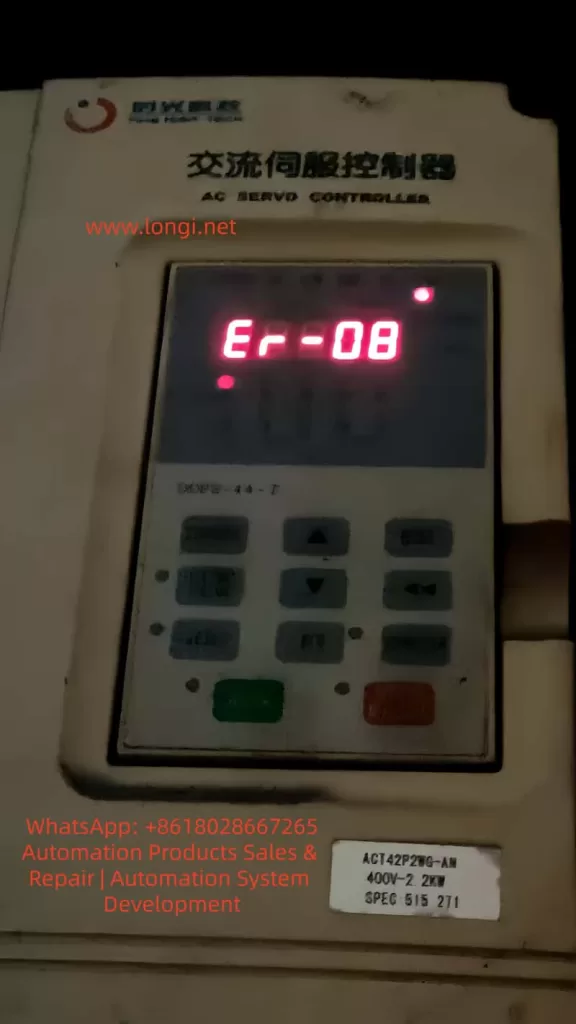
IMS-A Series Servo Controller Er-08 Fault Analysis and Troubleshooting Guide

The Er-08 alarm on the IMS-A series servo controller from Shiguang Technology is not a typical hardware protection fault such as overcurrent, overvoltage, undervoltage, or overheating. Instead, it is mainly related to internal parameter storage, QMCL program execution, CPU operation, and RAM memory retention.

According to the IMS-A series controller documentation, Er-08 indicates a QMCL language error or parameter initialization abnormality caused by CPU interference. Common causes include severe input power interference, corrupted parameter areas, abnormal QMCL programs, insufficient RAM backup battery voltage, or internal communication abnormalities.

Unlike ordinary frequency inverters, the IMS-A controller uses digital vector control combined with QMCL motion control programming. Therefore, the controller operation depends not only on electrical hardware but also on internally stored parameters and motion programs. Once these data become corrupted or lost, the controller may fail to initialize properly and trigger Er-08.


IMS-ACT42P2WG-AG

1. Understanding the Meaning of Er-08

The IMS-A series is designed for high-performance control of AC induction motors using PG-based vector control. The controller integrates speed control, position control, torque control, programmable I/O, communication functions, and QMCL motion logic inside the controller itself.

Because of this architecture, Er-08 is fundamentally different from ordinary drive alarms.

This alarm usually means one of the following:

  • The CPU detected abnormal QMCL program execution
  • RAM parameter data became corrupted
  • Internal parameters were unexpectedly initialized
  • The controller experienced severe electrical interference
  • The RAM backup battery voltage became insufficient
  • The QMCL motion program was lost or damaged

In practical applications, Er-08 commonly appears in these situations:

  • Equipment remained powered off for a long period
  • The machine was stored for years before reuse
  • The control cabinet contains heavy electrical noise
  • Nearby contactors or braking systems generate interference
  • Parameters were modified but not properly saved
  • The controller lost RAM retention power
  • The control board suffered moisture or dust contamination

2. Why the RAM Backup Battery Is Important

The IMS-A controller stores part of its parameters and QMCL programs inside RAM memory. RAM requires continuous backup power to preserve data after shutdown.

The controller uses an onboard backup battery for this purpose.

If the battery voltage becomes low, the RAM contents may partially or completely disappear during power-off periods. When the controller powers on again, the CPU may detect invalid parameter data or corrupted QMCL instructions and generate Er-08.

The IMS-A manual specifically mentions that the RAM backup battery must maintain sufficient voltage. Long-term storage without periodic power-up may cause parameter and QMCL data loss.

This is extremely important in real maintenance work.

Many technicians repeatedly power-cycle the controller after Er-08 appears, but the alarm remains because the issue is no longer temporary interference. The internal data itself may already be corrupted.

Replacing the battery alone does not automatically restore lost parameters or QMCL programs. The original data may still need to be rewritten manually.

Older machines, second-hand equipment, spare stock units, and machines stored for years are especially vulnerable to this issue.


Er-08 Fault of the IMS-A drive

3. Difference Between Er-08 and Normal Hardware Faults

Typical servo or inverter faults usually point to specific hardware problems:

  • Overcurrent
  • Overvoltage
  • Undervoltage
  • IGBT module overheating
  • Encoder disconnection
  • Motor overload
  • Cooling fan failure

Er-08 is different.

It mainly points to software-level or memory-level abnormalities rather than direct power hardware failure.

This means the motor, encoder, power module, and braking resistor may still be physically normal while the controller itself cannot correctly execute internal logic.

However, this does not mean hardware inspection should be ignored.

Electrical noise, grounding problems, unstable control power supplies, moisture contamination, and control board deterioration can all indirectly trigger parameter corruption and CPU instability.

Therefore, Er-08 troubleshooting must combine both software and hardware inspection.


4. First Troubleshooting Step: Check Power Supply and Electrical Noise

One major cause of Er-08 is severe electrical interference entering through the input power line.

The first step should always be verifying the incoming power quality.

Check the following carefully:

  • Three-phase input voltage balance
  • Loose input terminals
  • Burned contactor contacts
  • Voltage fluctuation during startup
  • Sudden voltage dips
  • Grounding quality
  • Cabinet interference sources

Particular attention should be paid to:

  • Large contactors
  • Welding machines
  • Solenoid valves
  • Brake units
  • Large motors
  • Frequent switching loads

Poor grounding can allow common-mode noise to enter the control board and CPU circuitry.

Encoder cables, communication lines, and motor power cables should not run together in parallel for long distances.

If Er-08 appears randomly during machine operation rather than immediately after startup, electrical interference becomes highly suspect.


5. Second Troubleshooting Step: Inspect the RAM Backup Battery

For older or long-stored equipment, the RAM battery must be inspected immediately.

Important inspection points include:

  • Battery voltage level
  • Corrosion around battery terminals
  • Loose solder joints
  • Oxidized connectors
  • Signs of leakage or swelling

If the battery voltage is low, parameter retention becomes unreliable.

Even if the controller temporarily starts normally, the parameters may disappear again after shutdown.

After battery replacement, the following items must still be verified:

  • System parameters
  • Motor parameters
  • Encoder settings
  • I/O assignments
  • QMCL programs
  • Motion control logic

Battery replacement alone does not guarantee recovery.


6. Third Troubleshooting Step: Verify Controller Parameters

After Er-08 occurs, parameters may revert to defaults or become partially corrupted.

The technician must compare the current settings against original machine records.

Critical parameters include:

  • Motor rated voltage
  • Rated current
  • Encoder pulse count
  • Speed loop settings
  • Position loop settings
  • Torque limits
  • Acceleration and deceleration settings
  • I/O terminal assignments
  • Communication settings
  • QMCL execution parameters

Machines using position control, synchronization, tension control, lifting systems, or indexing systems are especially sensitive to parameter corruption.

Improper parameters may cause:

  • Wrong motor direction
  • Brake release failure
  • Limit switch malfunction
  • Mechanical collisions
  • Servo instability

The machine should never be restarted aggressively before confirming parameter correctness.


7. Fourth Troubleshooting Step: Inspect the QMCL Program

The IMS-A controller uses QMCL programming for motion logic execution.

If the QMCL program becomes corrupted, missing, or incompatible with the hardware configuration, Er-08 may appear continuously.

Possible QMCL-related causes include:

  • Program corruption
  • Incomplete writing process
  • Incorrect parameter addressing
  • Invalid jump instructions
  • Program storage failure
  • Wrong hardware type configuration
  • PG configuration mismatch
  • Incorrect I/O definitions

If the machine previously operated normally for years and suddenly developed Er-08 after long storage or power interruption, the original program itself is usually not defective. Instead, the stored data may have been lost or damaged.

In such cases, restoring the original backup program is often necessary.

Without a backup, repair becomes significantly more difficult because the QMCL program may contain custom machine logic specific to the application.


8. Recommended Repair Procedure for Er-08

A proper troubleshooting sequence is extremely important.

Step 1: Power Down Safely

Disconnect main power and wait until the DC bus fully discharges.

Step 2: Inspect Input Power

Measure three-phase voltage and confirm stable power quality.

Step 3: Eliminate Electrical Noise

Check grounding, shielding, cabinet layout, and interference sources.

Step 4: Attempt Alarm Reset

Clear the alarm only after ensuring all run commands are removed.

Step 5: Verify Parameters

Compare all important parameters with original records.

Step 6: Inspect Backup Battery

Measure battery voltage and replace if necessary.

Step 7: Restore Parameters

Rewrite original motor and control parameters.

Step 8: Restore QMCL Program

Reload the original motion control program if required.

Step 9: Perform No-Load Testing

Check motor direction, encoder feedback, and brake control.

Step 10: Perform Full Load Testing

Gradually restore full machine operation while monitoring stability.


9. Common Mistakes During Er-08 Repair

Repeated Power Cycling

If RAM data is already corrupted, repeated restarting will not solve the issue.

Ignoring the Backup Battery

Low battery voltage is one of the most common root causes.

Treating Er-08 as a Power Module Failure

Er-08 does not directly indicate IGBT damage.

Restarting Without Parameter Verification

Incorrect parameters may cause dangerous machine movement.

Ignoring QMCL Programs

Many technicians only understand inverter parameters and overlook motion logic programs.


10. Verification After Repair

Successful repair means more than simply clearing the alarm.

The following conditions should be verified:

  • No Er-08 alarm during startup
  • Parameters remain stable after power cycling
  • QMCL programs execute correctly
  • Encoder feedback operates normally
  • Motor direction is correct
  • Brake control functions properly
  • Limit switches respond correctly
  • No abnormal vibration or noise
  • Long-term operation remains stable

11. Preventive Measures

To reduce the risk of future Er-08 faults:

  • Periodically power up long-stored equipment
  • Replace aging RAM batteries proactively
  • Maintain clean and dry control cabinets
  • Separate encoder cables from motor cables
  • Use proper cable shielding and grounding
  • Install surge suppression for inductive loads
  • Maintain backups of parameters and QMCL programs
  • Reduce electrical interference inside the cabinet

For older machines, maintaining complete backups is extremely important. Losing a custom QMCL program may lead to extended downtime and difficult recovery.


12. Conclusion

The Er-08 alarm on the IMS-A series servo controller is fundamentally related to QMCL program execution, parameter initialization abnormalities, CPU interference, and RAM memory retention problems.

Unlike standard hardware protection alarms, Er-08 mainly involves the controller’s internal software and storage system.

Effective troubleshooting requires systematic inspection of:

  • Input power quality
  • Electrical interference
  • Grounding
  • RAM backup battery condition
  • Parameter integrity
  • QMCL program integrity
  • Control board condition

In many cases, especially on older or long-stored equipment, low backup battery voltage and corrupted RAM data are the primary root causes.

Maintaining stable electrical environments, proper grounding, regular maintenance, and reliable backups of parameters and QMCL programs are the most effective long-term strategies for preventing recurring Er-08 faults.

Posted on

Diagnosing and Calibrating AO2 Analog Current Output Deviation on the JT330S2 Inverter: Complete Analysis from Parameter F6-08 to PLC Engineering Value Scaling

In industrial automation systems, analog outputs from inverters are widely used to transmit operating frequency, output current, output voltage, torque, power, and other real-time operating data to PLCs, HMIs, recorders, or supervisory systems. Although this appears to be a simple analog wiring task, field commissioning often reveals problems such as:

“The parameter has already been set correctly, but the PLC display is still inaccurate.”

A typical example involves a JT330S2 inverter configured to output a 0–20mA analog signal through terminal AO2 so that a Siemens S7-200 SMART PLC can monitor the motor’s actual running current. According to the inverter manual, the technician sets parameter:

F6-08 = 2

which selects “Output Current” as the AO2 output function.

However, during operation, the inverter display or clamp meter shows an actual motor current of approximately 20A, while the PLC displays only 10A — exactly half of the real value.

This type of issue should not immediately be interpreted as:

“The inverter is faulty”
or
“The parameter was set incorrectly.”

From a troubleshooting perspective, the problem is usually related to scaling mismatch between:

1. What signal the inverter actually outputs
2. What signal the PLC actually receives
3. How the PLC program converts that signal into engineering units

To solve the problem correctly, all three stages must be analyzed independently.


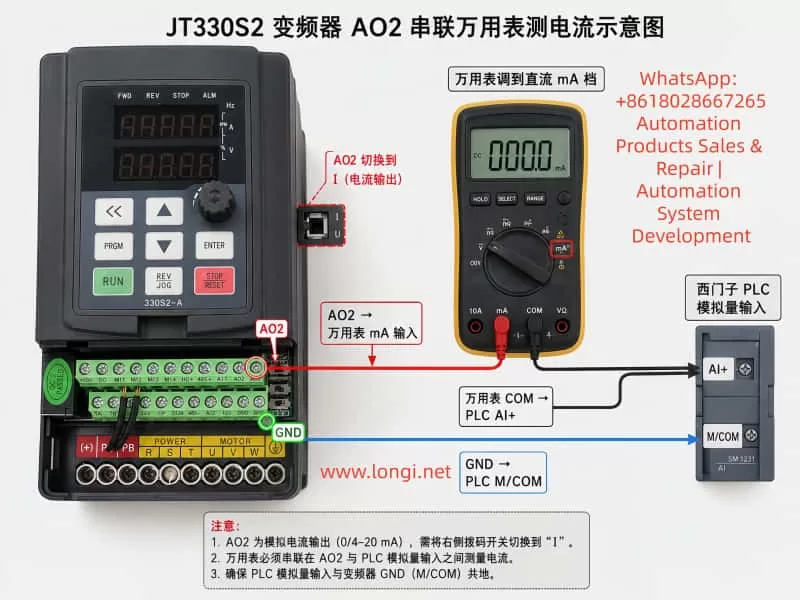
JT330S2 inverter AO2 analog current output measurement wiring diagram showing a digital multimeter connected in series between the inverter AO2 terminal and Siemens PLC analog input AI+, with GND connected to PLC M/COM, demonstrating correct 0–20mA current signal testing and AO2 current-output jumper setting.

1. Basic Function of AO2 Analog Output

The JT330S2 inverter provides two analog outputs:

AO1
AO2

These outputs can be configured to represent different operating parameters, including:

Running frequency
Set frequency
Output current
Output torque
Output power
Output voltage
Input analog values
Motor speed
Communication settings

In this application, the user wants the PLC to monitor the motor output current, therefore AO2 should be configured as:

F6-08 = 2

meaning:

AO2 output function = Output Current

This setting direction is correct. However, F6-08 only determines:

“What AO2 outputs”

It does NOT automatically guarantee:

“20A motor current = 20mA analog output”

Analog output accuracy also depends on:

Output mode
Zero offset
Gain
Full-scale mapping
PLC input scaling
Engineering unit conversion

Therefore, F6-08 is only the first step. The technician must still verify:

Whether AO2 is configured as current or voltage output
Whether AO2 outputs 0–20mA or 4–20mA
How the PLC analog module is configured
How the PLC program converts the raw analog value

2. Why the PLC Displays Only Half the Actual Current

The key field symptom is:

Actual motor current: 20A
PLC displayed current: 10A

An error that is exactly “half” is usually not random. It almost always indicates a scaling mismatch.

Suppose the inverter internally defines:

20mA = 40A

Then when the motor current is 20A, AO2 only needs to output half-scale current:

Approximately 10mA

Now suppose the PLC program assumes:

20mA = 20A

Then the PLC interprets 10mA as:

10A

This creates the observed condition:

Actual 20A
→ AO2 outputs approximately 10mA
→ PLC interprets 10mA as 10A

Therefore, the issue is most likely NOT that AO2 is malfunctioning. Instead, the scaling relationship between the inverter analog output and the PLC engineering conversion is inconsistent.


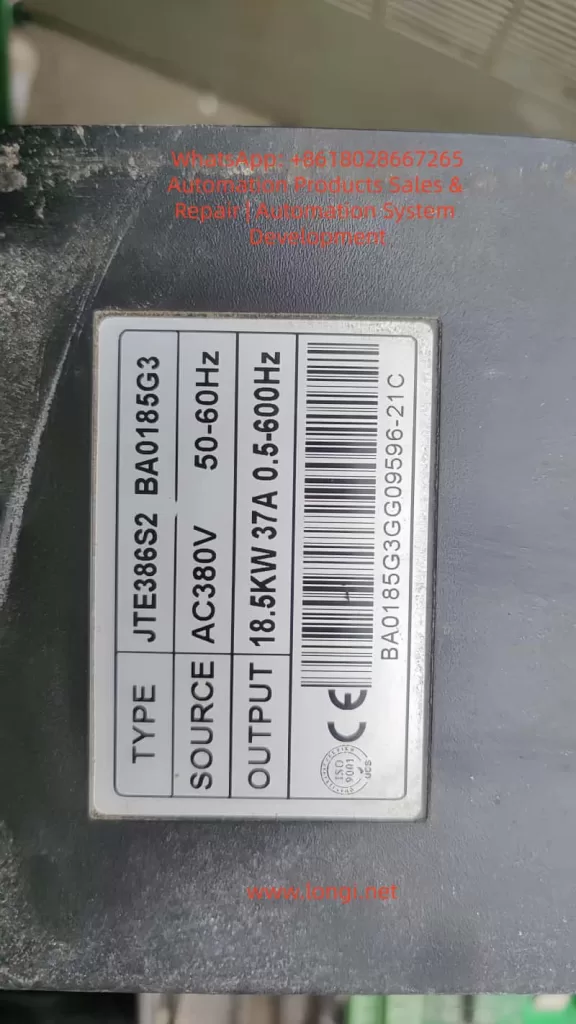
JTE386S2 BA0185G3

3. Measure the Actual AO2 Output Current First

One of the biggest mistakes in field troubleshooting is immediately changing parameters without measurement.

The correct approach is to first measure the real AO2 output current using a multimeter.

Unlike voltage measurement, current measurement must be performed in series.

The correct wiring method is:

Inverter AO2 → Multimeter mA Input
Multimeter COM → PLC Analog Input AI+
Inverter GND → PLC Analog M/COM

In practical terms:

Disconnect the wire between AO2 and PLC AI+
Insert the multimeter in series

The multimeter must be set to:

DC mA measurement mode

The red probe must be inserted into the:

mA terminal

and the black probe into:

COM

If the meter is accidentally placed in voltage mode, AC current mode, or connected in parallel, the reading will be incorrect and the meter fuse may even blow.


4. Using Measured Values to Determine the Root Cause

During testing, record three values simultaneously:

1. Inverter displayed output current
2. Multimeter measured AO2 current signal
3. PLC displayed current

Measurements should be taken at multiple load points:

Low load (e.g. 5A)
Medium load (e.g. 10A)
High load (e.g. 20A)

Case 1: Actual 20A → AO2 ≈ 10mA → PLC Displays 10A

This means the PLC display follows the analog signal correctly, but the engineering scaling range is too small.

The PLC likely assumes:

20mA = 20A

while the inverter output behaves like:

20mA = 40A

Typical PLC conversion formula:

Current = Raw_AI × 20 / 27648

should instead become:

Current = Raw_AI × 40 / 27648

This adjustment causes:

10mA → 20A

which restores correct display.


Case 2: Actual 20A → AO2 ≈ 20mA → PLC Displays 10A

In this case, the inverter analog output is already correct.

The fault is entirely on the PLC side.

Possible causes include:

Incorrect analog module range
Incorrect PLC scaling formula
Incorrect HMI engineering scaling
Additional divide-by-two logic in the program
Incorrect analog module configuration

If the PLC raw analog value already reaches near full scale but the displayed engineering value is still half, the inverter is NOT the problem.


Case 3: Actual 20A → AO2 Has Almost No Current Output

This suggests a hardware or wiring issue.

The technician should verify:

AO2 jumper/switch position
AO2 wiring
PLC analog input type
GND common reference
F6-08 parameter
F6-12 offset
F6-13 gain

On the JT330S2 control board, AO1 and AO2 can be configured as either:

Voltage output (V)
Current output (I)

If AO2 is still configured for voltage output while the PLC expects current input, readings will be abnormal.


5. Recommended Inverter Parameter Settings

For transmitting actual motor current through AO2:


AO2 Hardware Mode

Set AO2 jumper/switch to:

I = Current Output

Do NOT leave it at:

V = Voltage Output

AO2 Function Selection

F6-08 = 2

meaning:

AO2 outputs motor current

AO2 Offset

F6-12 = 0.0%

Normally keep default.

Improper offset adjustment can create false low-current readings.


AO2 Gain

F6-13 = 1.00

Normally keep default initially.

If measurements confirm the AO2 signal is exactly half the desired value, gain can be increased:

F6-13 = 2.00

However, increasing gain also risks premature saturation.

Example:

Originally:

40A = 20mA

After doubling gain:

20A = 20mA

Then any current above 20A can no longer be represented properly.

Therefore, adjusting PLC scaling is usually preferable.


6. PLC Engineering Unit Scaling Is Often Overlooked

Siemens S7-200 SMART analog modules typically convert analog current into digital values.

A common full-scale raw value is:

27648

for:

0–20mA

Engineering conversion formula:

Engineering_Value = Raw_AI × FullScale / 27648

The key question is:

What actual current does 20mA represent?

The PLC does not know automatically.

The programmer must define it.

If the PLC program assumes:

20mA = 20A

then:

10mA = 10A

If the inverter behavior is actually:

20mA = 40A

then the PLC formula must be updated accordingly.


7. 0–20mA and 4–20mA Must Not Be Confused

Industrial analog current signals are commonly:

0–20mA
4–20mA

0–20mA:

0mA = zero signal
20mA = full scale

4–20mA:

4mA = zero signal
20mA = full scale

4–20mA allows wire-break detection because signal loss drops below 4mA.

The following three elements must always match:

Inverter output type
PLC analog input type
PLC scaling formula

If one side uses 0–20mA and the other assumes 4–20mA, scaling errors will occur.


8. Why Special Output Modes Should Not Be Used Randomly

Some JT330S2 firmware versions include special AO2 scaling options such as:

100% = 1000A

These modes are usually intended for:

Special scaling
Communication mapping
Large-current systems
Manufacturer calibration

They are generally unsuitable for standard motor current monitoring applications.

For normal PLC monitoring:

F6-08 = 2

is the preferred choice.

Scaling corrections should then be handled through:

F6-13 gain adjustment
or
PLC engineering scaling

9. Recommended Field Commissioning Procedure

A practical troubleshooting workflow:


Step 1 — Verify Wiring

AO2 → PLC AI+
GND → PLC M/COM

For testing:

AO2 → Multimeter mA input
Multimeter COM → PLC AI+
GND → PLC M/COM

Step 2 — Verify AO2 Hardware Mode

AO2 jumper = I

Step 3 — Verify Parameters

F6-08 = 2
F6-12 = 0.0%
F6-13 = 1.00

Step 4 — Record Operating Data

Measure:

Actual motor current
AO2 mA signal
PLC raw analog value
PLC displayed engineering value

Step 5 — Analyze Results

Correct AO2 but wrong PLC display
→ PLC scaling issue

AO2 signal too small
→ Gain or scaling mismatch

No AO2 signal
→ Wiring/jumper/input mode issue

Unstable signal
→ Grounding/shielding/noise problem

10. Wiring and Safety Considerations

Even though AO2 is a low-level control signal, inverter commissioning still involves dangerous power circuits.

Important precautions:

Never modify power wiring while energized
Do not short 24V, 10V, or GND terminals
Current measurement must be series-connected
Use correct meter terminals
Avoid shorting AO2 to GND
Ensure proper common grounding
Use shielded analog cables
Separate analog cables from motor cables

Many analog signal issues are actually caused by:

Improper shielding
Noise interference
Incorrect grounding
Mixed routing with motor cables
Floating analog commons

rather than parameter settings.


11. Explaining the Problem to Customers

A practical explanation for customers is:

“Setting F6-08=2 only tells the inverter to output motor current through AO2. The PLC display depends on how many milliamps AO2 actually outputs and how the PLC converts those milliamps into amps. If actual current is 20A but PLC shows 10A, the scaling ratio is incorrect. First measure the real AO2 output current with a multimeter. If 20A corresponds to 10mA, either adjust PLC scaling so that 20mA equals 40A, or increase AO2 gain. If 20A already corresponds to 20mA, then the issue is entirely inside the PLC program.”

This explanation helps avoid unnecessary inverter replacement.


12. Conclusion

When using the JT330S2 inverter AO2 analog output to transmit motor current to a Siemens PLC, parameter:

F6-08 = 2

is correct, but it is only the function selection step.

The common field symptom:

Actual 20A
PLC displays 10A

is usually caused by mismatch between:

AO2 output scaling
PLC analog input scaling
Engineering conversion formulas

The proper diagnostic method is to:

Measure the real AO2 mA signal first

using a multimeter connected in series.

Then determine whether the issue lies in:

PLC scaling
AO2 gain
Wiring
Output mode
Grounding

In most practical applications, correcting PLC engineering scaling is preferable to increasing AO2 gain, because it avoids premature analog output saturation and preserves full measurement range.

The key principle in troubleshooting analog output systems is understanding the complete signal chain:

Motor Current
→ Inverter Internal Calculation
→ AO2 Analog Output
→ PLC Analog Acquisition
→ PLC Engineering Conversion
→ HMI Display

By testing and verifying each stage independently, technicians can rapidly locate the true cause of scaling errors and avoid unnecessary hardware replacement or repeated blind parameter adjustments.

Posted on

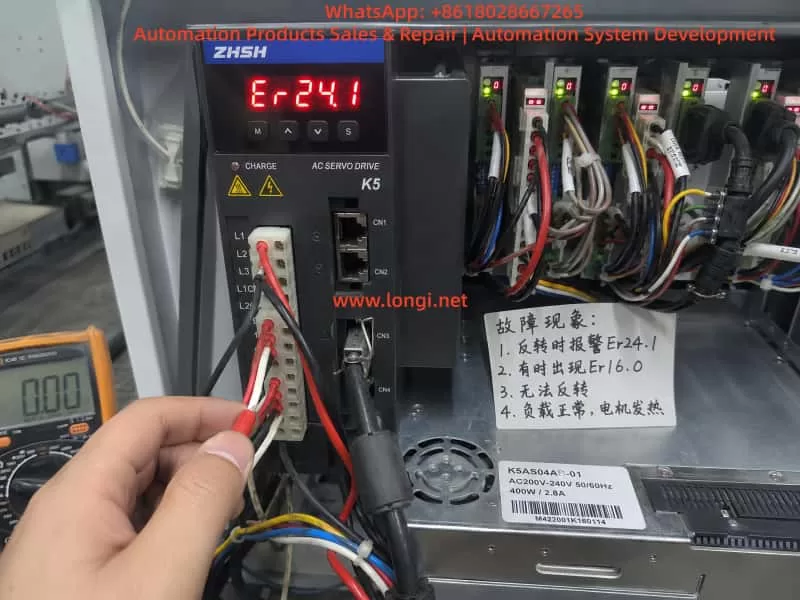
Troubleshooting Er24.1 and Er16.0 on the Zhishan K5 Servo Drive: Reverse Rotation Failure, Excessive Speed Deviation, and Overload Protection

In CNC equipment, automatic feeding systems, packaging machines, printing machines, dispensing machines, winding machines, and many other automation mechanisms, AC servo systems are responsible for accurate positioning, speed control, and torque output. Once a servo drive reports an alarm, the machine usually stops immediately. Compared with a standard inverter, a servo drive has stricter monitoring logic because it does not only check current, voltage, and temperature; it also continuously compares command position, command speed, actual encoder position, and actual feedback speed.

For this reason, when a servo system fails, the technician should not only ask whether the motor can rotate. It is more important to analyze the relationship between command, feedback, load, wiring, parameters, and the mechanical transmission structure.

In field applications, the Zhishan K5 series AC servo drive may show the following symptom: the drive powers on normally, the servo can be enabled, forward rotation may work, but reverse rotation fails. Once a reverse command is given, the motor may not move, may move slightly and stop, or may immediately trigger Er24.1. In some cases, Er16.0 also appears.

This fault may look like a defective servo drive, but the real cause may be mechanical jamming, excessive load, abnormal encoder feedback, incorrect motor phase wiring, wrong direction logic, active reverse limit signal, brake not released, or improper parameter settings. To solve this problem correctly, the alarm meaning must be combined with the real machine behavior.

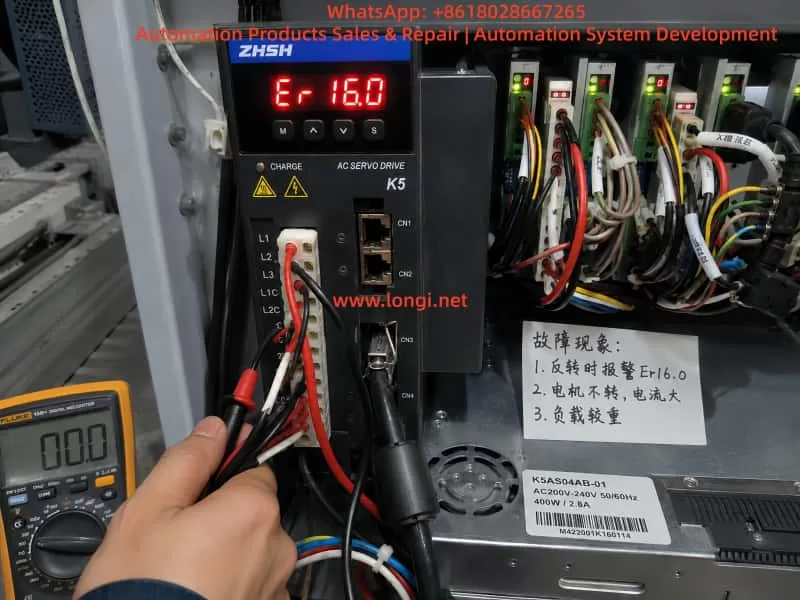
Zhishan K5 AC servo drive displaying Er24.1 speed deviation alarm inside an industrial control cabinet during on-site maintenance and troubleshooting.

1. The Meaning of Er24.1: Excessive Speed Deviation

For the K5 servo drive, Er24.1 generally means excessive speed deviation protection. Speed deviation is the difference between the speed commanded by the drive and the actual speed fed back by the motor encoder.

For example, the PLC or motion controller sends a reverse rotation command to the servo drive. The drive outputs three-phase current to make the motor rotate in reverse. However, the encoder feedback shows that the motor speed does not reach the expected value, or the motor almost does not move. In this case, the drive determines that the difference between command speed and actual speed is too large. To prevent overcurrent, overload, mechanical impact, or loss of control, the drive stops and reports Er24.1.

Therefore, Er24.1 does not necessarily mean that the drive is internally damaged. More accurately, it means:

The drive has issued a motion command, but the actual motor movement does not match the expected result.

Common causes include:

motor blocked by mechanical load;

reverse direction mechanically jammed;

mechanical hard limit reached;

motor brake not released;

load inertia too large;

acceleration or deceleration time too short;

motor U/V/W wiring wrong or loose;

encoder cable loose or abnormal;

motor and drive not matched;

reverse direction signal logic incorrect;

speed deviation detection threshold set too small;

servo gain not suitable for the machine.

If the actual symptom is “forward rotation works, but reverse rotation fails,” the key point is not only speed deviation. The real question is:

Why does the motor fail to follow the command only in reverse direction?

2. The Meaning of Er16.0: Overload Protection

Er16.0 is usually related to overload protection. Overload does not always mean an instant short circuit, and it does not always mean that the drive power module is damaged. In servo systems, overload usually means that the motor current has exceeded the allowed range for a certain period of time. The drive judges that the motor or drive is carrying excessive load.

If the machine is mechanically jammed in reverse direction, the drive will increase output current in an attempt to make the motor rotate. But because of mechanical resistance, brake locking, wiring error, or abnormal feedback, the motor cannot reach the target speed. This may first trigger Er24.1. If the high current continues, Er16.0 may also appear.

In other words, Er24.1 and Er16.0 are often connected:

A reverse command is given.

The motor cannot rotate correctly because of mechanical load, limit signal, brake, wiring, or feedback problem.

The drive increases output current.

The encoder feedback speed cannot follow the command.

The drive reports Er24.1.

If high current continues, the drive reports Er16.0.

Therefore, when Er24.1 appears together with Er16.0, do not treat them as two unrelated faults. The correct diagnostic logic is:

Find out why the motor cannot follow the command first, then determine whether overload is the cause or the result.

Zhishan K5 AC servo drive showing Er16.0 overload alarm while a technician performs electrical diagnostics inside an industrial automation control panel.

3. When Reverse Rotation Fails, Mechanical Problems Are Highly Suspect

In real repair work, if a servo system can rotate forward but cannot rotate backward, the mechanical side must be checked first. Many technicians immediately suspect the servo drive and replace it. However, after replacing the drive, the same alarm may still appear because the root cause is not in the drive.

Common mechanical causes include the following.

The first is one-direction mechanical jamming. Lead screws, guide rails, belts, chains, gearboxes, feeding wheels, and clamping mechanisms may move smoothly in one direction but become tight in the opposite direction. Lack of lubrication, damaged bearings, worn lead screw nuts, misaligned belts, damaged gearbox teeth, or foreign objects may all cause reverse movement failure.

The second is a mechanical hard limit. If the mechanism has reached the end position, and the limit switch or software limit does not stop the axis correctly, the servo may command movement against a dead stop. The motor receives torque command but cannot move. Current rises quickly, actual speed remains very low, and the drive reports an alarm.

The third is brake failure. If the servo motor has an electromagnetic brake, the brake must be released before motion. If the brake power supply is missing, the brake relay contact is damaged, the brake coil is faulty, or the brake mechanism is stuck, the motor may hum, vibrate, or fail to rotate. Sometimes the brake is not completely locked but only partially released. This is more difficult to detect because the motor may rotate at no load but fail under load.

The fourth is asymmetric load. Many machines do not have the same load in forward and reverse directions. Lifting mechanisms, feeding systems, pressing rollers, and clamping systems may have very different resistance depending on direction. If reverse direction happens to be the heavy-load direction, Er24.1 and Er16.0 may appear more easily.

For this reason, when a K5 servo drive reports Er24.1 or Er16.0 and the machine cannot reverse, do not start by changing parameters. First confirm whether the machine is mechanically able to move in reverse.

4. The Most Effective First Test: Disconnect the Load

The fastest way to separate mechanical problems from electrical problems is to disconnect the motor from the mechanical load. This means loosening the coupling, belt, gear connection, or other transmission connection so that the motor can run freely without load.

Do not test at high speed first. Use a low-speed jog command, such as 30 rpm, 50 rpm, or 100 rpm, and observe whether the motor rotates smoothly.

Check the following:

Can the motor rotate forward without load?

Can the motor rotate backward without load?

Does the motor vibrate during reverse rotation?

Does it make abnormal noise?

Does Er24.1 still appear?

Does Er16.0 still appear?

If the motor runs normally in both directions without load, the servo drive, motor, and encoder are probably not the main problem. The focus should move to mechanical load, brake, limit switch, or machine process.

If reverse rotation still triggers Er24.1 without load, the problem is more likely in motor wiring, encoder feedback, control signal, parameters, motor, or drive hardware.

This simple test is extremely valuable because it can quickly divide the fault into mechanical side or electrical side. Many servo faults take too long to repair because the technician keeps adjusting drive parameters without first separating the motor from the machine.

5. Check U/V/W Motor Wiring and Encoder Feedback

A servo motor is not the same as a normal three-phase induction motor. For a normal induction motor, changing two phases can reverse the direction. But for a servo motor, U/V/W phases cannot be changed randomly. The drive output phase sequence must correspond correctly to the encoder feedback angle. If the motor phase wiring is wrong, or if the encoder feedback direction does not match the drive output, the servo loop may become unstable.

Possible symptoms include vibration, no torque, excessive current, overcurrent, speed deviation alarm, or overload alarm.

The following points must be checked carefully:

U, V, and W are connected to the correct drive terminals;

motor cable has no broken wire;

terminal screws are tight;

connector pins are not bent or pushed back;

motor cable is not damaged;

encoder connector is fully inserted;

encoder cable shield is properly grounded;

encoder cable is not bundled together with power cables for a long distance;

motor and drive belong to the same axis;

motor cable and encoder cable are not crossed with another axis.

Multi-axis machines are especially prone to cable mix-up. For example, the motor power cable may belong to axis A, but the encoder feedback cable may be connected to axis B. Once the motor and encoder are not matched, the drive cannot close the loop correctly. The result may be immediate alarm, vibration, or dangerous motion.

If the fault appeared after repair, transportation, rewiring, motor replacement, or drive replacement, wiring error must be treated as a high-probability cause.

6. Check Reverse Limit and Inhibit Signals

“Cannot reverse” may also be caused by external control signals. A servo drive usually receives signals from a PLC, motion controller, or control board, including pulse command, direction signal, servo enable, positive limit, negative limit, emergency stop, alarm reset, and inhibit signals.

If the reverse direction limit signal is active, the drive may block movement in that direction. The field symptom may look like the motor cannot reverse, or it may stop immediately when reverse command is given.

Check these signals:

positive limit input;

negative limit input;

forward inhibit input;

reverse inhibit input;

emergency stop input;

servo enable input;

pulse input;

direction input;

PLC output logic;

control common wiring;

input terminal function assignment.

Some machines use normally closed limit logic, while others use normally open logic. If a limit switch, PLC output card, wiring, or parameter has been changed, the input logic may become inverted. The machine may not actually be at the negative limit, but the drive may think the negative limit is active, so reverse movement is blocked.

The correct method is not only to watch whether the limit switch moves mechanically. The technician must confirm the actual input status seen by the servo drive. This can be done through the drive monitor function or by measuring the terminal voltage with a multimeter.

7. Check Whether the Brake Is Released

If the servo motor has a holding brake, the brake circuit must be checked separately. Many technicians assume that the brake will automatically release when the servo is enabled, but in actual machines this is not always true.

The brake often requires an independent 24 VDC supply. It may be controlled by a relay, PLC output, or drive output. If the brake power supply is missing, the relay contact is burnt, the brake coil is damaged, or the brake mechanism is stuck, the motor will be forced to rotate against the brake.

Check the following:

brake rated voltage;

whether brake voltage appears after servo enable;

whether the brake makes a clear release sound;

whether the motor shaft can rotate freely after brake release;

whether brake power supply capacity is enough;

whether relay contacts are burnt;

whether brake coil is open or shorted;

whether brake gap is abnormal;

whether the brake is mechanically stuck.

If the brake is not released and the servo is forced to run, Er24.1 and Er16.0 can appear together. The drive outputs current, but the motor does not reach commanded speed. The result is speed deviation and overload.

8. Parameter Adjustment Should Not Be the First Solution

When technicians see speed deviation alarm, they may want to increase the speed deviation threshold. When they see overload alarm, they may want to increase acceleration time, reduce gain, or modify torque limit. Parameter adjustment can sometimes reduce false alarms, but it should not be used to hide a real mechanical or wiring problem.

If the mechanism is jammed, increasing the speed deviation threshold only delays the alarm. The motor may remain stalled for a longer time, causing motor overheating, drive damage, or mechanical deformation.

If U/V/W wiring or encoder feedback is wrong, parameter adjustment cannot solve the root problem. It may only make the fault more dangerous.

Parameter checking should be done after mechanical and wiring checks. Important parameter groups include:

speed deviation detection threshold;

speed deviation detection time;

acceleration time;

deceleration time;

speed loop gain;

position loop gain;

torque limit;

electronic gear ratio;

pulse input mode;

direction signal polarity;

motor capacity setting;

encoder-related settings;

positive and negative limit input assignment.

Do not restore factory parameters blindly. Machine builders may have set electronic gear ratio, limit logic, pulse mode, gain, and control mode according to the actual machine. A careless factory reset may make the machine unable to return to its original working condition.

9. How to Distinguish Drive Fault, Motor Fault, and External Fault

A practical diagnostic sequence should follow this order:

external mechanical system;

motor and encoder wiring;

control signals;

parameters;

drive and motor hardware.

If the motor runs normally without load but alarms under load, suspect mechanical load, brake, guide rail, lead screw, belt, gearbox, or machine jamming.

If forward works but reverse fails, suspect reverse mechanical resistance, negative limit, reverse inhibit, direction logic, or reverse acceleration impact.

If both forward and reverse vibrate or lack torque, suspect U/V/W wiring, encoder cable, motor matching, or servo gain.

If the alarm appears immediately after servo enable, suspect encoder fault, motor cable fault, drive power module, motor winding, brake locking, or serious parameter mismatch.

If the alarm appears randomly, suspect loose connectors, poor shield grounding, encoder interference, terminal contact problem, unstable power supply, or intermittent mechanical jamming.

If replacing the drive does not change the fault, the problem is probably not inside the drive. It is more likely in motor, encoder, wiring, mechanics, or control signal.

If replacing the motor solves the problem, the original motor may have encoder, winding, or brake failure.

If replacing the encoder cable solves the problem, the original cable or connector has a hidden fault.

If the same drive and motor work normally on a test bench but fail after installation, the machine mechanism or control logic must be checked.

10. Recommended Field Troubleshooting Procedure

For a Zhishan K5 servo drive showing Er24.1, sometimes with Er16.0, and failing to reverse, the following procedure is recommended.

First, record the alarm timing. Confirm whether the alarm appears at power-on, at servo enable, during forward rotation, or only during reverse rotation. The timing is more important than the alarm code alone.

Second, check whether the mechanism can move backward. With power off, manually rotate the transmission mechanism if possible. Check for tight points, hard stops, abnormal noise, brake locking, or one-direction resistance.

Third, disconnect the load and test the motor alone. Run forward and reverse at low speed. If the motor runs normally without load, focus on the mechanical side. If reverse still alarms without load, focus on wiring, feedback, control signal, or parameter.

Fourth, check the brake. If the motor has a brake, confirm that it is really released, not only that the control signal exists.

Fifth, check U/V/W and encoder wiring. Confirm motor phase wiring, encoder cable, shielding, connectors, and axis matching.

Sixth, check control input status. Focus on negative limit, reverse inhibit, emergency stop, servo enable, direction signal, and pulse command.

Seventh, check parameters. Confirm speed deviation threshold, acceleration and deceleration time, torque limit, direction polarity, pulse mode, electronic gear ratio, and limit input function assignment.

Eighth, test again at low speed. Start with no load, then light load, then normal load. Observe current, speed feedback, machine movement, and alarm behavior at each step.

Ninth, use substitution testing only when necessary. A same-model motor, encoder cable, or drive can be exchanged for comparison, but wiring and parameters must be confirmed before testing to avoid causing new damage.

11. Common Mistakes During Repair

Several mistakes are common when repairing this type of servo fault.

The first mistake is increasing the speed deviation threshold immediately after seeing Er24.1. This may hide mechanical jamming and cause more serious damage.

The second mistake is assuming the drive power module is bad after seeing Er16.0. Overload is often caused by load or motion conditions, not necessarily by drive hardware failure.

The third mistake is repeatedly testing the machine without disconnecting the load. If the mechanism is jammed, repeated testing sends high current into the motor and drive.

The fourth mistake is swapping U/V/W phases casually. A servo motor cannot be treated like a normal induction motor.

The fifth mistake is checking only the motor power cable and ignoring the encoder cable. Servo control is closed-loop. Encoder feedback problems can also cause speed deviation and overload.

The sixth mistake is looking only at the physical limit switch but not the drive input status. A switch may move correctly, but the drive terminal may receive the wrong signal.

The seventh mistake is restoring factory settings blindly. This may erase the original electronic gear ratio, limit logic, pulse mode, and gain settings.

The eighth mistake is ignoring the brake. A brake that does not fully release is a frequent cause of overload and speed deviation alarms.

12. Conclusion

When a Zhishan K5 series servo drive reports Er24.1, the core meaning is excessive speed deviation. When Er16.0 appears as well, the system also has an overload condition. For the symptom “reverse rotation failure,” the correct conclusion is not to immediately condemn the servo drive. The most likely causes are reverse-direction mechanical resistance, active reverse limit, brake not released, excessive load, abnormal encoder feedback, wrong wiring, or incorrect direction logic.

The correct repair method is to separate the mechanical side from the electrical side first. Disconnect the load and test forward and reverse rotation at low speed. If the motor works normally without load, check the mechanism, brake, and limit signals. If the alarm still appears without load, check U/V/W wiring, encoder cable, control terminals, direction command, and parameters.

Parameter adjustment should be used only after the real cause is identified. It should never be used to cover up mechanical jamming or wiring errors.

A servo alarm is the result of closed-loop monitoring. Er24.1 means the actual motor speed does not follow the command. Er16.0 means the motor or drive is overloaded. Only by analyzing command, feedback, current, mechanical load, and control signals together can the technician locate the fault quickly, avoid unnecessary part replacement, reduce downtime, and prevent further damage to the motor, drive, and machine mechanism.

Posted on

Troubleshooting the TECO JSDAP Servo Drive RL-04 Overcurrent Alarm: Fault Mechanism and On-Site Diagnostic Method

In CNC machine tools, turret mechanisms, feeder axes, clamping axes, and automated special-purpose machines, servo systems are responsible for precise positioning, fast response, and closed-loop control. Compared with a standard inverter driving an induction motor, a servo system has much higher requirements for motor power wiring, encoder feedback wiring, parameter matching, mechanical load condition, and control sequence. Once any of these links becomes abnormal, the servo drive may not merely show unstable speed or positioning deviation. Instead, it may directly trigger protective alarms such as overcurrent, encoder fault, overload, or excessive position deviation.

In the TECO JSDAP series servo drive, one common field alarm is RL-04, AL-04, or simply 04 on the keypad display. In actual repair work, many users tend to interpret this alarm as “high motor current” or “heavy load.” However, from a maintenance perspective, alarm 04 should not be treated as a simple overload. It is closer to an instantaneous abnormal current protection in the main power circuit. Possible causes include incorrect U/V/W motor phase wiring, abnormal encoder feedback, servo motor winding defects, damaged drive power module, mismatch between parameter Cn030 and the actual motor, mechanical jamming, or a brake that has not been released.

When a machine-tool customer reports that “the servo motor should normally rotate two turns, but now it only moves briefly and then reports RL-04 overcurrent,” this symptom has strong diagnostic value. It usually means the system is not completely faulty at power-on. Instead, the alarm occurs when the servo is enabled, the drive begins outputting current, and the motor just starts to respond. The diagnostic focus should therefore be placed on why the current rises abnormally at the moment of operation, rather than only looking at the auxiliary alarm displayed on the CNC screen.

TECO JSDAP-15A servo drive showing an RL-04 overcurrent alarm during CNC machine troubleshooting, with visible drive label, wiring terminals, technician test probes, and LNC control panel in the background.

1. Basic Meaning of the TECO JSDAP RL-04 Alarm

On the TECO JSDAP series servo drive, alarm 04 generally corresponds to drive overcurrent. From the drive’s protection logic, overcurrent does not simply mean that the load is slightly higher than usual. It means that the main circuit has detected current exceeding the protection threshold. To protect the IGBT/IPM power module, motor windings, and mechanical system, the drive immediately cuts off output and issues an alarm.

For alarm 04, the diagnostic direction normally includes checking whether the motor-side U, V, W wiring and encoder wiring are normal, and confirming that the wiring follows the standard connection diagram. If the alarm still exists after the power has been turned off for a period and then reapplied, the fault may involve the internal power transistor module of the servo drive or severe electrical noise interference.

This means RL-04/04 is not caused by one single fixed fault. It is a protective result for a class of abnormal output-current conditions. Maintenance personnel must judge the cause together with the timing of the alarm: whether it appears immediately after power-on, after servo enable, after the motor moves briefly, after a period of running, under mechanical load, or even when the motor is disconnected. Different timing points correspond to completely different fault ranges.

2. Why “The Motor Moves Once and Then Reports 04” Is Important

In field service, customers often describe the problem as “the servo motor moves a little and then alarms,” “normally it should rotate two turns, but now it stops immediately,” or “after reset, the same thing happens again.” This simple description actually contains several important clues.

First, the drive is not completely unable to power up. If the drive reports 04 immediately after control power or main power is applied, the first suspects would be the drive power module, current detection circuit, main-circuit short circuit, or serious internal component failure. In this case, however, the alarm occurs after operation begins, which means the drive can at least complete part of its initialization. The fault is triggered during output.

Second, the motor has made a short movement. If the motor can move briefly, it means the main circuit has probably output three-phase current, and the servo enable signal and part of the control logic are present. But when the motor starts and the alarm immediately appears, it suggests that the drive detects an abnormal closed-loop control condition. The current response may be much higher than expected, or the motor feedback may not match the drive output, causing the servo amplifier to increase current sharply before tripping.

Third, if the motor should normally complete two revolutions but now cannot, the axis may be involved in homing, turret indexing, clamping-axis positioning, or a fixed travel sequence. If the CNC screen also displays a message such as “clamping axis not returned to home,” that CNC message may not be the root cause. It may simply be the interlock result after the servo axis fails to complete its action. The true primary fault should still be judged from the servo drive display.

Therefore, “one brief movement followed by RL-04” should not be directly judged as motor failure, nor should it immediately be judged as drive failure. The correct approach is to distinguish mechanical load problems, motor feedback problems, power wiring problems, parameter mismatch, and drive hardware failure.

3. Common Cause 1: Incorrect, Loose, or Poorly Insulated U/V/W Motor Wiring

The U, V, W three-phase power wires of a servo motor cannot be swapped casually like those of a standard induction motor. For an ordinary three-phase induction motor, swapping any two phases mainly changes the rotation direction. But an AC servo system is closed-loop controlled. The current vector output by the drive must strictly correspond to the rotor position feedback from the encoder. If the U/V/W phase sequence is wrong, or if one phase is loose or intermittently connected, the drive may find that the motor feedback direction, speed, or phase does not match the expected response. It may then rapidly increase current to correct the error, eventually causing overcurrent protection.

In real field cases, U/V/W problems commonly occur in the following situations:

The motor or drive has been removed for repair, and the wiring was restored without a reference photo.

The terminal screws are aged or not tightened, and vibration causes poor contact during operation.

The motor cable has been worn by the drag chain, sheet-metal edge, or oil-contaminated area, damaging the insulation.

The motor connector has oil or water ingress, causing leakage or short circuits between pins.

The motor cable was replaced, but the wire colors do not match the original factory definition.

The drive output cables are bundled together with other strong-current cables, causing interference or insulation damage.

For field maintenance, wire color alone should not be used as the final judgment. The motor nameplate, connector pinout, original wiring diagram, and actual terminal marks must all be compared. After power-off and full discharge, check whether U, V, and W correspond correctly from the drive to the motor. Then measure the resistance of U-V, V-W, and W-U with a multimeter. The three values should be basically balanced. Next, measure insulation from U/V/W to the motor frame or ground. A standard multimeter can only detect serious short circuits. If insulation degradation is suspected, a megohmmeter should be used. In servo motors, insulation problems may not appear as a complete static short circuit, but may become obvious only when the drive outputs PWM voltage.

JSDAP-15A

4. Common Cause 2: Abnormal Encoder Feedback

The core of a servo system is closed-loop control. The drive not only outputs three-phase current to the motor, but also reads encoder feedback in real time to determine rotor position, speed, and direction. If encoder feedback is lost, reversed, distorted, intermittent, or affected by broken wires or poor connector contact, the drive’s judgment of motor status becomes unreliable.

Encoder faults do not always immediately appear as a dedicated encoder alarm. In some cases, the encoder signal seems normal while stationary, but once the motor starts, vibration causes an internally broken conductor to lose contact, or the feedback position jumps. The drive may then output abnormal current and finally show overcurrent protection. In machine-tool environments, oil mist, coolant, metal chips, long-term vibration, and repeated drag-chain bending can all cause hidden encoder cable damage.

Encoder troubleshooting should be performed systematically. First, power off and unplug the encoder connector. Check whether the pins are bent, retracted, oxidized, or contaminated by oil. Second, inspect the cable sheath for crushing, pulling, or excessive bending. Third, check whether the encoder power supply is normal. Many systems use 5 V encoder power, but the actual value should be confirmed according to the motor and manual. Fourth, if a same-model motor or cable is available, cross-substitution is the most effective method. Encoder cables are one of the most easily overlooked but most common fault points in field service.

If the motor is separated from the mechanical load and still shakes, rushes briefly, or reports 04 as soon as it is enabled, while U/V/W wiring shows no obvious short circuit, encoder feedback should be placed very high on the suspect list.

5. Common Cause 3: Mechanical Jamming, Brake Not Released, or Clamping Mechanism Not Open

In machine tools, a servo motor often does not drive a light free-running load. It may be connected through a coupling, timing belt, reducer, ballscrew, turret, clamping mechanism, homing mechanism, or other mechanical transmission. If the mechanical side is not fully released, the servo motor may face a near-stall load at startup. The current rises instantly, and the drive may report RL-04.

The word “no-load rotation” must be clarified. Customers may use it in two different ways. One means the motor is physically disconnected from the machine and the motor shaft is truly unloaded. The other simply means the machine is running an “empty cycle” or homing program, while the motor is still connected to the mechanical structure. These two meanings are completely different for diagnosis.

If the motor remains connected to the mechanism, the following problems may cause overcurrent:

The mechanical brake has not released.

The turret clamping mechanism has not opened.

Hydraulic or pneumatic pressure is insufficient, so unclamping is incomplete.

The reducer is internally damaged or jammed.

The ballscrew, bearing, or guideway resistance is too high.

The coupling is eccentric, over-tightened, or deformed during installation.

The home switch or limit switch state is incorrect, causing the axis to drive into a mechanical stop.

The machine has been idle for a long time, and oil sludge, chips, or dried coolant has blocked the mechanism.

For servo motors with mechanical brakes, the brake power supply must be checked carefully. A brake usually requires an external DC 24 V control supply to release. The brake wires must not be mistaken for ordinary signal wires. If the brake is not released, the motor is effectively starting against a locked rotor, and overcurrent is almost unavoidable.

The most effective way to identify a mechanical problem is to disconnect the coupling, timing belt, or reducer and let the motor truly run without load. If the motor runs normally after being disconnected and no longer reports 04, the drive and motor are probably not the main cause. The fault should be traced to the mechanical side. If the motor is completely disconnected and still reports 04 immediately after movement, the mechanical side can largely be excluded, and the electrical system should be checked first.

6. Common Cause 4: Incorrect Cn030 Motor Matching Parameter

The TECO JSDAP series drive cannot run any motor arbitrarily. The drive must know the connected motor’s power, rated current, rated speed, encoder type, inertia class, and related characteristics. The parameter Cn030 is used for the motor/drive series matching setting. The diagnostic item dn-08 can be used to check the currently configured drive and motor combination. If the displayed combination does not match the actual motor, Cn030 must be corrected.

This point is especially important for second-hand machine tools, old equipment repair, drive replacement, and parameter initialization. Many field failures are not caused by damaged hardware, but by a mismatch between the drive parameters and the actual motor. For example, the drive may be a JSDAP-15A, but the connected motor may have a different encoder type, rated current, or power class. If Cn030 is set for another motor combination, the drive’s understanding of motor electrical angle, rated current, and feedback resolution will be wrong. The result may be vibration, abnormal movement, or overcurrent immediately after operation.

Parameter mismatch is common in the following situations:

The drive has been replaced, but the original parameters were not imported.

The drive was repaired and reset to default parameters.

A used drive was installed as a substitute, with similar appearance but wrong parameter settings.

The motor was replaced, but the old drive parameters were retained.

Only part of the motion parameters was restored, while the motor-series parameter was ignored.

Different JSDAP capacity ranges or encoder specifications were mixed incorrectly.

Therefore, when troubleshooting RL-04, hardware measurement alone is not enough. The drive’s diagnostic item dn-08 should be checked and compared with the actual motor nameplate. If the motor model, power, speed, or encoder specification does not match the drive setting, Cn030 must be corrected before trial operation. Repeated testing under wrong parameter conditions not only fails to solve the problem, but may also expand the damage.

7. Common Cause 5: Servo Motor Failure

Servo motor failure can also trigger RL-04. Common motor faults include winding turn-to-turn short circuit, three-phase imbalance, insulation breakdown to ground, encoder internal failure, bearing seizure, rotor demagnetization, or brake mechanism failure.

Turn-to-turn short circuit is a relatively hidden fault. It may not show as a complete U/V/W short circuit. When measured with a standard multimeter, one phase resistance may only be slightly different, or the difference may not be obvious. However, once the drive outputs PWM current, the shorted turns generate abnormal current and heat, causing the drive to trip on overcurrent. Motors that have overheated, been contaminated by oil or water, or suffered insulation aging are more likely to develop this fault.

Insulation degradation to ground is also common. In machine-tool environments, coolant, oil mist, and metal powder can enter the motor connector or junction area, causing leakage to ground. Servo drives are sensitive to output-side leakage and current abnormalities. When leakage current becomes large, the drive may report 04 or another main-circuit alarm.

Motor bearing seizure should not be ignored either. If the motor shaft feels tight, has periodic sticking points, produces abnormal noise, or feels as though it is scraping internally, the bearing, brake, or internal mechanical structure may be damaged. A motor with a brake cannot be rotated normally unless the brake is released, so the brake-release condition must be confirmed before judgment.

For the motor itself, the most effective method is still cross-substitution. If a same-model normal motor is available, install the original motor on a known-good axis, or connect a known-good motor to the faulty drive. If the fault follows the motor, the motor or encoder is confirmed as the likely cause. If the fault remains with the original drive or original machine axis, continue checking the drive, cable, and mechanical load.

8. Common Cause 6: Drive Power Module or Current Detection Circuit Failure

If the motor, cable, encoder, parameters, and mechanical load have all been excluded, the drive itself must be considered. The power module inside the JSDAP servo drive converts the DC bus voltage into three-phase output current for the servo motor. If the IGBT/IPM module is aged, partially shorted, or if the gate drive circuit or current detection circuit is abnormal, alarm 04 may appear during operation.

Drive hardware failure often appears in the following ways:

The drive reports 04 even when the motor is disconnected.

Any connected motor causes the same 04 alarm.

The drive runs briefly when cold but frequently reports 04 after warming up.

The output three-phase current is obviously unbalanced.

The motor produces abnormal squealing or vibration before alarm.

There is a burnt smell, visible explosion mark, heavy oil contamination, or dust accumulation inside the drive.

The power module shows abnormal readings in diode-mode testing.

After power-off and full discharge, an experienced technician may perform a preliminary diode-mode check between U/V/W and the DC bus points. However, this type of inspection must be done by qualified personnel. A servo drive contains high-voltage capacitors, and dangerous voltage may remain after power is turned off. Touching internal circuits before the charge indicator is off is unsafe.

If the drive power module is confirmed to be damaged, parameter reset or external cable replacement will not solve the problem. The drive must be inspected internally, including the IPM/IGBT, gate drive optocouplers, current sensors, DC bus capacitors, snubber circuit, power supply board, and control board. For old machine tools, the external motor and cables should also be checked for the original cause. Otherwise, the repaired drive may fail again after installation.

9. Correct On-Site Troubleshooting Sequence

For alarms like RL-04, the diagnostic sequence is very important. If the drive is removed and repaired immediately, time may be wasted. If the mechanical system is jammed and the operator repeatedly resets and retries the machine, the drive power module may be damaged. A reasonable diagnostic procedure is as follows.

First, confirm the true alarm source. CNC screen messages such as “clamping axis not returned to home,” “servo abnormal,” or “axis not ready” are often system interlock messages, not necessarily the root cause. A clear photo of the servo drive display must be taken to confirm whether the alarm is 04, AL-04, or RL-04.

Second, observe the alarm timing. If the alarm appears immediately after power-on, suspect the drive body, main-circuit short circuit, or serious wiring error first. If it appears after servo enable, focus on motor wiring, encoder wiring, and parameters. If it appears only at a fixed mechanical position, mechanical jamming, limit status, clamping mechanism, and program sequence become more suspicious.

Third, disconnect the mechanical load. Separate the motor from the coupling, timing belt, or reducer so the motor can truly run unloaded. If it runs normally unloaded, the mechanical side is the priority. If it still alarms unloaded, the electrical side is the priority.

Fourth, check U/V/W and encoder wiring. Confirm phase order, terminal tightness, connector condition, shielding, grounding, insulation, and possible internal cable breakage. Pay special attention to drag-chain cables and oil-contaminated connectors.

Fifth, check Cn030 and dn-08. Confirm whether the drive model, motor model, power, speed, and encoder specification match. This step is essential for second-hand machines and machines whose drives have been replaced or repaired.

Sixth, test the motor. Check three-phase resistance balance, insulation to ground, brake release, shaft rotation resistance, and encoder feedback condition.

Seventh, perform cross-substitution. Use a known-good same-model motor, cable, or drive for comparison. Cross-substitution is more reliable than guessing.

Eighth, evaluate drive hardware. If the drive reports 04 without the motor connected, or if the same alarm remains after replacing the motor and cable, the drive should enter the internal repair process.

10. Analysis of the CNC “Clamping Axis Not Returned to Home” Message

On some CNC lathes or special-purpose machines, the servo axis may not be a standard X/Z feed axis. It may be used for a clamping axis, turret, indexing table, feeder mechanism, or auxiliary homing mechanism. When the CNC screen displays “clamping axis not returned to home,” this does not necessarily mean the home switch is faulty. It may mean the servo axis reported RL-04 immediately after starting during the homing process, so the PLC never received the home-complete signal.

In this situation, the fault chain should be divided into two layers.

The lower-level fault is the servo drive 04 overcurrent alarm.
The upper-level fault is the CNC/PLC message caused by the servo axis failing to complete the required motion.

If only the upper-level alarm is handled, such as replacing the home switch, changing the PLC input, or forcing home completion, the real problem may remain. The correct method is to make the servo axis run stably first, then handle the homing logic. For clamping, unclamping, turret positioning, and similar mechanisms, pneumatic or hydraulic signals are often required before servo movement. If the unclamp signal is not complete and the servo axis is forced to move, the motor is effectively starting against a mechanical lock, so overcurrent is a reasonable result.

For JSDAP servo alarms on clamping-axis or turret mechanisms, the following items should be checked at the same time:

Whether the unclamping solenoid valve operates.

Whether air pressure or hydraulic pressure meets the required level.

Whether the clamped and unclamped position switches provide correct feedback.

Whether the mechanical lock pin has fully retracted.

Whether the homing direction is correct.

Whether the servo enable sequence occurs after unclamping is completed.

Whether an abnormal PLC input causes the servo to start under the wrong condition.

11. Maintenance Precautions

When dealing with RL-04, frequent reset and forced operation are not recommended. Every overcurrent trip stresses the power module, motor winding, and DC bus capacitors. If the actual fault is U/V/W short circuit, unreleased brake, or mechanical jamming, repeated trial operation can turn a repairable minor fault into a damaged power module.

U/V/W should also not be swapped casually to “test direction.” In a servo system, direction should be corrected through parameters, command settings, or proper motor matching, not by randomly swapping output phases like an induction motor. Incorrect phase sequence may cause closed-loop runaway and instantaneous current shock.

Encoder wiring must not be modified randomly either. Encoder feedback is a low-voltage high-speed signal. It should use proper shielded cable and be routed away from power wiring. Shield grounding should follow the original design. Multiple random grounding points can create interference loops. If the encoder cable has been soaked in oil or repeatedly bent in the drag chain, replacing the cable is often more effective than merely cleaning the connector.

For old machine tools, the cabinet environment also matters. Oil mist, metal dust, poor heat dissipation, fan failure, poor grounding, supply voltage fluctuation, and strong electrical interference can all reduce servo system stability. The drive should be installed in an environment with proper ventilation, limited dust and oil mist, reliable grounding, and sufficient heat dissipation.

12. Conclusion

The TECO JSDAP servo drive RL-04 or 04 alarm is essentially a drive overcurrent protection. It may be caused by a damaged drive power module, but in machine-tool field service, more common causes include abnormal U/V/W motor power wiring, encoder feedback problems, mechanical jamming, unreleased brake, clamping mechanism not open, or mismatch between parameter Cn030 and the actual motor.

For the symptom “the servo motor only moves briefly and then reports RL-04, while it should normally rotate two turns,” the most important diagnostic method is to disconnect the motor from the mechanical load and perform a true no-load test. If the motor runs normally after being disconnected, focus on the mechanical lock, brake, reducer, turret, or clamping-axis mechanism. If it still reports 04 when disconnected, focus on U/V/W wiring, encoder cable, motor body, Cn030/dn-08 matching, and drive hardware.

When repairing this type of fault, do not rely only on the CNC screen message, and do not immediately assume the drive is damaged. The correct procedure is: confirm the alarm source, observe the alarm timing, disconnect the mechanical load, check power wiring, check encoder feedback, verify parameters, test the motor, perform cross-substitution, and then repair the drive if necessary. This sequence reduces misjudgment, lowers unnecessary replacement cost, and prevents repeated trial operation from expanding the fault.

In actual machine-tool maintenance, RL-04 is not an isolated alarm. It is the protective result of interaction among the servo drive, motor, cable, mechanical structure, and PLC sequence. Only by analyzing it as a complete system can the real cause be found.

Posted on

Hailipu HIP320 VFD EFO Fault: Causes, Diagnosis, and Repair Guide

On Hailipu HIP320 series variable frequency drives, the EFO alarm is not a normal parameter warning. It is a power module fault. According to the HIP320 manual, EFO fault code 10 may be caused by output short circuit or grounding, instantaneous overcurrent, control board abnormality or severe interference, and damaged power components.

The unit shown in the photo is HIP320-11C3_F, with AC 380–440V input, 11kW output power, 25A rated output current, and 0–400Hz output frequency. When this type of drive reports EFO during operation, the fault should be diagnosed around the output circuit, motor cable, motor insulation, load condition, IGBT module, current detection circuit, driver board, and control board.

1. What EFO Means on the HIP320 Series

EFO means that the inverter has detected a serious abnormal condition in the power output section. It is more severe than a simple overload alarm.

A normal overload fault usually develops over time. For example, the motor is overloaded for a long period, the motor rated current is set incorrectly, or the load is too heavy. However, EFO often appears suddenly, especially during starting, acceleration, or when the inverter output is under stress.

Typical EFO symptoms include:

The inverter powers on normally, but trips as soon as RUN is pressed.

The inverter runs for several seconds or minutes, then trips with EFO.

The inverter runs normally without the motor, but trips when the motor is connected.

The inverter still reports EFO even when U, V, and W are disconnected.

The fault can be reset, but returns quickly after another start command.

These symptoms show that EFO must not be treated as a simple resettable alarm. Repeated reset and restart may damage the IGBT module, rectifier bridge, DC bus capacitors, or driver circuit.

EFO fault

2. Official Fault Causes

The HIP320 manual defines EFO as a power module fault. The listed causes are:

Output short circuit or grounding.

Instantaneous inverter overcurrent.

Control board abnormality or serious interference.

Damaged power device.

The corresponding countermeasures are to check motor wiring, refer to overcurrent countermeasures, and seek service when the control board or power devices are suspected.

In real field service, these causes are often connected. A motor cable insulation problem may cause output leakage. Output leakage may trigger instantaneous overcurrent. Repeated overcurrent may damage the IGBT module. A damaged IGBT may then cause EFO even with no motor connected.

3. First Determine When the Fault Appears

The most important step is to identify the fault condition.

3.1 EFO Appears Immediately After Power-On

If the drive displays EFO as soon as power is applied, before pressing RUN, the fault is usually inside the inverter. Possible causes include:

Shorted IGBT module.

Abnormal driver circuit.

Current detection circuit fault.

Control board misjudgment.

Abnormal switching power supply.

DC bus detection problem.

Moisture, dust, corrosion, or carbonized contamination on the PCB.

In this situation, do not connect the motor for testing. Disconnect power, wait for the DC bus capacitors to discharge, and inspect the main power circuit first.

3.2 EFO Appears Immediately After Pressing RUN

If the drive powers on normally but trips immediately after a run command, check the output side first:

U, V, W output short circuit.

Motor winding short circuit.

Motor cable insulation damage.

Output cable touching the cabinet or ground.

Loose terminal strands touching another terminal.

Water inside the motor terminal box.

A contactor, capacitor, or unsuitable device connected on the inverter output side.

Acceleration time too short.

Torque boost too high.

Incorrect V/F curve.

The manual clearly states that U, V, and W are inverter outputs for motor connection. Output wires must not be shorted or connected to the enclosure, and the PE terminal must be properly grounded.

HIP320-11G3

3.3 EFO Appears After Running for Some Time

If the drive starts and runs for a short period before tripping, possible causes include:

Sudden mechanical load change.

Motor or load jamming.

Bearing damage.

Pump, fan, conveyor, reducer, or screw mechanism blockage.

Abnormal current rise at a certain frequency.

Motor insulation deteriorating after heating.

Poor inverter cooling.

IGBT thermal instability.

Driver board component thermal drift.

In this case, use the monitor parameters to observe running status. The HIP320 manual lists monitor parameters such as output frequency d-00, set frequency d-01, output voltage d-02, DC bus voltage d-03, output current d-04, input terminal status d-09, and temperature d-10. These parameters are useful for fault analysis.

3.4 EFO Only Appears When the Motor Is Connected

If the inverter runs normally with U, V, and W disconnected, but trips after connecting the motor, the external system is the first suspect:

Motor cable short circuit.

Motor insulation failure.

Motor winding short circuit.

Motor power mismatch.

Motor locked rotor.

Heavy starting torque.

Incorrect motor parameters.

Acceleration time too short.

Torque boost too high.

In this case, do not immediately judge the inverter as defective. Test the motor, cable, and mechanical load separately.

3.5 EFO Appears Even Without the Motor

If U, V, and W are disconnected and the inverter still reports EFO after a run command, the problem is probably inside the inverter:

IGBT leakage or short circuit.

Driver optocoupler or driver IC fault.

Upper/lower bridge driver abnormality.

Current sampling resistor, Hall sensor, or current transformer fault.

Module temperature detection abnormality.

Control board PWM output abnormality.

Control board power supply ripple.

Moisture or contamination on the control board.

This condition normally requires professional repair.

4. Check the Motor Cable, Grounding, and Insulation First

The most common external causes of EFO are output short circuit and grounding fault.

4.1 Power Off and Confirm DC Bus Discharge

For a 380V class inverter, the DC bus voltage can exceed 500VDC. After power-off, wait for discharge and confirm the DC voltage has dropped to a safe level before touching terminals.

4.2 Disconnect U, V, and W

Remove the motor wires from the inverter output terminals. Separate the inverter from the external motor circuit before measurement.

4.3 Measure Phase-to-Phase Resistance

Use a multimeter to measure:

U–V

V–W

U–W

The three readings should be balanced. If one pair is obviously much lower, the motor winding or cable may be shorted.

4.4 Measure Phase-to-Ground Insulation

Use a 500V megohmmeter to test:

U to PE

V to PE

W to PE

If insulation resistance is low or unstable, the inverter may trip with EFO under PWM output even if a normal multimeter does not show a direct short.

4.5 Inspect the Motor Terminal Box

Many EFO faults are caused by problems inside the motor terminal box:

Moisture.

Oil contamination.

Loose terminals.

Burned terminal block.

Carbon tracking.

Copper strands touching the enclosure.

Wrong star/delta connection.

Motor voltage mismatch.

In humid or dusty environments, leakage inside the terminal box is very common.

5. Check the Inverter Power Module

If the motor and cable are normal, or if the drive trips even without the motor, inspect the inverter main power circuit.

5.1 Check the Rectifier Section

With power disconnected and the DC bus discharged, use diode mode to check the rectifier bridge from R, S, T to DC+ and DC-. The readings should be consistent. A shorted rectifier usually causes input breaker tripping, but partial abnormalities can also destabilize the DC bus.

5.2 Check the IGBT Section

Measure:

U to DC+

U to DC-

V to DC+

V to DC-

W to DC+

W to DC-

U, V, W between phases

The readings should be generally balanced. If one phase is shorted, reads nearly zero, or conducts abnormally in both directions, the IGBT module is likely damaged.

5.3 Static Test May Not Find Every Fault

Some IGBT faults only appear under voltage, temperature, or dynamic switching. Static multimeter readings may look normal while the inverter still trips under operation. Possible hidden problems include:

High-voltage leakage.

Thermal leakage.

Insufficient gate drive voltage.

Distorted driver waveform.

Current detection error.

PWM control abnormality.

If the inverter trips with no motor connected, further bench testing is required.

6. Instantaneous Overcurrent and Parameter Problems

The HIP320 manual also connects EFO with instantaneous overcurrent. Overcurrent faults in the manual include hardware acceleration overcurrent, hardware deceleration overcurrent, hardware constant-speed overcurrent, software acceleration overcurrent, software deceleration overcurrent, and software constant-speed overcurrent. Listed causes include short acceleration time, short deceleration time, undersized inverter, improper V/F curve, improper torque boost, low supply voltage, sudden load change, and IGBT damage.

These conditions may also trigger EFO.

6.1 Acceleration Time Too Short

For high-inertia loads such as fans, centrifuges, mixers, conveyors, and pumps, short acceleration time can cause a large current surge.

Check and adjust:

F0.14 first acceleration time.

Increase acceleration time from 10s to 20s, 30s, or longer for heavy loads.

Observe d-04 output current.

Do not solve starting difficulty only by increasing torque boost.

6.2 Deceleration Time Too Short

Short deceleration time usually causes overvoltage, but in some mechanical systems it may also cause abnormal current. Increase F0.15 first deceleration time. If rapid stopping is required, check whether the braking resistor is correctly selected. The manual provides braking resistor recommendations for different power ratings.

6.3 Torque Boost Too High

F1.01 is the torque boost setting. Excessive torque boost increases low-frequency output voltage and motor magnetizing current. This may cause low-speed overcurrent, motor heating, vibration, noise, or EFO.

Corrective actions:

Reduce F1.01.

Check F1.02 torque boost cutoff frequency.

Use suitable V/F settings.

Check mechanical load before increasing boost.

6.4 Incorrect Motor Parameters

Check F9 group motor parameters:

Rated power.

Rated voltage.

Rated current.

Rated speed.

Rated frequency.

Stator resistance.

No-load current.

Incorrect motor data may distort protection behavior. Also confirm that the motor is suitable for inverter operation and matches the drive rating.

7. Check Input Power and DC Bus

Although EFO is a power module fault, unstable input power may indirectly cause it.

Check:

R–S voltage.

S–T voltage.

R–T voltage.

Input voltage balance.

Input contactor condition.

Breaker condition.

Loose terminals.

Cable crimp quality.

If one phase is loose or voltage drops under load, the inverter output current may become abnormal and trigger EFO.

The HIP320 monitor parameter d-03 shows DC bus voltage. If d-03 drops sharply during starting, inspect the input power supply before blaming the motor or inverter.

8. Control Board Abnormality and Interference

The manual also lists “control board abnormality or serious interference” as an EFO cause. This is common in industrial cabinets.

Possible interference sources include:

Large contactors.

Welding machines.

High-frequency heaters.

Servo drives.

Lightning surge.

Long control cables.

Analog signal wires routed together with power cables.

Poor grounding.

Several drives sharing a poor ground point.

Check whether control wires are separated from input power cables and motor cables. Analog signals should use shielded cable where necessary. The shield should be grounded properly.

Also check the control terminals COM, X1–X5, GND, AVI, ACI, AO, +10V, and relay output wiring. The HIP320 manual lists these terminal functions and confirms that COM is the digital signal common, while GND is the analog signal common.

Poor PE grounding can also cause random alarms, analog drift, communication instability, and control board malfunction.

9. Recommended Field Diagnosis Procedure

Use the following sequence.

First, record the fault condition:

Does EFO appear at power-on?

Does it appear after pressing RUN?

Does it happen only with the motor connected?

Does it happen at a certain frequency?

What is the output current before trip?

Has the motor, cable, load, parameter, or power supply been changed recently?

Second, disconnect U, V, and W and run the inverter without the motor.

If the inverter runs normally without the motor, check the motor, cable, insulation, grounding, mechanical load, and parameters.

If the inverter still reports EFO without the motor, inspect the inverter power module, driver board, current detection circuit, and control board.

Third, test the motor and cable with a megohmmeter.

Fourth, disconnect the mechanical load and test the motor alone.

Fifth, check key parameters:

F0.14 acceleration time.

F0.15 deceleration time.

F1.01 torque boost.

F1.03 carrier frequency.

F9.00–F9.04 motor parameters.

FA.05 current limit level.

FA.14 and FA.15 cycle-by-cycle current limit settings.

Sixth, inspect the inverter main circuit after power-off and discharge.

Seventh, if static measurements are normal but EFO remains, inspect the driver waveform, current sampling circuit, control board power supply, and PCB condition.

10. Can Factory Reset Solve EFO?

HIP320 parameter F0.17 is parameter initialization. The manual lists:

0: No operation.

1: Restore factory settings.

2: Fault clear.

Factory reset can help only if the fault is caused by incorrect parameters. It cannot repair a shorted motor cable, damaged IGBT, bad driver board, or contaminated control board.

Factory reset may be considered when:

The previous parameter settings are unknown.

The inverter hardware tests normal.

The inverter runs normally without load.

The fault is suspected to be caused by acceleration time, torque boost, V/F curve, command source, or motor parameter mismatch.

Do not rely on factory reset when:

EFO appears at power-on.

EFO appears with U, V, and W disconnected.

There is burning smell or visible damage.

IGBT measurement is abnormal.

Motor insulation is poor.

Before resetting, record important parameters such as motor data, command source, frequency source, digital input functions, relay output function, and process settings.

11. When Field Repair Is Possible

Field correction is usually possible when:

The inverter runs normally without the motor.

The motor cable insulation is poor.

The motor terminal box is wet or contaminated.

The mechanical load is jammed.

Acceleration time is too short.

Input voltage is unbalanced.

Grounding is poor.

Control wiring interference is obvious.

These are external system faults.

12. When Professional Repair Is Required

Send the inverter for repair when:

EFO appears with no motor connected.

EFO appears immediately after power-on.

IGBT static measurement is abnormal.

U, V, W output terminals show short circuit.

There is internal burning or explosion damage.

The driver power supply is abnormal.

The control board is corroded, wet, or burned.

Different motors produce the same EFO fault.

In professional repair, the technician should check not only the IGBT module but also the driver circuit, gate resistors, driver optocouplers, gate protection components, current detection circuit, DC bus capacitors, rectifier bridge, control board power supply, cooling fan, and heatsink condition.

13. Preventing EFO from Returning

To reduce future EFO faults:

Keep the motor cable as short as possible. The manual recommends that the motor cable should preferably not exceed 50 meters to reduce leakage current.

Do not install a contactor on the inverter output side unless the system is correctly interlocked and switching occurs only when the inverter has stopped output.

Check motor insulation regularly, especially in humid, dusty, oily, or outdoor environments.

Set acceleration and deceleration times according to actual load inertia.

Do not use excessive torque boost.

Separate control wiring from power wiring.

Use shielded cable for analog signals when required.

Ensure reliable PE grounding.

Clean the cooling fan, air duct, and heatsink regularly.

Conclusion

The EFO fault on a Hailipu HIP320 VFD is a power module protection alarm. It may be caused by output short circuit, grounding fault, motor insulation failure, cable damage, load jamming, instantaneous overcurrent, severe interference, driver circuit failure, current detection error, or damaged IGBT power devices.

The correct diagnostic principle is:

Check external wiring before internal hardware. Isolate the motor before testing the inverter. Measure before resetting. Find the cause before replacing components.

If the inverter runs normally with U, V, and W disconnected, focus on the motor, cable, grounding, load, and parameters. If the inverter still reports EFO without the motor, the fault is most likely inside the inverter and should be repaired professionally. Repeated reset and forced restarting are not recommended, because they may turn a minor output fault into serious power module damage.

Posted on

E04 “Constant Speed Overcurrent” Fault in Cpg.invt Drives: Mechanism, Root Cause Analysis, and Systematic Troubleshooting Guide

1. Overview of the E04 Fault

In Cpg.invt series variable frequency drives (VFDs), the E04 fault represents a “Constant Speed Overcurrent” condition. This fault occurs when the inverter detects that the output current exceeds the allowable threshold while the motor is already running at a stable speed (i.e., not during acceleration or deceleration).

This is a critical protection mechanism designed to prevent:

  • Power device (IGBT) damage
  • Motor overheating
  • System instability or mechanical failure

Unlike transient overcurrent conditions, E04 indicates a sustained abnormal load or electrical condition during steady-state operation, making it particularly important to analyze correctly.


E04 fault

2. Internal Mechanism of E04 Fault Detection

2.1 Current Monitoring Path

The inverter continuously monitors output current through:

  • Current sensors (Hall sensors or shunt resistors)
  • Analog-to-digital conversion (ADC)
  • DSP/MCU processing

The system compares real-time current with internally calculated limits based on:

  • Motor rated current
  • Control mode (V/F or vector)
  • Operating conditions

2.2 Trigger Logic

The E04 fault is triggered when:

  • Output frequency is stable (steady-state operation)
  • Output current exceeds the protection threshold
  • The overcurrent persists beyond a defined time window

3. Differentiation from Other Overcurrent Faults

Fault CodeOperating StageDescription
E01StartupOvercurrent during motor start
E02AccelerationOvercurrent during ramp-up
E03DecelerationOvercurrent during ramp-down
E04Constant speedOvercurrent during steady operation

Key insight:
E04 does not result from transient dynamics, but from load or system abnormalities under stable conditions.


4. Root Cause Analysis (Engineering Classification)

4.1 Mechanical Load Issues (Most Common)

Typical scenarios:

  • Bearing seizure or increased friction
  • Sudden load increase
  • Conveyor jam or blockage
  • Pump clogging or valve closure
  • Gearbox failure

Characteristics:

  • System starts normally
  • After running for some time, current gradually increases
  • Eventually triggers E04

4.2 Motor-Related Problems

  • Partial winding short circuit
  • Insulation degradation (especially in humid environments)
  • Mechanical drag inside motor
  • Mismatch between motor and load

Diagnostic approach:

  • Measure phase resistance balance
  • Perform insulation test (megger)
  • Run motor without load

4.3 Output Side Electrical Faults

  • Cable insulation damage
  • Loose terminals causing arcing
  • Phase-to-ground leakage

Characteristics:

  • Fault may appear immediately or randomly
  • Unstable current behavior

4.4 Incorrect Parameter Settings (Critical Factor)

Key parameters affecting current protection:

  • Rated motor current
  • Rated voltage
  • Rated frequency
  • Control mode selection (V/F or vector)

Improper configuration leads to:

  • Incorrect current calculation
  • False triggering of protection
  • Poor control performance

4.5 Acceleration/Deceleration Time Too Short

If ramp time is too short:

  • High inertia loads behave like shock loads
  • Even at near-constant speed, current spikes occur
  • System may misinterpret as steady-state overcurrent

4.6 Power Supply Issues

  • Voltage fluctuation
  • Phase imbalance or phase loss
  • Harmonic distortion

Indicators:

  • Multiple devices affected simultaneously
  • No consistent load-related pattern

4.7 Inverter Hardware Fault

Possible failures:

  • IGBT degradation or partial failure
  • Current sensing circuit malfunction
  • Gate driver issues

Characteristics:

  • Fault persists even without load
  • May be accompanied by abnormal noise or heat

CPG-H-075G-T4

5. Systematic Troubleshooting Procedure

Step 1: Confirm Fault Timing

  • Occurs during startup → not E04
  • Occurs during steady operation → E04 confirmed

Step 2: Run Motor Without Mechanical Load

Procedure:

  • Disconnect mechanical load
  • Run motor freely

Result interpretation:

ResultConclusion
NormalMechanical problem
Fault persistsElectrical or drive issue

Step 3: Check Motor Condition

  • Measure three-phase resistance balance
  • Perform insulation resistance test
  • Replace with known-good motor for comparison

Step 4: Inspect Output Circuit

  • Check U/V/W wiring integrity
  • Inspect cable insulation
  • Verify no grounding faults

Step 5: Verify Parameter Settings

Focus on:

  • Motor rated current
  • Control mode
  • Parameter consistency

Recommended approach:

  • Restore factory settings
  • Reconfigure parameters from motor nameplate
  • Perform auto-tuning

Step 6: Adjust Acceleration/Deceleration Time

Recommendations:

  • Increase acceleration time (especially for heavy loads)
  • Ensure smooth torque transition

Step 7: Monitor Real-Time Current

Observe inverter display:

  • Check current value during operation
  • Compare with rated current

Step 8: Evaluate Inverter Hardware

If all above steps fail:

  • Suspect power module (IGBT)
  • Check current sensing circuit
  • Consider board-level repair or replacement

6. Engineering Conclusions

  1. Over 80% of E04 faults originate from mechanical load problems
  2. Incorrect parameter configuration is the second most common cause
  3. Output-side grounding faults are often hidden but critical
  4. Hardware failures are less frequent but must be considered

7. Preventive Measures

7.1 Proper Parameter Configuration

  • Always input motor nameplate data accurately
  • Perform auto-tuning before operation

7.2 Optimize Ramp Time

  • Use longer acceleration time for high-inertia loads
  • Avoid abrupt torque changes

7.3 Regular Maintenance

  • Inspect mechanical system regularly
  • Check cable insulation condition

7.4 Improve Power Quality

  • Install filters if necessary
  • Ensure stable and balanced supply

8. Final Insight

The E04 “Constant Speed Overcurrent” fault is not simply an indication of high current. It reflects a deeper issue:

The system is unable to maintain stable operation under existing load or electrical conditions.

Effective resolution requires a structured approach:

Mechanical → Motor → Parameters → Electrical → Drive Hardware

Only by following this hierarchy can the root cause be accurately identified and permanently eliminated.

Posted on

In-Depth Analysis and Troubleshooting Guide for ER019 Encoder Fault in Megmeet M6-N Series Servo Drives

I. Introduction

In the field of industrial automation, Megmeet’s (MEGMEET) M6-N series AC servo drives are widely used in scenarios such as machine tools, robots, packaging machinery, and textile equipment due to their high precision, high reliability, and ease of use. As a core component of closed-loop control systems, encoders are responsible for feeding back the motor’s position, speed, and torque information. A fault in the encoder can directly lead to servo system shutdown, reduced precision, or even equipment damage. Among them, the ER019 encoder fault is one of the most common faults in the M6-N series, accounting for approximately 30% (according to fault statistics from an automotive parts factory in 2023). This article will systematically analyze the ER019 fault from the perspectives of fault definition, cause analysis, troubleshooting steps, solutions, and preventive measures, providing practical fault handling guidelines for engineering technicians.

ER019 FAULT

II. Overview of ER019 Fault

1. Fault Code Definition

According to the Megmeet M6-N series user manual, ER019 falls under the “encoder fault” category and is specifically divided into two sub-faults (detailed information can be viewed through the drive panel or debugging software):

  • Er.019-1: Encoder Type Error: The drive cannot recognize the feedback signal format of the encoder (such as incremental/absolute type, signal type, line count, etc.), resulting in closed-loop control failure.
  • Er.019-2: Encoder Disconnection: The drive cannot detect the encoder’s feedback signal (such as loss of A/B phase pulses or abnormal Z phase signal), or the signal interruption time exceeds the threshold (usually 100 ms).

2. Core Functions of the Encoder

The encoder is the “eye” of the servo system, with functions including:

  • Position Feedback: Calculating the motor’s rotation angle through pulse counting (incremental) or directly outputting the absolute position (absolute).
  • Speed Feedback: Calculating the motor’s rotational speed through pulse frequency.
  • Torque Feedback: Some encoders (such as resolvers) can feed back the motor’s torque information.
    If the encoder fails, the drive cannot achieve precise closed-loop control, which may trigger secondary faults such as “overcurrent” or “overload” and even damage the motor.

III. In-Depth Analysis of ER019 Fault Causes

(A) Encoder Type Error (Er.019-1)

An encoder type error is one of the primary causes of the ER019 fault (accounting for approximately 45%). The core issue is a mismatch between the drive parameters and the actual encoder, with specific causes including:

1. Parameter Setting Errors

  • Incorrect Encoder Type Selection: The M6-N series drive sets the encoder type through parameter Pr0.03 (encoder type selection) (e.g., 0 = incremental, 1 = absolute, 2 = resolver). If an incremental encoder is actually used but Pr0.03 is set to “1” (absolute), the drive cannot parse the feedback signal.
  • Incorrect Encoder Line Count Setting: Parameter Pr0.04 (encoder line count) must match the encoder’s nameplate (e.g., 2500 P/R, 1024 P/R). If set incorrectly, the drive’s calculated speed/position will be inaccurate, triggering the fault.
  • Incorrect Signal Type Setting: Parameter Pr0.06 (encoder signal type) must match the encoder’s output signal (e.g., 0 = TTL, 1 = HTL, 2 = Sin/Cos). If a TTL encoder is set to HTL, the signal level mismatch will prevent recognition.

2. Hardware Incompatibility

  • Non-specified Encoders: Using third-party encoders not certified by Megmeet (such as a certain brand’s incremental encoder) may result in signal format or electrical characteristics incompatible with the M6-N series.
  • Firmware Version Mismatch: After the encoder firmware is upgraded, the drive parameters are not updated accordingly (e.g., changes in the communication protocol for absolute encoders).

3. Parameter Loss or Accidental Modification

  • Factory Reset: If the drive is accidentally restored to factory settings, the encoder parameters (Pr0.03–Pr0.06) are reset to default values (e.g., incremental, 1000 P/R), which may not match the actual encoder.
  • Human Error: Untrained operators may randomly modify encoder parameters (e.g., changing absolute to incremental).

(B) Encoder Disconnection (Er.019-2)

An encoder disconnection is another primary cause of the ER019 fault (accounting for approximately 55%). The core issue is an interruption in the feedback signal transmission link, with specific causes including:

1. Physical Cable Faults

  • Cable Breakage: The encoder cable may break internally due to long-term vibration or compression when passing through moving parts such as drag chains or protective plates (e.g., a machine tool spindle servo cable broken due to protective plate jamming).
  • Loose Connectors: Connectors on the encoder or drive side (such as the CN2 interface) may become loose due to vibration, resulting in poor pin contact (e.g., bent or oxidized pins on an M12 circular connector).
  • Cable Aging: Damage to the cable’s insulation (e.g., corrosion from oil or high-temperature aging) may cause short circuits or grounding of the conductors.

2. Incorrect Cable Selection

  • Non-shielded Cables: Encoder signals are weak (TTL signal level: 0–5 V). Using non-shielded cables makes them susceptible to electromagnetic interference (EMI), leading to signal errors that the drive may misinterpret as disconnections.
  • Excessive Length: The M6-N series specifies a maximum encoder cable length of 50 meters (incremental) or 30 meters (absolute). Beyond this, signal attenuation is severe, preventing the drive from detecting the signal.
  • Incorrect Core Count: The encoder requires a 5-core cable (power + signal). Using a 4-core cable will result in missing power or signal.

3. Electromagnetic Interference (EMI)

  • Improper Wiring: If the encoder cable is routed parallel to power lines (L1/L2/L3) with a spacing of less than 10 cm, high-frequency electromagnetic radiation from the power lines may couple into the encoder signal lines, causing signal distortion.
  • Poor Grounding: If the encoder cable’s shield is not grounded or is grounded at both ends (forming a ground loop), interference cannot be suppressed.

4. Encoder Internal Faults

  • Internal Wire Breakage: Internal leads in the encoder may break due to vibration (e.g., motor shaft vibration causing encoder chip pin desoldering).
  • Chip Damage: The encoder chip may be damaged by overvoltage (e.g., power supply voltage fluctuations) or overcurrent (e.g., short circuits), preventing signal output.
M6-NT012AX

IV. ER019 Fault Troubleshooting Steps (Logical Process)

1. Step 1: Confirm the Fault Type

View the fault details through the drive panel or debugging software (such as Megmeet M6 Studio):

  • Panel Display: Er.019 + sub-code (e.g., Er.019-1 or Er.019-2).
  • Software Display: The fault record will indicate “encoder type error” or “encoder disconnection” and record the operating status at the time of the fault (e.g., speed, current).
    Key Judgment: If it is Er.019-1, prioritize checking parameters; if it is Er.019-2, prioritize checking the wiring.

2. Step 2: Check Encoder Type Parameters (for Er.019-1)

Operation Steps:

  1. Enter the drive parameter mode (press the panel SET key and enter the password “0000”).
  2. Locate the encoder parameters: Pr0.03 (encoder type), Pr0.04 (encoder line count), Pr0.06 (signal type).
  3. Compare with the encoder nameplate: For example, if the nameplate indicates “incremental, 2500 P/R, TTL signal,” Pr0.03 should be set to “0,” Pr0.04 to “2500,” and Pr0.06 to “0.”
  4. If the parameters are incorrect, modify them to the correct values and save (press the ENTER key).
    Note: For absolute encoders, additionally check the battery voltage (parameter Pr0.12). If the battery voltage is < 3 V, replace the battery to avoid position loss.

3. Step 3: Check Physical Wiring (for Er.019-2)

Tools Required: Multimeter (resistance/voltage range), oscilloscope (optional), encoder tester (optional).
Operation Steps:

  1. Visual Inspection: Check the encoder cable for damage, compression, or aging (e.g., cracked sheath, exposed conductors).
  2. Connector Inspection: Unplug and replug the connectors on the encoder and drive sides (such as CN2), checking for bent or oxidized pins (clean with alcohol).
  3. Continuity Test: Use a multimeter to measure the resistance between corresponding pins at both ends of the cable (e.g., pin 1 on the drive-side CN2 and pin 1 on the encoder side). Normal resistance should be < 1 Ω. If the resistance is infinite, the cable is broken.
  4. Power Test: Measure the encoder power supply at the drive side (e.g., pin 1 on CN2). The normal voltage should be 5 V ± 0.1 V (default for M6-N series). If the voltage is abnormal, check the drive’s power module.
  5. Signal Test: Use an oscilloscope to measure the encoder signals (e.g., A and B phases). Normal signals should be square waves (TTL) or sine waves (Sin/Cos). If the signals are missing or distorted, the wiring or encoder is faulty.

4. Step 4: Substitution Testing (Quick Fault Localization)

  • Replace the Cable: Use a spare encoder cable (same model and length) to replace the original cable. If the fault disappears, the original cable is damaged.
  • Replace the Encoder: Use a spare encoder (same model) to replace the original encoder. If the fault disappears, the original encoder is damaged.
  • Replace the Drive: If the above substitutions are ineffective, the drive’s encoder interface circuit may be faulty (e.g., CN2 interface chip damage), requiring contact with the manufacturer for repair.

5. Step 5: Check for Electromagnetic Interference (for difficult disconnection faults)

  • Wiring Inspection: Confirm that the encoder cable is spaced ≥ 10 cm from power lines and crosses them perpendicularly (avoid parallel routing).
  • Shield Inspection: The encoder cable shield should be grounded at only one end (drive side, encoder side not grounded) to avoid ground loops.
  • Interference Test: Use an oscilloscope to measure interference components in the encoder signal (e.g., high-frequency noise). If the interference amplitude exceeds 10% of the signal amplitude, install a filter (e.g., an EMI filter on the drive’s input side).

V. ER019 Fault Solutions (Targeted Plans)

(A) Solutions for Encoder Type Error (Er.019-1)

  • Reconfigure Parameters: Modify Pr0.03, Pr0.04, and Pr0.06 according to the encoder nameplate, save the changes, and restart the drive.
  • Replace with Compatible Encoder: If a third-party encoder is used, replace it with a Megmeet-specified model (e.g., MEGMEET EN-2500-TTL incremental encoder).
  • Restore Parameter Backup: If parameters are lost, restore them from a backup (regular parameter backups are recommended).
  • Train Operators: Avoid accidental parameter modifications (e.g., set parameter modification permissions).

(B) Solutions for Encoder Disconnection (Er.019-2)

  • Repair/Replace Cable:
    • If the cable is broken: Re-crimp the connector (using a dedicated crimping tool) or replace it with the same model cable (e.g., MEGMEET EC-5M-SHIELD shielded cable).
    • If the connector is loose: Clean the pins and re-plug, or replace the connector (e.g., M12 circular connector).
  • Optimize Wiring:
    • Route the encoder cable separately from power lines (spacing ≥ 10 cm).
    • Use shielded cables and ground the shield at only one end (drive side).
    • Avoid routing the cable through moving parts (e.g., drag chains). If unavoidable, use flexible cables (bending radius ≤ 10 times the cable diameter).
  • Replace Encoder: If the encoder is internally damaged (e.g., chip burnout), replace it with the same model (note that parameters must be set for absolute encoders).
  • Suppress Electromagnetic Interference: Install an EMI filter on the drive’s input side (e.g., MEGMEET MF-30A filter) or add a magnetic ring to the encoder signal lines.

VI. Case Studies (Real-World Validation)

Case 1: ER019-2 Fault (Encoder Disconnection) in a Machine Tool Spindle Servo

Fault Phenomenon: A stamping machine tool’s spindle servo (M6-N-2.9KW) suddenly stopped, with the panel displaying Er.019 and the software indicating “encoder disconnection.”
Troubleshooting Process:

  1. Check Encoder Cable: The cable was found to be flattened and damaged where it passed through the machine tool’s protective plate.
  2. Continuity Test: Using a multimeter, the A-phase signal line (pin 3) was found to be open between the drive and encoder sides (infinite resistance).
  3. Replace Cable: The cable was replaced with the same model shielded cable (MEGMEET EC-5M-SHIELD).
  4. Verification: After restarting the drive, the fault disappeared, and the machine tool resumed normal operation.
    Root Cause: The cable was broken due to compression by the protective plate, interrupting the signal.

Case 2: ER019-1 Fault (Encoder Type Error) in a Packaging Machine Feed Servo

Fault Phenomenon: During debugging of a packaging machine’s feed servo (M6-N-1.5KW), Er.019 appeared, with the software indicating “encoder type error.”
Troubleshooting Process:

  1. Check Parameters: Pr0.03 was set to “1” (absolute encoder), but an incremental encoder was actually used (nameplate: “incremental, 2048 P/R”).
  2. Modify Parameters: Pr0.03 was changed to “0” (incremental), and Pr0.04 was changed to “2048.”
  3. Verification: After saving the parameters and restarting, the fault disappeared, and the feed accuracy was restored to ±0.01 mm.
    Root Cause: The operator accidentally set the incremental encoder as an absolute encoder, causing a parameter mismatch.

VII. ER019 Fault Preventive Measures (Reduce Faults at the Source)

1. Regular Maintenance (Critical)

  • Daily Check: Inspect the encoder cable for damage or compression.
  • Weekly Check: Measure cable continuity (using a multimeter) and clean encoder connectors (using alcohol).
  • Monthly Check: Check encoder mounting screws for looseness and measure encoder power supply voltage (5 V ± 0.1 V).
  • Quarterly Check: Replace absolute encoder batteries (if voltage < 3 V) and back up drive parameters.

2. Proper Selection and Installation

  • Encoder Selection: Prioritize Megmeet-specified models (e.g., EN series) to ensure compatibility with the M6-N series.
  • Cable Selection: Use shielded cables (aluminum foil + braided shield), with ≥ 5 cores (power + signal) and a length not exceeding the drive’s specified value.
  • Installation Requirements: Ensure encoder and motor shaft coaxiality ≤ 0.02 mm and connector insertion force ≥ 5 N (to prevent looseness).

3. Optimize Wiring and Grounding

  • Wiring Rules: Route encoder cables separately from power lines (spacing ≥ 10 cm) and cross them perpendicularly.
  • Grounding Requirements: Ground the encoder cable shield at only one end (drive side) with a grounding resistance ≤ 4 Ω.
  • Interference Suppression: Install an EMI filter on the drive’s input side and add magnetic rings to encoder signal lines in high-interference scenarios.

4. Personnel Training and Management

  • Operators: Must undergo Megmeet training and be familiar with parameter settings and fault troubleshooting procedures.
  • Parameter Management: Set parameter modification permissions (e.g., password protection) to prevent accidental operations.
  • Fault Recording: Establish a fault log to record fault time, cause, and solution, and analyze fault trends (e.g., frequent disconnections in a specific device may indicate wiring improvements are needed).

VIII. Extended Knowledge (Deeper Understanding)

1. Correspondence Between Encoder Types and M6-N Series Parameters

Encoder TypePr0.03 SettingPr0.04 (Line Count)Pr0.06 (Signal Type)
Incremental (TTL)01000–100000
Incremental (HTL)01000–100001
Absolute (SSI)11024–163842
Resolver23

2. Key Points for Encoder Cable Selection

  • Shielding: Must use dual shielding (aluminum foil + braided shield) for strong EMI resistance.
  • Core Count: Incremental encoders require 5 cores (VCC, GND, A, B, Z), while absolute encoders require 6 cores (adding a clock line).
  • Material: The sheath should be PVC or PUR (oil- and heat-resistant), and the conductor should be copper (good conductivity).
  • Bending Radius: For drag chain applications, the bending radius should be ≤ 10 times the cable diameter (e.g., if the cable diameter is 5 mm, the bending radius should be ≤ 50 mm).

3. Methods for Suppressing Electromagnetic Interference (EMI)

  • Filtering: Install input filters on the drive’s input side (to suppress grid interference) and output filters on the output side (to suppress motor interference).
  • Isolation: Use isolation transformers (to isolate the grid from the drive) or fiber-optic communication (to isolate encoder signals).
  • Grounding: Ensure the drive, motor, and encoder share a common ground (grounding resistance ≤ 4 Ω) to avoid ground loops.

IX. Conclusion

The ER019 encoder fault is a common issue in Megmeet’s M6-N series servo drives, primarily caused by parameter setting errors or interruptions in the signal transmission link. By following a systematic troubleshooting process (confirm fault type → check parameters → check wiring → substitution testing → suppress interference), faults can be quickly located and resolved. The key to preventing ER019 faults lies in regular maintenance, proper selection, optimized wiring, and personnel training to reduce faults at the source.

For engineering technicians, mastering ER019 fault troubleshooting and solutions not only improves equipment utilization (reducing downtime) but also enhances servo system reliability (avoiding secondary faults). It is recommended that enterprises establish a comprehensive fault management system and leverage Megmeet’s technical support (e.g., remote debugging, parameter backup) to achieve rapid fault response and prevention.