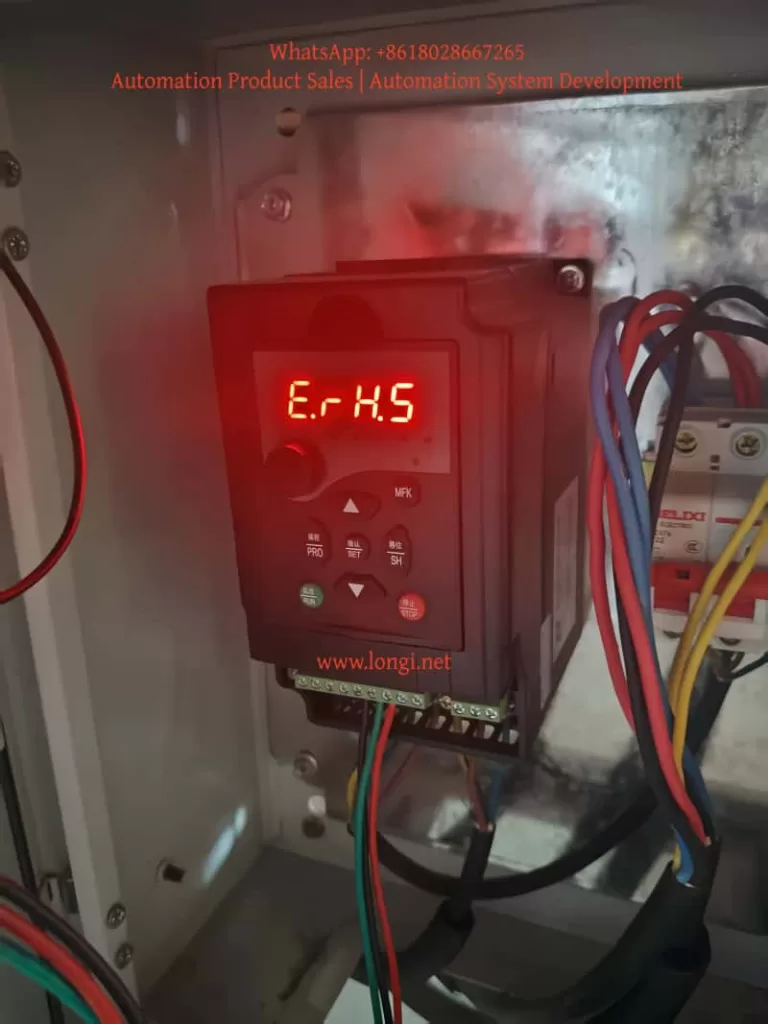
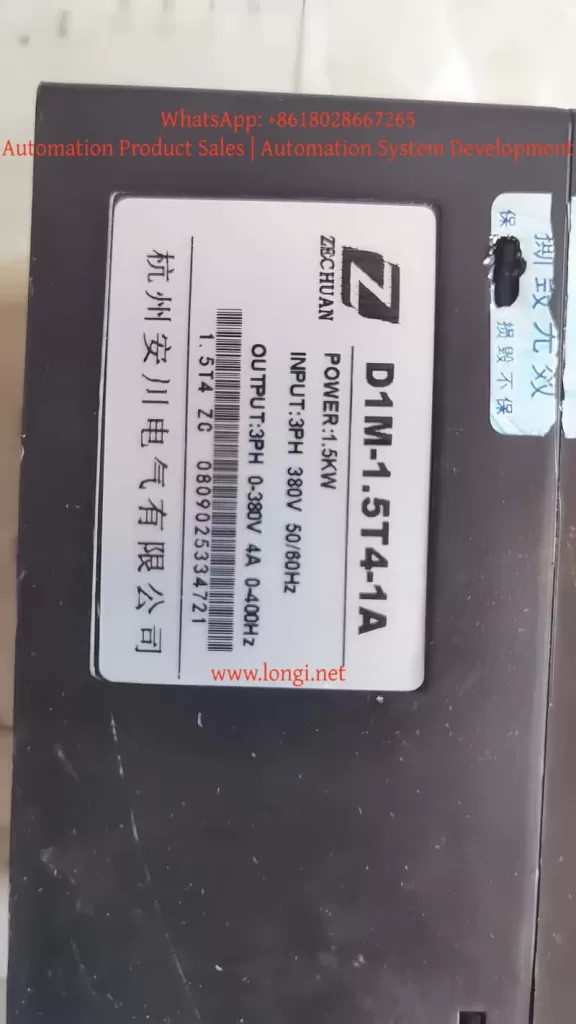
The Hangzhou Yaskawa D1M – 1.5T4 – 1A frequency converter, a domestically – produced simple device with a nominal power of 1.5 kW, an input of 3PH 380V 50/60Hz, and an output of 0 – 400Hz, showed the “E.rH5” display on its digital tube immediately after being powered on at the user’s site. The device was completely locked up, unable to start, modify parameters, or run any motor load. The user searched through the entire 32 – page PDF “User Quick Manual” (Version 1.1, August 8, 2014), from the table of contents to Chapter 4 “Maintenance and Fault Information”, including 4.1 “Fault Information and Troubleshooting” and 4.2 “Common Abnormal Phenomena”. However, the list of all fault codes in the manual did not include E.rH5. The manual only listed conventional protections such as over – voltage, under – voltage, over – current, and over – heating, but remained silent about this error. When the user contacted the manufacturer, the first response was “Find the dealer who sold you the device.” The dealer replied that this was a pre – set “usage period lock” at the factory. Once the period expired, the device would be forced to shut down, and it could only be restored by an authorized dealer entering an unlock code. In essence, this was a “time bomb” implanted by the manufacturer to control the dealer’s payment collection.
This practice is not an isolated case but an open – secret in the current domestic low – end frequency converter market, especially for simple series like D1M and X5M. It is directly derived from the “lease control” model in the PLC industry from the late 1990s to the early 2000s. At that time, many small and medium – sized PLC manufacturers embedded real – time clocks (RTCs) or counters in their programs to recover project final payments. If the final payment was not settled after project acceptance, the PLC would enter a read – only or shutdown state, and users could only unlock it through the manufacturer’s backend. Now, with a deteriorating market environment, the frequency converter industry has directly replicated this logic at the hardware level. During factory programming, manufacturers write a hidden parameter (usually an encrypted internal counter or a countdown based on the built – in RTC of the main control chip) into the EEPROM or Flash. Users cannot see this during normal use, and it only triggers a specific hidden error code (such as E.rH5) when it expires. The manual deliberately omits it to prevent end – users from (cracking) it on their own, forcing them to (obediently) seek paid unlocking from dealers.
Technically, it is not a complex implementation. The low – cost main control chips (commonly ST or domestic MCUs) used in the D1M series support RTCs or software timers. Manufacturers only need to pre – set an “authorization duration” variable (e.g., 180 days or 365 days) in the factory firmware, along with a simple CRC check or simple encryption. During power – on self – check, it compares the current timing. Once it exceeds the set time, it directly jumps to a lock – up sub – program, blocking all operation commands and displaying the pre – set hidden code on the panel. In the “Basic Function Parameters” and “Protection Function Parameters” tables in the manual, there are no parameter groups related to “usage period” at all, because this is a “backdoor” left by the manufacturer for dealers. This design has extremely low costs but fully transfers the payment collection risk to dealers and end – users. When dealers purchase goods, manufacturers often supply them on a “installment” or “account period” basis, but at the same time require dealers to bind a period lock on the devices. When end – users buy the devices, if dealers default on payments to manufacturers, manufacturers may remotely lock the devices through dealers or directly, creating a layer – by – layer transfer of risk.
The current macro – environment has exacerbated this practice. Since 2023, the domestic low – voltage frequency converter market has suffered from severe overcapacity, and the price war has become extremely fierce. The factory price of a 1.5 kW three – phase model has dropped to the 200 – 300 yuan range, and dealers’ gross profits have been compressed to almost zero. At the same time, small and medium – sized enterprises have highly volatile orders and long payment collection cycles. Manufacturers are worried that dealers will accumulate inventory and then run away, so they use the “time lock” as a payment collection insurance. As a result, end – users have become the ultimate victims. A knitting factory, a small packaging machinery factory, or a logistics door equipment factory may spend thousands of yuan to buy the device, install and debug it, and be ready for mass production when suddenly the E.rH5 code appears on the panel, the motor stops, and the production line is paralyzed. When users contact the manufacturer, the manufacturer refers them to the dealer. When they contact the dealer, the dealer either asks for a price difference to unlock it or directly states that it is “manufacturer’s policy.” There is no contract agreement or prior notice in the whole process. It is simply a case of “buying is equivalent to renting.”
What is even more egregious is that this lock – up mechanism directly violates the integrity of ownership after product delivery. After users pay the full amount, the ownership of the device has been transferred, but they are still controlled by the manufacturer through a firmware backdoor regarding the operation right. This is similar to digital rights management (DRM) in the software industry but lacks any legal authorization agreement. Users only see an ordinary commodity when making a purchase but end up with a “hardware with a limited service life.” The manual repeatedly emphasizes “Only qualified professionals can install and debug” and “Please use it correctly according to the manual” but deliberately conceals the most critical restrictive clauses, which is a typical case of information asymmetry fraud. In case of disputes, it is extremely difficult for users to defend their rights: the fault code is not in the manual, the manufacturer does not admit it as a quality issue but only as a “commercial policy,” and it is also difficult for the court to determine it as a product quality liability.
This phenomenon has spread among multiple domestic simple frequency converter brands. Series such as Wanxin X5M, Taichuang D1M, and Hangzhou Yaskawa D5M are essentially different re – branded products on the same technical platform, targeting cost – sensitive fields such as knitting machinery, small and medium – sized mechanical equipment, and constant – pressure water supply. These fields have a large number of users, low unit prices, and high replacement costs, making them the most likely targets for “lock – up.” In contrast, regular Japanese brands (such as the real Yaskawa Electric) or high – end domestic brands have never had such hidden lock – up functions. They compete based on technology, reliability, and service rather than using backdoors to control payment collection. However, the low – end market uses such “unpleasant functions” as a competitive weapon. Although it may help manufacturers and dealers tide over difficulties in the short term, it will completely destroy the industry’s reputation in the long run. Once users have a bad experience, they will develop a trust crisis towards all domestic frequency converters and turn to imported or more transparent brands, ultimately compressing the living space of the entire domestic supply chain.
To break this cycle, multiple parties need to take action. First, users must require manufacturers or dealers to provide a “no usage period lock” commitment letter when making purchases and immediately perform a full parameter backup and long – term power – on test (at least run for the pre – set period) after the device arrives. Second, dealers should jointly resist the lock – up requirements imposed by manufacturers and promote the industry association to issue clear regulations: the factory firmware must disclose all hidden parameters, and operation restrictions without written notice are prohibited. Third, manufacturers themselves should reflect. In today’s price war that has reached the bottom line, relying on backdoors to maintain cash flow is like drinking poison to quench thirst. Only by focusing on improving heat dissipation design, optimizing vector control algorithms, reducing harmonics, and enhancing EMC performance can they truly win the market. The positioning of the D1M as a “simple frequency converter with high cost – effectiveness, simple and practical” should have been a breakthrough for domestic substitution, but it has self – destructed due to a “time bomb.”
On a deeper level, this reflects the dilemma of Chinese manufacturing industry’s internal competition at the low – end of the industrial chain. Under the pressure of economic downturn, enterprises, in order to survive, are willing to sacrifice user experience and long – term reputation. Similar phenomena are also emerging in other industrial automation components: some contactors and servo drives are also starting to have “paid activation” or “cloud – based locks.” If this is allowed to continue, the underlying trust foundation of Industry 4.0 and smart manufacturing will collapse. Users are not fools; they will vote with their feet: they would rather spend more money on a device that “guarantees permanent operation” than touch a “cheap product” that may be locked up halfway.
The E.rH5 fault of the Hangzhou Yaskawa D1M is just the tip of the iceberg. It reminds us that technology is never neutral. A simple counter in embedded software can turn an industrial device into “leased hardware.” Manufacturers, dealers, and users must return to the spirit of contract: clear pricing,信息公开 (information disclosure), and full ownership upon delivery. Otherwise, the low – end frequency converter market will only become more and more “competitive in a vicious way,” and in the end, there will only be “zombie devices” that are locked up with each other and ( can be translated as “lost” here, referring to lost users) users. True competitiveness always comes from the product itself, not from backdoors hidden in the firmware.