Posted on

In-Depth Analysis and Troubleshooting Guide for ER019 Encoder Fault in Megmeet M6-N Series Servo Drives

I. Introduction

In the field of industrial automation, Megmeet’s (MEGMEET) M6-N series AC servo drives are widely used in scenarios such as machine tools, robots, packaging machinery, and textile equipment due to their high precision, high reliability, and ease of use. As a core component of closed-loop control systems, encoders are responsible for feeding back the motor’s position, speed, and torque information. A fault in the encoder can directly lead to servo system shutdown, reduced precision, or even equipment damage. Among them, the ER019 encoder fault is one of the most common faults in the M6-N series, accounting for approximately 30% (according to fault statistics from an automotive parts factory in 2023). This article will systematically analyze the ER019 fault from the perspectives of fault definition, cause analysis, troubleshooting steps, solutions, and preventive measures, providing practical fault handling guidelines for engineering technicians.

II. Overview of ER019 Fault

1. Fault Code Definition

According to the Megmeet M6-N series user manual, ER019 falls under the “encoder fault” category and is specifically divided into two sub-faults (detailed information can be viewed through the drive panel or debugging software):

  • Er.019-1: Encoder Type Error: The drive cannot recognize the feedback signal format of the encoder (such as incremental/absolute type, signal type, line count, etc.), resulting in closed-loop control failure.
  • Er.019-2: Encoder Disconnection: The drive cannot detect the encoder’s feedback signal (such as loss of A/B phase pulses or abnormal Z phase signal), or the signal interruption time exceeds the threshold (usually 100 ms).

2. Core Functions of the Encoder

The encoder is the “eye” of the servo system, with functions including:

  • Position Feedback: Calculating the motor’s rotation angle through pulse counting (incremental) or directly outputting the absolute position (absolute).
  • Speed Feedback: Calculating the motor’s rotational speed through pulse frequency.
  • Torque Feedback: Some encoders (such as resolvers) can feed back the motor’s torque information.
    If the encoder fails, the drive cannot achieve precise closed-loop control, which may trigger secondary faults such as “overcurrent” or “overload” and even damage the motor.

III. In-Depth Analysis of ER019 Fault Causes

(A) Encoder Type Error (Er.019-1)

An encoder type error is one of the primary causes of the ER019 fault (accounting for approximately 45%). The core issue is a mismatch between the drive parameters and the actual encoder, with specific causes including:

1. Parameter Setting Errors

  • Incorrect Encoder Type Selection: The M6-N series drive sets the encoder type through parameter Pr0.03 (encoder type selection) (e.g., 0 = incremental, 1 = absolute, 2 = resolver). If an incremental encoder is actually used but Pr0.03 is set to “1” (absolute), the drive cannot parse the feedback signal.
  • Incorrect Encoder Line Count Setting: Parameter Pr0.04 (encoder line count) must match the encoder’s nameplate (e.g., 2500 P/R, 1024 P/R). If set incorrectly, the drive’s calculated speed/position will be inaccurate, triggering the fault.
  • Incorrect Signal Type Setting: Parameter Pr0.06 (encoder signal type) must match the encoder’s output signal (e.g., 0 = TTL, 1 = HTL, 2 = Sin/Cos). If a TTL encoder is set to HTL, the signal level mismatch will prevent recognition.

2. Hardware Incompatibility

  • Non-specified Encoders: Using third-party encoders not certified by Megmeet (such as a certain brand’s incremental encoder) may result in signal format or electrical characteristics incompatible with the M6-N series.
  • Firmware Version Mismatch: After the encoder firmware is upgraded, the drive parameters are not updated accordingly (e.g., changes in the communication protocol for absolute encoders).

3. Parameter Loss or Accidental Modification

  • Factory Reset: If the drive is accidentally restored to factory settings, the encoder parameters (Pr0.03–Pr0.06) are reset to default values (e.g., incremental, 1000 P/R), which may not match the actual encoder.
  • Human Error: Untrained operators may randomly modify encoder parameters (e.g., changing absolute to incremental).

(B) Encoder Disconnection (Er.019-2)

An encoder disconnection is another primary cause of the ER019 fault (accounting for approximately 55%). The core issue is an interruption in the feedback signal transmission link, with specific causes including:

1. Physical Cable Faults

  • Cable Breakage: The encoder cable may break internally due to long-term vibration or compression when passing through moving parts such as drag chains or protective plates (e.g., a machine tool spindle servo cable broken due to protective plate jamming).
  • Loose Connectors: Connectors on the encoder or drive side (such as the CN2 interface) may become loose due to vibration, resulting in poor pin contact (e.g., bent or oxidized pins on an M12 circular connector).
  • Cable Aging: Damage to the cable’s insulation (e.g., corrosion from oil or high-temperature aging) may cause short circuits or grounding of the conductors.

2. Incorrect Cable Selection

  • Non-shielded Cables: Encoder signals are weak (TTL signal level: 0–5 V). Using non-shielded cables makes them susceptible to electromagnetic interference (EMI), leading to signal errors that the drive may misinterpret as disconnections.
  • Excessive Length: The M6-N series specifies a maximum encoder cable length of 50 meters (incremental) or 30 meters (absolute). Beyond this, signal attenuation is severe, preventing the drive from detecting the signal.
  • Incorrect Core Count: The encoder requires a 5-core cable (power + signal). Using a 4-core cable will result in missing power or signal.

3. Electromagnetic Interference (EMI)

  • Improper Wiring: If the encoder cable is routed parallel to power lines (L1/L2/L3) with a spacing of less than 10 cm, high-frequency electromagnetic radiation from the power lines may couple into the encoder signal lines, causing signal distortion.
  • Poor Grounding: If the encoder cable’s shield is not grounded or is grounded at both ends (forming a ground loop), interference cannot be suppressed.

4. Encoder Internal Faults

  • Internal Wire Breakage: Internal leads in the encoder may break due to vibration (e.g., motor shaft vibration causing encoder chip pin desoldering).
  • Chip Damage: The encoder chip may be damaged by overvoltage (e.g., power supply voltage fluctuations) or overcurrent (e.g., short circuits), preventing signal output.

IV. ER019 Fault Troubleshooting Steps (Logical Process)

1. Step 1: Confirm the Fault Type

View the fault details through the drive panel or debugging software (such as Megmeet M6 Studio):

  • Panel Display: Er.019 + sub-code (e.g., Er.019-1 or Er.019-2).
  • Software Display: The fault record will indicate “encoder type error” or “encoder disconnection” and record the operating status at the time of the fault (e.g., speed, current).
    Key Judgment: If it is Er.019-1, prioritize checking parameters; if it is Er.019-2, prioritize checking the wiring.

2. Step 2: Check Encoder Type Parameters (for Er.019-1)

Operation Steps:

  1. Enter the drive parameter mode (press the panel SET key and enter the password “0000”).
  2. Locate the encoder parameters: Pr0.03 (encoder type), Pr0.04 (encoder line count), Pr0.06 (signal type).
  3. Compare with the encoder nameplate: For example, if the nameplate indicates “incremental, 2500 P/R, TTL signal,” Pr0.03 should be set to “0,” Pr0.04 to “2500,” and Pr0.06 to “0.”
  4. If the parameters are incorrect, modify them to the correct values and save (press the ENTER key).
    Note: For absolute encoders, additionally check the battery voltage (parameter Pr0.12). If the battery voltage is < 3 V, replace the battery to avoid position loss.

3. Step 3: Check Physical Wiring (for Er.019-2)

Tools Required: Multimeter (resistance/voltage range), oscilloscope (optional), encoder tester (optional).
Operation Steps:

  1. Visual Inspection: Check the encoder cable for damage, compression, or aging (e.g., cracked sheath, exposed conductors).
  2. Connector Inspection: Unplug and replug the connectors on the encoder and drive sides (such as CN2), checking for bent or oxidized pins (clean with alcohol).
  3. Continuity Test: Use a multimeter to measure the resistance between corresponding pins at both ends of the cable (e.g., pin 1 on the drive-side CN2 and pin 1 on the encoder side). Normal resistance should be < 1 Ω. If the resistance is infinite, the cable is broken.
  4. Power Test: Measure the encoder power supply at the drive side (e.g., pin 1 on CN2). The normal voltage should be 5 V ± 0.1 V (default for M6-N series). If the voltage is abnormal, check the drive’s power module.
  5. Signal Test: Use an oscilloscope to measure the encoder signals (e.g., A and B phases). Normal signals should be square waves (TTL) or sine waves (Sin/Cos). If the signals are missing or distorted, the wiring or encoder is faulty.

4. Step 4: Substitution Testing (Quick Fault Localization)

  • Replace the Cable: Use a spare encoder cable (same model and length) to replace the original cable. If the fault disappears, the original cable is damaged.
  • Replace the Encoder: Use a spare encoder (same model) to replace the original encoder. If the fault disappears, the original encoder is damaged.
  • Replace the Drive: If the above substitutions are ineffective, the drive’s encoder interface circuit may be faulty (e.g., CN2 interface chip damage), requiring contact with the manufacturer for repair.

5. Step 5: Check for Electromagnetic Interference (for difficult disconnection faults)

  • Wiring Inspection: Confirm that the encoder cable is spaced ≥ 10 cm from power lines and crosses them perpendicularly (avoid parallel routing).
  • Shield Inspection: The encoder cable shield should be grounded at only one end (drive side, encoder side not grounded) to avoid ground loops.
  • Interference Test: Use an oscilloscope to measure interference components in the encoder signal (e.g., high-frequency noise). If the interference amplitude exceeds 10% of the signal amplitude, install a filter (e.g., an EMI filter on the drive’s input side).

V. ER019 Fault Solutions (Targeted Plans)

(A) Solutions for Encoder Type Error (Er.019-1)

  • Reconfigure Parameters: Modify Pr0.03, Pr0.04, and Pr0.06 according to the encoder nameplate, save the changes, and restart the drive.
  • Replace with Compatible Encoder: If a third-party encoder is used, replace it with a Megmeet-specified model (e.g., MEGMEET EN-2500-TTL incremental encoder).
  • Restore Parameter Backup: If parameters are lost, restore them from a backup (regular parameter backups are recommended).
  • Train Operators: Avoid accidental parameter modifications (e.g., set parameter modification permissions).

(B) Solutions for Encoder Disconnection (Er.019-2)

  • Repair/Replace Cable:
    • If the cable is broken: Re-crimp the connector (using a dedicated crimping tool) or replace it with the same model cable (e.g., MEGMEET EC-5M-SHIELD shielded cable).
    • If the connector is loose: Clean the pins and re-plug, or replace the connector (e.g., M12 circular connector).
  • Optimize Wiring:
    • Route the encoder cable separately from power lines (spacing ≥ 10 cm).
    • Use shielded cables and ground the shield at only one end (drive side).
    • Avoid routing the cable through moving parts (e.g., drag chains). If unavoidable, use flexible cables (bending radius ≤ 10 times the cable diameter).
  • Replace Encoder: If the encoder is internally damaged (e.g., chip burnout), replace it with the same model (note that parameters must be set for absolute encoders).
  • Suppress Electromagnetic Interference: Install an EMI filter on the drive’s input side (e.g., MEGMEET MF-30A filter) or add a magnetic ring to the encoder signal lines.

VI. Case Studies (Real-World Validation)

Case 1: ER019-2 Fault (Encoder Disconnection) in a Machine Tool Spindle Servo

Fault Phenomenon: A stamping machine tool’s spindle servo (M6-N-2.9KW) suddenly stopped, with the panel displaying Er.019 and the software indicating “encoder disconnection.”
Troubleshooting Process:

  1. Check Encoder Cable: The cable was found to be flattened and damaged where it passed through the machine tool’s protective plate.
  2. Continuity Test: Using a multimeter, the A-phase signal line (pin 3) was found to be open between the drive and encoder sides (infinite resistance).
  3. Replace Cable: The cable was replaced with the same model shielded cable (MEGMEET EC-5M-SHIELD).
  4. Verification: After restarting the drive, the fault disappeared, and the machine tool resumed normal operation.
    Root Cause: The cable was broken due to compression by the protective plate, interrupting the signal.

Case 2: ER019-1 Fault (Encoder Type Error) in a Packaging Machine Feed Servo

Fault Phenomenon: During debugging of a packaging machine’s feed servo (M6-N-1.5KW), Er.019 appeared, with the software indicating “encoder type error.”
Troubleshooting Process:

  1. Check Parameters: Pr0.03 was set to “1” (absolute encoder), but an incremental encoder was actually used (nameplate: “incremental, 2048 P/R”).
  2. Modify Parameters: Pr0.03 was changed to “0” (incremental), and Pr0.04 was changed to “2048.”
  3. Verification: After saving the parameters and restarting, the fault disappeared, and the feed accuracy was restored to ±0.01 mm.
    Root Cause: The operator accidentally set the incremental encoder as an absolute encoder, causing a parameter mismatch.

VII. ER019 Fault Preventive Measures (Reduce Faults at the Source)

1. Regular Maintenance (Critical)

  • Daily Check: Inspect the encoder cable for damage or compression.
  • Weekly Check: Measure cable continuity (using a multimeter) and clean encoder connectors (using alcohol).
  • Monthly Check: Check encoder mounting screws for looseness and measure encoder power supply voltage (5 V ± 0.1 V).
  • Quarterly Check: Replace absolute encoder batteries (if voltage < 3 V) and back up drive parameters.

2. Proper Selection and Installation

  • Encoder Selection: Prioritize Megmeet-specified models (e.g., EN series) to ensure compatibility with the M6-N series.
  • Cable Selection: Use shielded cables (aluminum foil + braided shield), with ≥ 5 cores (power + signal) and a length not exceeding the drive’s specified value.
  • Installation Requirements: Ensure encoder and motor shaft coaxiality ≤ 0.02 mm and connector insertion force ≥ 5 N (to prevent looseness).

3. Optimize Wiring and Grounding

  • Wiring Rules: Route encoder cables separately from power lines (spacing ≥ 10 cm) and cross them perpendicularly.
  • Grounding Requirements: Ground the encoder cable shield at only one end (drive side) with a grounding resistance ≤ 4 Ω.
  • Interference Suppression: Install an EMI filter on the drive’s input side and add magnetic rings to encoder signal lines in high-interference scenarios.

4. Personnel Training and Management

  • Operators: Must undergo Megmeet training and be familiar with parameter settings and fault troubleshooting procedures.
  • Parameter Management: Set parameter modification permissions (e.g., password protection) to prevent accidental operations.
  • Fault Recording: Establish a fault log to record fault time, cause, and solution, and analyze fault trends (e.g., frequent disconnections in a specific device may indicate wiring improvements are needed).

VIII. Extended Knowledge (Deeper Understanding)

1. Correspondence Between Encoder Types and M6-N Series Parameters

Encoder TypePr0.03 SettingPr0.04 (Line Count)Pr0.06 (Signal Type)
Incremental (TTL)01000–100000
Incremental (HTL)01000–100001
Absolute (SSI)11024–163842
Resolver23

2. Key Points for Encoder Cable Selection

  • Shielding: Must use dual shielding (aluminum foil + braided shield) for strong EMI resistance.
  • Core Count: Incremental encoders require 5 cores (VCC, GND, A, B, Z), while absolute encoders require 6 cores (adding a clock line).
  • Material: The sheath should be PVC or PUR (oil- and heat-resistant), and the conductor should be copper (good conductivity).
  • Bending Radius: For drag chain applications, the bending radius should be ≤ 10 times the cable diameter (e.g., if the cable diameter is 5 mm, the bending radius should be ≤ 50 mm).

3. Methods for Suppressing Electromagnetic Interference (EMI)

  • Filtering: Install input filters on the drive’s input side (to suppress grid interference) and output filters on the output side (to suppress motor interference).
  • Isolation: Use isolation transformers (to isolate the grid from the drive) or fiber-optic communication (to isolate encoder signals).
  • Grounding: Ensure the drive, motor, and encoder share a common ground (grounding resistance ≤ 4 Ω) to avoid ground loops.

IX. Conclusion

The ER019 encoder fault is a common issue in Megmeet’s M6-N series servo drives, primarily caused by parameter setting errors or interruptions in the signal transmission link. By following a systematic troubleshooting process (confirm fault type → check parameters → check wiring → substitution testing → suppress interference), faults can be quickly located and resolved. The key to preventing ER019 faults lies in regular maintenance, proper selection, optimized wiring, and personnel training to reduce faults at the source.

For engineering technicians, mastering ER019 fault troubleshooting and solutions not only improves equipment utilization (reducing downtime) but also enhances servo system reliability (avoiding secondary faults). It is recommended that enterprises establish a comprehensive fault management system and leverage Megmeet’s technical support (e.g., remote debugging, parameter backup) to achieve rapid fault response and prevention.
Posted on

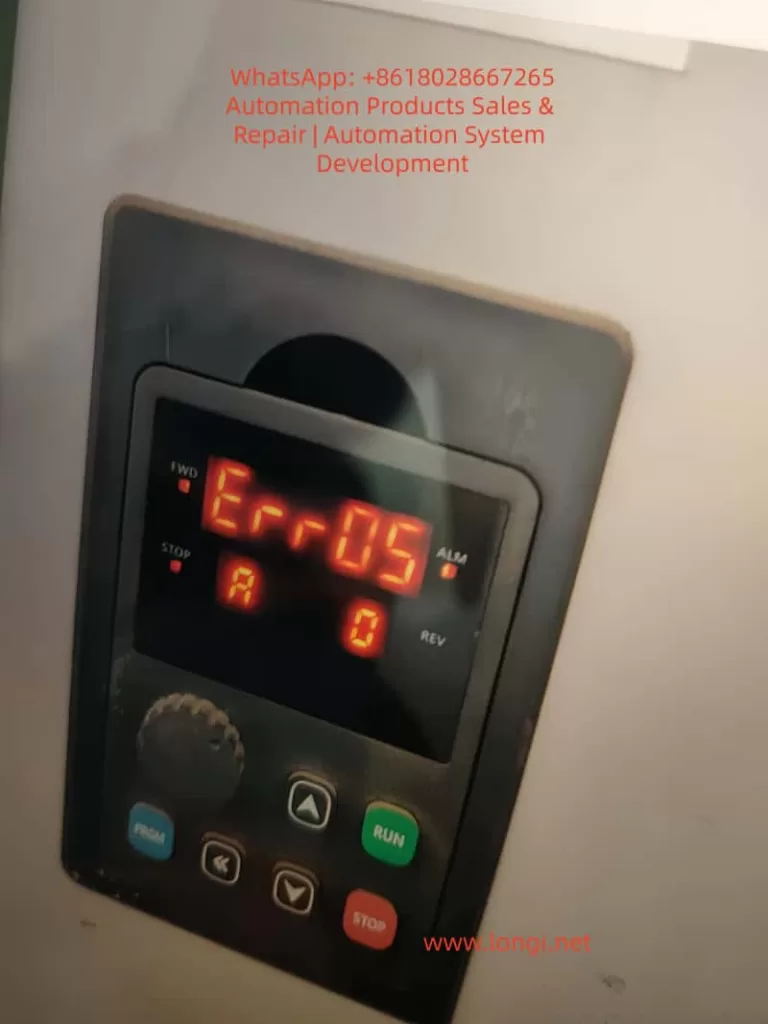
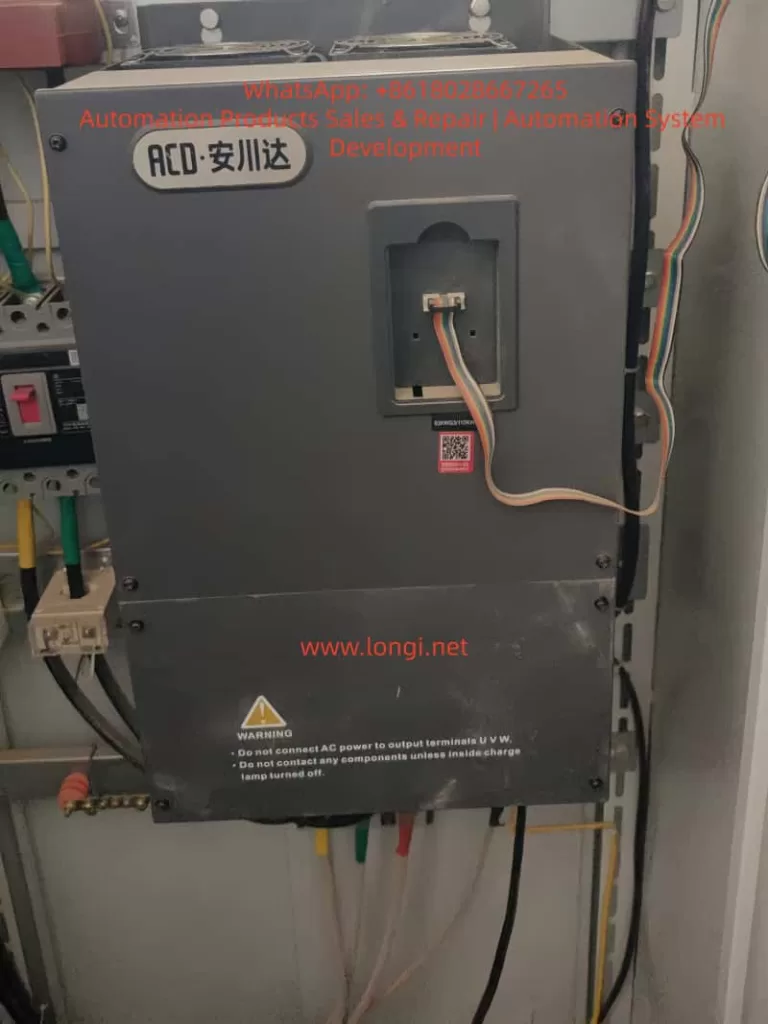
ERR05 Overvoltage Fault in ACD 900 Series (M900) VFD: Root Cause Analysis and Engineering-Level Solutions for Intermittent Shutdown After Long Runtime

In industrial applications, ACD 900 Series (M900) variable frequency drives are widely used in fans, pumps, conveyors, and general automation systems. A common field issue reported after a period of normal operation is:

The drive runs for several hours or even more than ten hours, then suddenly trips with ERR05, and the shutdown timing is irregular.

This type of fault is often misinterpreted as random failure or unstable electronics. In reality, it is a deterministic energy management problem that develops over time due to component aging, thermal effects, and load behavior.

This article provides a detailed engineering-level analysis of ERR05 faults in ACD 900 Series VFDs, along with practical diagnostic steps and permanent solutions.


ERR05 fault

1. What ERR05 Really Means in ACD 900 Series

According to the manual, ERR05 is defined as:

Acceleration Overvoltage

However, this definition is misleading in real-world scenarios.

From an engineering standpoint, ERR05 should be understood as:

DC bus overvoltage caused by regenerative energy that cannot be dissipated

In other words:

  • ERR05 is not only related to acceleration
  • ERR05 is primarily a regenerative overvoltage condition

2. Internal Mechanism of Overvoltage

The internal energy flow of the ACD 900 VFD is:

  1. AC input → Rectifier → DC bus (~540V for 380V systems)
  2. DC bus → IGBT inverter → Motor

During certain operating conditions:

  • Deceleration
  • Load inertia release
  • External force driving the motor

The motor acts as a generator:

Mechanical energy → Electrical energy → Fed back into DC bus

If this energy has no discharge path:

→ DC bus voltage rises
→ Protection threshold exceeded
→ ERR05 triggered


3. Key Characteristics of This Case

Based on the field description:

  • The drive has been used for a period (not new)
  • Fault appears after several hours
  • Fault timing is irregular
  • No fault at startup

These characteristics clearly indicate:

This is NOT a parameter or wiring issue, but a degradation or dynamic condition problem


4. Four Major Root Causes (Ranked by Probability)


4.1 DC Bus Capacitor Aging (Primary Cause)

The ACD 900 series uses electrolytic capacitors for DC bus energy storage.

Over time, capacitors degrade:

  • Capacitance decreases
  • ESR (Equivalent Series Resistance) increases
  • Heat generation increases

Consequences:

  • Reduced ability to absorb regenerative energy
  • Increased voltage fluctuation

Result:

Conditions that were previously safe now trigger overvoltage

This is the most common reason why:

  • The system worked before
  • But starts failing after months or years

4.2 Braking Resistor or Braking Unit Failure

In normal design:

  • Regenerative energy is dissipated through a braking resistor
  • Connected between “+” and “PB” terminals

Typical failures:

  • Open circuit braking resistor
  • Loose wiring
  • Damaged braking transistor (IGBT)
  • Resistance value drift

If the braking circuit fails:

Regenerative energy accumulates in DC bus → inevitable overvoltage

This matches the symptom:

  • Random trips
  • Load-dependent behavior

ACD M900 VFD

4.3 Thermal Effects and Cooling Degradation

The delayed fault (after hours) strongly suggests thermal influence.

Over time:

  • Cooling fans slow down or fail
  • Heat sinks accumulate dust
  • Internal temperature rises

Effects:

  • Capacitor ESR increases further
  • Voltage sensing drifts
  • IGBT switching characteristics change

Result:

System becomes unstable under thermal conditions


4.4 Load Condition Changes (Often Ignored)

In many cases, the VFD is not the root cause.

Typical mechanical causes:

  • Fan reverse airflow
  • Pump backflow
  • Increased inertia (belt, flywheel)
  • Mechanical looseness

These cause:

Motor enters regenerative mode unexpectedly


5. Why the Fault Appears Random

ERR05 is triggered only when multiple factors coincide:

  • High DC bus voltage
  • Certain load condition
  • Elevated temperature
  • Slightly higher supply voltage

Only when all conditions align:

Threshold exceeded → trip occurs

Therefore, the fault appears:

  • Intermittent
  • Non-repeatable at fixed times
  • “Random” to operators

But in reality:

It is a predictable physical process


6. Field Diagnostic Procedure (Practical Approach)


Step 1: Monitor DC Bus Voltage

Check monitoring parameters:

  • Normal: ~540V (380V system)
  • Before trip: rises significantly

If confirmed:

✔ Regenerative overvoltage


Step 2: Check Braking Resistor

After power off:

  • Measure resistance
  • Check for open circuit

Also verify:

  • Wiring at + / PB terminals
  • Physical condition (burn marks)

Step 3: Increase Deceleration Time

Parameter:

  • Deceleration time (e.g., F0-05)

Action:

  • Increase 2–3 times

Result:

  • If fault disappears → regeneration issue confirmed

Step 4: Inspect Cooling System

Check:

  • Fan operation
  • Dust accumulation
  • Cabinet ventilation

Step 5: Measure Input Voltage

Record:

  • Line voltage level
  • Voltage fluctuations

If consistently high:

→ reduced safety margin


Step 6: Run Without Load

Disconnect mechanical load:

  • No fault → mechanical issue
  • Still fault → electrical issue

7. Engineering Solutions (From Temporary to Permanent)


Solution 1: Increase Deceleration Time (Temporary)

Advantages:

  • Easy implementation
  • Immediate effect

Disadvantages:

  • Slower process response
  • Not a root fix

Solution 2: Install or Replace Braking Resistor (Recommended)

Advantages:

  • Directly handles regenerative energy
  • Most effective solution

Solution 3: Replace DC Bus Capacitors (Permanent Fix)

Applicable when:

  • Equipment has long service time
  • Capacitor degradation confirmed

Solution 4: Improve Cooling System

Actions:

  • Clean heat sinks
  • Replace fans
  • Improve cabinet airflow

Solution 5: Optimize Mechanical System

Examples:

  • Prevent reverse driving
  • Reduce inertia
  • Improve load stability

8. Is Main Board Failure Possible?

Main board faults typically show:

  • Immediate fault after power-on
  • Repeatable and stable error

In this case:

  • Delayed occurrence
  • Load-dependent behavior

Conclusion:

Main board failure is unlikely and should NOT be the first assumption


9. Final Engineering Conclusion

ERR05 faults in ACD 900 Series VFDs, especially after a period of operation, are not random failures but a result of energy imbalance in the system.

Core mechanism:

Regenerative energy generation → Reduced absorption capability (capacitor aging / braking failure) → DC bus voltage rise → ERR05 trip

Recommended troubleshooting priority:

  1. Braking circuit condition
  2. DC bus capacitor health
  3. Cooling system
  4. Load behavior

Only by addressing the system as a whole can the issue be permanently resolved, rather than relying on repeated parameter adjustments or component replacement.


Posted on

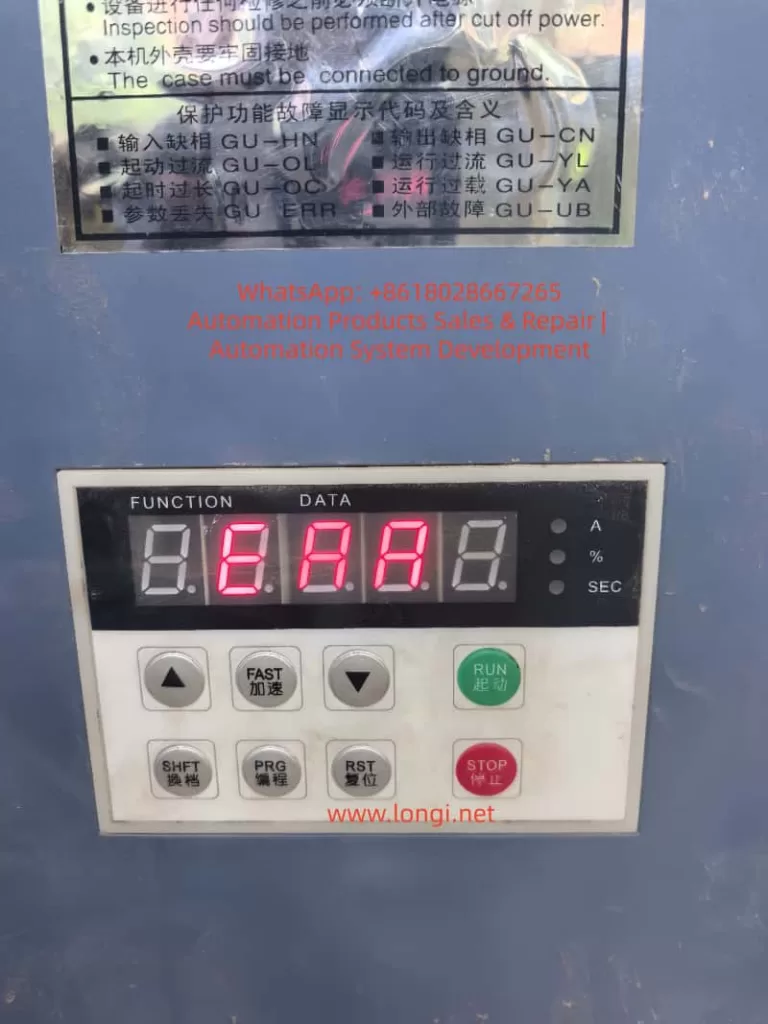
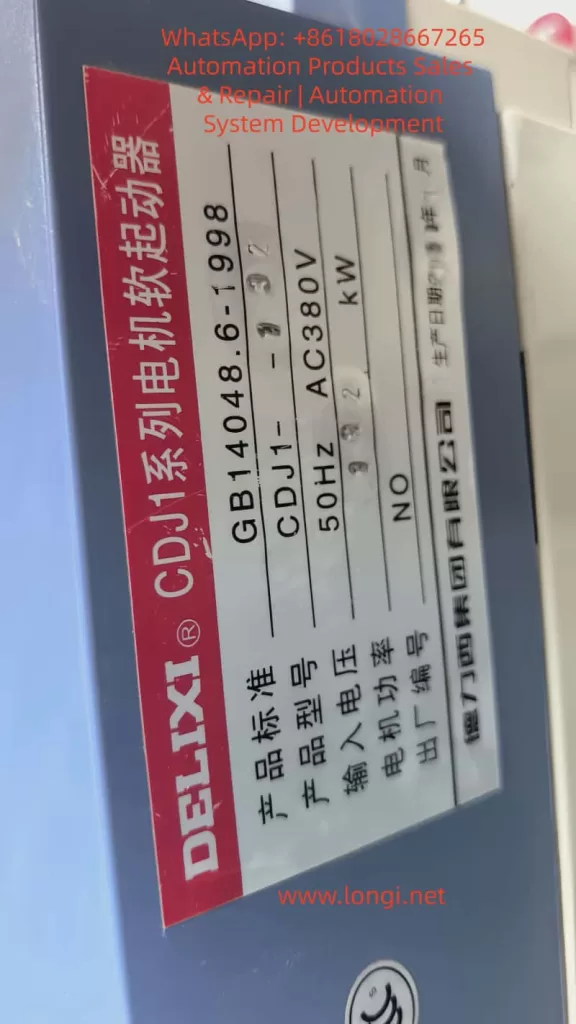
DELIXI CDJ1 Soft Starter Displaying E.AA With No Keypad Response: Why the Main Control Board Should Be Suspected First

When a DELIXI CDJ1 soft starter powers on, the display lights up, but shows E.AA, and none of the keypad buttons respond, this should not be treated as a normal motor overload, overcurrent, phase loss, or emergency stop fault.

For CDJ1 series soft starters, ordinary protection faults are usually displayed as defined fault codes such as Err-0, Err-1, Err-2, Err-3, Err-4, Err-5, Err-6, Err-7, Err-8, or d.Err. However, E.AA is not listed in the standard fault table. More importantly, the keypad has no response. This means the problem is probably not a normal external running fault, but an internal control system fault.

In this situation, the most likely causes are:

  • Main control board failure
  • Keypad communication failure
  • Low-voltage control power supply fault
  • EEPROM parameter storage fault
  • MCU reset or oscillator failure
  • Damaged keypad board or ribbon cable

Among these possibilities, the main control board should be considered the primary suspect, especially if reseating the keypad cable and checking the external control terminals does not change the fault.

E.AA fault

1. Basic Structure of the CDJ1 Soft Starter

The CDJ1 soft starter is used to start three-phase squirrel-cage induction motors smoothly. Its main function is to control the firing angle of three-phase thyristors, allowing the motor voltage to rise gradually during startup. This reduces starting current, mechanical shock, and stress on the motor and driven machine.

A typical CDJ1 soft starter contains several main sections.

The first section is the power circuit. This includes the three-phase input terminals, three-phase output terminals, anti-parallel thyristor modules, current detection circuits, heat sink, temperature detection, and bypass contactor control circuit.

The second section is the low-voltage control power supply. This circuit generates voltages such as +5V, +12V, or +15V for the control board, keypad board, detection circuits, relay circuits, optocouplers, and communication circuits.

The third section is the main control board. This board normally contains the MCU, EEPROM or parameter memory, reset circuit, crystal oscillator circuit, current and voltage sampling circuits, phase loss detection, thyristor trigger output, relay drive circuit, keypad interface, and communication interface.

The fourth section is the keypad display board. This board displays operating status and fault codes, scans keypad buttons, and communicates with the main control board through a ribbon cable or connector.

Under normal conditions, after power-on, the main control board performs self-checking, reads parameters from memory, checks the three-phase input, checks control terminals, verifies emergency stop input, monitors current detection signals, and then enters standby or ready mode.

If a standard fault is detected, the soft starter displays a defined fault code. If the system does not even enter the normal display and operation logic, then the fault may be inside the control system itself.

2. Why E.AA Is Not Like a Normal External Fault

For normal CDJ1 protection faults, the display should follow the fault code table. For example:

Err-0 usually indicates phase loss.

Err-1 usually indicates overheating.

Err-2 usually indicates overload.

Err-3 usually indicates light load.

Err-4 usually indicates three-phase current imbalance.

Err-5 usually indicates emergency stop.

Err-6 usually indicates overcurrent.

Err-7 usually indicates control board fault.

Err-8 usually indicates excessive starting time.

d.Err usually indicates parameter error.

The displayed code E.AA does not belong to this normal fault code format. Therefore, it should not be directly treated as phase loss, overload, overcurrent, or emergency stop.

The more important symptom is that the keypad does not respond. In a normal protection fault, the control board is still running. It detects the fault and displays the corresponding code. In that condition, the keypad should usually still work. The user should normally be able to press STOP, RESET, PRG, SHIFT, or other keys to check parameters or clear the fault.

If all buttons have no response, it means the control logic may not be running properly. The keypad board may not be communicating with the main board, or the main control board may be stuck during initialization.

This is why E.AA plus no keypad response is much more serious than an ordinary protection alarm.

CDJ1 soft starter

3. Why the Main Control Board Is a High-Probability Fault Point

The main control board is responsible for almost all logic functions inside the soft starter. If it fails, the unit may still power on and the display may still light up, but the machine will not operate correctly.

A main board fault may cause:

Abnormal display code

No keypad response

No access to parameter menu

No reset function

No RUN command acceptance

No relay output

No thyristor trigger output

No communication response

Failure to complete power-on self-test

The common causes of main board failure include aged electrolytic capacitors, unstable +5V power supply, damaged reset circuit, failed crystal oscillator, corrupted EEPROM data, damaged MCU, damaged communication interface, or external control terminal overvoltage damage.

In many cases, the board is not completely dead. The display may still show something, but the program is not running normally. This creates the impression that the machine is “alive,” while the control system is actually locked or abnormal.

That is exactly the type of condition suggested by an undefined code such as E.AA with no keypad response.

4. Low-Voltage Control Power Supply Must Be Checked First

Before replacing the main control board, the first technical check should be the low-voltage control power supply.

The +5V supply is especially important. The MCU, EEPROM, keypad communication circuit, display driver, and logic ICs all depend on a stable +5V rail. If the +5V voltage is too low, unstable, or has excessive ripple, the control board may behave abnormally.

A soft starter can still light its display even when the control power is poor. Therefore, “the display is on” does not prove that the control power supply is normal.

The technician should measure:

+5V on the main control board

+5V at the EEPROM

+5V at the keypad connector

Power supply ripple with an oscilloscope

Power-on voltage rise waveform

Relay or auxiliary control voltage

If the 5V line is only 4.3V to 4.7V, or if the ripple is very high, the MCU may reset repeatedly or run incorrectly. In that case, the fault should be repaired from the power supply section first.

Common failed parts include:

Electrolytic capacitors

Switching power supply IC

Optocoupler feedback circuit

TL431 reference circuit

Rectifier diode

Voltage regulator

Startup resistor

Solder joints around the power supply section

In older soft starters, aged electrolytic capacitors are very common. Replacing the weak capacitors may restore the main board without replacing the entire board.

5. MCU Reset Circuit Failure Can Cause No Keypad Response

The MCU needs three basic conditions to run correctly:

Stable power supply

Stable clock signal

Correct reset signal

If the reset circuit is abnormal, the MCU may not start correctly. It may remain in reset, reset repeatedly, or start before the power supply is stable.

In this condition, the display board may still light up, but the main program will not run normally. The keypad will not respond because the MCU is not processing key commands.

The reset circuit may use an RC reset circuit, a reset IC, or a watchdog reset circuit. The technician should measure the MCU reset pin during power-on. A normal reset signal should change state after the power supply becomes stable.

If the reset pin remains permanently active, the MCU will not run.

If the reset pin keeps pulsing, the board may be repeatedly restarting.

If there is no proper power-on reset delay, the MCU may start incorrectly and lock up.

Therefore, when E.AA is displayed and no key works, the reset circuit should be checked carefully.

6. Crystal Oscillator Failure Can Stop the Main Program

The MCU also needs a clock source. Many industrial control boards use an external crystal oscillator or ceramic resonator. If the oscillator does not start, the MCU cannot execute the program correctly.

Typical symptoms of oscillator failure include:

Display abnormality

No keypad response

No relay operation

No communication activity

No trigger pulse output

No parameter access

The oscillator should be checked with an oscilloscope using a 10X probe. The probe should measure each crystal pin to ground. A low-impedance probe or long ground lead may load the oscillator and stop it, so measurement technique is important.

Causes of oscillator failure include:

Damaged crystal

Changed or leaking load capacitors

Cracked solder joints

PCB contamination

Damaged MCU oscillator pins

Abnormal reset state

Noisy power supply

If replacing the crystal and capacitors does not restore oscillation, the MCU itself may be damaged.

7. EEPROM or Parameter Memory Fault

The CDJ1 soft starter depends on stored parameters. Parameters such as starting voltage, starting time, stopping time, starting mode, load type, control mode, emergency stop setting, overload protection factor, light-load detection, communication settings, parameter protection, and factory reset status are stored in non-volatile memory.

If the EEPROM data is slightly abnormal, the unit may display a parameter error such as d.Err. But if the EEPROM is seriously corrupted, shorted, unreadable, or incompatible, the MCU may fail during initialization and display an undefined code.

EEPROM-related faults can cause:

Abnormal startup display

Failure to enter parameter menu

No response to keys

Parameter error

Incorrect current rating

Communication abnormality

Random fault display

The technician should check:

EEPROM VCC voltage

SDA and SCL line voltage

Pull-up resistors on the I2C bus

Communication waveform during power-on

Whether SDA or SCL is stuck low

EEPROM solder joints

Board corrosion around the memory IC

If SDA or SCL is permanently low, the I2C bus may be locked. The cause may be the EEPROM itself, the MCU, or another device on the same bus.

If a compatible good unit is available, EEPROM data comparison may help. However, copying EEPROM data must be done carefully, because different power ratings or software versions may use different parameter calibration data.

8. Keypad Board and Ribbon Cable Should Not Be Ignored

Although the main control board is a strong suspect, the keypad board and ribbon cable must also be checked.

A faulty keypad board can create the same symptom:

Display abnormality

No key response

Wrong code shown

No communication with main board

The ribbon cable may also be loose, oxidized, broken, or poorly seated.

Common keypad-related problems include:

Aged membrane keys

Water or oil contamination

Conductive dust

Cracked solder joints

Damaged display driver

Damaged keypad MCU

Broken ribbon cable

Oxidized connector

Poor contact after vibration

The best method is cross-testing with a known good keypad board of the same model. If the machine returns to normal after replacing the keypad board, the main board may be good. If the fault remains unchanged after replacing the keypad board, the main control board becomes the most likely fault point.

The keypad model must be compatible. Similar-looking keypad boards from different versions may not use the same communication protocol.

9. External Control Terminal Damage Can Kill the Main Board

Soft starters have external control terminals such as RUN, STOP, RET, EMS, COM, relay outputs, analog output, and RS485. These terminals are designed for specific signal types. If AC220V, AC380V, or another incorrect voltage is connected to a low-voltage control terminal, the input circuit can be destroyed.

Damage may occur in:

Optocouplers

Input resistors

Zener diodes

Protection diodes

MCU input pins

RS485 communication IC

Control power supply

Once the input section is damaged, the failure may not appear as a simple terminal fault. It may cause the whole main board to lock up, display undefined codes, or stop responding to the keypad.

Therefore, before replacing a control board, all external wiring should be checked. Otherwise, a new board may be damaged again immediately after installation.

Particular attention should be paid to:

RUN/STOP/COM wiring

EMS emergency stop input

RET reset input

RS485 A/B terminals

Relay output wiring

Any external voltage connected to control terminals

Signs of burning near terminal circuits

If an external overvoltage caused the main board failure, the wiring error must be corrected before power is applied again.

10. Thyristor Trigger Circuit May Also Affect the Main Board

Although E.AA is more likely a control board fault, the thyristor trigger circuit should still be considered in deeper repair.

The main board sends trigger pulses to the thyristors through optocouplers, pulse transformers, or driver circuits. If a thyristor gate circuit is shorted, or if the trigger board is damaged, it may load the control board output or pull down the power supply.

Possible symptoms include:

Low control voltage

Hot driver components

Abnormal resistance on trigger outputs

No trigger pulses

Display abnormality when trigger cable is connected

Normal control voltage after trigger cable is disconnected

A useful method is separation testing. Disconnect the keypad board, trigger cable, communication board, or external terminal wiring one by one and observe whether the +5V supply or display behavior changes.

If the main board behaves differently after disconnecting a certain external section, that section may be dragging the main board down.

11. When Can We Say the Main Board Is Probably Faulty?

It is reasonable to suspect the main board if most of the following conditions are present:

The displayed code is not listed in the manual.

The display shows E.AA instead of a standard Err code.

All keypad buttons have no response.

External control wiring has been removed or checked.

Three-phase input is normal.

Keypad ribbon cable has been reseated.

A known good keypad board does not solve the problem.

The +5V supply, reset, oscillator, or EEPROM bus shows abnormal behavior.

There is visible corrosion, overheating, or damaged components on the main board.

SDA/SCL, reset, or communication lines are stuck.

The main board does not communicate or respond normally.

If these conditions are confirmed, the main control board fault probability is high.

However, “main board fault” is still a broad conclusion. The technician should further determine whether the problem is in the power supply, reset circuit, oscillator circuit, EEPROM, communication interface, input terminal circuit, or MCU itself.

12. Recommended Troubleshooting Procedure

A practical repair sequence should be as follows.

First, confirm the fault. Power on the soft starter and verify whether E.AA appears every time. Press all keys and check whether there is any response.

Second, disconnect external control wiring. Keep only the necessary three-phase input and ground. Remove RUN, STOP, EMS, RET, and other external control connections temporarily.

Third, inspect the keypad cable. Power off, reseat the ribbon cable, clean the connector, check for oxidation, and inspect the keypad board for contamination.

Fourth, test with a compatible keypad board if available.

Fifth, measure the control power supply. Check +5V, auxiliary voltages, and ripple with an oscilloscope.

Sixth, check the MCU reset signal during power-on.

Seventh, check the crystal oscillator waveform.

Eighth, check EEPROM VCC, SDA, and SCL lines.

Ninth, inspect the main board visually. Look for burnt resistors, cracked solder joints, leaking capacitors, corroded areas, damaged optocouplers, hot ICs, and terminal input damage.

Tenth, disconnect external internal modules one by one if needed, such as trigger cables or communication boards, to see whether the control voltage recovers.

This sequence avoids unnecessary replacement of power components and focuses on the most likely fault area first.

13. Common Repair Mistakes

One common mistake is treating every soft starter alarm as a motor problem. E.AA is not a normal overload or overcurrent code, especially when the keypad does not respond.

Another mistake is assuming that the control power supply is good because the display is lit. A weak 5V supply can still light the display but fail to run the MCU correctly.

Another mistake is trying to restore parameters through the keypad when the keypad itself has no response. Parameter recovery is impossible until the control system can operate normally.

Another mistake is replacing the keypad board without testing the main board. The keypad may be faulty, but the main board may also be the real cause.

Another mistake is replacing the main board without checking external control wiring. If a wrong external voltage damaged the first board, it may damage the replacement board again.

Another mistake is ignoring environmental causes. Dust, humidity, oil mist, heat, and vibration can cause leakage, corrosion, connector failure, and capacitor aging.

14. Repair Value Assessment

For a CDJ1-132 soft starter, board-level repair can be worthwhile if the fault is limited to the power supply, reset circuit, crystal oscillator, EEPROM, optocoupler, RS485 chip, or input protection circuit.

Repair becomes more difficult if the MCU is damaged. The MCU program is usually not publicly available. A blank MCU cannot simply be installed unless the firmware can be obtained or copied from a compatible board.

If the board is heavily corroded, burnt, carbonized, or mechanically damaged, repair reliability may be poor.

If both the main control board and power thyristor section are damaged, the repair cost will increase significantly. In that case, the cost of repair should be compared with replacing the soft starter.

For critical production equipment, the best solution is often to repair the board while preparing a replacement soft starter or spare control board at the same time. This reduces downtime risk.

15. Practical Conclusion

When a DELIXI CDJ1 soft starter displays E.AA after power-on and the keypad has no response, the fault should be treated as an internal control system abnormality rather than a normal motor or load protection fault.

The most likely fault areas are:

Main control board

Keypad communication circuit

Low-voltage control power supply

MCU reset circuit

Crystal oscillator circuit

EEPROM parameter memory

Keypad board or ribbon cable

External control terminal damage

Among these, the main control board is the most important suspect, especially if the keypad cable and external wiring have already been checked.

A proper diagnosis should focus on five basic conditions of the control board:

Power supply

Reset

Clock

Memory

Communication

If any one of these conditions is abnormal, the soft starter may display an undefined code, fail to respond to the keypad, and remain locked before entering normal operation.

Therefore, the judgment that “the main board is probably faulty” is reasonable. But in professional repair, the next step is not simply to replace the entire unit blindly. The correct approach is to locate the exact failed section on the control board, beginning with the +5V power supply, reset circuit, oscillator, EEPROM, keypad communication, and external terminal input circuits.

Posted on

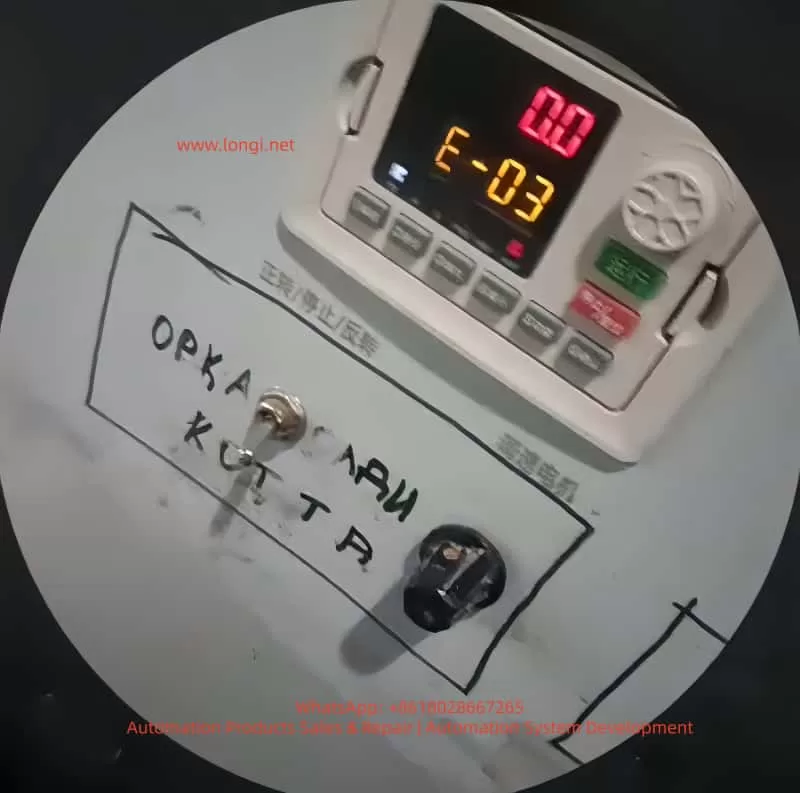
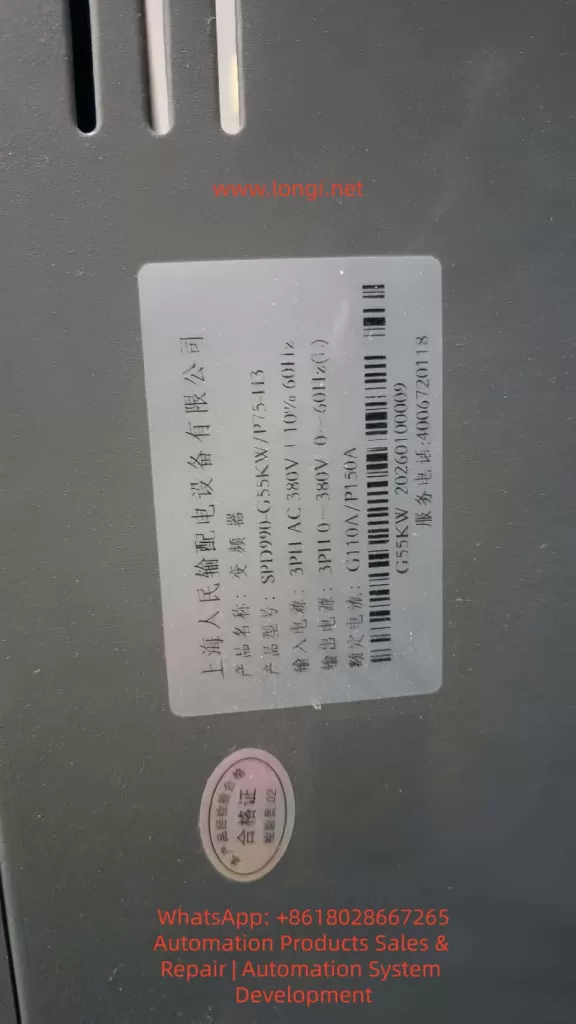
In-Depth Analysis and Comprehensive Solutions for the E-03 Constant-Speed Overcurrent Fault in SPD990 Inverters by Shanghai People’s Electric Appliance

The SPD990 series high-performance current vector inverters from Shanghai People’s Electric Appliance integrate four core control modes: ordinary V/F control, advanced V/F control, separated V/F control, and open-loop current vector control. With features such as wide voltage adaptability, high-precision speed regulation, and comprehensive overload/overvoltage/overheating protection functions, these inverters are widely compatible with three-phase AC asynchronous motors. They are extensively applied in industrial automation scenarios, including fans, pumps, conveyor belts, machine tools, textile machinery, and constant-pressure water supply systems, serving as the core industrial control equipment for achieving energy-saving speed regulation and stable motor operation in industrial settings.

During long-term continuous operation, inverter faults are the primary cause of production line shutdowns and equipment damage. Among them, the E-03 overcurrent fault during constant-speed operation is one of the most frequently triggered, most widely impactful, and most clearly traceable typical faults in the SPD990 inverter. Upon triggering this fault, the inverter immediately blocks PWM power output, cuts off power supply to the motor, and displays the E-03 code with a flashing operation panel and a constantly lit ALM fault indicator. In mild cases, it causes production interruptions, while in severe cases, it can lead to irreversible hardware damage, such as motor winding burnout and inverter IGBT power module breakdown.

This article strictly adheres to the official user manual of the Shanghai People’s Electric Appliance SPD990 inverter and combines thousands of actual industrial field maintenance cases to provide an in-depth analysis of the official definition, triggering mechanism, and all-dimensional causes of the E-03 fault. It offers a full-process technical solution from safe shutdown, rapid troubleshooting, precise repair to long-term prevention. All content is practical technical know-how without redundant expressions, serving as a directly applicable fault handling guide for industrial control maintenance engineers, equipment repair personnel, and electrical technicians.

E-03 fault

I. Official Definition and Core Triggering Mechanism of the SPD990 Inverter E-03 Fault

According to Chapter 9 “Fault Diagnosis and Countermeasures” in the SPD990 inverter user manual, the E-03 fault, fully named “Overcurrent during Constant-Speed Operation,” is a safety mechanism triggered by the DSP controller in milliseconds when the internal current detection circuit detects that the output-side three-phase current exceeds the rated current limit protection threshold during the stable constant-speed operation phase after the inverter drives the motor through the acceleration process and reaches the set frequency.

1. Officially Stated Core Causes of the Fault

The manual explicitly identifies three direct causes of the E-03 fault:

  • Sudden or abnormal load changes: Sudden increases in motor load during constant-speed operation, mechanical transmission mechanism jamming, or load-end stalling.
  • Undersized inverter power: The rated output current of the inverter is less than the rated operating current of the motor, leading to long-term overload operation and triggering protection.
  • Implicit associated causes: Abnormal fluctuations in grid voltage, hardware faults in the motor itself, and unreasonable control parameter settings.

2. Core Working Principle of Overcurrent Protection

The SPD990 inverter employs full-process current closed-loop control. High-precision Hall current sensors are built in to sample the U, V, and W three-phase output currents in real time, converting the current signals into voltage signals and transmitting them to the main control board. During constant-speed operation, with stable motor speed and constant output frequency, the output current should remain within the rated range under normal load conditions. When the output current exceeds 160% of the rated current for G-type machines or 120% of the rated current for P-type machines (set by the F9.06 parameter), the main control board immediately determines it as an overcurrent fault, cuts off the drive signals to the IGBT power modules, and outputs a fault alarm, providing dual protection for the inverter power devices and motor windings.

Key distinguishing points: Overcurrent faults in SPD990 inverters are triggered in three scenarios. The E-03 fault is triggered only during the stable constant-speed phase, while overcurrent during acceleration triggers the E-01 fault, and overcurrent during deceleration triggers the E-02 fault. The triggering phases are different, and the troubleshooting logic is completely distinct, which is the core premise for locating the E-03 fault.

SPD990-G55KW

II. Comprehensive and Precise Troubleshooting of All-Dimensional Causes of the SPD990 Inverter E-03 Fault

Based on the actual operating environment in industrial fields, the causes of the E-03 fault can be categorized into four main types: load-side abnormalities, inverter body faults, incorrect parameter settings, and electrical wiring and environmental interference. Each type of cause has corresponding clear fault characteristics and troubleshooting directions, covering 100% of fault scenarios.

(I) Load-Side Abnormalities: The Primary Cause of the E-03 Fault (Accounting for over 70%)

The load is the direct driving object of the inverter, and the stability of the load during constant-speed operation directly determines the magnitude of the output current. Load abnormalities are the core reason for triggering the E-03 fault, with specific subdivisions as follows:

1. Sudden Load Changes and Mechanical Jamming

  • Fluid load backpressure: Blockages in pipes, partially open valves, or scale buildup on filters in fans and pumps lead to a sudden increase in fluid resistance, doubling the motor load instantly.
  • Transmission load jamming: Overweight material accumulation on conveyor belts and conveyors, broken gear teeth in reducers, belt slippage/breakage, or eccentric coupling prevent the motor’s output torque from being transmitted, causing a sudden change in load resistance.
  • Processing load stalling: Stalling of workpieces in machine tools and textile machinery due to jamming, yarn winding, or mold sticking causes the motor to tend to stall, resulting in a sharp increase in current.

2. Hardware Faults in the Motor Itself

  • Winding faults: Inter-turn short circuits, phase-to-phase short circuits, or ground short circuits in the stator windings reduce the motor’s equivalent resistance, causing the current to rise exponentially.
  • Mechanical faults: Worn motor bearings, rotor rubbing, or stuck cooling fans significantly increase rotational resistance, leading to motor overload operation.
  • Selection and operation faults: Long-term low-frequency operation (below 30 Hz) of ordinary motors results in poor heat dissipation, causing winding overheating and insulation degradation, and abnormal current.
  • Overload in multi-motor parallel operation: When one inverter drives multiple asynchronous motors, if the total rated current of the motors exceeds 1.1 times the rated output current of the inverter, overload occurs during constant-speed operation.

(II) Inverter Body Faults: Overcurrent Caused by Hardware Abnormalities

Hardware damage in the inverter itself can lead to current detection inaccuracies or abnormal power output, triggering the E-03 fault. These are hardware-related faults with relatively high troubleshooting difficulty:

1. Incorrect Power and Model Selection

The SPD990 inverter is divided into G-type (for constant-torque loads) and P-type (for fan and pump square-torque loads), with significantly different overload capabilities. G-type machines support 110% long-term overload and 150%/5-second instantaneous overload, while P-type machines support only 105% long-term overload and 150%/1-second instantaneous overload. Using a P-type machine for constant-torque loads such as machine tools and cranes or selecting an inverter with a power rating one level lower than the motor will inevitably result in overload and overcurrent during constant-speed operation.

2. Current Detection Circuit Faults

Damage to Hall current sensors, drift in current sampling resistors, or abnormalities in the current signal processing circuit on the main control board can lead to inaccurate current detection values, either causing false E-03 alarms or triggering protection when the actual current exceeds the limit.

3. Power Module and Heat Dissipation Faults

Minor breakdowns in IGBT power modules or aging drive circuits can cause distortion in the output current waveform, increasing the effective value. Blocked air ducts due to dust accumulation, damaged cooling fans, or overheating of the heat sink (exceeding the 65°C threshold set by F9.14) in the inverter can indirectly trigger overcurrent protection (interlocked triggering of overheating and overcurrent).

4. Main Control Board Faults

Program disorders or aging components on the main control board can lead to misjudgment of the current protection threshold, triggering the E-03 fault irregularly.

(III) Incorrect Parameter Settings: Overcurrent Caused by Improper Software Configuration

The parameters of the SPD990 inverter are the core for controlling its operation. Mismatched parameters with the motor and load are common software causes of the E-03 fault:

1. Uncalibrated Motor Parameters

Failure to enter parameters such as F1.01 (rated power), F1.04 (rated voltage), and F1.05 (rated current) according to the motor nameplate or failure to perform F1.16 motor static/dynamic self-learning prevents the inverter from accurately matching the motor characteristics, resulting in uncontrolled output current during constant-speed operation.

2. Improper V/F Control Parameter Settings

Incorrect selection of the F3.00 V/F curve, excessively high F3.01 torque boost values leading to excessive low-frequency torque and overcurrent during constant-speed operation, and unreasonable setting of the F3.02 torque boost cutoff frequency further aggravate motor overload.

3. Incorrect Current Limit Protection Parameter Settings

Setting the F9.06 current limit level too low (G-type < 160%, P-type < 120%) can trigger overcurrent protection even during normal load operation. Improper setting of the F9.08 (acceleration current limit) and F9.09 (constant-speed current limit) coefficients fails to suppress current fluctuations.

4. Incorrect Control Mode Selection

Open-loop current vector control (F0.01 = 2) is highly sensitive to motor parameters. Control precision decreases and current fluctuations become excessive, triggering the E-03 fault if self-learning is not performed.

(IV) Electrical Wiring and Environmental Interference: Implicit Causes Often Overlooked

1. Output Wiring Faults

Short circuits between phases or to ground in the inverter’s U/V/W output lines, poor contact at wiring terminals, and failure to install output reactors for 380V series output lines exceeding 100 meters can lead to a sudden increase in output current due to high-order harmonics increasing leakage current.

2. Grid and Grounding Issues

Unbalanced three-phase grid voltages or voltage fluctuations exceeding ±10% can cause abnormal input voltages in the inverter, resulting in unbalanced output currents. Long grounding wires or shared grounding with high-power equipment can cause electromagnetic interference, leading to inaccurate current detection.

3. Environmental Interference

Electromagnetic interference from electric welding machines, high-power inverters, and contactors on-site, operation at temperatures exceeding 40°C without derating, and abnormal operation of inverter components can trigger overcurrent protection.

III. Step-by-Step Troubleshooting and Practical Solutions for the SPD990 Inverter E-03 Fault

For the E-03 fault, a 7-step step-by-step troubleshooting plan is formulated following the principles of starting with the easy and then the difficult, addressing mechanical issues before electrical ones, and dealing with software problems before hardware ones. Maintenance personnel can directly follow these steps for operation:

Step 1: Safe Shutdown and Power-Off Confirmation (Core Safety Operation)

Immediately press the STOP/RESET key to force a shutdown when the inverter triggers a fault. Do not perform maintenance with power on. Disconnect the input-side non-fuse breaker according to the manual’s safety requirements and wait for more than 10 minutes until the internal DC capacitors of the inverter are fully discharged (the charging indicator goes out) before proceeding with disassembly and wiring checks to avoid electric shock and arc injuries.

Step 2: Fault Status and Parameter Confirmation

Power on again without starting the motor and enter the d-group monitoring parameter interface of the inverter to check key operating data:

  • d-05: Check the output current before the fault to confirm whether it exceeds the rated current of the inverter.
  • d-33/d-34: Check the heat sink temperature to confirm whether it exceeds the 65°C overheating threshold.
  • d-51: Confirm that the current fault type is E-03 to rule out interference from other faults.
  • F0.00: Check whether the G/P model matches the load type.

Step 3: Load-Side Mechanical and Motor Troubleshooting (Prioritize Troubleshooting)

1. Mechanical Load Inspection

  • Manual disk test: Disconnect the coupling between the motor and the load and manually rotate the motor shaft to check for jamming or excessive resistance.
  • Load mechanism cleaning: Clean blockages in fan/pump pipes, remove foreign objects from conveyor belts, and repair reducer faults to ensure smooth operation of the transmission mechanism.
  • Load matching verification: Confirm that the load is not overweight and that the valves of fans and pumps are fully open, with no risks of backpressure or stalling.

2. Motor Body Detection

  • Insulation test: Use a 500V megohmmeter to measure the insulation resistance of the motor windings to ground, which should be ≥ 5MΩ. A lower value indicates damage to the winding insulation.
  • Winding balance test: Measure the DC resistance of the three-phase windings. The difference in resistance values between the three phases should be ≤ 5%. Otherwise, there is a winding short circuit.
  • Mechanical test: Check the motor bearings, fans, and rotors for wear or rubbing.
  • Multi-motor parallel verification: Calculate the total rated current of the motors to ensure it is ≤ 1.1 times the rated output current of the inverter.

Step 4: Inverter Body Hardware Detection

1. Power and Model Review

Check the inverter model and motor power: G-type machines are suitable for constant-torque loads, and their power should match the motor. P-type machines are suitable for fan and pump loads, and their power can be one level lower. Replace with the corresponding model immediately if the selection is incorrect.

2. Heat Dissipation System Maintenance

Clean dust from the inverter air ducts and replace damaged cooling fans. Set the FE.08 fan control parameter to 1 (forced operation) to ensure that the heat sink temperature remains stable below 40°C.

3. Power Module and Detection Circuit Detection

Use a multimeter to measure the three-phase output of the IGBT module for short circuits or breakdowns.
Check the wiring of Hall sensors and the current sampling circuit on the main control board for looseness or damage.
Replace the power module or main control board directly or send them for repair if hardware damage is detected.

Step 5: Inverter Parameter Calibration and Optimization (Core of Software Repair)

1. Precise Motor Parameter Settings

Enter the F1 group motor parameters and input the following strictly according to the motor nameplate:

  • F1.01 (motor rated power), F1.02 (rated frequency), F1.03 (rated speed), F1.04 (rated voltage), F1.05 (rated current).
    Set F1.16 = 1 (static tuning) and perform parameter self-learning with the motor unloaded to obtain accurate motor characteristic parameters.

2. V/F and Control Parameter Optimization

  • F0.01 control mode: Set to 0 (ordinary V/F control) when the load requirements are low to reduce control sensitivity.
  • F3.00 V/F curve: Set to 4 (square curve) for fans and pumps and to 0 (linear curve) for constant-torque loads.
  • F3.01 torque boost: Set to 0.0% (automatic boost) to avoid excessive manual boost causing overload.
  • F9.06 current limit level: Set to 160% for G-type machines and 120% for P-type machines to restore the factory current limit values.

3. Protection Parameter Reset to Default

Set the F9.08 acceleration current limit coefficient and F9.09 constant-speed current limit to factory values and enable the automatic current limiting function.

Step 6: Electrical Wiring and Environmental Rectification

1. Output Wiring Rectification

Tighten the U/V/W wiring terminals to ensure no looseness or short circuits. Do not install capacitors or surge absorbers on the output side.
Install output AC reactors if the output lines exceed 100 meters to reduce harmonic leakage current.
Separate power lines from control lines in wiring, and use shielded control lines with single-end grounding.

2. Grounding and Grid Optimization

Use independent single-point grounding for the inverter’s grounding terminal, with a grounding wire length ≤ 2 meters. Avoid sharing grounding with electric welding machines and high-power motors.
Install input reactors and voltage stabilizers to stabilize the input voltage if the grid voltage fluctuations are large.

Step 7: No-Load and Loaded Trial Operation Verification

1. No-load trial operation

Disconnect the load, start the inverter, and operate at a constant speed for 10 minutes. Check that the output current is normal and no E-03 fault occurs.

2. Loaded trial operation

Connect the load, gradually increase the frequency, and operate at a constant speed for 30 minutes. Monitor that the output current is stable, indicating that the fault has been completely resolved.

IV. Typical Industrial Case Analysis of the SPD990 Inverter E-03 Fault

Case 1: E-03 Fault Caused by Blockage in a Fan Load

A SPD990-5.5KW/P-type inverter in a factory workshop drives a centrifugal fan and frequently reports the E-03 fault during operation. Troubleshooting revealed extremely high resistance when manually rotating the fan shaft. Upon disassembly, a large amount of debris was found blocking the fan’s air inlet, causing backpressure and overload. Solution: The debris was cleared, the fan bearings were lubricated, and the inverter restarted. The constant-speed operating current remained stable at the rated value, permanently eliminating the fault.

Case 2: E-03 Fault Caused by Unperformed Motor Parameter Self-Learning

A SPD990-7.5KW/G-type inverter on a production line frequently reported the E-03 fault during the constant-speed phase after replacing the motor. Troubleshooting revealed that the inverter had not entered the new motor’s nameplate parameters and had not performed motor self-learning, resulting in a mismatch between the control parameters and the motor. Solution: The new motor’s rated parameters were entered, static self-learning was performed, and the V/F curve was optimized, immediately eliminating the fault.

Case 3: E-03 Fault Caused by Incorrect Inverter Selection

A machine tool equipment used a SPD990-11KW/P-type inverter (for fan and pump loads) to drive a constant-torque machine tool spindle, frequently experiencing overcurrent during constant-speed operation. Troubleshooting revealed that the P-type machine had insufficient overload capacity and could not meet the high-torque requirements of the constant-torque load. Solution: The inverter was replaced with a G-type 11KW model to match the load characteristics, permanently resolving the fault.

V. Long-Term Prevention Measures for the SPD990 Inverter E-03 Fault

Regular Load Maintenance

Inspect the mechanical transmission mechanism weekly, remove foreign objects, lubricate bearings, and tighten connecting parts. Test the motor insulation and winding resistance monthly to ensure normal motor operation.

Standardized Model Selection and Parameter Settings

Select G/P-type machines strictly according to the load type, and ensure that the inverter power is ≥ the motor power. Enter the motor’s nameplate parameters and perform self-learning when powering on for the first time. Do not arbitrarily modify current limit and torque parameters.

Daily Inverter Inspection

Check the cooling fan and air duct temperature daily and clean dust. Test wiring terminals, grounding, and output lines monthly for looseness, short circuits, or aging.

Electrical Environment Optimization

Install input/output reactors to suppress grid harmonics and output leakage current. Standardize wiring and grounding to reduce electromagnetic interference. Control the ambient temperature within -10°C to 40°C and humidity ≤ 90%, and enforce heat dissipation in high-temperature environments.

Conclusion

The E-03 constant-speed overcurrent fault in the Shanghai People’s Electric Appliance SPD990 inverter is not caused by a single hardware or software issue but rather results from the combined effects of load, inverter, parameter, and environmental factors. Maintenance personnel only need to firmly grasp the core characteristic of being triggered only during the constant-speed phase and follow the troubleshooting logic of “starting with the easy and then the difficult, addressing mechanical issues before electrical ones, and dealing with software problems before hardware ones” to quickly locate the causes and accurately resolve the fault.

Meanwhile, by implementing preventive measures such as standardized model selection, parameter calibration, daily maintenance, and environmental optimization, the triggering probability of the E-03 fault can be fundamentally reduced, ensuring the long-term stable operation of the SPD990 inverter and motor system and providing reliable support for the continuous production of industrial automation production lines.

In actual maintenance, over 90% of E-03 faults can be resolved through simple operations such as load cleaning, motor parameter calibration, and wiring tightening. Only a few cases involving hardware damage require part replacement. Mastering the troubleshooting and repair methods in this article can significantly shorten fault handling time, reduce equipment repair costs, and improve the operational efficiency of industrial control equipment.

Posted on

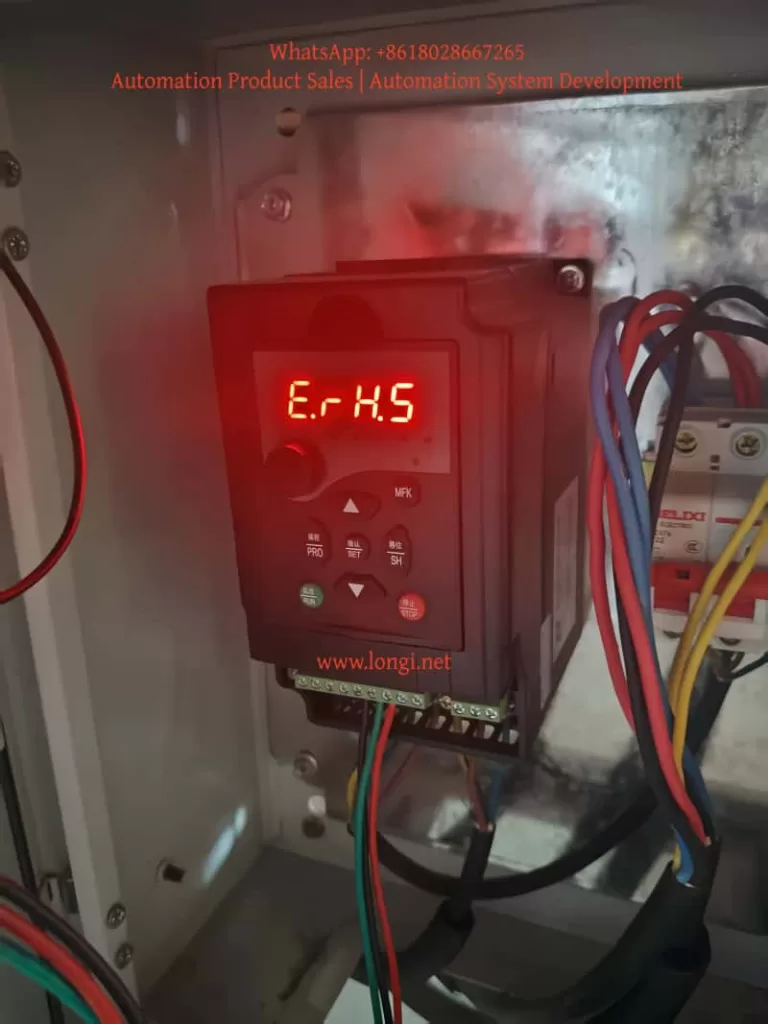
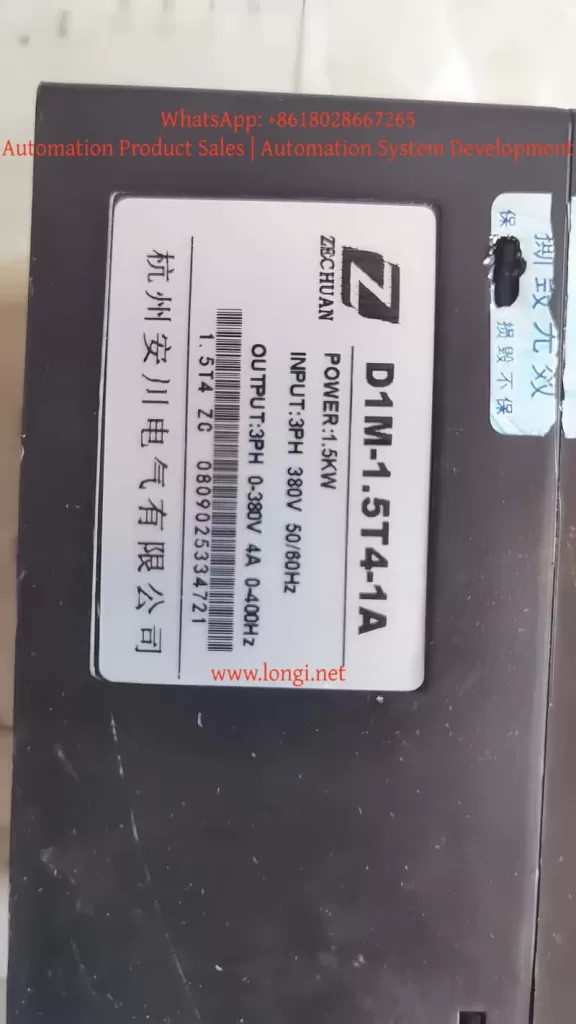
The “Time Bomb” of Frequency Converters: The Hidden Payment Rules and Industry Chronic Illness Behind the E.rH5 Fault of the D1M Series

The Hangzhou Yaskawa D1M – 1.5T4 – 1A frequency converter, a domestically – produced simple device with a nominal power of 1.5 kW, an input of 3PH 380V 50/60Hz, and an output of 0 – 400Hz, showed the “E.rH5” display on its digital tube immediately after being powered on at the user’s site. The device was completely locked up, unable to start, modify parameters, or run any motor load. The user searched through the entire 32 – page PDF “User Quick Manual” (Version 1.1, August 8, 2014), from the table of contents to Chapter 4 “Maintenance and Fault Information”, including 4.1 “Fault Information and Troubleshooting” and 4.2 “Common Abnormal Phenomena”. However, the list of all fault codes in the manual did not include E.rH5. The manual only listed conventional protections such as over – voltage, under – voltage, over – current, and over – heating, but remained silent about this error. When the user contacted the manufacturer, the first response was “Find the dealer who sold you the device.” The dealer replied that this was a pre – set “usage period lock” at the factory. Once the period expired, the device would be forced to shut down, and it could only be restored by an authorized dealer entering an unlock code. In essence, this was a “time bomb” implanted by the manufacturer to control the dealer’s payment collection.

E.RH.5 OR E.RH.S fault

This practice is not an isolated case but an open – secret in the current domestic low – end frequency converter market, especially for simple series like D1M and X5M. It is directly derived from the “lease control” model in the PLC industry from the late 1990s to the early 2000s. At that time, many small and medium – sized PLC manufacturers embedded real – time clocks (RTCs) or counters in their programs to recover project final payments. If the final payment was not settled after project acceptance, the PLC would enter a read – only or shutdown state, and users could only unlock it through the manufacturer’s backend. Now, with a deteriorating market environment, the frequency converter industry has directly replicated this logic at the hardware level. During factory programming, manufacturers write a hidden parameter (usually an encrypted internal counter or a countdown based on the built – in RTC of the main control chip) into the EEPROM or Flash. Users cannot see this during normal use, and it only triggers a specific hidden error code (such as E.rH5) when it expires. The manual deliberately omits it to prevent end – users from (cracking) it on their own, forcing them to (obediently) seek paid unlocking from dealers.

Technically, it is not a complex implementation. The low – cost main control chips (commonly ST or domestic MCUs) used in the D1M series support RTCs or software timers. Manufacturers only need to pre – set an “authorization duration” variable (e.g., 180 days or 365 days) in the factory firmware, along with a simple CRC check or simple encryption. During power – on self – check, it compares the current timing. Once it exceeds the set time, it directly jumps to a lock – up sub – program, blocking all operation commands and displaying the pre – set hidden code on the panel. In the “Basic Function Parameters” and “Protection Function Parameters” tables in the manual, there are no parameter groups related to “usage period” at all, because this is a “backdoor” left by the manufacturer for dealers. This design has extremely low costs but fully transfers the payment collection risk to dealers and end – users. When dealers purchase goods, manufacturers often supply them on a “installment” or “account period” basis, but at the same time require dealers to bind a period lock on the devices. When end – users buy the devices, if dealers default on payments to manufacturers, manufacturers may remotely lock the devices through dealers or directly, creating a layer – by – layer transfer of risk.

D1M-1.5T4-1A

The current macro – environment has exacerbated this practice. Since 2023, the domestic low – voltage frequency converter market has suffered from severe overcapacity, and the price war has become extremely fierce. The factory price of a 1.5 kW three – phase model has dropped to the 200 – 300 yuan range, and dealers’ gross profits have been compressed to almost zero. At the same time, small and medium – sized enterprises have highly volatile orders and long payment collection cycles. Manufacturers are worried that dealers will accumulate inventory and then run away, so they use the “time lock” as a payment collection insurance. As a result, end – users have become the ultimate victims. A knitting factory, a small packaging machinery factory, or a logistics door equipment factory may spend thousands of yuan to buy the device, install and debug it, and be ready for mass production when suddenly the E.rH5 code appears on the panel, the motor stops, and the production line is paralyzed. When users contact the manufacturer, the manufacturer refers them to the dealer. When they contact the dealer, the dealer either asks for a price difference to unlock it or directly states that it is “manufacturer’s policy.” There is no contract agreement or prior notice in the whole process. It is simply a case of “buying is equivalent to renting.”

What is even more egregious is that this lock – up mechanism directly violates the integrity of ownership after product delivery. After users pay the full amount, the ownership of the device has been transferred, but they are still controlled by the manufacturer through a firmware backdoor regarding the operation right. This is similar to digital rights management (DRM) in the software industry but lacks any legal authorization agreement. Users only see an ordinary commodity when making a purchase but end up with a “hardware with a limited service life.” The manual repeatedly emphasizes “Only qualified professionals can install and debug” and “Please use it correctly according to the manual” but deliberately conceals the most critical restrictive clauses, which is a typical case of information asymmetry fraud. In case of disputes, it is extremely difficult for users to defend their rights: the fault code is not in the manual, the manufacturer does not admit it as a quality issue but only as a “commercial policy,” and it is also difficult for the court to determine it as a product quality liability.

This phenomenon has spread among multiple domestic simple frequency converter brands. Series such as Wanxin X5M, Taichuang D1M, and Hangzhou Yaskawa D5M are essentially different re – branded products on the same technical platform, targeting cost – sensitive fields such as knitting machinery, small and medium – sized mechanical equipment, and constant – pressure water supply. These fields have a large number of users, low unit prices, and high replacement costs, making them the most likely targets for “lock – up.” In contrast, regular Japanese brands (such as the real Yaskawa Electric) or high – end domestic brands have never had such hidden lock – up functions. They compete based on technology, reliability, and service rather than using backdoors to control payment collection. However, the low – end market uses such “unpleasant functions” as a competitive weapon. Although it may help manufacturers and dealers tide over difficulties in the short term, it will completely destroy the industry’s reputation in the long run. Once users have a bad experience, they will develop a trust crisis towards all domestic frequency converters and turn to imported or more transparent brands, ultimately compressing the living space of the entire domestic supply chain.

To break this cycle, multiple parties need to take action. First, users must require manufacturers or dealers to provide a “no usage period lock” commitment letter when making purchases and immediately perform a full parameter backup and long – term power – on test (at least run for the pre – set period) after the device arrives. Second, dealers should jointly resist the lock – up requirements imposed by manufacturers and promote the industry association to issue clear regulations: the factory firmware must disclose all hidden parameters, and operation restrictions without written notice are prohibited. Third, manufacturers themselves should reflect. In today’s price war that has reached the bottom line, relying on backdoors to maintain cash flow is like drinking poison to quench thirst. Only by focusing on improving heat dissipation design, optimizing vector control algorithms, reducing harmonics, and enhancing EMC performance can they truly win the market. The positioning of the D1M as a “simple frequency converter with high cost – effectiveness, simple and practical” should have been a breakthrough for domestic substitution, but it has self – destructed due to a “time bomb.”

On a deeper level, this reflects the dilemma of Chinese manufacturing industry’s internal competition at the low – end of the industrial chain. Under the pressure of economic downturn, enterprises, in order to survive, are willing to sacrifice user experience and long – term reputation. Similar phenomena are also emerging in other industrial automation components: some contactors and servo drives are also starting to have “paid activation” or “cloud – based locks.” If this is allowed to continue, the underlying trust foundation of Industry 4.0 and smart manufacturing will collapse. Users are not fools; they will vote with their feet: they would rather spend more money on a device that “guarantees permanent operation” than touch a “cheap product” that may be locked up halfway.

The E.rH5 fault of the Hangzhou Yaskawa D1M is just the tip of the iceberg. It reminds us that technology is never neutral. A simple counter in embedded software can turn an industrial device into “leased hardware.” Manufacturers, dealers, and users must return to the spirit of contract: clear pricing,信息公开 (information disclosure), and full ownership upon delivery. Otherwise, the low – end frequency converter market will only become more and more “competitive in a vicious way,” and in the end, there will only be “zombie devices” that are locked up with each other and ( can be translated as “lost” here, referring to lost users) users. True competitiveness always comes from the product itself, not from backdoors hidden in the firmware.

Posted on

In-Depth Analysis and Comprehensive Troubleshooting Guide for ERR14 Module Overheating Fault in Ruichi RC-9 Series Inverters

Foreword

The Ruichi RC-9 series, a high-performance vector-type inverter launched by Shenzhen Ruichi Electronics, is widely used in various industrial automation scenarios such as textiles, machine tools, building materials, fan and pump systems, and lifting and conveying systems. It features both V/F and vector control modes, a wide speed regulation range, high starting torque, and rich networking capabilities. Among them, the RC-9-T18.5GB model with an 18.5kW rating is a core device in small- to medium-power industrial drive systems.

During long-term operation in the field, the ERR14 fault code is one of the most frequently occurring fault types in the RC-9 series inverters. This fault represents overheating protection for the inverter’s core power device module. Once triggered, the inverter immediately blocks its output and shuts down for protection, which not only directly interrupts the production process but also causes permanent degradation or even breakdown of the IGBT (Insulated Gate Bipolar Transistor) inverter module due to repeated overheating impacts. In severe cases, it can lead to catastrophic failures such as inverter explosions.

Based on the technical specifications in the official user manual of the RC-9 series inverters and combined with practical maintenance experience in industrial settings, this article provides an in-depth analysis of the underlying triggering logic and core causes of the ERR14 fault. It establishes a standardized, step-by-step troubleshooting and resolution process and proposes a systematic preventive maintenance plan. This guide offers directly applicable technical guidance for equipment maintenance personnel to fundamentally reduce the occurrence probability of this fault and ensure the long-term stable operation of drive systems.

Err 14 fault

I. Core Definition and Underlying Protection Logic of the ERR14 Fault

In the fault code system of the Ruichi RC-9 series inverters, ERR14 is officially defined as an inverter module overheating fault. It represents a hardware + software dual-level protection mechanism implemented by the inverter for the core power device, the IGBT. This fault is classified as a highest-priority shutdown protection type.

The IGBT module is the core component of the inverter responsible for converting alternating current (AC) to direct current (DC) and then back to adjustable-frequency and adjustable-voltage AC power. During its operation, two primary types of losses occur: conduction losses when the IGBT is in the conducting state and switching losses during state transitions. All these losses are ultimately dissipated in the form of heat. As a semiconductor power device, the performance and lifespan of an IGBT are directly related to its operating temperature. The industry consensus is that for every 10°C increase in the IGBT junction temperature, the device’s lifespan is halved. When the junction temperature exceeds the chip’s rated tolerance threshold, it directly causes irreversible thermal breakdown of the chip, leading to permanent damage to the module.

Based on this, the RC-9 series inverters integrate high-precision NTC (Negative Temperature Coefficient) thermistors within the IGBT module. Through the sampling circuit on the drive board, the module’s case temperature data is continuously collected and transmitted to the main control board for real-time monitoring. The factory-default module overheating protection threshold for the inverter is set at 75°C (adjustable within the range of 0-100°C via function code P8-47). When the temperature sampling circuit detects that the IGBT module temperature reaches the protection threshold, the main control board immediately triggers the ERR14 fault protection, blocks the IGBT drive signals, stops the inverter output, activates the fault relay, illuminates the fault indicator on the panel, and displays the ERR14 fault code, providing rapid protection for the IGBT module.

It is important to note that ERR14 faults can be categorized into two types: genuine overheating faults triggered by actual overheating of the IGBT module and false alarms caused by abnormalities in the temperature sampling circuit. The former results from the actual temperature of the IGBT module exceeding the limit, while the latter is caused by incorrect protection triggered by damage to the temperature sensing element or the sampling circuit. The troubleshooting approaches for these two types are entirely different, and this distinction is a common source of misjudgment in field maintenance.

II. In-Depth Analysis of the Five Core Causes of ERR14 Module Overheating Faults

Based on the hardware design, user manual specifications, and field maintenance data of the RC-9 series inverters, the triggering of ERR14 faults can be attributed to five core causes that cover the entire chain of factors from the external environment and mechanical cooling to electrical parameters and hardware components. Over 80% of these faults are concentrated in the first three external and cooling-related causes.

(I) Excessive Operating Environment Temperature Exceeding Inverter Design Tolerance

The standard designed operating environment temperature range for the RC-9 series inverters is -10°C to 50°C, with a maximum allowable ambient temperature of 50°C under rated load conditions. When the ambient temperature exceeds this range, the inverter’s cooling capacity drops sharply, directly causing overheating of the IGBT module and triggering the ERR14 fault.

Common scenarios where the ambient temperature exceeds the limit include:

  • The inverter is installed inside a closed electrical control cabinet without a properly designed cooling air duct or without additional cooling equipment such as cooling fans or air conditioners. The heat generated by the inverter’s operation accumulates continuously within the cabinet, creating a “heat island effect.” In high-temperature workshops during summer, the cabinet temperature can easily exceed the 50°C threshold.
  • Multiple inverters are stacked vertically inside the cabinet without installing thermal insulation and airflow guide plates as specified in the manual. The hot air exhausted by the lower inverter is directly drawn into the air intake of the upper inverter, creating a hot air circulation loop that renders the cooling system ineffective.
  • The inverter is installed in a location exposed to direct sunlight or near external heat sources such as boilers, heating furnaces, or resistance boxes, causing the ambient temperature to rise passively.
  • The installation site has high humidity or corrosive gases, which not only accelerate device aging but also reduce insulation performance, indirectly increasing device leakage currents and exacerbating heat generation.

According to the installation specifications for the RC-9 series inverters, for models with a rated power greater than 22kW, a vertical installation spacing of ≥200mm is required. For models with a rated power of 18.5kW and below, a vertical spacing of ≥100mm and sufficient lateral cooling space are required. Field maintenance data shows that non-compliance with these installation specifications and poor environmental cooling conditions are the most common诱因 (causes) for ERR14 faults.

(II) Blocked Cooling Air Duct, Sharp Decline in Heat Sink Heat Exchange Efficiency

The RC-9 series 18.5kW model adopts a cooling structure consisting of an IGBT module in direct contact with an aluminum heat sink and a bottom-mounted axial fan for forced air cooling. The designed air duct follows a bottom-in, top-out pattern, where the fan drives air to flow through the heat sink fins, carrying away the heat generated by the IGBT module. The heat exchange efficiency of the heat sink directly determines the effectiveness of temperature control for the IGBT module, and air duct blockage is the most common cooling failure issue in the field.

In scenarios with high levels of dust, cotton fibers, or metal chips, such as cement and building materials production, textile and chemical fiber manufacturing, mining, and woodworking, the inverter continuously operates, and airborne particulate matter continuously adheres to the spaces between the heat sink fins and the air intake filter screen. Especially for the 18.5kW model, which has relatively small fin spacing on the heat sink, the fins can easily become completely blocked by particulate matter, forming a “thermal insulation layer.” In this case, even if the fan operates normally, air cannot flow through the heat sink fins to form convection, causing the heat exchange efficiency of the heat sink to drop by over 80%. The heat generated by the IGBT module cannot be dissipated, and its temperature can rise rapidly to the protection threshold within a few minutes, triggering the ERR14 fault.

Additionally, when oil and moisture adhere to the surface of the heat sink, they combine with dust to form oil sludge, which not only blocks the air duct but also significantly reduces the thermal conductivity of the heat sink, further worsening the cooling effect. This is a core cause of ERR14 faults in scenarios with high levels of oil and grease, such as food processing and metalworking.

(III) Failure of the Cooling Fan System, Complete Loss of Forced Air Cooling Function

The cooling fan is the core power component of the forced air cooling system in the RC-9 series inverters, and its operating status directly determines the effectiveness of the cooling system. According to the user manual’s specifications for replacing consumable parts, the designed service life of the cooling fan is 2-3 years. After long-term operation, the fan is prone to aging and failure, making it a high-frequency诱因 (cause) of ERR14 faults.

The main forms of cooling fan system failure include:

  • Wear and aging of the fan bearings, resulting in reduced rotational speed, shutdown, abnormal noise during operation, and a significant decrease or complete loss of air volume. As a result, the heat sink cannot form effective convection.
  • Severe dust accumulation on the fan blades, fractures, or defects, causing a loss of dynamic balance and substandard air pressure and volume that cannot meet the cooling requirements of the heat sink.
  • Faults in the fan power supply circuit, including loose or oxidized connection terminals, blown fuses in the power supply, or damage to the fan power supply circuit on the drive board, preventing the fan from starting up when powered on.
  • Incorrect settings for the fan control parameters. The RC-9 series inverters use function code P8-48 to set the cooling fan control mode, with a factory default value of 0 (fan operates during inverter operation). If it is mistakenly set to other modes, the fan may not start up when the inverter is running, directly causing an overheating fault. If it is set to 1 (fan always operates) for an extended period, it accelerates bearing aging and shortens the fan’s service life.

Field maintenance data shows that for RC-9 series inverters with an operating life exceeding 2 years, failures caused by fan issues account for over 60% of ERR14 faults. Moreover, most of these faults are preceded by warning signs such as abnormal fan noise or reduced rotational speed, which are often not addressed in a timely manner during maintenance.

RC-9-T18.5GB

(IV) Abnormalities in the Temperature Sampling Circuit, Triggering False Overheating Alarms

If the inverter triggers the ERR14 fault under low-temperature environmental conditions or during no-load operation, and no abnormalities are found in the heat sink or fan, there is a high probability of abnormalities in the IGBT module’s temperature sampling circuit, causing the main control board to receive incorrect high-temperature signals and trigger false protection. This is a cause that is easily overlooked and prone to misjudgment in field maintenance, leading many maintenance personnel to mistakenly conclude that the module is damaged and incur unnecessary costs for replacing spare parts.

The temperature sampling circuit in the RC-9 series inverters consists of three parts: the NTC thermistor built into the IGBT module, connection terminals and wiring harnesses, and the temperature sampling circuit on the drive board and main control board. Abnormalities in any of these parts can lead to incorrect temperature sampling.

  • Damage or aging of the NTC thermistor: The NTC thermistor is a negative temperature coefficient device with a nominal resistance of mostly 10kΩ at a normal temperature of 25°C. After long-term operation at high temperatures, it may experience resistance drift, open circuits, or short circuits. If the resistance becomes abnormally low, it will transmit false high-temperature signals to the main control board, triggering a false ERR14 alarm.
  • Faults in the wiring and transmission circuit: Loose or oxidized connection terminals of the thermistor, broken wires, or poor contact in the 32-pin wiring harness between the drive board and the main control board can interrupt or distort the temperature sampling signals, causing false alarms.
  • Hardware damage in the sampling circuit: Faults in the temperature sampling circuit on the drive board or main control board, including changes in the values of sampling resistors, damage to operational amplifiers, or failure of filtering capacitors, can lead to abnormal temperature sampling data and trigger protection actions.

(V) Performance Degradation/Damage of the IGBT Inverter Module Itself, Exacerbating Abnormal Heat Generation

When all the above external factors have been ruled out and the ERR14 fault still occurs frequently, the core cause is performance degradation or physical damage to the IGBT inverter module itself, resulting in significantly higher heat generation than normal during operation and triggering overheating protection.

The degradation and damage of IGBT modules mainly result from the following scenarios:

  • Long-term operation under heavy loads and frequent starting and stopping, especially when the 18.5kW inverter is used for impact loads such as cranes, mixers, and wire drawing machines. The IGBT is subjected to high current impacts for extended periods, causing fatigue in the chip solder layer, a significant increase in thermal resistance, and an inability to transfer heat to the heat sink effectively, leading to a rapid rise in junction temperature.
  • Previous occurrences of output short circuits, motor-to-ground short circuits, overcurrent faults, or other issues in the inverter, which caused hidden damage to the IGBT chip. Although these incidents may not directly cause an explosion, they significantly increase the chip’s on-resistance. Under the same load current, the conduction losses increase exponentially, leading to a sharp increase in heat generation.
  • Aging of the freewheeling diodes within the module, resulting in a significant increase in reverse leakage current and generating additional heat.
  • Drying out or脱落 (detachment) of the thermal conductive silicone grease between the module and the heat sink, or loosening of the fixing screws, creating air gaps between the module and the heat sink and causing a sharp increase in thermal resistance, rendering the cooling ineffective.

The performance degradation of IGBT modules is irreversible. If not addressed promptly, not only will ERR14 faults occur frequently, but it will eventually lead to module breakdown, inverter explosions, and even damage to core components such as the main control board and drive board, resulting in greater economic losses.

III. Step-by-Step Troubleshooting and Standardized Resolution Process for ERR14 Faults

In response to the five core causes of ERR14 faults, we have developed a step-by-step troubleshooting and resolution process that progresses from easy to difficult, from external to internal factors, and from low-cost to high-cost solutions. This process fully complies with the maintenance logic in industrial settings, helping maintenance personnel quickly locate the root cause of the fault, resolve issues efficiently, and strictly adhere to the safety operation specifications of the RC-9 series inverters to avoid risks such as electric shock and secondary damage to the equipment.

Step 1: Initial Fault Assessment and Safety Operation Specifications (Prerequisite)

After the inverter triggers the ERR14 fault, the following operations must be performed first. Repeated resetting or forced starting and operation are strictly prohibited to avoid exacerbating the fault:

  • Press the STOP/RES (stop/reset) button on the inverter panel to confirm that the inverter is in a stopped state. Then, disconnect the air circuit breaker on the input side of the inverter to completely cut off the input power supply.
  • Strictly adhere to the safety specifications in the user manual. After powering off, wait at least 2 minutes to allow the bus capacitors inside the inverter to fully discharge. Confirm that the CHARGE indicator is off or use a multimeter to measure that the bus voltage is below AC36V before opening the cover for operation to eliminate the risk of electric shock.
  • Record key fault information, including the operating conditions when the fault was triggered (no-load/full-load, starting process/stable operation/deceleration process), ambient temperature, operating life of the inverter, past maintenance records, and the operable duration after fault reset. This information provides direction for subsequent troubleshooting.

Step 2: Inspection and Rectification of External Environment and Installation Compliance

This step is the priority for troubleshooting and does not require disassembly of the inverter itself. It can resolve most environment-related faults. The core inspection and rectification content is as follows:

  • Ambient temperature measurement and rectification: Use a temperature gun to measure the ambient temperature inside the inverter control cabinet and confirm whether it exceeds 45°C. If it approaches or exceeds the 50°C threshold, take immediate rectification measures: Install axial cooling fans or industrial air conditioners in closed control cabinets, remove heat-generating devices from the cabinet, avoid direct sunlight on the inverter, keep it away from external heat sources, and ensure that the cabinet’s ambient temperature remains stable below 40°C.
  • Compliance check for installation specifications: Check whether the inverter is installed vertically and strictly prohibit inversion or tilting beyond 5°, as this will affect air duct convection. Confirm whether sufficient cooling space is reserved above, below, and to the sides of the inverter. For the 18.5kW model, a vertical spacing of ≥100mm and a lateral spacing of ≥50mm are required. When multiple inverters are installed vertically in a stack, thermal insulation and airflow guide plates must be installed to avoid hot air circulation.
  • Inspection for obstructions at air inlets and outlets: Clear any obstructions at the air inlets and outlets of the inverter and replace clogged air intake filters to ensure smooth air intake and exhaust in the air duct.

Step 3: Inspection and Maintenance of the Cooling Air Duct and Fan System

This step is the core环节 (part) for resolving ERR14 faults, and over 80% of the faults in the field can be resolved through this step. The specific operations are as follows:

  • Thorough cleaning of the cooling air duct: After the inverter is powered off and discharged, remove the top and bottom covers. Use dry compressed air with a pressure ≤0.6MPa to blow dust, cotton fibers, and metal chips out of the heat sink fins from the air outlet towards the air inlet. If there is oil and grease on the heat sink surface, wipe it clean with anhydrous alcohol and allow it to dry completely before reinstalling the covers.
  • Comprehensive inspection and replacement of the cooling fan:
    • Visual inspection: Check for fractures or dust accumulation on the fan blades, abnormal noise from the bearings, and loose or aged connection terminals.
    • Power-on testing: After reinstalling the safety covers and powering on, set function code P8-48 to 1 to force the fan to operate continuously. Check whether the fan starts up normally, feel the air volume at the air outlet with your hand, and use a tachometer to measure the fan speed to confirm whether it meets the rated specifications.
    • Fault handling: If the fan does not rotate, first troubleshoot the power supply circuit and wiring connections, then inspect the fan itself and replace any damaged fans with ones of the same specifications immediately. If the fan has been in operation for more than 2 years, even if it is temporarily operating normally, preventive replacement is recommended to avoid sudden failures in the future.
    • Verification after rectification: After completing the cleaning and fan replacement, restore the inverter’s normal wiring connections, power it on, and run it under no-load conditions. Monitor the IGBT module temperature through the monitoring parameters in the U0 group on the inverter panel. Under normal ambient conditions, the no-load temperature should be 10-20°C higher than the ambient temperature and stabilize between 40-60°C.

Step 4: Inspection and Optimization of Load and Operating Parameter Rationality

If the cooling system is functioning normally but the inverter still triggers the ERR14 fault under load, it is necessary to inspect whether the load conditions and operating parameter settings are reasonable to eliminate additional heat generation caused by improper parameters or overloading:

  • Load current monitoring and overloading inspection: Check the inverter’s output current (monitoring parameter U0-02) through the panel. The rated output current of the RC-9-T18.5GB model is 37A. If the operating current consistently exceeds 90% of the rated value, it indicates heavy-load or overloading operation, which is a core诱因 (cause) of IGBT heat generation. Immediately inspect whether the motor is experiencing stalling, whether the mechanical load is jammed, whether the transmission mechanism is faulty, and whether the inverter selection matches the load. Resolve mechanical faults, reduce the load, and if the inverter is undersized, replace it with a model of a higher power rating.
  • Optimization of carrier frequency parameters: The carrier frequency is set by function code P0-15. A higher carrier frequency reduces motor noise but increases the switching losses of the IGBT, resulting in higher heat generation. For scenarios with high ambient temperatures and frequent ERR14 faults, the carrier frequency can be appropriately reduced within an acceptable range of motor noise. For the 18.5kW model, it can be lowered from the factory default of 8kHz to 4-5kHz, significantly reducing the IGBT’s switching losses and heat generation.
  • Optimization of motor parameters and control modes: If the inverter is operating in vector control mode (SVC/VC) and motor parameter auto-tuning has not been performed, it will result in insufficient control accuracy, large current fluctuations, and increased additional heat generation. Strictly follow the steps in Section 4.2 of the user manual to perform complete tuning (set P1-37=2) with the motor and load completely decoupled. If decoupling the load is not possible, perform static tuning (set P1-37=1) to ensure that the motor parameters match the actual operating conditions and reduce operating current and heat generation.
  • Optimization of V/F curves and torque boost: For V/F control mode, if the torque boost parameter P3-03 is set too high, it will result in excessive no-load current for the motor and increased IGBT heat generation. For square torque loads such as fans and pumps, set P3-02 to 2 (square V/F curve) and reduce the manual torque boost value to eliminate additional losses and heat generation at low speeds.

Step 5: Inspection of Temperature Sampling Circuit Abnormalities and Handling of False Alarm Faults

If the inverter triggers the ERR14 fault under low-temperature and no-load conditions and no abnormalities are found in the above steps, it is necessary to inspect the temperature sampling circuit to resolve false alarm faults:

  • Inspection of the NTC thermistor: After the inverter is powered off and discharged, unplug the NTC thermistor connector from the IGBT module. Use a multimeter’s resistance range to measure the NTC resistance at a normal ambient temperature of 25°C. If the resistance is 0, infinite, or deviates by more than 30% from the nominal 10kΩ, it indicates that the NTC thermistor is damaged and needs to be replaced with one of the same specifications. If the NTC is built into the IGBT module, the entire IGBT module must be replaced.
  • Inspection of wiring and transmission circuits: Check for broken wires, loose connections, or oxidation in the wiring of the thermistor. Clean the connection terminals and tighten them. Unplug and replug the 32-pin wiring harness between the drive board and the main control board and clean the oxidation on the harness pins to ensure normal transmission of temperature sampling signals.
  • Inspection of sampling circuit hardware: If the NTC and wiring are normal but false alarms still occur, it indicates that the temperature sampling circuit on the drive board or main control board is damaged and needs to be replaced with the corresponding drive board or main control board. It is recommended to contact the manufacturer’s technical support to complete this operation to avoid secondary damage caused by self-repair.

Step 6: Inspection and Replacement of the IGBT Module Itself

If all the above steps have been completed and the inverter’s temperature still rises rapidly and triggers the ERR14 fault under load, it indicates that the IGBT module has undergone irreversible performance degradation or damage and requires module inspection and replacement:

  • Static inspection of the IGBT module: After the inverter is powered off and discharged, disconnect the input R, S, T and output U, V, W terminals. Use a multimeter’s diode range to measure the diode characteristics of the three-phase upper and lower bridge arms of the IGBT module. Under normal conditions, there should be a forward conduction voltage drop of 0.3-0.7V and reverse blocking. If forward and reverse conduction or blocking occur, or if the voltage drop differences between the three-phase bridge arms exceed 0.2V, it indicates that the module is damaged and must be replaced.
  • Standardized replacement operation for the module: When replacing the IGBT module, first thoroughly clean the old thermal conductive silicone grease from the surface of the heat sink. Apply a new layer of thermal conductive silicone grease with a thermal conductivity of ≥1.2W/m·K evenly on the contact surface between the module and the heat sink, ensuring no air bubbles or impurities. Tighten the module fixing screws in a diagonal sequence with the specified torque to avoid module warping and increased thermal resistance. After replacement, first perform a static test to confirm no short circuits, then conduct a no-load test and a rated load test to ensure that the inverter operates normally with no fault alarms and a stable temperature.

IV. Systematic Preventive Maintenance Plan for ERR14 Module Overheating Faults

The core essence of the ERR14 fault is “overheating,” and the vast majority of these faults can be fundamentally avoided through standardized preventive maintenance. Based on the user manual specifications of the RC-9 series inverters and practical maintenance experience in industrial settings, we have developed a full-lifecycle preventive maintenance plan that can significantly reduce the occurrence probability of ERR14 faults and extend the service life of inverters.

(I) Establish a Graded Regular Maintenance System

  • Daily inspections: During equipment operation, check whether the module temperature and output current displayed on the inverter panel are normal, whether the cooling fan is operating smoothly without abnormal noise, whether the ambient temperature inside the control cabinet exceeds the limit, and whether the motor is operating with abnormal noise or vibration. If any abnormalities are found, stop the equipment immediately for inspection.
  • Monthly maintenance: Use dry compressed air to clean the dust on the surface of the inverter and inside the control cabinet. Check whether the air inlet and outlet filters are clogged and clear any debris. Check for loose or overheated and discolored connection terminals in the main and control circuits and tighten them promptly. Verify that the inverter’s operating parameters have not been modified incorrectly.
  • Quarterly maintenance: After disconnecting the power and discharging, open the cover to clean the dust accumulation on the heat sink fins and fan. Inspect the operating status of the fan and replace any bearings with abnormal noise in advance. Measure the static characteristics of the IGBT module and verify the sampling accuracy of the temperature sampling circuit to ensure normal temperature detection.
  • Annual maintenance: Perform a comprehensive disassembly and cleaning of the inverter. Replace cooling fans that have been in operation for 2 years. Inspect the bus electrolytic capacitors for bulging or leakage and perform preventive replacement for those that have reached
Posted on

Shanghai Renmin Electric SPD900M Series Inverter ECCF Fault Analysis and Troubleshooting Guide

I. Introduction

In the field of industrial automation, inverters, as the core equipment for motor drives, directly impact production efficiency and equipment lifespan with their stability. The Shanghai Renmin Electric SPD900M series inverters (e.g., SPD990-M0.75KW-H3) are widely used in loads such as fans, pumps, and conveyor belts due to their high cost-effectiveness and reliability. However, users often encounter the ECCF fault (current detection fault) during operation. If not promptly troubleshot, this fault can lead to inverter shutdown or even damage. This article combines the circuit design and field experience of the SPD900M series to provide an in-depth analysis of the causes, troubleshooting steps, and solutions for the ECCF fault, offering users an operable technical guide.

SPD990-M0.75KW-H3

II. Definition and Classification of ECCF Faults

According to the fault code table of the Shanghai Renmin Electric SPD900M series inverters (see Table 1), the ECCF (current detection fault) falls under the “severe fault” category (fault level 16). Once triggered, the inverter immediately stops outputting and requires fault clearance before resetting. The core logic is that the inverter’s CPU detects abnormal current sampling signals or a failure in the auxiliary power supply that prevents the current detection circuit from functioning properly.

Table 1: SPD900M Series ECCF Fault Classification

Fault CodeFault NameSub-Fault TypeFault Description
ECCFCurrent Detection FaultCurrent Sampling Circuit FaultCurrent sampling signal exceeds the normal range (e.g., overcurrent, undercurrent, or signal distortion)
Auxiliary Power Supply FaultAbnormal auxiliary power supply (e.g., 24V/15V) for the current detection circuit, preventing the sampling circuit from functioning

III. In-Depth Cause Analysis of ECCF Faults

The essence of an ECCF fault is the failure of the current detection chain, involving three links: “auxiliary power supply → sampling circuit → CPU processing.” The following is an analysis of specific causes by link:

(I) Current Sampling Circuit Fault: The Core Cause of Signal Anomalies

The SPD900M series adopts a Hall current sensor + operational amplifier solution for current sampling (some low-power models use sampling resistors). The sampled signal is amplified and filtered before being sent to the CPU’s ADC (analog-to-digital converter). Common fault points include:

1. Sampling Resistor/Sensor Damage

The sampling resistor is a key component for current-to-voltage conversion (e.g., the DC bus sampling resistor is typically 10Ω/5W). If its resistance value changes (e.g., increases from 10Ω to 20Ω) or it becomes open-circuit due to overcurrent, overheating, or aging, the sampled voltage will deviate from the normal value (e.g., the normal sampled voltage is 0-5V, but it may drop below 2V after the change). The CPU detects a “mismatch between the sampled voltage and the actual current” and triggers an ECCF.

Case: A user’s SPD990-M1.5KW inverter frequently reported ECCF. Upon disassembly, it was found that the DC bus sampling resistor was burnt black, and its resistance value had become infinite. After replacing it with a resistor of the same specification, the fault disappeared.

2. Operational Amplifier (Op-Amp) Fault

The sampled signal needs to be amplified by an operational amplifier (e.g., LM358 or TL082). If the op-amp’s gain decreases (e.g., the normal gain is 10 times, but it becomes 5 times after a fault) or its output is offset (e.g., an output of 3V with no input) due to power supply fluctuations, electrostatic discharge, or aging, the signal received by the CPU will be incorrect. For example, after the op-amp is damaged, the sampled signal may be misjudged as “overcurrent” even when the motor current is normal.

3. Poor Contact in Sampling Lines

If the connection terminals of the current sensor (e.g., the “+”, “-“, and “OUT” pins of the Hall sensor) become loose due to vibration or oxidation, the sampled signal may be interrupted or fluctuate. Use a multimeter to measure the continuity of the sampling lines. If the resistance is greater than 1Ω, it indicates poor contact.

4. Electromagnetic Interference (EMI)

If the sampling lines do not use shielded wires or are laid parallel to power lines (e.g., motor cables), they may induce high-frequency noise (e.g., harmonics of the PWM wave), causing distortion of the sampled signal (e.g., superimposing杂波 [jitter or noise] of more than 1V). The CPU cannot recognize the distorted signal and misjudges it as a “current detection fault.”

(II) Auxiliary Power Supply Fault: Failure of the “Power Source” for the Sampling Circuit

The current sampling circuit (e.g., Hall sensors and op-amps) relies on an auxiliary power supply (usually DC24V or DC15V) to function. If the auxiliary power supply is abnormal, the sampling circuit will completely stop working, and the CPU will detect “no sampled signal,” triggering an ECCF. Common causes include:

1. Auxiliary Power Supply Module Damage

The auxiliary power supply of the SPD900M series mostly uses a switching power supply module (e.g., TNY264GN). If the module is damaged due to overvoltage, overcurrent, or poor heat dissipation, the output voltage will be 0V or much lower than the rated value (e.g., 24V drops to 10V). Use a multimeter to measure the output terminal of the power supply module. If the voltage is abnormal, the module needs to be replaced.

2. Filter Capacitor Failure

If the filter capacitors (e.g., electrolytic capacitors 470μF/25V) of the auxiliary power supply bulge or leak due to long-term high temperatures or excessive ripple currents, the power supply ripple will increase (e.g., the ripple voltage increases from 50mV to 500mV), interfering with the normal operation of the sampling circuit. In severe cases, a short-circuited capacitor can cause the power supply module to be overloaded and damaged.

Case: A user’s SPD990-M0.75KW inverter reported ECCF. Upon inspection, it was found that the filter capacitor of the auxiliary power supply was bulging. After replacing the capacitor, the power supply ripple dropped to 80mV, and the fault was eliminated.

3. Short Circuit/Open Circuit in Power Lines

If the input lines of the auxiliary power supply (e.g., the lines from the rectifier bridge to the power supply module) are short-circuited due to damaged insulation, the fuse will blow. If the lines are open-circuited (e.g., loose connection terminals), the power supply module will have no input. Check the continuity and insulation resistance of the lines (use a megohmmeter; it should be greater than 10MΩ).

ECCF

IV. Systematic Troubleshooting Steps for ECCF Faults

For ECCF faults, it is necessary to follow the principles of “safety first → from simple to complex → verify by link.” The following is the specific troubleshooting process:

Step 1: Safety Operations (Critical!)

The inverter contains high voltages (the DC bus voltage is approximately 540V, and there is still residual charge even after power-off). Before troubleshooting, the following must be done:

  • Disconnect the input power supply (R/S/T terminals) of the inverter.
  • Wait for more than 5 minutes (to allow the DC bus capacitors to discharge).
  • Use a multimeter to measure the DC bus voltage (P/N terminals) and confirm that it is below 36V (safe voltage).
  • Wear insulating gloves and avoid touching charged components.

Step 2: Check the Auxiliary Power Supply (Quickly Locate “Power Source” Issues)

The auxiliary power supply is the foundation of the sampling circuit. Checking it first can quickly eliminate common faults:

  • Locate the auxiliary power supply module (usually on the left side inside the inverter, marked with “POWER”).
  • Use a multimeter to measure the input voltage of the module (AC220V or DC380V, depending on the model).
  • Measure the output voltage of the module (e.g., DC24V). If the output voltage deviates from the rated value by more than ±10% (e.g., 24V drops below 20V), it indicates a fault in the power supply module or filter capacitor.
  • If the output voltage is normal, continue troubleshooting the sampling circuit.

Step 3: Check the Current Sampling Circuit (Core Link)

If the auxiliary power supply is normal, focus on checking the “signal chain” of the sampling circuit:

1. Check Sampling Resistors/Sensors

  • For sampling resistors: Use a multimeter to measure the resistance value (power must be off). If the resistance value deviates from the nominal value by more than ±5% (e.g., a 10Ω resistor becomes 12Ω), it needs to be replaced.
  • For Hall sensors: Measure the power supply pins of the sensor (e.g., “+” connected to 24V, “-” connected to GND). If the power supply is normal, measure the voltage of the output pin (“OUT”) (normal is 0-5V, corresponding to the motor current of 0-rated value). If the output voltage is 0V or 5V (saturated), it indicates that the sensor is damaged.

2. Check Operational Amplifiers

  • Locate the op-amps in the sampling circuit (e.g., LM358, usually near the sensor).
  • Measure the power supply pins (Vcc/GND) of the op-amp to confirm a normal voltage (e.g., 15V).
  • Measure the voltages of the input pins (IN+/IN-) and output pin (OUT) of the op-amp: If the input pins have a normal sampled signal (e.g., IN+ is 2V and IN- is 1V), but the output pin has no voltage or an abnormal voltage (e.g., OUT is 0V), it indicates that the op-amp is damaged.

3. Check Sampling Lines

  • Use a multimeter to measure the continuity of the sampling lines (e.g., the lines from the sensor to the op-amp). If the resistance is greater than 1Ω, it indicates that the lines are loose or oxidized.
  • Check whether the shielding layer of the lines is grounded (the shielding layer needs to be connected to the GND terminal of the inverter, not the chassis). If it is not grounded, reconnect it.

Step 4: Eliminate Electromagnetic Interference (An Often-Overlooked “Invisible Killer”)

If the sampling circuit hardware is normal but the fault still occurs frequently, consider electromagnetic interference:

  • Check whether the sampling lines are laid parallel to power lines (e.g., motor cables and input power lines). If so, they need to be laid separately (spacing greater than 20cm).
  • Confirm that the shielding layer of the sampling lines is intact (no damage) and reliably grounded (connected to the “GND” terminal of the inverter, not the chassis).
  • Use an oscilloscope to measure the waveform of the sampled signal. If there is obvious jitter (e.g., a peak value exceeding 1V) on the waveform, a magnetic ring (e.g., a nickel-zinc magnetic ring) needs to be connected in series in the sampling lines or a filter capacitor (e.g., a 0.1μF ceramic capacitor) needs to be connected in parallel.

Step 5: Verify Whether the Fault is Eliminated

After completing the above troubleshooting and repairs, a “loaded test” is required:

  • Power on again and press the “STOP/RST” key to reset the fault.
  • Start the motor and observe the display panel of the inverter (whether there is an ECCF alarm).
  • Use a clamp-on ammeter to measure the actual current of the motor and compare it with the “output current” displayed by the inverter (the deviation should be less than ±5%).
  • If the inverter runs for more than 30 minutes without a fault, it indicates that the troubleshooting is successful.

V. Solutions and Cases for ECCF Faults

(I) Solutions for Common Faults

Fault CauseSolution
Sampling resistor damageReplace with a sampling resistor of the same specification (e.g., 10Ω/5W → 10Ω/5W)
Operational amplifier damageReplace with an op-amp of the same model (e.g., LM358 → LM358), and pay attention to the pin definitions (avoid reverse connection)
Auxiliary power supply module damageReplace with a power supply module of the same model (e.g., TNY264GN → TNY264GN), or contact the manufacturer to purchase original parts
Filter capacitor failureReplace with an electrolytic capacitor of the same specification (e.g., 470μF/25V → 470μF/25V, and pay attention to the polarity)
Poor contact in sampling linesRetighten the connection terminals, polish the oxidized layer with sandpaper, or replace with new wires
Electromagnetic interferenceAdd a shielding layer to the sampling lines and ground them, lay them separately from power lines, connect a magnetic ring in series or connect a filter capacitor in parallel

(II) Typical Case Analysis

Case 1: ECCF Caused by a Burnt Sampling Resistor

  • Fault Phenomenon: A SPD990-M1.5KW inverter reported ECCF immediately after startup and could not be reset.
  • Troubleshooting Process:
    • After power-off and discharge, it was found upon disassembly that the DC bus sampling resistor (10Ω/5W) was burnt black, and its resistance value was infinite.
    • Checking the motor cable, it was found that the motor winding was short-circuited (the insulation resistance of the winding measured by a megohmmeter was 0Ω).
    • The motor winding (or motor) was replaced, and the sampling resistor was replaced with one of the same specification.
  • Result: The inverter returned to normal and no longer reported ECCF.

Case 2: ECCF Caused by Filter Capacitor Failure in the Auxiliary Power Supply

  • Fault Phenomenon: A SPD990-M0.75KW inverter frequently reported ECCF, especially in high-temperature environments (summer).
  • Troubleshooting Process:
    • The output voltage of the auxiliary power supply (DC24V) was normal.
    • Using an oscilloscope to measure the power supply ripple, it was found that the ripple voltage was as high as 600mV (normal should be less than 100mV).
    • Upon disassembling the power supply module, it was found that the filter capacitor (470μF/25V) was bulging and leaking.
    • The filter capacitor was replaced with one of the same specification.
  • Result: The power supply ripple dropped to 70mV, the inverter ran stably, and the fault was eliminated.

VI. Preventive Measures for ECCF Faults

To reduce the occurrence of ECCF faults, measures need to be taken from the aspects of “design, use, and maintenance”:

1. Correct Selection and Installation

  • Select an appropriate inverter according to the load type (e.g., select “V/F control” for fans and pumps and “vector control” for precision loads).
  • Use shielded twisted-pair wires for the sampling lines and reliably ground the shielding layer (connect to the GND terminal of the inverter).
  • Lay the power lines separately from the sampling lines (spacing greater than 20cm) and avoid parallel laying.

2. Regular Maintenance

  • Clean the dust inside the inverter every 3 months (use compressed air to blow it away) to avoid dust accumulation leading to poor heat dissipation.
  • Check the connection terminals (e.g., input and output terminals and sampling line terminals) every 6 months and tighten loose screws.
  • Measure the ripple voltage of the auxiliary power supply every year (use an oscilloscope). If the ripple exceeds 100mV, replace the filter capacitor.

3. Reasonable Parameter Settings

  • Correctly set the “current detection threshold” (e.g., set the overcurrent protection threshold to 1.2 times the rated current to avoid false alarms).
  • Avoid long-term overload operation (the motor current should not exceed 1.1 times the rated current).
  • Enable the “current filtering” function (available in some models) to reduce noise in the sampled signal.

4. Manufacturer Service Support

  • If the fault cannot be solved by self-troubleshooting (e.g., CPU board damage or sampling circuit design defects), contact the after-sales service of Shanghai Renmin Electric (phone: 4006720118).
  • The manufacturer can provide remote diagnosis (through the communication interface of the inverter), on-site maintenance, or part replacement services.
  • For models with frequent faults, the manufacturer can upgrade the sampling circuit (e.g., replace with more reliable Hall sensors) to fundamentally solve the problem.

VII. Summary

The ECCF fault is a common fault in the SPD900M series inverters, and its core is the “failure of the current detection chain,” involving multiple links such as the auxiliary power supply, sampling circuit, and electromagnetic interference. During troubleshooting, follow the principles of “safety first and from simple to complex,” first check the auxiliary power supply, then check the sampling circuit, and finally eliminate interference. The solutions should be targeted at specific causes, such as replacing damaged resistors, op-amps, or capacitors, repairing poor line contact, or taking anti-interference measures.

The key to preventing ECCF faults is “regular maintenance + correct use”: regularly clean the dust, check the lines, and measure the power supply ripple; correctly select, install, and set parameters. If a fault that cannot be solved by oneself is encountered, contact the manufacturer in a timely manner to avoid greater losses due to delays.

Through the analysis and guide in this article, it is hoped that users can quickly locate ECCF faults, improve the reliability of inverters, and ensure the continuity of production.

Posted on

CM-SVC Servo Manual User Guide: In-depth Analysis Based on Donghua Machinery Injection Molding Machine Applications

I. Introduction

In the field of plastic injection molding equipment, the application of servo oil pump technology has become a core indicator for measuring the energy efficiency rating and dynamic response performance of injection molding machines. Donghua Machinery Co., Ltd., as a key enterprise in the domestic injection molding machine industry, utilizes the CM-SVC series servo drives as a dedicated product developed specifically for servo oil pump driving. Based on the technical content of the “CM-SVC Servo Drive Operation Guide Manual” and combined with the operational characteristics of Donghua Machinery injection molding machines in actual production, this user guide is compiled to assist field engineers, equipment maintenance personnel, and process debugging personnel in better mastering the entire process of installation, debugging, parameter optimization, and troubleshooting of this servo system.

CML drives

II. Technical Positioning of CM-SVC Servo Drive and Its Adaptability to Donghua Machinery

The CM-SVC series servo drives have a rated current coverage ranging from 15A to 300A and are compatible with three-phase 380V power supplies, capable of stable operation within a voltage fluctuation range of -15% to +20%. This series of drives is specifically designed for servo oil pump control scenarios and incorporates a built-in oil pressure closed-loop control algorithm, CAN communication interface, dual analog input channels, and multi-group PID parameter switching functionality, making it highly compatible with Donghua Machinery’s commonly used hydraulic system architecture of quantitative pump + servo motor + pressure sensor.

Donghua Machinery’s injection molding machine product line covers a clamping force range from 80 tons to over 3000 tons, with its hydraulic systems generally adopting a “flow-pressure dual closed-loop” control strategy. Under this system, the CM-SVC drive can operate in two typical oil pressure control modes:

  • Mode 2 (A3-00=2): Analog input method. The AI1 channel receives the oil pressure command (0~10V) from the controller (computer), the AI2 channel receives the flow command (0~10V), and the AI3 channel receives the actual feedback signal from the pressure sensor. This method is suitable for most standard models, offering fast signal response and strong anti-interference capability.
  • Mode 1 (A3-00=1): CAN communication input method. Oil pressure and flow commands are transmitted through the CAN bus, with AI3 still serving as the pressure feedback channel. This method is more suitable for large or high-speed models, reducing attenuation and interference of analog signals during long-distance transmission.

Understanding the differences between these two operating modes is fundamental to correctly using this manual. The following sections will provide detailed explanations centered around actual installation, debugging, and operational maintenance.

III. Key Points for Mechanical Installation and Suggestions for Donghua Electrical Cabinet Layout

3.1 Installation Environment Requirements

According to the content in Chapter 1 and Chapter 3 of the manual, the CM-SVC servo drive must be installed under the following environmental conditions:

  • Ambient temperature: -10°C to +40°C. If the temperature exceeds 40°C but does not exceed 50°C, derating must be applied.
  • Altitude: Below 1000m. Derating is also required if this altitude is exceeded.
  • Relative humidity: Less than 95%, non-condensing.
  • Absence of corrosive gases, flammable gases, oil mist, and conductive dust.

In Donghua Machinery’s actual production workshops, injection molding machines are usually arranged in a centralized manner, and the ambient temperature in summer may approach the upper limit of 40°C. Therefore, the following points should be noted during electrical cabinet design:

  1. Heat Dissipation Space: For drives with power ratings of CM-SVC-00400 and above, when installed vertically, the clear distance A between two sets of drives above and below should be greater than 50mm, and heat-insulating deflectors should be added. For models CM-SVC-00700 and above, A should be greater than 300mm.
  2. Metal Dust Protection: During plastic processing, fine dust may be generated, especially from materials with fillers (such as glass fiber, calcium carbonate). The manual specifically points out that for applications involving metal dust, it is recommended to adopt an external installation method for the radiator. This means extending the heat dissipation part of the drive outside the electrical cabinet while keeping the cabinet sealed.
  3. Vibration Isolation: The manual requires that vibration should not exceed 0.6G and specifically reminds to keep away from punching machines and other equipment. For large injection molding machines, although the impact from the injection unit and clamping unit is not significant, the drive should not be directly installed on the oil tank cover or frame but should be fixed on an independent electrical cabinet backplate welded with reinforcing ribs.

3.2 Lower Cover Removal and Wiring Space

Figure 3-2 in the manual illustrates the removal method of the metal shell lower cover. During actual wiring, it is recommended to first remove the lower cover, complete the main circuit and control circuit wiring, and then reinstall the cover. For models CM-SVC-01400 and above, the main circuit copper bar terminals are relatively large, and sufficient wrench space (recommended not less than 150mm) should be reserved.

CM-SVC-00500-09

IV. Engineering Guidance for Electrical Wiring

4.1 Key Points for Main Circuit Wiring

Section 3.2.4 of the manual details the terminal definitions of the main circuit and wiring precautions. Combined with Donghua Machinery’s typical configuration, the following key points are emphasized:

  1. Input Power R, S, T: There is no phase sequence requirement, but it must be connected through a circuit breaker and contactor. Table 3-1 in the manual provides recommended values for circuit breakers, contactors, and wire cross-sections for each model. For example, for CM-SVC-00500, a 125A circuit breaker, 100A contactor, 16mm² input wire, and 10mm² output wire are recommended. On-site wiring must not be lower than this standard.
  2. External DC Reactor: For models CM-SVC-01400 and above, an external DC reactor is标配(中文应为“标配”意思是 standard configuration,这里按原文保留英文不译更好,即标配用英文“standard”表达更准确,以下按此处理) standard. During installation, the short-circuit copper bar between P and (+) terminals must be removed, and the reactor must be connected in series between P and (+). This is a common error-prone point. If the copper bar is not removed, the reactor is bypassed, leading to increased input harmonics, reduced power factor, and potentially damaging the rectifier module in severe cases.
  3. Brake Resistor Wiring: For models CM-SVC-00500 and below with built-in brake units, the brake resistor is connected between (+) and PB. The resistance value must not be less than the recommended value in Table 2-6 of the manual; otherwise, the brake unit may be burned. For example, for CM-SVC-00300, the recommended resistance value is ≥32Ω, with a power of ≥1000W. The wiring distance should be less than 5m, and twisted-pair wires should be used.
  4. Output Side U, V, W: It is strictly prohibited to connect capacitors or surge absorbers. When the motor cable length exceeds 100m, an AC output reactor must be added. Donghua Machinery’s large models (such as those above 1300 tons) sometimes place the electrical control cabinet and oil pump motor separately, with distances possibly exceeding 50m. Although not reaching 100m, it is still recommended to evaluate whether to add a reactor based on the actual site conditions to reduce leakage current and motor insulation stress.

4.2 Key Points for Control Circuit Wiring

The control terminals serve as the bridge between the servo drive and the injection molding machine controller (computer). Table 3-3 in the manual provides a detailed description of terminal functions. The following lists the most commonly used wiring schemes:

  • +10V-GND: Provides 10V power externally, with a maximum of 10mA, for connecting external potentiometers (1kΩ~5kΩ). In analog input mode, potentiometers are generally not used; instead, a 0~10V signal is directly output by the controller.
  • AI1-GND: Default pressure setting. In Mode 2, it receives the oil pressure command signal output by the controller.
  • AI2-GND: Default flow setting. In Mode 2, it receives the flow command signal output by the controller.
  • AI3-GND: Pressure sensor feedback signal. Shielded twisted-pair wires must be used, with the shield grounded at the drive side. The sensor is usually of a four-wire system (power +, power -, signal +, signal -), with signal + connected to AI3 and signal – connected to GND.
  • +24V-COM: Provides 24V power externally, with a maximum of 200mA. It is used for dry contact input of DI terminals.
  • DI1-COM: Digital input 1, with the factory default function being forward rotation (FWD), i.e., the oil pump enable signal. Donghua Machinery’s controller usually outputs a passive contact signal connected between DI1 and COM.
  • DI4-COM: Default function is fault reset (RESET), connected to the reset output of the controller.
  • T/A1-T/C1: Relay output, with the default function being fault output. When the drive experiences a fault, this relay operates, providing a switch signal to the controller for shutdown protection.

Section 3.2.5 of the manual also provides solutions when the analog input terminals are interfered with: use shielded cables, keep the wiring distance within 20m, and add filter capacitors and ferrite cores if necessary. At the injection molding machine site, there are many electromagnetic interference sources such as frequency converters, contactors, and relays, making these measures very necessary.

V. Detailed Explanation of Parameter Setting and Debugging Process

5.1 Motor Parameter Tuning (Motor Identification)

This is a prerequisite for the normal operation of the servo system. Chapter 7 of the manual provides detailed tuning steps. At Donghua Machinery’s site, the following sequence should be followed:

  1. Correctly input the motor nameplate parameters: F1-00 (motor type, select 2 for permanent magnet synchronous), F1-01 (rated power), F1-02 (rated voltage), F1-03 (rated current), F1-04 (rated frequency), F1-05 (rated speed).
  2. Set A1-04 (resolver pole pairs), usually 1 pair or 2 pairs, as provided by the motor manufacturer.
  3. Set A3-00=0 (non-oil pressure control mode), F0-02=0 (operation panel control).
  4. If the back EMF (F1-15) is known, perform static tuning (F1-16=1). The motor can be loaded (not disconnected from the oil pump), but it is recommended to open the relief valve to allow the motor to operate under no-load or light-load conditions.
  5. If the back EMF is unknown, dynamic tuning (F1-16=2) must be performed. At this time, the motor must be disconnected from the load (i.e., the motor shaft disconnected from the oil pump); otherwise, the tuning results will be inaccurate, affecting subsequent speed control and pressure stability.

During tuning, if ERR43 (encoder fault) occurs, check the encoder wiring and A1-04 pole pair setting. After successful tuning, parameters such as F1-10 to F1-15 and A1-02 will be automatically filled in.

5.2 Oil Pressure Control Mode Switching and Automatic Parameter Setting

When switching from non-oil pressure mode (A3-00=0) to oil pressure mode (A3-00=1 or 2), the parameters listed in Table 7-4 of the manual will be automatically set. This means that users do not need to manually modify parameters such as F0-01 (control mode), F0-02 (command source), F4-00~F4-04 (terminal functions), as the system will automatically configure them to recommended values.

However, it should be noted: after automatic setting, if the user manually modifies these parameters again and wishes to retain them, their rationality must be confirmed. For example, F0-17 (acceleration time 1) and F0-18 (deceleration time 1) will be set to 0.0s. This is because in oil pressure control mode, acceleration and deceleration are actually determined by the oil pressure PID and flow command, rather than traditional acceleration and deceleration times. If users do not understand this, they may mistakenly believe that the parameters are lost.

5.3 Core Process Parameter Setting

The following parameters directly affect the action quality of the injection molding machine and need to be adjusted based on the actual mold and process:

  • A3-01 (maximum speed): Corresponds to the motor speed when the flow command is 100%. It is recommended to be set within 140% of the motor’s rated speed. For example, if the rated speed is 1500rpm, the maximum speed can be set to 2100rpm. After exceeding 150% of the rated speed, the motor torque decreases sharply, which is unfavorable for pressure holding.
  • A3-02 (system oil pressure): The highest working pressure set for the injection molding machine, in kgf/cm². For example, 175kgf/cm² (approximately 17.2MPa).
  • A3-03 (maximum oil pressure): The range of the pressure sensor, which should be consistent with the sensor’s nominal value. For example, if the sensor range is 250kgf/cm² (corresponding to 0~10V output), then A3-03=250.0.
  • A3-04 (oil pressure command rise time): Filters the oil pressure command signal, in ms. A smaller value results in faster response, but too small a value may cause pressure overshoot. It is generally set to 20~50ms.
  • A3-05~A3-07 (first group of PID): Proportional gain Kp, integral time Ti, and derivative time Td. This is the most commonly used set of PID parameters. Increasing Kp or decreasing Ti can improve response speed, but excessive values may cause oscillation. Donghua Machinery’s typical value range: Kp=150~300, Ti=0.05~0.20s, Td is generally set to 0 or a very small value.
  • A3-08 (maximum reverse speed): The maximum reverse speed during pressure relief, in percentage of the maximum speed. For example, if set to 50%, the reverse speed does not exceed half of the maximum speed. Reverse rotation is used for rapid pressure relief, but excessive values may cause oil pump reverse rotation noise and even damage the oil pump.
  • A3-09 (bottom flow): Minimum flow setting, as a percentage of the maximum speed. It is used to overcome internal leakage of the oil pump and prevent air from entering the oil circuit. It is generally set to 0.5%~3%.
  • A3-10 (bottom pressure): Minimum pressure setting, in kgf/cm². It is also used to maintain positive pressure in the oil circuit and is generally set to 0.5~2.0kgf/cm².

5.4 Multi-group PID Switching Logic

The manual provides four groups of oil pressure PID parameters, which can be switched through the digital state combination of DI2 and DI3. Table 7-2 shows the combination relationship. During the actual injection molding process, different DI combinations can be output by the controller to switch PID groups based on different requirements for pressure response in different actions (such as rapid injection, pressure holding, plasticizing, and cooling). For example:

  • Rapid injection stage: Fast response is required, so the first group with larger Kp and smaller Ti can be selected.
  • Pressure holding stage: Good stability and no overshoot are required, so the second or third group with moderate Kp and larger Ti can be selected.

This function requires the controller to support multiple DO outputs and to perform segmented PID scheduling in the program.

5.5 AI Zero-drift Automatic Calibration

Zero-drift inevitably exists in pressure sensor and controller-output analog signals. The manual provides a very practical function: set A3-20 to 1, and the drive will automatically detect the zero-drift values of AI1, AI2, and AI3 and write them to F4-18, F4-23, and F4-28 (minimum input values). When performing this function, ensure that all analog input signals are 0 (i.e., no pressure command, no flow command, and the pressure sensor is at zero pressure). After calibration, A3-20 automatically reverts to 0.

VI. Fault Diagnosis and Rapid Handling

Chapter 9 of the manual lists 23 fault codes and corresponding handling countermeasures. The following are the most common types of faults and handling experiences at Donghua Machinery’s site:

  1. ERR02~ERR04 (overcurrent): Common during acceleration, deceleration, or constant speed processes. First, check whether the motor parameters are accurate, especially F1-03 rated current and F1-15 back EMF. Second, check whether the acceleration and deceleration times are too short. For oil pressure control mode, check whether the A3-05~A3-07 PID parameters are too large, causing oscillation.
  2. ERR05~ERR07 (overvoltage): Common during deceleration or pressure relief processes. The reason is that the motor’s regenerative energy cannot be consumed by the brake resistor. Check whether the resistance value and power of the brake resistor comply with Table 2-6, and whether the brake unit is working properly. For large inertia systems (such as large injection molding machines), it may be necessary to increase the brake resistor power or use multiple brake units in parallel.
  3. ERR12 (input phase loss): Only models CM-SVC-00350 and above have this protection. Check whether the input power R, S, T is phase-missing and whether the circuit breaker and contactor contacts are in good condition.
  4. ERR13 (output phase loss): Check whether the connection from the drive output U, V, W to the motor is disconnected or has poor contact.
  5. ERR14 (module overheating): Check whether the fan is running, whether the air duct is blocked, whether the carrier frequency F0-15 is set too high (recommended 4~8kHz), and whether the ambient temperature is too high.
  6. ERR42 (CAN communication fault): Occurs under Mode 1 or Mode 3. Check the CAN bus wiring (CANH, CANL) for open circuit or short circuit, whether the terminal resistance matches (120Ω), and whether the communication address A2-01 and baud rate A2-00 are consistent with the controller.
  7. ERR43 (encoder fault): Occurs during tuning or operation. Check the encoder (resolver) wiring, confirm the A1-04 pole pairs, and check whether the PG card is properly inserted.
  8. ERR44 (excessive speed deviation): The deviation between the actual motor speed and the command speed exceeds the F9-14 set value and lasts longer than F9-15. Common causes include motor blockage, encoder fault, inaccurate motor parameters, and too low torque upper limit F2-10 setting.

VII. Daily Maintenance and Replacement of Vulnerable Parts

Section 2.7 of the manual provides detailed requirements for maintenance and upkeep. For Donghua Machinery users, the following regular maintenance plan is recommended:

  • Daily inspection: Check whether the motor operation sound is abnormal, whether the vibration increases, whether the cooling fan runs normally, and whether the current and voltage displayed on the drive panel are within the normal range.
  • Quarterly cleaning: Use a vacuum cleaner or compressed air (dry, low pressure) to clean the dust accumulated on the drive air inlet, heat sink, and fan. For workshops with high dust levels, this should be shortened to once a month.
  • Fan replacement every two years: The manual indicates that the fan life is 2~3 years. When the fan makes abnormal noise or the speed decreases, it should be replaced immediately.
  • Electrolytic capacitor inspection every four years: The life is 4~5 years. Check for electrolyte leakage and whether the safety valve is raised. If necessary, measure the electrostatic capacitance and insulation resistance.
  • Long-term storage: If the drive is stored for more than 2 years, it must be powered on once. The power-on time should be at least 5 hours, and the voltage should be slowly increased to the rated value using a voltage regulator to restore the performance of the electrolytic capacitors.

VIII. Summary

The CM-SVC servo drive is a powerful drive product dedicated to servo oil pump control for injection molding machines. This article provides an engineering interpretation of the key content in the manual, combining the actual application scenarios of Donghua Machinery injection molding machines, from mechanical installation, electrical wiring, parameter debugging, fault handling, to daily maintenance.

The key to mastering this user guide lies in understanding three aspects: first, motor parameter tuning is the foundation and must be accurately performed; second, oil pressure PID adjustment is the soul and needs to be optimized in segments based on the process actions; third, fault codes are clues and should be judged in combination with the manual flowchart and actual measurement data on site.

It is hoped that this article can help field engineers reduce debugging time, lower fault rates, extend equipment life, and enable the CM-SVC servo drive to deliver optimal performance on Donghua Machinery’s injection molding machines.

Posted on

In-depth Analysis and Solution Guide for U-phase Current Transformer Zero Offset (CT1) Fault in Lingshida LSD-B7000 Series Inverters

I. Introduction

In industrial automation production lines, inverters serve as the core equipment for motor driving, and the accuracy of their current sampling systems directly determines the stability of motor control. The Lingshida LSD-B7000 series inverters, known for their high cost-effectiveness and reliable vector control performance, are widely applied in load scenarios such as fans, pumps, conveyor belts, and injection molding machines. However, during long-term operation, the U-phase current transformer zero offset (Fault Code 18, displaying “C”, “T”, “1”) is one of the high-frequency faults in this series of inverters. This fault can lead to abnormal current sampling values, triggering overcurrent protection shutdowns, and even causing motor damage due to misjudgment of current, seriously affecting production efficiency.

This article combines the hardware architecture, control principles, and on-site maintenance experience of the LSD-B7000 series to systematically analyze solutions for the CT1 fault from four dimensions: the nature of the fault, diagnostic procedures, solution strategies, and case studies, providing maintenance personnel with a practical technical guide.

II. The Nature and Causes of CT1 Faults

1. The Role of Current Transformers (CTs) and the Definition of Zero Offset

Current transformers are key components for current sampling in inverters. Their core function is to convert the large current in the motor windings (primary side, e.g., 0-100A) into a small current (secondary side, e.g., 0-5A) or voltage signal (e.g., 0-10V) at a fixed ratio for the main control chip (DSP/MCU) to calculate motor current, torque, and power.

Zero offset refers to the phenomenon where the secondary side output is not zero when there is no current on the primary side. For the LSD-B7000 series, a zero offset in the U-phase CT (CT1) can cause the control circuit to misjudge the motor current. When the sampled value exceeds the threshold (usually 5%-10% of the rated current), it triggers the “CT1” fault (Code 18), forcing a shutdown.

2. Main Causes of Zero Offset

The root causes of CT1 faults can be classified into three categories: hardware defects, software misconfigurations, and external interference, as detailed below:

Hardware Defects:

  • CT Damage: Residual magnetism in the iron core (due to long-term energization without demagnetization), winding short circuits/open circuits (due to worn insulation or overloading), or incorrect ratio (due to selecting the wrong model during replacement).
  • Wiring Issues: Loose primary/secondary side connections, oxidation (increasing contact resistance), or incorrect phase sequence (U/V/W reversed).
  • Sampling Circuit Faults: Operational amplifier offset (e.g., OP07 with an offset voltage exceeding 75μV), changes in sampling resistor values (e.g., a 0.1Ω resistor increasing to 0.15Ω), or leakage in filter capacitors (causing signal drift).

Software Misconfigurations:

  • Incorrect current ratio parameters (e.g., CT ratio of 100/5, but Pr012 set to 10 instead of 20).
  • Unupdated zero offset calibration parameters (due to long-term operation, CT characteristics change, requiring recalibration).
  • Improper settings for the fault auto-reset parameter (Pr137) (although CT1 belongs to codes 14-30 and cannot be auto-reset, misconfiguration may mask the fault).

External Interference:

  • Power supply fluctuations (three-phase voltage imbalance exceeding 5%).
  • Electromagnetic interference (power and signal lines not separated, shielding not grounded).
  • Load abnormalities (motor stalling or overloading causing CT iron core saturation).

III. Precise Diagnostic Procedures for CT1 Faults

The digital operator (LSD-B) of the LSD-B7000 series provides comprehensive fault diagnosis functions. Combined with hardware testing tools (multimeter, oscilloscope, megohmmeter), faults can be located using the following steps:

Step 1: Confirm Fault Code and Display Content

Operation: Press the DSPL key on the operator to switch to the fault display mode and observe the screen:

  • If “C”, “T”, “1” flash alternately or Code “18” is displayed directly, the CT1 fault is confirmed.
  • If other codes are displayed (e.g., “O”, “H”, “2” for overheating faults), chain faults must be excluded first.
    Note: Fault codes are latching and must be reset by pressing the STOP/RESET key before they can be cleared. Before resetting, record the operating status at the time of the fault (e.g., frequency, current, load).

Step 2: Hardware Wiring and CT Inspection

(1) Wiring Inspection

Safety Operation: Disconnect the inverter’s input power (R/S/T), wait 5 minutes (for the DC bus capacitors to discharge), and use a multimeter to measure the DC bus voltage (between P/N) to ensure it is 0V before opening the housing.
Inspection Content:

  • CT1 Primary Side (connected to motor U-phase) wiring: Check for loose terminals, broken wires, or damaged insulation.
  • CT1 Secondary Side (connected to the sampling circuit) wiring: Check for confusion with V/W phase wiring (incorrect phase sequence causes zero offset) and oxidation of terminals (polish with sandpaper and re-crimp).
  • Grounding Check: Ensure the CT housing is reliably connected to the inverter’s grounding terminal (PE) (grounding resistance must be less than 4Ω).

(2) CT Inspection

Resistance Measurement: Use a multimeter to measure the primary side resistance (normal range: 0.1-0.5Ω, e.g., about 0.2Ω for a 100/5 CT) and the secondary side resistance (normal range: 5-20Ω, e.g., about 10Ω for a 100/5 CT). If the resistance is ∞ (open circuit) or 0Ω (short circuit), the CT is damaged.
Insulation Measurement: Use a megohmmeter (500V) to measure the insulation resistance between the primary and secondary sides, between the primary side and housing, and between the secondary side and housing (normal should be greater than 10MΩ). If the insulation resistance is less than 1MΩ, the CT insulation has failed.
Residual Magnetism Detection: Use an oscilloscope to measure the CT secondary side output (with no current). If a continuous induced voltage (e.g., above 0.1V) is present, the iron core has residual magnetism and requires demagnetization using a demagnetizer.

Step 3: Sampling Circuit Inspection

The current sampling circuit of the LSD-B7000 series is usually located near the main control board, marked as “CT1”, “U-phase Sampling”, or “Current Detection”. The inspection steps are as follows:

Locate the Circuit

Find the CT1 secondary side connection terminals and follow the wires to locate the sampling resistor (usually a 0.1Ω/5W metal film resistor) and operational amplifier (e.g., OP07, LM358).

Signal Measurement

  • No-load Condition (motor stopped): Use an oscilloscope to measure the voltage across the sampling resistor (normal should be close to 0V). If the voltage exceeds 0.05V, a zero offset is present.
  • Measure the input voltage of the operational amplifier (non-inverting and inverting terminals): normal should be close to 0V. If the input voltage is abnormal, check the feedback resistor (e.g., Rf = 10kΩ) for value changes (measure resistance with a multimeter, replace if the error exceeds ±1%).
  • Measure the output voltage of the operational amplifier: normal should be close to 0V. If the output voltage is continuously high (e.g., above 1V), the operational amplifier is offset and requires replacement (the typical offset voltage of OP07 is 10μV, with a maximum of 75μV).

Component Inspection

  • Sampling Resistor: If the resistance value changes (e.g., from 0.1Ω to 0.12Ω), it will increase the sampling voltage and requires replacement with a resistor of the same specification.
  • Filter Capacitor: If the capacitor leaks (measure capacitance with a capacitor meter or insulation resistance with a multimeter), it will cause signal drift and requires replacement (e.g., a 10μF/25V electrolytic capacitor).

Step 4: Software Parameter and External Factor Inspection

Parameter Inspection

  • Enter the parameter mode (press the PROG key), select Pr012 (current transformer ratio), and confirm it matches the CT nameplate (e.g., for a CT of 150/5, Pr012 should be set to 30).
  • Select Pr050 (U-phase zero offset calibration) and check the current value (normal should be 0.00A or 0.00V). If the value is abnormal (e.g., 0.1A), recalibration is required.
  • Check Pr137 (fault auto-reset count): although CT1 belongs to codes 14-30 and cannot be auto-reset, confirm it is not misconfigured to “0” (no auto-reset for any faults).

External Factor Inspection

  • Power Supply Inspection: Use an oscilloscope to measure the input power waveform (three-phase 380V). If there are phase losses or harmonics (waveform distortion rate exceeding 10%), install an input filter.
  • Load Inspection: Use a clamp-on ammeter to measure the actual motor current and compare it with the inverter’s displayed current (error should be less than 5%). If the actual current is normal but the inverter’s display is abnormal, the sampling circuit is faulty.
  • Interference Inspection: Check if signal lines are shielded (shielding must be grounded at one end), the distance between power and signal lines is greater than 20cm, and the inverter is installed in a well-ventilated environment (temperature below 40°C).

IV. Targeted Solution Strategies for CT1 Faults

1. Hardware Fault Repair

Wiring Issues: Re-crimp loose terminals (use a torque screwdriver to tighten to 0.5N·m), polish oxidized contacts (with sandpaper), and replace damaged wires (use copper wires of the same specification with a cross-sectional area not less than the original).
CT Damage: Replace with a CT of the same model and ratio (note the installation direction: primary side connected to the motor, secondary side connected to the sampling circuit). Ensure the CT is installed more than 5cm away from the motor connection terminals to avoid vibration-induced insulation wear.
Sampling Circuit Faults:

  • Operational Amplifier Offset: Replace with the same model operational amplifier (e.g., replace OP07 with OP07D for lower offset).
  • Resistor Value Change: Replace with a metal film resistor (precision ±1%, power rating not less than the original).
  • Capacitor Leakage: Replace with an electrolytic capacitor (voltage rating not lower than the original, capacitance consistent).

2. Software Parameter Adjustment

Zero Offset Calibration:

  • Step 1: Ensure the motor is stopped (no load) and press the PROG key to enter the parameter mode.
  • Step 2: Use the up/down keys to select Pr050 (U-phase zero offset) and press the ENTER key to enter calibration mode.
  • Step 3: The screen displays the current zero offset value (e.g., 0.05A). Use the up/down keys to adjust it to 0.00A.
  • Step 4: Press the ENTER key to save and exit calibration mode (press the STOP/RESET key to return to operation mode).

Parameter Restoration: If parameters are混乱 (e.g., Pr012 set incorrectly), press PROG+DSPL keys to restore factory settings (note to back up important parameters such as motor rated power and pole pairs) and reconfigure motor parameters (Pr001-Pr005) and current parameters (Pr012).

3. External Environment Improvement

Grounding Optimization: Connect the inverter’s grounding terminal to the factory grounding busbar (grounding resistance less than 4Ω) and ground the motor housing separately (avoid common grounding interference).
Interference Suppression:

  • Power Side: Install an EMI filter (e.g., Schaffner FN2010) to suppress harmonics.
  • Output Side: Install a dv/dt filter (e.g., Siemens SINOFILTER) to reduce electromagnetic interference on the motor side.
  • Signal Lines: Use shielded twisted-pair cables (shielding connected to the inverter end) and separate them from power lines (distance greater than 20cm).
    Load Adjustment: If the motor is overloaded (actual current exceeds 1.2 times the rated current), reduce the load or replace with a higher-power motor. If stalling occurs, check the mechanical parts (e.g., bearings, conveyor belts) for jamming.

V. Typical Case Studies

Case 1: CT1 Fault Caused by Wiring Oxidation

Fault Phenomenon: An LSD-B7000-15kW inverter used for a fan suddenly stopped during operation, displaying a CT1 fault (Code 18).
Diagnostic Process:

  • After resetting, the inverter restarted but faulted again after 10 minutes.
  • Opened the housing and inspected the CT1 secondary side connection terminals, finding a black oxide film on the copper pieces with a contact resistance of 0.3Ω (normal should be less than 0.1Ω).
  • Polished the oxide film with sandpaper and re-crimped the terminals (torque 0.5N·m), reducing the contact resistance to 0.05Ω.
  • Tested operation for 24 hours, and the fault did not reoccur.
    Cause: Long-term operation in a humid environment (85%) caused oxidation of the connection terminals, leading to poor contact and signal drift on the secondary side, triggering the zero offset fault.

Case 2: Zero Offset Fault Caused by CT Residual Magnetism

Fault Phenomenon: An LSD-B7000-22kW inverter used for a water pump frequently displayed CT1 faults and could operate briefly after resetting.
Diagnostic Process:

  • Checked CT1 resistance: primary side 0.2Ω (normal), secondary side 10Ω (normal).
  • Insulation resistance: 15MΩ between primary and secondary sides (normal).
  • With no load, used an oscilloscope to measure the CT1 secondary side output: a continuous voltage of 0.2V (normal should be close to 0V), indicating residual magnetism in the iron core.
  • Demagnetized the CT iron core using a demagnetizer (operation: bring the demagnetizer close to the iron core and slowly move it away, repeating 3 times).
  • Recalibrated the zero offset (Pr050 = 0.00A), and test operation was normal.
    Cause: Frequent starting and stopping of the water pump motor (20 times per day) prevented complete demagnetization of the CT iron core, causing a residual magnetism-induced voltage on the secondary side and triggering the zero offset fault.

Case 3: Fault Caused by Sampling Resistor Value Change

Fault Phenomenon: An LSD-B7000-7.5kW inverter used for a conveyor belt displayed a CT1 fault, but the actual motor current (measured with a clamp-on ammeter) was 10A (rated current 15A), while the inverter displayed 12A.
Diagnostic Process:

  • Checked CT1: resistance and insulation were normal.
  • Inspected the sampling circuit: the sampling resistor (0.1Ω) actually measured 0.15Ω (a 50% increase).
  • Replaced the sampling resistor with a 0.1Ω/5W metal film resistor, reducing the sampling voltage from 0.15V to 0.1V (corresponding to 10A).
  • Recalibrated the zero offset (Pr050 = 0.00A), and test operation was normal.
    Cause: The sampling resistor, subjected to long-term high current (10A), heated up and increased in resistance, raising the sampling voltage and triggering the zero offset fault.

VI. Preventive Measures and Maintenance Recommendations

1. Regular Maintenance Plan

  • Monthly: Check for loose or oxidized connection terminals and clean inverter dust (use compressed air for blowing).
  • Every 3 months: Measure CT resistance and insulation resistance, and calibrate zero offset parameters (Pr050-Pr052).
  • Every 6 months: Inspect operational amplifiers, resistors, and capacitors in the sampling circuit and replace aging components.
  • Annually: Demagnetize the CT using a demagnetizer and check grounding resistance (less than 4Ω).

2. Environment Optimization

  • Installation Environment: Install the inverter in a well-ventilated, dry location (temperature 0-40°C, relative humidity less than 80%) and avoid direct sunlight.
  • Heat Dissipation Improvement: Install a cooling fan (e.g., an axial fan on top of the inverter) to ensure unobstructed heat dissipation channels.
  • Interference Protection: Separate power and signal lines, use shielded cables, and install filters.

3. Parameter Management

  • Establish Parameter Backups: Regularly back up inverter parameters using the operator or a computer (via RS485 interface) to avoid loss due to misoperation.
  • Record Parameter Modifications: When modifying parameters, record the modification time, parameter number, and before/after values for traceability.
  • Fault Recording: View the historical fault record (press the DSPL key to switch to fault record mode), analyze fault frequency, and take preventive measures in advance.

VII. Conclusion

The CT1 fault (U-phase current transformer zero offset) in Lingshida LSD-B7000 series inverters is the result of a combination of hardware defects, software misconfigurations, and external interference. However, through precise diagnosis (using fault codes and hardware testing), targeted repairs (wiring/CT/sampling circuit), software calibration (zero offset parameters), and environmental improvements (grounding/interference), this fault can be effectively resolved.

Maintenance personnel need to master the working principles of current transformers, sampling circuit testing methods, and parameter adjustment procedures, while also emphasizing preventive maintenance (regular inspection of wiring, calibration of parameters, and environmental improvement) to reduce the fault occurrence rate. For high-frequency faults (e.g., wiring oxidation, CT residual magnetism), the stability of the inverter can be further enhanced by replacing high-reliability components (e.g., silver-plated connection terminals, permalloy iron core CTs) and adding demagnetization circuits.

With the development of Industry 4.0, intelligent inverters (e.g., LSD-B8000 series) already have self-calibration functions (automatic compensation for zero offset), but traditional LSD-B7000 series still require manual maintenance. The diagnostic and solution methods in this article are not only applicable to the LSD-B7000 series but can also serve as a reference for current sampling faults in other brands of inverters.

Posted on

SES800 Servo Drive Er.SC1 Fault: In-Depth Analysis and Resolution Guide

I. Introduction

In the field of industrial automation, servo drives serve as the core hub connecting controllers (PLCs, upper computers) and actuating motors. Their communication stability directly determines the continuous operation capability of production lines. The SES800 series servo drives, renowned for their high cost-effectiveness and precise motion control performance, are widely applied in scenarios such as machine tools, packaging machinery, textile equipment, and logistics conveyor lines. However, during long-term operation, the Er.SC1 serial port communication anomaly is one of the most frequently reported faults by users. This can range from causing equipment shutdown to triggering production accidents. This article provides a comprehensive breakdown of the Er.SC1 fault, covering its definition, root causes, resolution process, case studies, and preventive measures, offering engineers a practical troubleshooting guide.

II. The Essence of the Er.SC1 Fault: Serial Communication Link Interruption

1. Fault Code Definition

Er.SC1 is the serial port communication anomaly fault code for SES800 drives (“SC” stands for “Serial Communication”). According to the drive manual, this fault is triggered when the following situations occur:

  • The serial communication link between the drive and external devices (PLCs, upper computers, HMIs) is interrupted.
  • Communication data frame errors occur (e.g., checksum failures, baud rate mismatches).
  • Communication anomalies are detected when fault alarm parameters are enabled.
    At this point, the drive stops motor output, and the operation panel displays “Er.SC1.” The fault can only be cleared by pressing the STOP/RESET key or resolving the underlying issue to resume operation.

2. The Role of Serial Communication Systems

The serial port of the SES800 (typically an RS485 interface, with some models supporting RS232) acts as the “nerve center” for interaction with external systems, performing the following functions:

  • Instruction Transmission: Receiving control instructions from PLCs/upper computers (e.g., start, stop, speed setting, torque limiting).
  • Status Feedback: Sending drive status information to external devices (e.g., current, voltage, rotational speed, fault codes).
  • Parameter Configuration: Modifying drive parameters via the communication interface (e.g., PID gains, acceleration/deceleration times).
  • Diagnostic Debugging: Using dedicated software (e.g., SES Studio) to read fault records and monitor real-time waveforms.
    Once the communication link is interrupted, the drive cannot receive instructions or provide feedback, causing the system to enter “safe shutdown” mode and triggering Er.SC1.
SES800-4T45

III. The Four Core Causes of the Er.SC1 Fault

Based on the SES800 manual and field troubleshooting experience, the root causes of Er.SC1 can be summarized into four categories, ranked by frequency of occurrence:

1. Baud Rate/Communication Parameter Mismatch (40%)

The baud rate serves as the “speed benchmark” for serial communication. If the baud rates of the drive and external device are inconsistent, data frame synchronization errors occur—where a “1” sent by the transmitter may be misinterpreted as a “0” by the receiver, ultimately leading to communication failures.

Key Parameters:

  • P15.03: Communication baud rate selection (default value for SES800-4T45 is 9600 bps).
  • P97.00: Fault alarm enable (bit0 = serial port communication fault alarm, 1 = enabled, 0 = disabled).
  • External device parameters: Baud rate, data bits (typically 8), stop bits (typically 1), and parity bits (typically none/even parity) for PLCs/upper computers.

Case Study: A machine tool factory’s SES800 drive connected to a Siemens S7-200 PLC triggered Er.SC1 because the PLC’s baud rate was set to 115200 bps, while the drive’s P15.03 remained at the default 9600 bps. As a result, the PLC’s instructions could not be interpreted by the drive, causing the fault.

2. Serial Communication Line Faults (30%)

Line issues are among the most common “hidden faults” in industrial settings, including:

  • Loose/Oxidized Connections: Unsecured terminal block screws or oxidized interface pins (especially for outdoor equipment).
  • Line Damage/Short Circuits: Cables squeezed by machinery, gnawed by rodents, or with damaged shielding leading to signal interference.
  • Missing Terminal Resistors: RS485 buses require 120Ω terminal resistors connected in parallel at both ends (some models have built-in resistors, while others require external ones). Failure to do so can cause signal reflections.
  • Electromagnetic Interference (EMI): Communication lines running parallel to inverter or motor power lines, resulting in crosstalk.

Case Study: A packaging machinery factory’s SES800 drive used ordinary twisted-pair cables (unshielded) for communication, running parallel to inverter power lines. Field testing revealed that the RS485 signal was superimposed with high-frequency noise (amplitude up to 3V), causing data frame checksum errors and triggering Er.SC1.

3. Upper Computer/External Device Faults (20%)

If the upper computer (industrial PC, HMI) or PLC is not functioning properly, the drive cannot establish a communication link, also triggering Er.SC1. Common scenarios include:

  • The upper computer software is not launched/has crashed (e.g., operator accidentally closed the software).
  • Mismatched communication protocols between the upper computer and drive (e.g., drive uses Modbus RTU, while upper computer uses Modbus ASCII).
  • Incorrect IP address/port settings for the upper computer (for network-based communication).
  • PLC program logic errors (e.g., failure to send a “communication enable” instruction).

Case Study: A logistics conveyor line’s SES800 drive triggered Er.SC1 because the upper computer (industrial PC) automatically restarted during a system update, failing to launch the communication software. Restarting the software resolved the fault.

4. Drive Communication Module Damage (10%)

If the above causes are ruled out, consider hardware faults in the drive’s communication module:

  • Burnt RS485 chips (e.g., MAX485) due to overvoltage or electrostatic discharge.
  • Oxidized/bent pins at the serial port interface (caused by frequent plugging/unplugging).
  • Damaged capacitors/resistors in the communication circuit (e.g., failed filtering capacitors).
ER.SC1

IV. Step-by-Step Resolution Guide for the Er.SC1 Fault

The following is a standardized troubleshooting process (ranked by priority) to help engineers quickly locate the issue:

Step 1: Confirm Fault Phenomena and Context

  • Check the operation panel: Does it display “Er.SC1”? Are there any accompanying faults (e.g., overcurrent, overvoltage)?
  • Inquire with operators: Were any parameters modified before the fault occurred? Was the communication line replaced? Did the upper computer exhibit any anomalies?
  • Check equipment status: Is the motor shut down? Does the upper computer display a “communication interruption” message?

Step 2: Investigate Upper Computer/External Device Status

Objective: Confirm whether the external device is functioning properly and sending instructions to the drive.

  • Check the upper computer: Is the software launched? Does it indicate “communication normal”?
  • Check the PLC: Is the program running? Are there any “communication fault” alarms?
  • Test instruction transmission: Use the upper computer to send a “jog” instruction and observe whether the drive responds (e.g., panel displays “RUN”).

Case Study: A textile factory’s SES800 drive triggered Er.SC1 due to a virus-induced crash of the upper computer software, which went unnoticed by the operator. Restarting the software resolved the fault.

Step 3: Inspect Communication Lines

Objective: Confirm whether the lines are connected and free from interference.

Power-Off Inspection:

  • Unplug the communication line and use a multimeter to measure the A-B resistance at the drive end (normal value should be 120Ω if terminal resistors are present).
  • Check terminal blocks for loose connections or oxidized pins. Clean and retighten them with alcohol wipes.
  • Inspect the line for damage or exposed shielding (ensure the drive end is grounded).

Power-On Inspection:

  • Use a multimeter to measure the RS485 signal voltage (A-B differential voltage should be 2–5V).
  • Use an oscilloscope to measure the signal waveform (normal waveform is an inverted square wave with consistent amplitude and no noise).
  • Replace the line with a spare shielded twisted-pair cable and observe whether the fault disappears.

Case Study: A machine tool factory’s SES800 drive had loose terminal block connections due to vibration. Tightening the terminals resolved the Er.SC1 fault.

Step 4: Verify Baud Rate/Communication Parameters

Objective: Ensure parameter consistency between the drive and external device.

  • Check drive parameters:
    • Press the “MENU” key to enter parameter mode and locate “P15.03” (baud rate).
    • Record the current value (e.g., 9600) and compare it with the external device’s baud rate (e.g., PLC’s 115200).
  • Modify parameters:
    • Use the up/down keys to select the correct baud rate (e.g., 115200 corresponds to P15.03 = 4).
    • Press “ENTER” to confirm and “MENU” to exit.
    • Power cycle the drive and check whether the fault disappears.
      Note: Before modifying the baud rate, ensure the external device’s data bits, stop bits, and parity bits match those of the drive (typically 8-1-N).

Step 5: Check Fault Alarm Parameters

Objective: Confirm whether “false alarms” are occurring due to parameter settings.

  • Check the “P97.00” parameter (fault alarm enable):
    • bit0: Serial port communication fault alarm (1 = enabled, 0 = disabled).
    • If bit0 = 1 and the communication link is normal, it may be a “false alarm” (e.g., due to interference).
  • Temporary solution: Set P97.00’s bit0 to 0 (disable alarm) and observe whether the fault is still triggered (if not, the issue is interference; if yes, the link is truly interrupted).

Step 6: Advanced Troubleshooting (Tool-Assisted)

If the above steps are ineffective, use professional tools to locate the issue:

  • Serial Port Debugging Assistant: Connect to the drive’s serial port and send Modbus instructions (e.g., 0x03 to query motor current). Observe the replies:
    • No reply: Line disconnection or communication module damage.
    • Error reply (e.g., CRC error): Baud rate mismatch or line interference.
    • Correct reply: Communication is normal; the fault may stem from upper computer logic.
  • Logic Analyzer: Capture communication data packets and analyze frame structure (start bit, data bits, stop bit, parity bit) for correctness and the presence of “error frames” (e.g., incorrect frame length, checksum failures).
  • Replacement Method: Replace the original drive with a same-model drive. If the fault disappears, the original drive’s communication module is damaged; if the fault persists, the issue lies with the external device or line.

Step 7: Reset and Recovery

  • After resolving the fault, press the operation panel’s “STOP/RESET” key to reset.
  • Restart the upper computer/PLC and send an “enable” instruction.
  • Observe the drive panel: Does it display “RUN”? Are there any new faults?

V. Typical Case Studies

Case 1: Baud Rate Mismatch Causing Frequent Shutdowns

Scenario: An SES800-4T45 drive at a packaging machinery factory, connected to a Mitsubishi FX3U PLC, frequently triggered Er.SC1.
Troubleshooting:

  • Checked upper computer: PLC program running normally, no alarms.
  • Checked lines: RS485 cables securely connected, shielding grounded.
  • Reviewed parameters: Drive’s P15.03 = 9600, PLC’s baud rate = 115200.
  • Modified parameters: Changed drive’s P15.03 to 115200 (option 4).
    Result: Fault disappeared, and the equipment ran continuously for 3 months without recurrence.

Case 2: Electromagnetic Interference Causing Occasional Faults

Scenario: An SES800 drive on a logistics conveyor line triggered Er.SC1 daily at 9 AM (when inverters started).
Troubleshooting:

  • Checked lines: Communication lines ran parallel to inverter power lines (spacing < 10 cm).
  • Detected signals: Used an oscilloscope to measure RS485 signals, finding 1 kHz noise superimposed (amplitude 3V).
  • Implemented corrections: Replaced communication lines with shielded twisted-pair cables, maintained a spacing of > 30 cm from power lines, and grounded the shielding at one end.
    Result: Noise disappeared, and Er.SC1 faults ceased.

Case 3: Upper Computer Software Crash Causing Shutdowns

Scenario: An SES800 drive at a machine tool factory triggered Er.SC1 due to an upper computer (industrial PC) automatically restarting during a system update.
Troubleshooting:

  • Checked upper computer: Software failed to launch automatically (operator had not set “auto-start”).
  • Tested: Manually launched the software and sent an “enable” instruction; drive resumed normal operation.
  • Preventive measure: Set software to “auto-start” and added a “watchdog” program (automatically restarts software if it crashes).
    Result: Fault did not recur.

VI. Preventive Measures for the Er.SC1 Fault

1. Line Maintenance

  • Inspect communication lines monthly for loose terminals, line damage, and proper shielding grounding.
  • Use shielded twisted-pair cables (RS485-specific) and avoid running them parallel to power lines.
  • Install terminal resistors: If the bus length exceeds 100 meters, connect 120Ω resistors in parallel at both ends (confirm whether the model has built-in resistors).

2. Parameter Management

  • Back up current parameters before modifying communication parameters (using the operation panel or SES Studio software).
  • Maintain a “parameter ledger” to record baud rates, protocols, and upper computer addresses for each drive.
  • Prohibit unauthorized personnel from modifying critical parameters such as P15.03 and P97.00.

3. Upper Computer Management

  • Designate a dedicated operator for the upper computer to prevent accidental software shutdowns or setting changes.
  • Install antivirus software on the upper computer and update the system regularly.
  • Set a “communication timeout alarm”: If no reply is received from the drive within 10 seconds, the upper computer prompts a “communication interruption” message.

4. Electromagnetic Interference Protection

  • Keep communication lines away from interference sources such as inverters, motors, and transformers (spacing > 30 cm).
  • Ground the drive enclosure (grounding resistance < 4Ω).
  • Use isolated communication modules (e.g., USB-to-RS485 isolators) to avoid ground loop interference.

5. Regular Maintenance

  • Clean drive dust quarterly (especially at the serial port interface).
  • Test the communication module annually: Use a serial port debugging assistant to send instructions and verify correct replies.
  • Replace aging lines: If lines have been in use for over 2 years, replace them with new shielded cables.

VII. Safety Precautions

  • Power-Off Operation: Before inspecting lines or parameters, disconnect the drive’s power (both main and control power) and wait at least 10 seconds (for capacitor discharge).
  • Electrostatic Discharge (ESD) Protection: Wear an ESD wrist strap when handling communication modules to avoid damaging chips with static electricity.
  • Tool Usage: When measuring voltage with a multimeter, select the correct range (RS485 voltage is 2–5V; avoid using high-voltage ranges).
  • Professional Repairs: If the communication module is damaged, return it to the manufacturer or an authorized repair center. Do not attempt to replace chips yourself (risk of secondary faults).

VIII. Conclusion

The Er.SC1 fault serves as a “communication warning light” for SES800 servo drives, with its root causes typically stemming from parameter mismatches, line issues, or external device faults. By following a “software-first, hardware-second” troubleshooting process (upper computer → line → parameters → hardware), over 90% of faults can be resolved quickly. Prevention focuses on standardizing line installation, strict parameter management, and enhancing upper computer maintenance—measures that can reduce the occurrence of Er.SC1 by over 80%.

For engineers, mastering Er.SC1 troubleshooting methods not only enables rapid production recovery but also allows for system design optimization (e.g., adjusting line routing, upgrading shielding measures) through “fault复盘” (fault review) to improve equipment reliability. As industrial IoT (IIoT) becomes more prevalent, SES800’s communication functions will increasingly rely on networks (e.g., EtherCAT, Profinet), but serial ports will remain critical for the “last mile” of connectivity. Prioritizing basic communication stability is essential for supporting more complex smart manufacturing systems.

Appendix: Key Communication Parameters for SES800

Parameter NumberParameter NameOptions/RangeDefault Value
P15.03Communication Baud Rate0 = 9600, 1 = 19200, 2 = 38400, 3 = 57600, 4 = 1152000 (9600)
P15.04Communication Timeout0–65535 (unit: 10 ms)100 (1 s)
P97.00Fault Alarm Enablebit0 = Serial Port Comm Fault (1 = enabled)1 (enabled)
P97.01Comm Fault Action0 = Alarm without Shutdown, 1 = Alarm with Shutdown1 (shutdown)

(Note: Parameters are based on the SES800-4T45 manual and may vary slightly for different models.)

By following this guide, engineers can systematically resolve Er.SC1 faults, minimize downtime, and improve equipment operational efficiency.